

Be the Referee: Football Rules Changes
September 5, 2019
This week, MHSAA Assistant Director Brent Rice discusses a pair of football rules changes made the enhance safety.
Be The Referee is a series of short messages designed to help educate people on the rules of different sports, to help them better understand the art of officiating, and to recruit officials.
Below is this week's segment - Football Safety Rules Changes - Listen
Among our football rules changes for this year are two which involve player safety.
The foul for tripping has been expanded to include a trip on the ball carrier. Intentionally tripping any player on the field – using the lower leg or foot to obstruct an opponent below the knees – will result in a 15-yard penalty.
And the definition of a horse-collar tackle has been expanded to include bringing down a runner backwards or sideways by grabbing the nameplate area on the back of the jersey – or inside the neck area of the jersey or shoulder plate. The penalty for a horse-collar tackle is 15 yards.
Past editions
Aug. 29: 40-Second Play Clock - Listen
1st & Goal: 2022 Week 9 Preview
By
Geoff Kimmerly
MHSAA.com senior editor
October 21, 2022
It’s not over yet.
Don’t look too far ahead to Sunday’s playoff selection when there’s plenty to behold during this weekend’s football regular-season finales.
 For starters, 37 teams are pursuing perfect finishes – and three games feature undefeated teams facing off. Additionally, Detroit Central, Negaunee and Bridgman moved to 9-0 with wins Thursday night.
A handful of league titles are still to be decided – including two by those matchups of unbeaten opponents.
And if last season’s first run using the enhanced strength-of-schedule format for playoff selection ends up the norm, we could see 15 changes in the playoff field between Thursday and the end of Saturday night. Last season, teams ranked Nos. 39 and 38 in playoff-point average heading into Week 9 were among those able to make the top 32 in their 11-player divisions, while 8-player saw teams sitting Nos. 18 and 17 move up into the top 16.
Don’t forget: We’ll unveil the full playoff field and all brackets during the “Sunday Selection Show” at 6 p.m. Sunday on Bally Sports Detroit.
Bay & Thumb
Davison (7-1) at Lapeer (7-1)
For the third time in five seasons but first since 2019, a Saginaw Valley League championship is coming down to these two – this time in the SVL South, as the winner takes the title outright. These two share an intriguing mutual opponent; Davison defeated Clarkston in its season opener, and the Lightning fell to the Wolves last week. But much can change over two months, and the key point instead may be how Davison’s offense – averaging 47 points per game – does against a Lapeer defense giving up 26 per contest. Lapeer scores just over 39 points per game as well, so this one could see a lot of scores put on the board – not too different from the Lightning’s 38-35 win over the Cardinals last season.
Keep an eye on these FRIDAY Freeland (7-1) at Croswell-Lexington (6-2), Millington (7-1) at Flint Beecher (4-3), Gladwin (8-0) at Standish Sterling (7-0), Romeo (6-2) at Grand Blanc (4-4).
Greater Detroit
Brownstown Woodhaven (6-2) at Gibraltar Carlson (7-1)
These two and Trenton are tied for the Downriver League lead, with the winner of this matchup guaranteed a share of the title and the Trojans needing to defeat Wyandotte Roosevelt for another share. It’s a similar situation to last year, when Woodhaven entered the Week 9 matchup undefeated but Carlson was able to force a shared title (also with Allen Park) thanks to a 28-14 win. The Warriors haven’t given up more than 26 points to anyone this season, so something will have to give as the Marauders have scored at least 27 in every game.
Keep an eye on these FRIDAY Detroit Cass Tech (5-3) at Bloomfield Hills Brother Rice (3-4), River Rouge (5-2) at Southfield Arts & Technology (6-2), Grosse Pointe South (5-3) at Grosse Pointe North (8-0). SATURDAY Madison Heights Bishop Foley (8-0) vs. Marine City Cardinal Mooney (7-1) at Ford Field.
Mid-Michigan
Belleville (8-0) at Brighton (8-0), Saturday
After turning back undefeated Livonia Franklin last week to clinch the Kensington Lakes Activities Association East title, Belleville will put its 19-game winning streak on the line against another unbeaten for the overall KLAA championship. This will be these teams’ first meeting since Brighton won a 2019 Semifinal matchup. Their strengths this time match up well. The Tigers are averaging 53 points per game despite scoring only 49 and 42 the last two weeks, respectively. Brighton has allowed only 81 points all season. Belleville is No. 1 in Division 1 playoff-point average, and Brighton is tied for No. 3.
Keep an eye on these FRIDAY Hopkins (5-3) at Belding (7-1), Marine City (7-1) at Durand (8-0), Grand Ledge (6-2) at East Lansing (6-2), Ithaca (7-1) at Shepherd (6-2).
Northern Lower Peninsula
Detroit Country Day (5-2) at Traverse City St. Francis (8-0)
The Gladiators should have a really great idea what they do best heading into the playoffs after dominating Lawton last week and facing Division 5 contender Country Day this week. St. Francis sits atop Division 7 in playoff-point average heading into the weekend, guaranteeing three home playoff games, and will still get a nice bonus win or lose. Country Day will be seeking a bounce back after a Week 8 loss to Brother Rice, and is seeking a third win over a league champion after previously downing Detroit U-D Jesuit and Warren Michigan Collegiate.
Keep an eye on these FRIDAY Elk Rapids (6-2) at Frankfort (7-1), Ogemaw Heights (6-2) at Lake City (5-3), Traverse City West (2-6) at Traverse City Central (4-4), Charlevoix (7-1) at Maple City Glen Lake (3-5).
Southeast & Border
Clinton (8-0) at Hudson (8-0)
Clinton is in its third season since returning to the Lenawee County Athletic Association and finds itself with a golden opportunity in addition to the chance to claim its first title since coming back from the Tri-County Conference. Hudson is riding a 22-game winning streak – the longest active streak in the state – and sits No. 3 in Division 7 playoff-point average after winning Division 8 a year ago. By the numbers, the Redwolves have scored about two points more and given up a little more than two points fewer against the other six teams in the league this fall. Hudson won last year’s meeting 36-28.
Keep an eye on these FRIDAY Dexter (8-0) at Chelsea (5-3), Addison (4-4) at Jonesville (4-4), Manchester (5-3) at Reading (6-2), Battle Creek Harper Creek (3-5) at Jackson Lumen Christi (5-3).
Southwest Corridor
St. Joseph (7-1) at Battle Creek Central (7-1)
This has been lining up as the potential deciding game in the Southwestern Michigan Athletic Conference for a few weeks, and both teams made good on their ends to make it happen. St. Joseph has won the last two meetings, but this is Central’s best team since at least 2018, and with another win will tie its most in a season since 2004. Neither team has lost since Week 1. The Bearcats are 3-1 in games decided by one score, so they will be ready if crunch time presents itself again. But St. Joseph also won its only similarly close game and has an impressive victory over Hudsonville Unity Christian to bolster its SMAC run.
Keep an eye on these FRIDAY Portland (7-1) at Berrien Springs (6-1), Centreville (6-2) at Buchanan (7-1), Napoleon (8-0) at Union City (7-1), Sturgis (5-3) at Edwardsburg (7-1).
Upper Peninsula
Benzie Central (3-5) at Sault Ste. Marie (5-3)
Sault Ste. Marie is one of four teams with a 5-3 record sitting outside the Division 3 playoff field heading into this weekend. The Blue Devils broke a three-game losing streak last week and will need those three opponents to continue harvesting bonus points while they look to take care of what they can control against the Huskies. Benzie has bounced back since starting the season 0-3 and sits No. 25 in Division 7 playoff-point average thanks in part to losses to some of the same powerhouse teams as Sault Ste. Marie has faced.
Keep an eye on these THURSDAY Bark River-Harris 28, Ishpeming 20; Negaunee 44, Ishpeming Westwood 0. FRIDAY Menominee (4-4) at Kingsford (6-2), Calumet (5-3) at L’Anse (4-4).
West Michigan
Rockford (8-0) at Caledonia (8-0)
This is a dream Week 9 showdown, with the top two teams in the most prominent league on the west side of the state facing off with a perfect regular season and Ottawa-Kent Conference Red outright title on the line. Rockford’s 17-14 win in Week 7 of last year ended up being the title decider. Don’t expect Caledonia’s fifth shutout of this season tonight, but the Fighting Scots’ defense has given up more than 14 points only once. Rockford will counter with an offense scoring 40 points per game that put up 31 against a similarly-strong Muskegon Mona Shores defense in a Week 2 win.
Keep an eye on these FRIDAY Muskegon Mona Shores (7-1) at Muskegon (6-2), Grand Rapids South Christian (8-0) at Ada Forest Hills Eastern (6-2), Hudsonville Unity Christian (5-3) at Grand Rapids West Catholic (7-1), Byron Center (6-2) at Grand Rapids Christian (3-5).
8-Player
Crystal Falls Forest Park (7-1) Powers North Central (8-0)
The Jets have won a record 32 straight 8-player games, and 40 straight during the regular season. But prior to the streak, Forest Park was one of few to have success against North Central, and the Trojans will try to find some again against a team that has outscored its seven opponents (one win was a forfeit) by a combined 448-17. Forest Park’s only loss was by two to Norway, which fell to North Central last week by a much more significant margin.
Keep an eye on these FRIDAY Tekonsha (7-1) at Colon (8-0), Peck (7-1) at Deckerville (5-3), Farwell (7-1) at Marion (8-0), Au Gres-Sims (7-1) at Posen (7-1).
Second Half’s weekly “1st & Goal” previews and reviews are powered by MI Student Aid, a part of the Office of Postsecondary Financial Planning located within the Michigan Department of Treasury. MI Student Aid encourages students to pursue postsecondary education by providing access to student financial resources and information. MI Student Aid administers the state’s 529 college savings programs (MET/MESP), as well as scholarship and grant programs that help make college Accessible, Affordable and Attainable for you. Connect with MI Student Aid at www.michigan.gov/mistudentaid and find more information on Facebook and Twitter @mistudentaid.
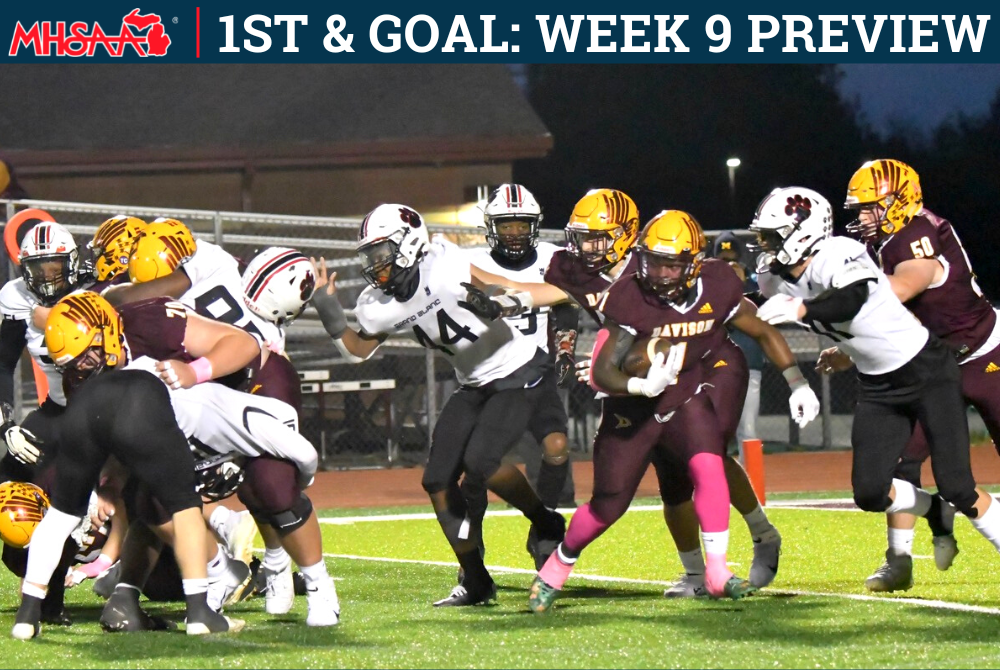
PHOTO Davison, on offense, and Grand Blanc match up last week; the Cardinals won 49-14. (Photo by Terry Lyons.)