

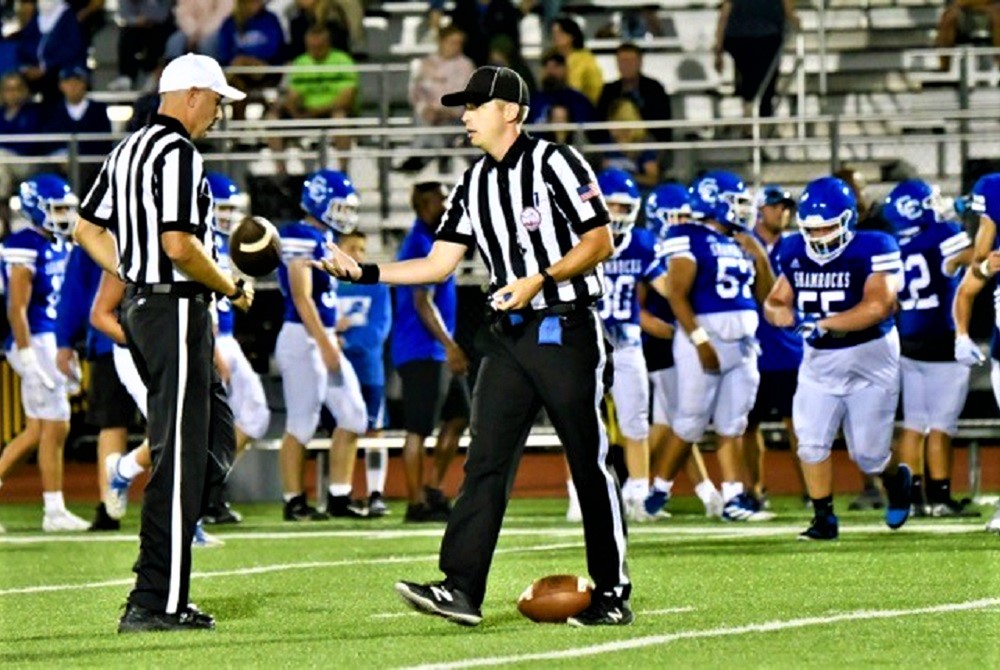
Be the Referee: Intentional Grounding
By
Geoff Kimmerly
MHSAA.com senior editor
September 9, 2021
This week, MHSAA assistant director Brent Rice explains football intentional grounding at the high school level.
Be The Referee is a series of short messages designed to help educate people on the rules of different sports, to help them better understand the art of officiating, and to recruit officials.
Below is this week's segment – Intentional Grounding – Listen
A quarterback is under heavy pressure and immediately throws the ball away. International grounding, right? Maybe. And maybe not.
What goes into an official deciding if grounding has occurred?
First, there is no such thing as a “tackle box” in high school football as it pertains to grounding. A quarterback scrambling outside of the tackle box who throws the ball away could still be penalized for grounding – even if it reaches the line of scrimmage.
Any pass can be penalized for grounding if there is no receiver in the immediate area. Behind the line, inside the tackle box – none of that matters – it only matters if there’s a potential receiver nearby. If there is – no grounding. If there’s not – there will be a flag on the field.
Previous editions
Sept. 2: Pass Interference – Listen
Aug. 26: Protocols and Mechanics – Listen
MHSAA Officials Awards & Alumni Banquet: Photos, Video & OMD 2026.
By
Geoff Kimmerly
MHSAA.com senior editor
April 30, 2026
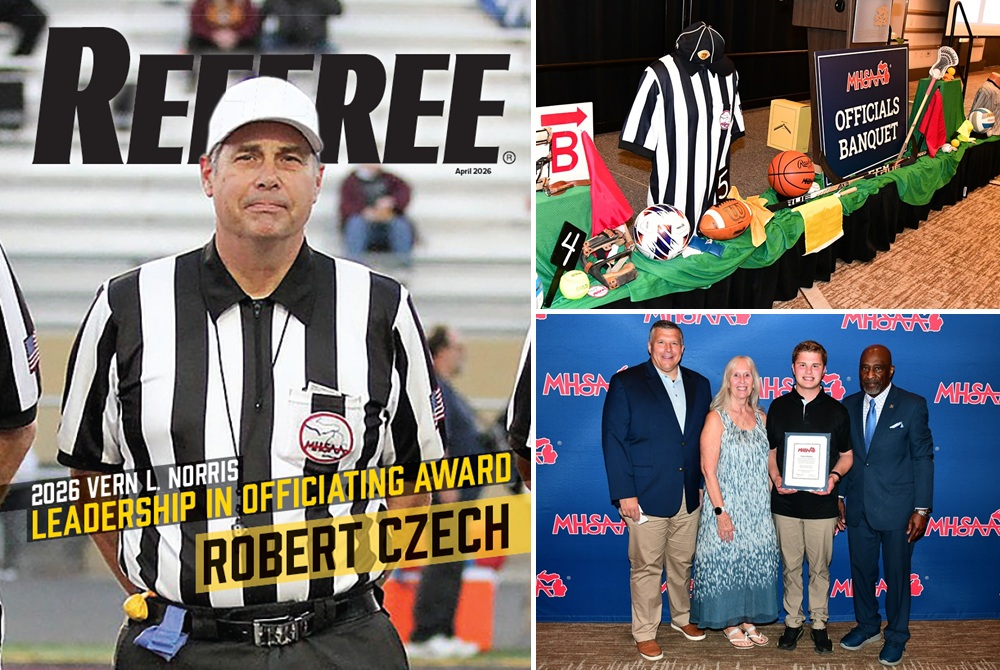
More than 80 MHSAA-registered game officials were honored Saturday during the annual Officials Awards & Alumni Banquet at Kellogg Center in East Lansing.
Our MHSAA communications director emeritus John Johnson was on site, camera in hand, to capture photos of our award winners and several more attendees and honorees. Check those out by clicking here – MHSAA Officials Banquet photos – to see not only photos from this past weekend but also from 2003-19, 2024-25, and the 2013 and 2018 Officiate Michigan Day events.
Among this year’s honorees was Grand Ledge senior Owen Rottier, who received the Randy Paulson Legacy Award and scholarship. Owen has officiated both cross country and track & field as part of the Legacy Program and will study next at Lansing Community College. He’s pictured above with (from left) MHSAA executive director Mark Uyl, Mary Paulson, Rottier and MHSAA director of officiating Sam Davis.
Receiving the 36th Vern L. Norris Leadership in Officiating Award was Metro Detroit’s Robert Czech, who is in his 44th year as a registered official and also has assigned officials for more than 35 years, including currently for four Detroit-area leagues.
Referee Magazine also created a commemorative cover celebrating Czech and in advance of this summer’s Officiate Michigan Day.
OMD 2026 will be July 25 at DeVos Place in Grand Rapids, followed by the National Association of Sports Officials (NASO) Summit from July 26-28.
For information on registration and details on both events, check out the Officiate Michigan Day page.