

Be the Referee: Pass Interference
By
Geoff Kimmerly
MHSAA.com senior editor
September 2, 2021
This week, MHSAA officials coordinator Sam Davis explains the differences in high school pass interference rules from those at the college and pro levels.
Be The Referee is a series of short messages designed to help educate people on the rules of different sports, to help them better understand the art of officiating, and to recruit officials.
Below is this week's segment – Pass Interference – Listen
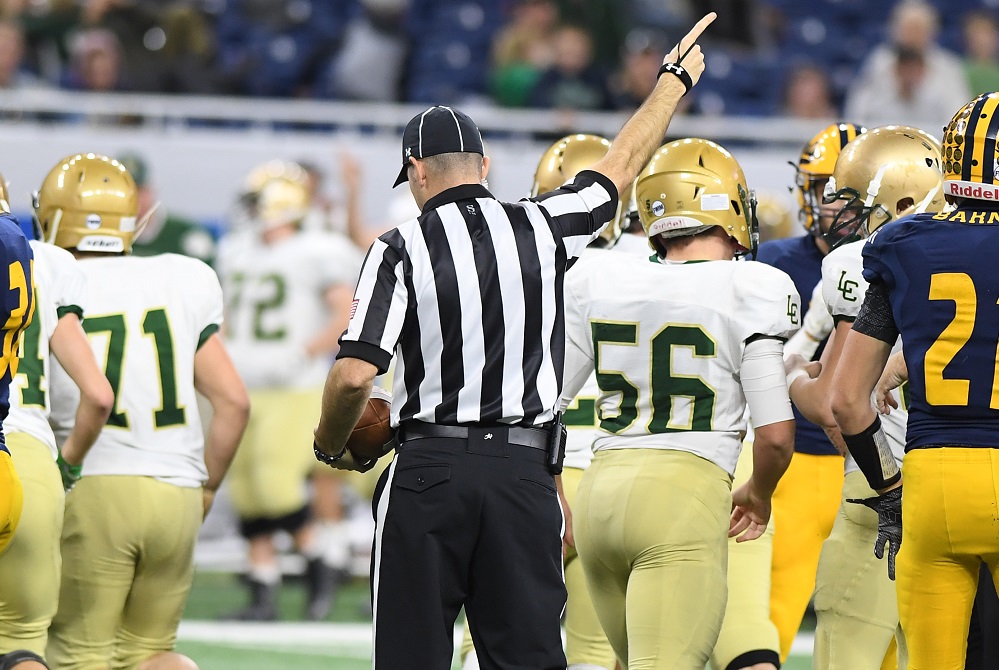
One of the big differences between high school football and the college or pro game is how pass interference is called.
In high school, there is no such thing as an “uncatchable” pass. If there is illegal contact by the defender while the ball is in the air, that’s pass interference, no matter where the pass ultimately ends up.
Also – in high school – a defender can “face guard” as long as no contact is made with the receiver. That is not pass interference, even if the defender does not look back for the ball.
Both of those interpretations differ from the college and pro game. Both (of those) levels have an uncatchable exception, and neither allows for face guarding.
Keep that in mind the next time you think you’ve spotted pass interference at the high school level.
Previous editions
Aug. 26: Protocols and Mechanics – Listen
North Central Extends Dominance with 37th-Straight Win, 3rd-Straight Title
By
Jason Juno
Special for MHSAA.com
November 19, 2022
MARQUETTE – What a run it’s been for North Central.
The Jets haven’t lost a game over the last three years and very few, if any of those games, have been close. They’ve won them all by multiple touchdowns and just three games have finished with a margin under 30 points. Most have been won by a lot more.
Their opponent in Saturday’s Division 2 championship game, Mendon, brought a strong tradition of its own, with 12 previous Finals appearances.
But this is North Central’s era, and that’s no secret. So imagine what it must do to a team’s psyche when that juggernaut returns the opening kickoff and adds another touchdown before a full minute runs off the clock.
The Jets turned that 14-0 lead into a 66-26 win for their third consecutive – and fifth total – 8-player championship Saturday at the Superior Dome. They also won a state-record 37th straight game.
“It’s gotta be part of the mystique and part of what these kids built,” North Central coach Leo Gorzinski said. “You want to have a two-touchdown lead in their head before you get off that bus. When you come out there and do that, set that tone, of course it’s going to get in their mind.”
And North Central did it with standout quarterback, and reigning Associated Press Player of the Year Luke Gorzinski, playing through what the Jets suspect is an ACL injury.
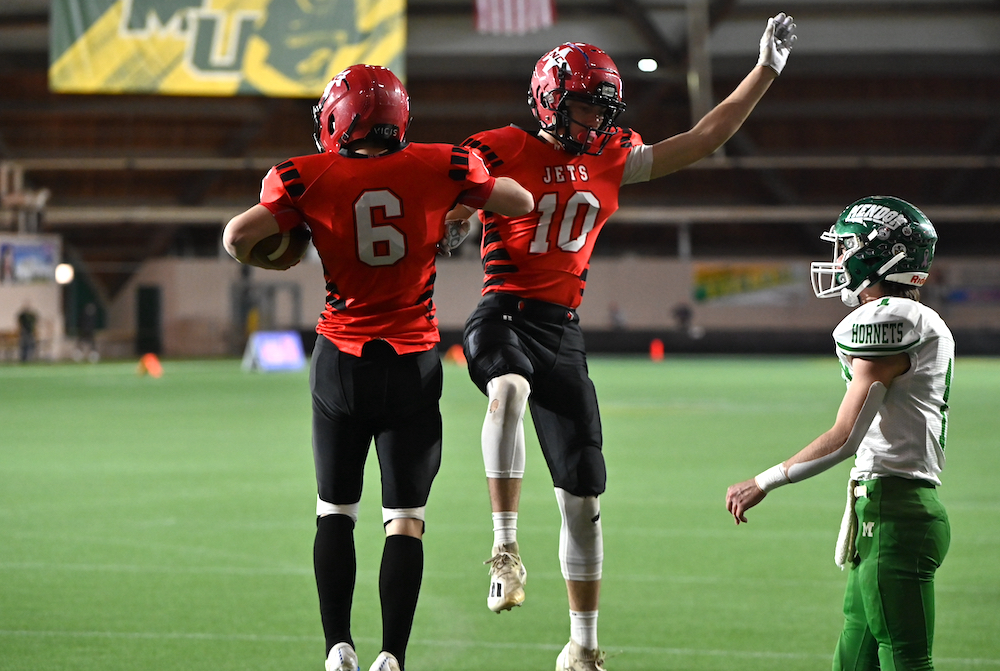
It was Elijah Gorzinski who returned the opening kickoff 85 yards to put North Central on the board just 11 seconds into the contest. Mendon muffed the ensuing kickoff and North Central’s kicker, Adrian Mercier, recovered. Two plays later, Lane Gorzinski caught a 14-yard Luke Gorzinski pass for a touchdown and a 14-0 Jets lead 50 seconds into the game.
And North Central didn’t let up.
 The Jets scored two more touchdowns in the first quarter, one on a 36-yard run by Dillon Raab and the other a 36-yard pass from Luke Gorzinski to Lane Gorzinski to make it 28-0.
Luke Gorzinski threw two TD passes in the second quarter, a 30-yarder to Dylan Plunger and another 20 yards to Jordan Messenger for a 41-6 lead at the half.
That opening kick return that set the tone came after North Central waited and waited for the D-1 title game to get over. The Jets went from amped up to play to the concession stand getting brats.
“We were flat; they were ready to take a nap,” Coach Gorzinski said. “Once that (return) happened, it was game on from there.”
That made four touchdown passes in the half for Gorzinski, who is explosive getting to the edge normally, but not Saturday with his injury. Leo said he wouldn’t get it checked out before the game because he just wanted to play, but Leo fears it will be an ACL injury once diagnosed.
“Thank God they didn’t catch on for a whole half that Luke Gorzinski can’t run,” Coach Gorzinski said. “He never ran a single time, and they never adjusted or blitzed him. I’ll praise God for that. Because if they would have blitzed him, I would have pulled him. That, for me, was the single thing – we knew they had a weak pass defense.”
Gorzinski ran for one touchdown in the second half, from a yard out. He caught a 33-yard TD pass and Lane Gorzinski ran 38 yards for six.
Jacob and Lane Gorzinski picked up the slack running the ball with 132 yards and 90 yards, respectively, with both getting eight carries. Four receivers caught touchdowns – Lane Gorzinski, Plunger, Messenger and Luke Gorzinski.
“If you watch what Jacob Gorzinski did today (on the ground), that’s Luke to a T, that’s Luke’s specialty. With Jacob Gorzinski stepping up, with Lane stepping up, with Dylan Plunger stepping up, the heart that Dillon Raab showed up there tonight, all of them, Max Nason, Jordan Messenger, Andrew Weber,” Coach Gorzinski said.
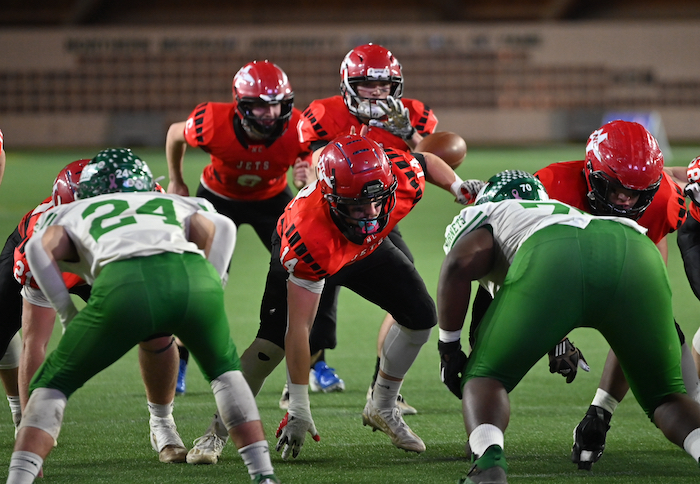 Luke Gorzinski finished the day with the single yard on the ground, and only that one carry, but he was 13 of 24 passing for 207 yards and four touchdowns.
He didn’t want to talk about how much it hurt.
“It’s Luke, man, he can play through anything,” Jacob Gorzinski said. “He’s a tough kid.”
Any way you slice it, Luke helped boost his team to a third-straight title.
“You come into this game knowing we could probably get the edge on these guys and we had good running out of our trip set, but with a bum wheel, we were limited,” he said. “We came out throwing a little more and put faith in our pass catchers, and they got it done.”
They made so many big plays, the kick return, long runs by the other guys, those big pass plays. It’s hard for an opponent to keep up.
“We did a lot of good things; we just gave up too many big plays. That’s really been our Achilles in our losses is giving up those big plays. But I give them a lot of the credit – they made the plays, they were making plays, ” Mendon coach Robert Kretschman said. “(Gorzinski) can sling the ball, he just put the ball on the money. They’re physical on the edge. That was probably one of the best perimeter blocking teams I’ve seen in a long time, 11-man, 8-man, they get after it. … Their physicality on the edge is something I don’t think we were quite prepared for.”
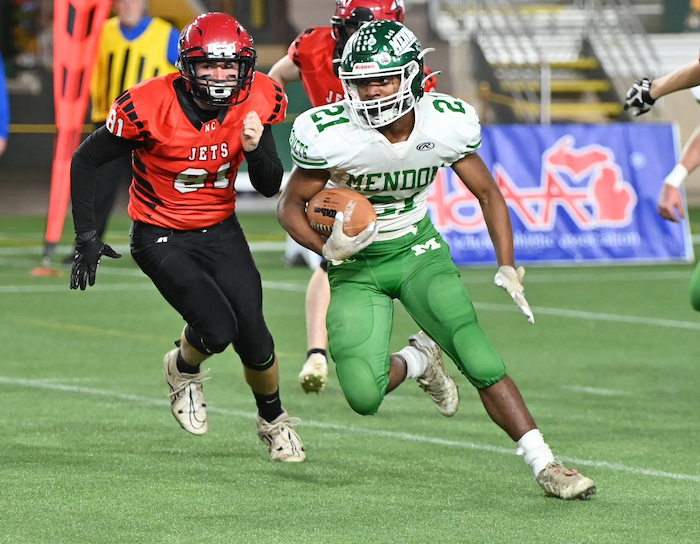
Mendon had an explosive player of its own in junior back Jack McCaw. He ran for three of the Hornets’ touchdowns, a 30-yarder in the second quarter to get on the board, a 58-yard rush to start the second half and a 70-yard score a few minutes later. Evan Lukeman scored Mendon’s final TD.
“We have Jack coming back. We’re excited about that,” Kretschman said.
North Central wants to keep its run going next year, but it won’t be easy after losing such a decorated group of seniors headlined by Luke Gorzinski.
Now they can savor all that they’ve done the last three years.
“We came out here to do it again; that was the goal for this season,” Jacob Gorzinski said.
And nobody was able to stop them.
PHOTOS (Top) Powers North Central’s Lane Gorzinski (6) and Dylan Plunger (10) celebrate an early touchdown Saturday at the Superior Dome. (Middle) Mendon’s Jack McCaw (21) bursts into an opening. (Below) The Jets line up on offense, led by quarterback Luke Gorzinski. (Photos by Cara Kamps.)