

Chippewa Valley Leads Macomb Charge
By
Tom Markowski
Special for Second Half
November 8, 2018
CLINTON TOWNSHIP – Since winning the Division 2 title in 2001, Clinton Township Chippewa Valley has played in the shadow of traditional Macomb County powers Macomb Dakota, Romeo, Sterling Heights Stevenson and Utica Eisenhower.
 Before this season, Chippewa Valley’s record against those four schools over the last 17 years was 26-52. The Big Reds did own a 10-8 record against Stevenson, but twice Stevenson reached MHSAA Finals while Chippewa Valley’s best showing since its championship season was a Semifinal appearance in 2003.
That trend started to change in 2017 as Chippewa Valley went 4-1 against these teams (including a second win over Dakota in the playoffs). This season, the Big Reds took another step forward posting a 6-0 mark and capturing their first outright title in the Macomb Area Conference Red.
And for the first time in program history, Chippewa Valley is 11-0. The Big Reds were 9-0 in 1975, the first season the MHSAA sponsored state playoffs, but did not qualify for the postseason (only four teams in each of the four classifications were selected for the playoffs that first year).
Scott Merchant is in his 10th season as head coach at Chippewa Valley, and the Big Reds have made the playoffs eight times during his tenure. These past two seasons have been his best by far. Last season, Chippewa Valley finished 10-2 losing to Detroit Cass Tech, 32-26, in a Division 1 Regional Final.
Most expected a rematch of that game this week. But Dearborn Fordson (10-1) upset Cass Tech last week, 41-14, and Chippewa Valley will host Fordson in the Division 1 Region 4 Final at 7 p.m. Friday. The teams have met just once before – and that game, in 2003, also took place in a Regional Final with Chippewa Valley claiming a 30-12 victory.
Merchant’s team is experienced, confident and loaded with talent. He has four three-year starters and eight seniors starting on defense.
“Dakota set the bar for the whole conference,” Merchant said of Chippewa Valley’s sister school (both are in the Chippewa Valley school system) and biggest rival. “In the mid- to late 2000s they had like five or six Regional titles. Our streak of losing to Dakota started in ’04, and I didn’t get here until ‘09. It was huge for us to win in 2014. It was the first time we beat them in 10 years. That was a big weight being lifted.”
When a team loses so often to another, especially a rival, the losses and the years often run together. For the record, here’s how bad it got for the Big Reds:
Beginning with a 7-0 loss to Dakota in a Division 1 Regional Final in 2004, the Big Reds lost 16 consecutive games to Dakota, and only six of the 16 were by 10 or fewer points. A 28-27 victory in a 2014 District Final ended this streak.
One loss stung most. In 2013, both teams were 7-0 and state-ranked. Dakota won 52-7.
“To this day I can’t explain what happened,” Merchant said. “It was one of the most disappointing losses I’ve had. A lot of it was mental.”
The tables have turned. Chippewa Valley has won five of the last six in the series and is two wins this month from reaching what would be the program’s second MHSAA Final.
The Big Reds’ success last season gave the players confidence and also fed their appetite for more. The 2017 team scored a school-record 463 points, and this season Chippewa Valley has scored 445.
The productivity is similar, but the means by which the offense this season has been successful is different. There’s a difference in personality. Last year Chippewa Valley was more of a finesse team that concentrated on the passing game. This team is more physical and its offense is geared more for the run, which is often more effective in November playoff games.
 Quarterback Tommy Schuster is a three-year starter who threw for 3,100 yards over his first two seasons. His numbers (1,400 yards) are down a tad this season, but he’s thrown 20 touchdown passes and just one interception. Schuster also is carrying the ball more as he showed last week by rushing for 60 yards in the 51-10 victory over Dakota.
This added dimension has become a fine complement to the Big Reds’ top two running backs, Andre Chenault and Ja’Von Kimpson. Chenault is the team’s leading rusher with 888 yards and 13 touchdowns on 107 carries while Kimpson, who also starts at cornerback, is more of a featured back in 3rd down situations. He’s scored nine touchdowns rushing and one receiving.
“Our run game has been dominant all season,” Schuster said. “The offensive line has gotten better and better. It took a little time. They’re all (first-year) starters, and they’re confident now.”
Replacing the entire offensive line was the main concern for Merchant and his staff coming into this season. With just one senior, this group grew up fast. In the opener, Chippewa Valley trailed Saline 13-0 before the offense began to click and the Big Reds won 31-26. Senior captain Ryan Cyrowski, the center, is the leader and juniors Charles Wesley, the left tackle, and Donovan McBride, the right guard, have developed nicely. The Big Reds rushed for an-eye-popping 445 yards last week.
Merchant’s top two players could well be linebacker Marcel Lewis, who also sees time at tight end, and David Ellis. Ellis rarely comes off the field as he starts at receiver and defensive back and is a dangerous kick returner. He has 33 tackles on defense, five rushing touchdowns, six receiving scores, three more on kickoff returns and he’s returned a punt for a touchdown.
“We don’t have any weaknesses,” Schuster said. “This team, all year, hasn’t panicked. We’re ready for whatever happens. Last year’s team was like that, too. The reason we’ve been so successful (the past two seasons) is we have great players and great coaches.
“Playing quarterback on this team is a lot of fun. There’s so many options. If the run game isn’t working, we have no problem throwing the ball.
“I’ve grown up a lot over these three years. I’ve gotten to work on my speed, and I’m able to help the younger guys out too. It’s easier for me now. There’s nothing that’s new to me.”
The experience Schuster and many of his teammates have is a big reason Chippewa Valley has come out on top in a number of close games. In addition to the victory over Saline, the Big Reds held on to defeat Romeo (41-34) and Dakota (24-17) during the regular season. All three of those games were on the road.
“We’ve had way more close games this year than last,” Merchant said. “It’s been great to see the program grow.”
 Tom Markowski is a columnist and directs website coverage for the State Champs! Sports Network. He previously covered primarily high school sports for the The Detroit News from 1984-2014, focusing on the Detroit area and contributing to statewide coverage of football and basketball. Contact him at [email protected] with story ideas for Oakland, Macomb and Wayne counties.
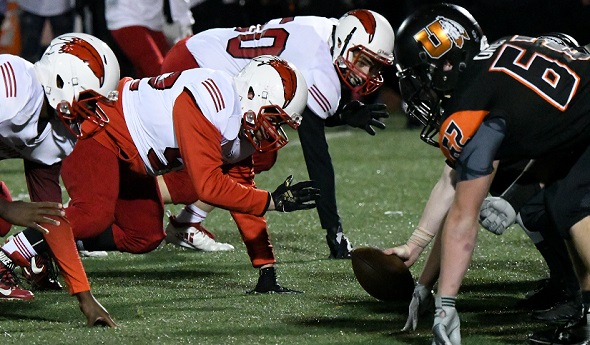
PHOTOS: (Top) Chippewa Valley’s defensive front lines up against Utica during a 49-0 Week 9 win. (Middle) David Ellis (8) follows his blockers into an opening against Utica Eisenhower in a 34-7 first-round playoff victory. (Photos courtesy of the Chippewa Valley athletic department.)
Friday Nights Always Memorable as Record-Setter Essenburg Begins 52nd Year as Official
By
Steve Vedder
Special for MHSAA.com
August 31, 2023
GRAND RAPIDS – All Tom Essenburg could think of was the warmth of a waiting bus.
Five decades later, that's what Essenburg – then a senior defensive back at Holland High School – remembers most about a stormy Friday night before 2,100 thoroughly drenched fans at Riverview Park. He recalls having a solid night from his position in the Dutch secondary. He remembers a fourth-quarter downpour, Holland eventually winning the game and trudging wearily through the lakes of mud to the team's bus.
But what never dawned on Essenburg until much later was that he had been the first to accomplish something only three defenders in the history of Michigan high school football have ever done:
Intercept five passes in a single game.
"I knew after the game that I had a bunch of them, but (at the time) we were in a 0-0 game and my mind was on just don't get beat (on a pass) and we lose 7-0," he said of the Sept. 21, 1962, contest against Muskegon Heights.
It wasn't until the next morning's story in the Holland Evening Sentinel that Essenburg grasped what exactly had happened. He didn't realize until then that he had picked off five passes in all, including two over the last 1:52 that sealed a 12-0 win over Muskegon Heights. One of the interceptions went for a 37-yard touchdown, which Essenburg does vividly remember.
"I remember thinking to myself that I had to score," said Essenburg, who has been involved with high school sports in one fashion or another for more than 60 years. "There was a Muskegon Heights guy who had the angle on me and I pretty much thought I was going to get tackled, but I got in there."
Essenburg's recollection of the first three interceptions is a bit hazy after 61 years, but the next day's newspaper account pointed out one amazing fact. The Muskegon Heights quarterback had only attempted six passes during the entire game, with five of them winding up in the hands of the 5-foot-8, 155-pound Essenburg – who had never intercepted a single pass before that night. He would later intercept two more in the season finale against Grand Rapids Central.
It wasn't until the middle 1970s that Essenburg began wondering where the five-interception performance ranked among Michigan High School Athletic Association records. What he remembers most about the game was the overwhelming desire to find warmth and dry out.
"I just wanted to get to the bus and get warm. We were all soaked," he said. "For me it was like, 'OK, game over.' I was just part of the story."
Curiosity, however, eventually got the better of Essenburg. A decade later he contacted legendary MHSAA historian Dick Kishpaugh, who in an attempt to confirm the five interceptions, wrote to Muskegon Heights coach Okie Johnson, who quickly verified the mark.
It turns out that at the time in 1962, nobody had even intercepted four passes in a game. And since Essenburg's record night, only Tony Gill of Temperance Bedford on Oct. 13, 1990, and then Zach Brigham of Concord on Oct. 15, 2010, have matched intercepting five passes in one game.
Three years after Essenburg's special night, Dave Slaggert of Saginaw St. Peter & Paul became the first of 17 players to intercept four passes in a game.
 Essenburg laughs about it now, but his five interceptions didn't even earn him Player of the Week honors from the local Holland Optimist Club. Instead, the club inexplicably gave the honor to a defensive lineman.
It was that last interception Essenburg cherishes the most. His fourth with 1:52 remaining at the Holland 17-yard line had set up a seven-play, 83-yard drive that snapped a scoreless tie. Then on Muskegon Height's next possession, Essenburg grabbed an errant pass and raced 37 yards down the sideline to seal the game with 13 seconds left.
In those days, running games dominated high school football and defensive backs were left virtually on their own, Essenburg said.
"I kept thinking don't let them beat you, don't let them beat you. No one can get beyond you. In those days, once a receiver got in the secondary, they were gone," said Essenburg, who describes himself as a capable defender but no star.
"I wasn't great, but I guess I was pretty good for those days," he said. "I'm proud that I'm in the record book with a verified record."
Essenburg's Holland High School career, which also included varsity letters in tennis and baseball, is part of a lifelong association with prep sports. After playing tennis at Western Michigan, he became Allegan High School's athletic director in 1971 while coaching the tennis team and junior varsity football from 1967-73.
But he's most proud of being a member of the West Michigan Officials Association for the last 47 years. During that time, Essenburg estimates he's officiated more than 400 varsity football games and nearly 1,000 freshman and junior varsity contests. In all, he's worked 83 playoff games, including six MHSAA Finals, the most recent in 2020 at Ford Field. An MHSAA-registered official for 52 years total, he's also officiated high school softball since 1989.
Essenburg also worked collegiately in the Division III Michigan Intercollegiate Athletic Association and NAIA for 35 years, including officiating the 2005 Alonzo Stag Bowl.
Essenburg said the one thing that's kept him active in officiating is being a small part of the tight community and family bonds that make fall Friday nights special.
"I enjoy being part of high schools' Friday night environment," he said. "All that is so good to me, especially the playoffs. It's the small schools and being part of community. I used to say it was the smell of the grass, but now, of course, it's turf.
"I can't play anymore, but I can play a part in high school football in keeping the rules and being fair to both teams. That's what I want to be part of."
While it can be argued high school football now is a far cry from Essenburg's era, he believes his even-tempered attitude serves him well as an official. It's also the first advice he would pass along to young officials.
"My makeup is that I don't get rattled," he said. "Sure, I hear things, but does it rattle me? No. I look at it as part of the game. My goal is to be respected.
"I've never once ejected a coach. It's pretty much just trying to be cool and collected in talking to coaches. It's like, 'OK Coach, You've had your say, let's go on."
While Essenburg is rightly proud of his five-interception record, he believes the new days of quarterbacks throwing two dozen times in a game will eventually lead to his mark falling by the wayside. And that's fine, he said.
"It'll get beaten, no question. It's just a matter of when," he said. "Quarterbacks are so big now, like 6-4, 200 pounds, and they are strong-armed because of weight programs. They throw lots of passes now, so there's no doubt it's going to happen."
Until Essenburg is erased from the record book, he'll take his satisfaction from his connection with Friday Night Lights.
"I love high school sports and being with coaches and players," he said. "My goal was once to work for the FBI or be a high school coach, but now I want to continue working football games on Friday nights until someone says no more."
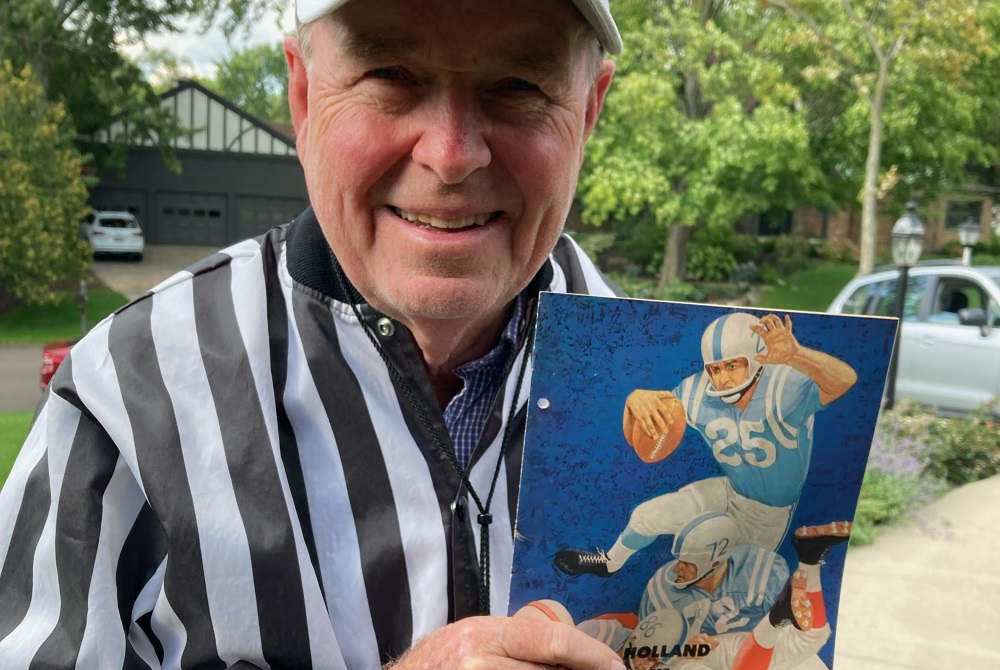
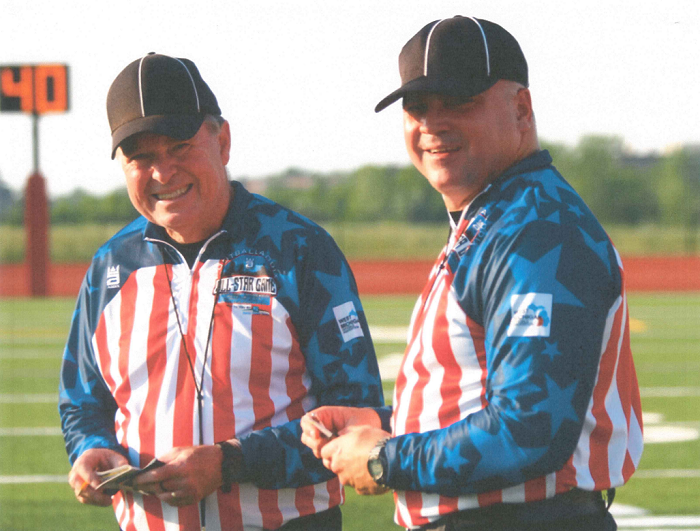
PHOTOS (Top) Tom Essenburg holds up a copy of the program from the 1962 game during which he intercepted a record five passes for Holland against Muskegon Heights. (Middle) Essenburg, left, and Al Noles officiate an Addix all-star game in Grand Rapids. (Photos courtesy of Tom Essenburg.)