


Football Practice Proposals
June 11, 2013
During 2013, a Football Task Force has been working on revisions to practice policies that might simultaneously improve acclimatization of players and reduce head trauma. Over three meetings, the following four-part recommendation has been developed:
-
During the first week of practice of the season, only helmets are allowed the first two days, only shoulder pads may be added on the third and fourth days, and full pads may not be worn until the fifth day of team practice.
-
Before the first regular-season game, schools may not schedule more than one “collision” practice in a day.
• A “collision” practice is one in which there is live, game-speed, player-vs.-player contact in pads (not walk-throughs).
• During any additional practice sessions that day, players may wear helmets and other pads (neither is mandatory). Blocking and tackling technique may be taught and practiced. However, contact is limited to players vs. pads, shields, sleds or dummies.
-
After the first regular-season game, teams may conduct no more than two collision practice days in any week, Monday through Sunday. During other days of practice, players may wear helmets and other protective pads (neither is mandatory). Blocking and tackling technique may be taught and practiced. However, contact is limited to players vs. pads, shields, sleds or dummies.
-
No single practice may exceed three hours, and the total practice time for days with multiple practice sessions may not exceed five hours.
• Warm-up, stretching, speed and agility drills and cool down are all considered part of practice. Neither strength/weight training activities nor classroom sessions are considered practice for the purposes of the three- or five-hour limits.
MHSAA staff will be taking this recommendation on the road from now through October to obtain constituent understanding and feedback. It is the intent of the Task Force to finalize its consensus regarding these matters by late November so they may be reviewed by the Michigan High School Football Coaches Association, the MHSAA Football Committee and at the MHSAA League Leadership meeting prior to Representative Council action in March 2014.
1st & Goal: 2021 Week 4 in Review
By
Geoff Kimmerly
MHSAA.com senior editor
September 20, 2021
With every varsity team getting at most nine regular-season games, every week of the high school football season has the potential to shift landscapes locally and sometimes statewide.
 Week 4 saw its share of movement with league races taking some early shape and playoff talk already beginning as programs work to get a read on how their early work fits into the now fully-implemented “enhanced strength-of-schedule” system.
We’ll discuss that more as we preview our Week 5 top matchups – below take a look at many of the results from this weekend that have the state talking as we approach the midway point.
Bay & Thumb
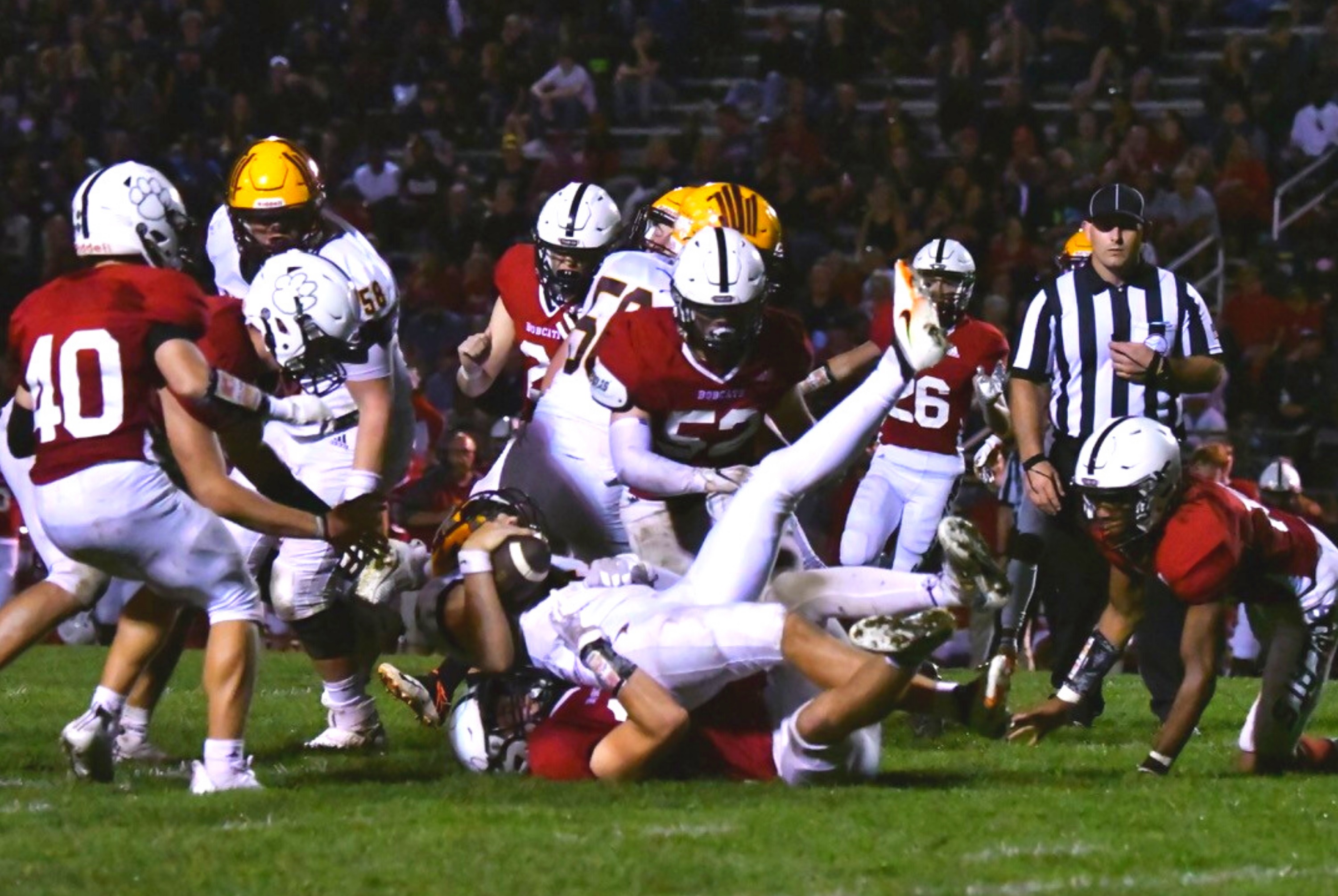
HEADLINER Grand Blanc 43, Davison 7 The Bobcats broke free after three single-score wins over strong opponents with a victory that may prove the most memorable of all this regular season, as they ended Davison’s four-game winning streak in this rivalry. Grand Blanc (4-0) joined the Cardinals in the Saginaw Valley League Red in 2018 and had lost the last three league meetings against them by an average of 36 points per defeat. Davison (1-3), last season’s Division 1 runner-up, also has played one of the state’s toughest opening slates. Click for more from the Flint Journal.
Our Mr. Football candidate Elijah Jackson-Anderson (@ihson_j) from Grand Blanc (@GrandBlancFB) with a touchdown run in the 43-7 win over Davison tonight. @_GB_Athletics_ #MrFootball X @hungryhowies pic.twitter.com/VVfuDLpg6L
— STATE CHAMPS! Michigan (@statechampsmich) September 18, 2021
Watch list Freeland 43, Essexville Garber 14 The Dukes’ defense has been a strong point the last two seasons and first three games of this one as they’d given up 22 points total during a 3-0 start. But Freeland’s offense after four games – and four wins – is more than halfway to equaling last season’s scoring across 11 games.
Remember this one Ubly 50, Harbor Beach 33 The Pirates (2-2) had won five of the last six in this series including twice during the playoffs and 16-14 to open the 2020 regular season. But Ubly (4-0) broke 50 points for the second straight week and is one of two teams sitting atop the Greater Thumb Conference East.
More shoutouts Millington 21, Standish-Sterling 8 The Cardinals (4-0) handed Standish-Sterling (3-1) its first defeat and can become the only undefeated team left in Tri-Valley Conference West I play when they take on Carrollton this week. Montrose 35, Chesaning 0 The Rams (3-1) are a one-point loss from a perfect start and ended Chesaning’s with their second shutout of the season.
Greater Detroit
HEADLINER Warren De La Salle Collegiate 21, Bloomfield Hills Brother Rice 16 The reigning Division 2 runner-up Pilots (3-0) scored all of their points during a mid-first half surge and held the Warriors’ offense scoreless during the second (two points came on a safety) to take an important first step in the Detroit Catholic League Central race. Brother Rice (3-1) hadn’t given up a point since the season opener and had defeated De La Salle the last two seasons. Click for more from the Detroit Free Press.
Tied at 7, @DLSFootball_MI quarterback Brady Drogosh (@BDrogosh) hits Triston Nichols (@t_nichols30) in stride for the touchdown!#StateChamps x @LTUAthletics pic.twitter.com/iuEBFHCh4E
— STATE CHAMPS! Michigan (@statechampsmich) September 18, 2021
Watch list Macomb Dakota 27, Clinton Township Chippewa Valley 23 With this one of the state’s best rivalries, and both coming off close Week 3 wins, this shouldn’t have been entirely stunning. But with the Big Reds 3-0 coming in, it still could represent a nice turning point for the Cougars (2-2) – and a possible reset on the Macomb Area Conference Red race with undefeated Romeo having defeated Dakota and seeing Chippewa Valley next.
Remember this one Armada 24, Richmond 10 Four teams have won at least one Blue Water Area Conference championship over the last five seasons, and Armada (4-0) is making a strong bid to be the fifth in six years after adding a nice win over the annually-contending Blue Devils (3-1) to their six-point victory over reigning league champ North Branch in Week 3.
More shoutouts Oak Park 30, North Farmington 24 The Knights’ first four opponents are a combined 14-2, and Oak Park (1-3) fell twice by five or fewer points during the first two weeks before getting on the better side of a close one in handing North Farmington (3-1) its first defeat. South Lyon 31, Detroit Country Day 7 The Lions are 4-0 to start for the third time in four seasons and after scoring the most points reigning Division 4 champion Country Day has given up since it also appeared in the 2019 Division 4 title game.
Mid-Michigan
HEADLINER Haslett 21, Mason 8 After opening with an eight-point loss to Jackson, Haslett (3-1) has won three straight – eclipsing its win totals of the last two seasons – to pull into first place alone in the Capital Area Activities Conference Red. The Vikings led 21-0 into the fourth quarter and all but stopped an offense that was averaging 35 points per game entering the weekend. Reigning league champ Mason (2-2) had opened the league schedule in Week 3 with a win over Williamston and joined the Hornets among four teams now a game back in the standings. Click for more from the Lansing State Journal
Watch list Mount Pleasant 33, Midland Dow 10 The Oilers (4-0) had opened with three wins over opponents with a combined one victory now through Week 4, but beating Dow (2-2) solidly reinforced Mount Pleasant’s playoff-point status as the top-ranked team in Division 3.
Remember this one East Lansing 20, Portage Central 15 Mason Woods’ 63-yard touchdown catch from Brevin Jackson with 2:21 to play helped the Trojans (2-2) get back to .500 after a start against opponents a combined 11-5 so far.
More shoutouts Beal City 48, Lake City 8 The Aggies (3-1) are a one-point Week 1 loss from a perfect start and will play Evart this week with the Highland Conference title potentially on the line after shutting down the Trojans (3-1). Stockbridge 68, Pontiac 40 Jeremy Pilch scored nine touchdowns – tying for fourth-most in MHSAA history – and a total of 64 points, which is tied for third-most in that category.
Northern Lower Peninsula
HEADLINER Traverse City Central 42, Traverse City West 14 The Trojans extended their winning streak against the rival Titans to three and moved into first place alone in a Big North Conference that features four of six teams at 3-1 overall – including both Central and West. The Trojans ran out to a quick lead this time and then ran away during a second-half surge. Click for more from the Traverse City Record-Eagle.
That should seal it! @carson_bourdo leaves them all in his dust as he puts more points on the board for @TCCHSfootball! #MIFTBL pic.twitter.com/atPeIV19EO
— Bally Sports Detroit (@BallySportsDET) September 18, 2021
Watch list Big Rapids 25, Central Montcalm 21 After opening with a loss to Coopersville, Big Rapids has won three straight to tie for the early lead in the Central State Activities Association Gold – while handing Central Montcalm (3-1) its lone defeat.
Remember this one Mancelona 66, Johannesburg-Lewiston 42 While the Cardinals (0-4) are admittedly off to a rare slow start, Mancelona (4-0) brought a high-scoring end to a seven-game losing streak against them.
More shoutouts Gaylord 10, Petoskey 7 The Blue Devils (2-2) avenged last season’s 22-14 loss, in the process handing the Northmen (3-1) their lone defeat. Frankfort 22, Oscoda 14 Playing a rare back-to-back series, the Panthers (3-1) finished a two-week sweep of the Owls (1-2), this one ending a bit closer than the Week 3 32-16 win.
Southeast & Border
HEADLINER Addison 36, Michigan Center 35 These Cascades Conference contenders never separated from each other by more than seven points, with Addison adding the winning score with 3:12 to play. While the Panthers (4-0) gave up as many points as they had over their first three games, they did hold Michigan Center (3-1) to a season low while scoring the first points the Cardinals had given up this fall. Addison’s Week 8 opponent is the only other team that has yet to lose a Cascades game. Click for more from the Jackson Citizen Patriot.
Watch list Union City 26, Reading 20 (OT) The Chargers (2-2) bounced right back from a Week 3 loss to Jonesville, handing Reading (3-1) only its second Big 8 Conference loss over the last five seasons.
Remember this one Monroe St. Mary Catholic Central 21, Milan 15 The Big Reds (3-1) had won three straight of St. Mary (although the two Huron League rivals didn’t play each other last season). But the Falcons ended that streak and put themselves in position to take a commanding advantage in the league title race this week against reigning champ Riverview.
More shoutouts Ida 26, Clinton 20 The Bluestreaks (3-1) are in position to contend for the Lenawee County Athletic Association title after edging the reigning Division 6 runner-up and with early league co-leader Hudson next up. Ann Arbor Huron 31, Temperance Bedford 30 The River Rats (3-1) equaled last season’s win total and set themselves up for their best finish in more than a decade by holding off a late Bedford comeback attempt.
Southwest Corridor
HEADLINER Portage Northern 35, Stevensville Lakeshore 28 Coming off a 2020 District Final run, Portage Northern (1-3) didn’t find its footing early this fall against three opponents who have made some early noise in the Southwestern Michigan Athletic Conference. But the Huskies may have turned the corner in a big way handing Lakeshore (3-1) its first loss – while also running their winning streak over the Lancers to four as well. Click for more from the Kalamazoo Gazette.
Watch list Lawton 52, Allegan 7 The Blue Devils (4-0) gave up their first points of the season and continued their streak of breaking 50 points every game this fall.
Remember this one Battle Creek Lakeview 31, Battle Creek Central 18 The Spartans (3-1) extended their winning streak in this rivalry series to three, bouncing back from a Week 3 loss to River Rouge to keep pace tied atop the SMAC.
More shoutouts Parchment 50, Saugatuck 43 Since opening with a loss to Lawton the Panthers (3-1) have equaled last season’s win total, with their next victory guaranteeing their best record since 2017. Plainwell 33, Richland Gull Lake 14 Much of the attention in the Wolverine Conference is being paid to powerful Edwardsburg, but Plainwell (4-0) will roll into this week’s matchup with the Eddies with its best start since 2013.
Upper Peninsula
HEADLINER Houghton 21, Bark River-Harris 20 The Gremlins (3-1) are on a roll since falling to Ishpeming Westwood in their season opener, with this win giving them one more than either last season or 2019. Similar to last season, this came down to the final minutes – a year ago Houghton won 3-0 on a fourth-quarter field goal, and this time the go-ahead points against the Broncos (3-1) came on late touchdown catch. Click for more from the Houghton Daily Mining Gazette.
Watch list Marquette 55, Kingsford 34 Halfway through the Greater Northern Conference schedule, Marquette (3-1) has two 50-point scoring performances and two double-digit wins – this one handing Kingsford (3-1) its first loss.
Remember this one Gladstone 30, Escanaba 15 The Braves (2-2) came back from a one-point loss to Menominee in Week 3 to defeat Escanaba (1-3) for the first time since 2010.
More shoutouts Sault Ste. Marie 49, Cheboygan 21 The Blue Devils (3-1) rebounded from their first loss with their highest points total of the season. Ishpeming Westwood 42, Ishpeming 0 The Patriots (3-1) posted a second-straight shutout of the rival Hematites (1-2), also in bouncing back from a Week 3 defeat.
West Michigan
HEADLINER Montague 33, Muskegon Oakridge 7 The Wildcats have outscored their three West Michigan Conference opponents by a combined 103-7 and have themselves in position to repeat as league champions with a second-straight big win over the rival Eagles (3-1). Two of Montague’s final three league foes are also 3-1 overall, but the Wildcats have at least a game on both in the league standings. Click for more from FOX 17.
Watch list Muskegon Heights Academy 34, Manistee 28 The Tigers didn’t play last season and before that had lost 21 of their last 22. But they’re off to a 4-0 start and have guaranteed their best finish since at least 2011.
Remember this one Rockford 53, Grandville 46 (2OT) Pay little attention to Grandville’s 1-3 record – the Bulldogs have played two of the three early frontrunners in the Ottawa-Kent Conference Red. This matchup is almost always memorable, and Rockford (4-0) made it six wins over their last eight meetings including three of those decided by one score.
More shoutouts Muskegon Mona Shores 47, Zeeland West 12 Over the last two weeks Muskegon High and then Mona Shores (3-1) have whittled the O-K Green race down a bit with back-to-back wins over West (1-2), and the Sailors get another contender in Zeeland East next. Byron Center 28, East Grand Rapids 20 The Bulldogs (4-0) avenged last season’s 12-8 Week 9 loss to the Pioneers (1-3) that cost them an outright O-K White championship.
8-Player
HEADLINER Bridgman 45, Mendon 0 The Bees (4-0) are now 19-2 since moving to 8-player in 2019, but this might be their most notable win since making the switch. Mendon (3-1) had entered averaging 63 points per game, but Bridgman earned its second-straight shutout of the fall while seeing its scoring average fall to only 53 points per contest. Click for more from the St. Joseph Herald-Palladium.
Watch list Morrice 59, Lawrence 6 The Orioles (4-0) appear to be building toward another special season now having scored at least 58 points in every game and giving up no more than six in any of them – and the Tigers (3-1) had scored 60+ the previous two weeks. Circle Morrice’s Week 9 matchup with Deckerville as potentially the biggest 8-player game of the regular season.
Remember this one Marion 44, Mesick 29 If Marion (4-0) eventually wins the West Michigan D League title, this could be the decider as it sent 2019 champion Mesick into second place and one game back. (No league title was awarded in 2020.)
More shoutouts Adrian Lenawee Christian 56, Athens 0 The Cougars moved to 15-0 since moving to 8-player last season, this time handing Athens (3-1) its lone defeat. Eau Claire 30, Wyoming Tri-unity Christian 26 The Beavers (2-2) have set themselves up to make a run at their best record in at least seven years, especially notable coming back from a stretch that saw them win only two games total from 2015-19.
Second Half’s weekly “1st & Goal” previews and reviews are powered by MI Student Aid, a part of the Office of Postsecondary Financial Planning located within the Michigan Department of Treasury. MI Student Aid encourages students to pursue postsecondary education by providing access to student financial resources and information. MI Student Aid administers the state’s 529 college savings programs (MET/MESP), as well as scholarship and grant programs that help make college Accessible, Affordable and Attainable for you. Connect with MI Student Aid at www.michigan.gov/mistudentaid and find more information on Facebook and Twitter @mistudentaid.
PHOTO: A swarm of Grand Blanc defenders bring a Davison ball carrier to the ground Friday. (Photo by Terry Lyons.)