

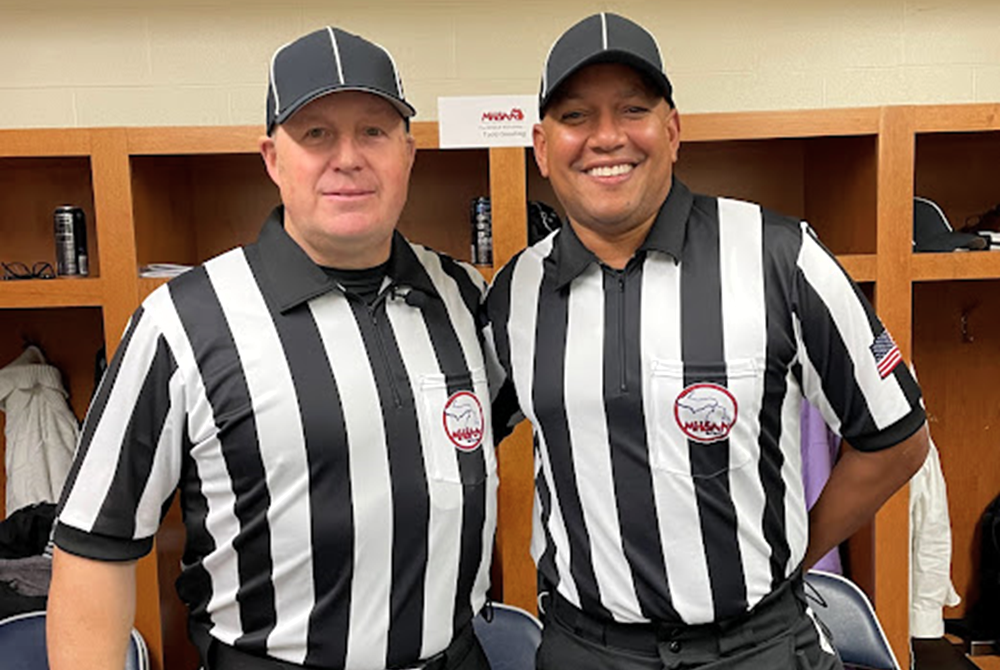
Gooding & King Work to Fill SW Michigan's Officiating Ranks, Schedules
By
Pam Shebest
Special for MHSAA.com
December 12, 2023
KALAMAZOO – Cheer them or boo them, without officials, there are no games. That’s just a fact in the sports world.
 Two area men are tasked with supplying those officials for Southwest Michigan schools, and it is not always as easy as it seems.
Portage’s Todd Gooding is in charge of assigning football referees for 70 schools across eight leagues, with 500 officials on his staff.
Vicksburg’s Rob King assigns officials for girls and boys basketball in five leagues and has 290 men and women on his roster to work 1,100 games throughout the hoops season.
“We have six females on staff,” King said. “We’re looking to add more. I think the girls who are playing enjoy having a female ref on the court with them, plus it shows them they can do this, too.”
Although totals were dropping a few percentage points every year, the MHSAA still registered an average of 10,317 officials annually during the decade ending in 2019-20. But the beginning of the COVID-19 pandemic that spring played a large part in a decrease in registered officials by 12 percent for 2020-21, down to 8,090.
The last two school years saw a bounce-back of four percent, and recruiting and retaining efforts continue. But Gooding and King – also veteran officials themselves, Gooding for 25 years and King for 24 – and their assigning colleagues across the state have the closest look at the effects of fewer officials as they work to schedule at the local level and make sure everything is covered.
Doing so gets even harder with unforeseen roadblocks.
One of those challenges for Gooding came in August when extreme heat forced most schools to reschedule or delay their football games.
“Everyone was trying to get their games in,” he said. “We were moving start times back, then we were moving days. Football is a little different than basketball or baseball because you can only play within so many days, so we were really squeezed against the schedule.
 “I had a school or two reach out on Monday or Tuesday (before the Friday night game), so they looked ahead at the heat. Some of them waited, waited, waited, and then in some cases, it posed some big challenges because most of those crews had been spoken for.”
For a typical football Friday, Gooding staffs 30 or 35 games, “which is really difficult because everybody wants to play Friday night.”
Some referees in both football and basketball “double dip” by officiating games at freshman or junior varsity levels on nights other than Friday.
Gooding said at one time he hoped to go to seven officials for a football game, but with a shortage of officials, “Right now we’re just lucky to staff five in the games we have, and we’re still very short.
“Parents are a key component to a shortage of officials. A lot of it is more at the youth level, but everyone has to remember the sportsmanship aspect. Without officials there are no games, and sometimes we lose track of that, and that’s one reason there’s a shortage.”
Still, King noted that officiating provides more advantages than disadvantages.
“Everyone hears about the bad stuff, getting yelled at by fans and coaches, but those are so small,” he said.
“After a season of doing this, you learn to block out that stuff and realize it’s just part of the game. Fifty percent of people are mad at you every time you blow the whistle, so you get used to that.”
Pay raises in some leagues enticed many of those who “retired” to return, King said, but both he and Gooding agree the camaraderie developed while officiating is what makes it most special.
“It’s more about the time you spend on the floor with guys, in the locker room, driving to games, grabbing something to eat after the games, just talking about life, just building friendships,” King said. “That’s the part you remember.”
Gooding added some games stick in his memory more than others.
“My first varsity game (refereeing) was Lawton playing Saugatuck,” he said. “I show up and Channel 3 was there. I wondered what’s going on.
“Both schools were 0-8, both senior classes were 0-35. Somebody had to win, and it was my first varsity game. I think Saugatuck won, and it was close to 25 years ago.”
Another memory came as he officiated a basketball game.
 “A girl from Benton Harbor (Kysre Gondrezick in 2016) had 72 points,” he said. “It’s in the record books. and you’re just one small part of that and you remember them.”
Officiating is not only for adults. Even teenagers still in high school can become referees as part of the MHSAA Legacy Program.
King recently hosted an officiating summit at Paw Paw for high school athletes.
“There are nine schools in the Wolverine Conference and six of them brought 10 to 15 kids,” he said. “Myself and another official presented on basketball. They also did something on other sports.
“We got the kids up blowing the whistles and doing some of the signals. Three reached out wanting to get involved.”
King said officiating is a great way to earn money, especially while in college.
“You’ll work maybe two or three hours at the most and make $150 to $300 depending on the level,” he said. “Your friends will have to work six-, seven-, eight-hour days to make that much money.
“You can also block your schedule. We have a software with a calendar on it. If there are days you know you can’t work because you have classes or other things, you just block those days out, so you control your own schedule.”
With training, freshmen and sophomores can work junior high/middle school games, and juniors and seniors are able to officiate at the freshman and junior varsity levels.
“Usually what we do is get you a mentor,” King said, “and you work with that mentor and make some money.”
Those Legacy officials hopefully continue in the avocation, eventually becoming the next mentors.
Officiating, like school sports in general, is a cycle that’s constantly in motion – both when it comes to filling the ranks and filling the schedule to cover games ahead.
For example, although football season is over, “I don’t know if there really is an offseason,” Gooding said. “Leagues are going to start giving me their schedules. We’ll get those into an Arbiter system. Everything’s assigned by Arbiter, a computer system where officials get their assignments.
“I’ll start evaluating the crews, reach out to the crew chiefs. They’ll let me know any changes in their crew dynamics. I’ll evaluate the year gone by, how they performed and then start getting ready to work on getting those games staffed. That will start after the new year.”
For more information on officiating, including the Legacy Program, go to the Officials page of MHSAA.com.
 Pam Shebest served as a sportswriter at the Kalamazoo Gazette from 1985-2009 after 11 years part-time with the Gazette while teaching French and English at White Pigeon High School. She can be reached at [email protected] with story ideas for Calhoun, Kalamazoo and Van Buren counties.
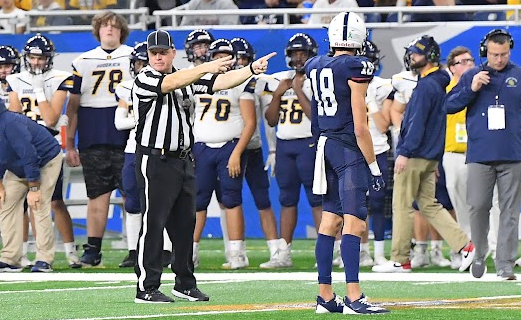
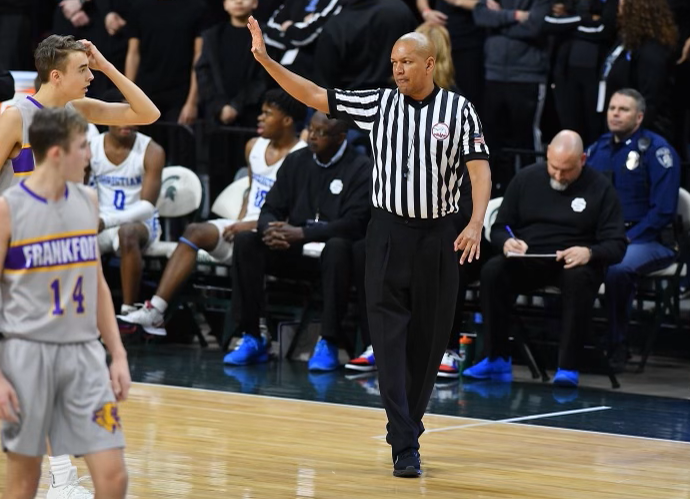
PHOTOS (Top) Todd Gooding, left and Rob King take a photo together while officiating the Division 4 Final at Ford Field in 2022. (Middle) Gooding signals during that contest between Goodrich and Grand Rapids South Christian. (Below) King officiates the 2019 Division 4 Boys Basketball Final at Breslin Center. (Photos courtesy of Gooding and King.)
1st & Goal: 2026 Week 7 Preview
By
Geoff Kimmerly
MHSAA.com senior editor
October 9, 2026
It’s an enjoyable coincidence that several football games we annually forecast to be the most consequential of the regular season generally are played near the end, even as league schedules rotate when teams face off year to year.
 Season-long anticipation is being fulfilled in many parts of the state this week, as numerous league championships are set to be decided, including by most of the matchups we glance at below.
Games highlighted are Friday unless noted. Tune in to the NFHS Network to watch the majority and follow the MHSAA Scores page for results as they’re submitted.
Bay & Thumb
Fenton (5-1) at Linden (5-1)
Fenton has clinched a share of the Flint Metro League Stripes championship, but Linden has a chance to do the same if it can break a 13-year regular-season Tigers winning streak in the series. Of the teams’ last 16 regular-season meetings, 13 have been decided by eight points or fewer, including Fenton’s 46-41 victory a year ago. Intriguing as well: These two also met in the playoffs in 2022 and 2024, and Linden won both rematches. Both are Division 3 this season.
Keep an eye on these FRIDAY Macomb Lutheran North (6-0) at Almont (6-0), Ovid-Elsie (3-3) at Montrose (5-1), New Lothrop (5-1) at Chesaning (4-2), Cass City (5-1) at Elkton-Pigeon-Bay Port Laker (4-2).
Greater Detroit
Detroit Catholic Central (6-0) at Orchard Lake St. Mary’s (5-1)
This matchup of the reigning Division 1 and 2 champions, respectively, has been one of the state’s most anticipated all season. The Shamrocks have won the last six meetings, including 29-14 a year ago. DCC’s closest challenge this fall came a week ago in a 31-12 win over Toledo Central Catholic, while the Eaglets similarly have marched through the Catholic High School League Central since falling to Detroit Martin Luther King 44-42 in Week 2.
Keep an eye on these FRIDAY Northville (5-1) at Belleville (4-2), Allen Park Cabrini (4-2) at Royal Oak Shrine Catholic (6-0), Detroit Central (5-1) at Detroit Denby (5-1), Brownstown Woodhaven (5-1) at Gibraltar Carlson (6-0).
Mid-Michigan
Saginaw Valley Lutheran (5-1) at Ithaca (6-0)
Valley Lutheran’s 23-22 win in last year’s matchup gave the Chargers the Tri-Valley Conference Blue title and also was Ithaca’s first league loss since 2019. Ithaca certainly has stormed back this fall and already clinched a share of the league championship, shutting out three opponents this season and allowing only 19 points over six games total while scoring at least 47 in all of them. Valley Lutheran will attempt to rebound quickly from a 35-0 loss to Saginaw Michigan Lutheran Seminary last week, but otherwise has been mostly dominant with three shutouts as well.
Keep an eye on these FRIDAY Harrison (5-1) at Farwell (4-2), Brighton (4-2) at Howell (6-0), Mason (6-0) at Williamston (4-2), Pewamo-Westphalia (6-0) at Saranac (5-1).
Northern Lower Peninsula
Gladwin (4-2) at Ogemaw Heights (5-1)
Three teams are tied for first in the Jack Pine Conference Division 1 with 3-1 league records, and at least one will end up with a share or more of the championship this weekend. Bullock Creek is the third team in the hunt and defeated Gladwin last week, while Ogemaw’s lone league loss came to Shepherd two weeks ago. A Falcons title would be their fourth straight, including the last three in the JPC1 with last season’s outright thanks to an early 49-14 win over the eventual runner-up Flying Gs.
Keep an eye on these FRIDAY Johannesburg-Lewiston (3-3) at East Jordan (5-1), Boyne City (3-3) at Kingsley (6-0), Frankfort (5-1) at Maple City Glen Lake (4-2), Mount Pleasant (6-0) at Traverse City West (3-3).
Southeast & Border
Union City (6-0) at Springport (5-1)
A Union City win would clinch the Chargers a share of the Big 8 Conference title, while Springport would still need one more victory after this weekend to accomplish the same. The Spartans clinched last year’s with a 35-34 victory over Union City in the league finale. A 42-13 Week 3 loss to undefeated Beal City remains Springport’s only regular-season loss over the last two years, while Union City has thrived this fall with a defense giving up only 7.7 points per game.
Keep an eye on these FRIDAY Ypsilanti Community (3-3) at Adrian (5-1), Ida (6-0) at Clinton (5-1), Leslie (4-2) at Hanover-Horton (5-1), Brooklyn Columbia Central (5-1) at Napoleon (5-1).
Southwest Corridor
Lawton (5-1) at Constantine (5-1)
Both are chasing Kalamazoo United with three league games left on the Southwestern Athletic Conference schedule, and the winner of this matchup will have a chance to claim a share of the league title if the Titans slip up. Lawton has taken the last three meetings with Constantine, including in back-to-back weeks last fall with the regular-season finale followed by a Division 7 District Semifinal.
Keep an eye on these FRIDAY Portage Central (5-1) at Battle Creek Central (3-3), Vicksburg (6-0) at Niles (3-3), Kalamazoo Loy Norrix (4-2) at Stevensville Lakeshore (5-1), Redford Union (4-2) at St. Joseph (5-1).
Upper Peninsula
Menominee (6-0) at Negaunee (4-2)
Arguably the most anticipated matchup in the Upper Peninsula this season will pit Menominee against also potentially undefeated Kingsford next week. But Negaunee can make a mess of that scenario if it can end the Maroons’ 20-game winning streak. Menominee has claimed the last two meetings between this pair, including 40-12 a year ago, but the Miners are just a combined eight points from being undefeated as well this fall.
Keep an eye on these FRIDAY Calumet (4-2) at Escanaba (2-4), Bark River-Harris (5-1) at Hancock (3-3), L’Anse (3-3) at Iron Mountain (4-2), Gaylord (3-3) at Marquette (4-2).
West Michigan
East Kentwood (6-0) at Caledonia (5-1)
This is another one we’ve been waiting for, as these two have separated themselves in the Ottawa-Kent Conference Red. East Kentwood is seeking its first league title since 2018 and also must still face reigning champion Hudsonville in Week 9. Caledonia earned a 13-7 win over the Eagles two weeks ago, the middle result of three straight victories decided by seven points or fewer. The Falcons have won the last two in this series, including 42-6 in 2025.
Keep an eye on these FRIDAY Battle Creek Harper Creek (5-1) at Grand Rapids Kenowa Hills (5-1), Berrien Springs (6-0) at Hopkins (6-0), Zeeland West (5-1) at Hudsonville Unity Christian (4-2), Muskegon Mona Shores (5-1) at Muskegon (3-3).
8-Player
Blanchard Montabella (5-1) at Merrill (6-0)
Montabella has several strong reasons to be dreaming of another run to the Superior Dome next month, and last year’s on the way to finishing Division 1 runner-up included 36-26 and 26-0 victories over Merrill, the first that decided the Mid-State Activities Blue championship. This weekend’s matchup will do the same as both enter 4-0 in league play and full of playmakers who have allowed them to break 50 points regularly.
Keep an eye on these FRIDAY Rudyard (5-1) at St. Ignace (5-1), Pickford (5-1) at Indian River Inland Lakes (4-2), Pittsford (4-2) at Litchfield (6-0). SATURDAY Crystal Falls Forest Park (5-1) at Lake Linden-Hubbell (6-0).
MHSAA.com's weekly “1st & Goal” previews and reviews are powered by MI Student Aid, a division within the Department of Lifelong Education, Advancement, and Potential (MiLEAP). MI Student Aid encourages students to pursue postsecondary education by providing access to student financial resources and information. MI Student Aid administers the state’s scholarship and grant programs that help make college Accessible, Affordable and Attainable for you. Click to connect with MI Student Aid and find more information on Facebook and Twitter @mistudentaid.
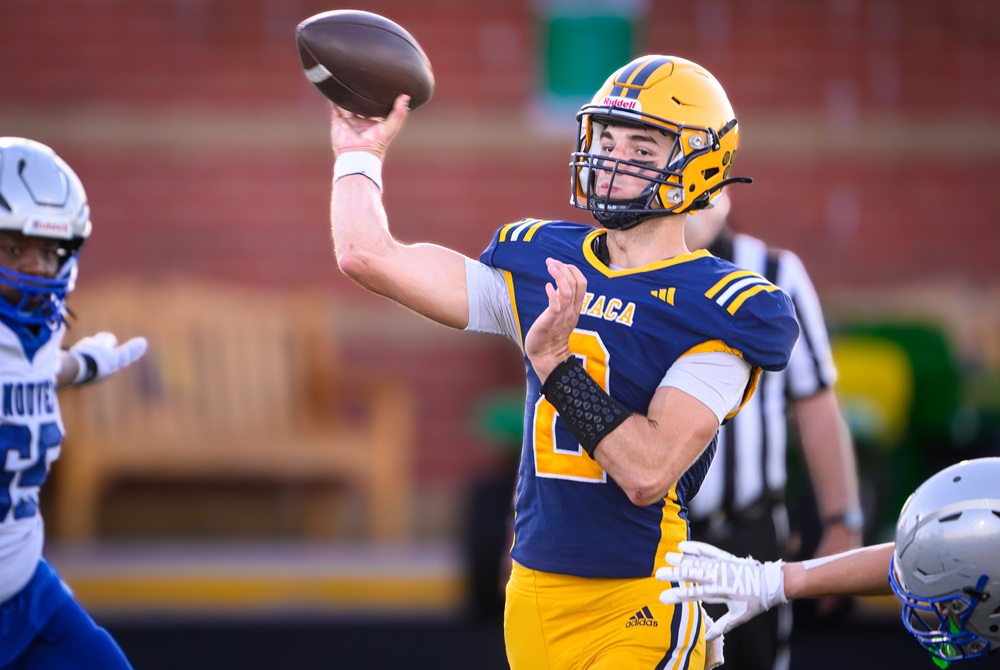
PHOTO Ithaca senior quarterback Gibson Rondy (2) releases a pass under pressure during the first half of his team’s Week 3 win over Saginaw Nouvel Catholic Central. (Photo by Kolleth Photography.)