

Inside Selection Sunday: Mapping the Football Playoffs
October 24, 2011
Sitting on the other side of this process for a number of years, I can admit to occasionally scratching my cynical head over some of the matchups that have come out of Selection Sunday.
How could teams so far from each other play in the same district? Why would two schools in the same town play in different regionals? Are they picking out of a hat at 1661 Ramblewood Drive?
Now, I have answers.
Sunday morning, we filed into headquarters for what might be the most important non-game day on the MHSAA calendar. “We” were made up of half of the MHSAA staff, plus a representative from the Michigan High School Football Coaches Association.
Here’s some of what I learned from being a part of the process:
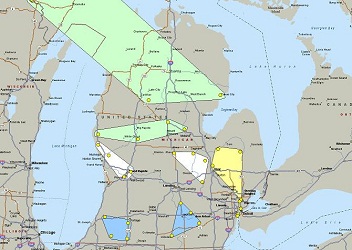
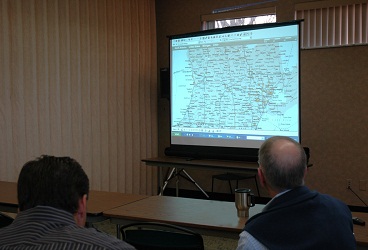
? First, a brief history lesson. In early years (or until the middle of the last decade), lines were drawn by hand. Dots representing qualifying schools were pasted on maps, one map for each division, and those maps were then covered by plastic sheets. Districts and regionals literally were drawn with dry-erase markers. No longer. Using a variety of spreadsheets and mapping software, we’ve gone digital. Staff is split into two teams, each considering four divisions (and the 8-player map) before we reconvene and look at all nine divisions together.
? We are presented digital maps of the state covered in dots. That’s about it. The rule of the day, simply, is “geography rules.” Which teams are represented by the dots is not considered, much less discussed, until lines are drawn. While considering my group’s first map, I began to bring up teams – and immediately was shot down (with good reason). Teams, matchups, rivalries, previous playoff pairings, etc. DO NOT come into play. We draw boxes in what we figure are the most logical ways of making districts and regions work.
? Travel distance and ease DO come into play. This especially is true when considering which districts will include teams from the Upper Peninsula. An example: Marquette is closer to the schools we placed in its district – Fenton, Bay City Western and Okemos – than some other options because those schools are closer to I-75. Schools further north on the map but farther from a main highway would’ve created longer trips.
? Sometimes, maps get ugly. And sometimes, it was a matter of choosing the least ugly situation. Of course, a D
ivision 4 District of Lansing Sexton, Dearborn Heights Robichaud, Battle Creek Pennfield and Vicksburg isn’t ideal. But with no other Division 4 schools within 35 miles of Lansing, we were put in a tough spot. Add in that there were 13 teams in the Detroit area, leaving one as the odd team out of three districts based there. Something had to give, and drawing things up as we did caused the fewest messes.
? Considering how to set up the entire state is different than figuring out what teams make the most sense for just one school or area. And shifting just one dot on a map can change things for all 32.
? Back to “geography rules.” The Division 8 district including Saugatuck, Muskegon Catholic, Mendon and St. Joseph Lake Michigan Catholic might be the most competitive, on paper, in the state. Saugatuck is the reigning MHSAA runner-up in the division, and Muskegon Catholic and Mendon were ranked Nos. 1 and 2, respectively, in the most recent Association Press poll. Seeing that after we’d drawn the line caused a collective “ouch.” But again, the line was drawn based on dots on a map.
I thought back on some of the matchups I’d questioned in the past, and came back to what I’d ask people now: How would you do things differently?
I imagine there would be some creative answers, but I also would guess we considered those scenarios too.
And remember, determining the playoff schedule is just one step in many. Eight state champions must survive it, regardless of which opponents they face along the way.

Talking Practice: Texas, Illinois Revise Policies
December 20, 2013
By Rob Kaminski
MHSAA benchmarks editor
Coaches and players in Texas and Illinois adapted to new football practice limitations this fall, with the Texas policy focusing on contact, and the Illinois regulation emphasizing length of preseason practices.
Following are the main changes those states put in place heading into the 2013-14 season:
The University Interscholastic League, which governs school sports in Texas, put into writing that, “During the regular season and postseason, no football player is allowed to participate in more than ninety (90) minutes of full contact practice per week,” effective with the first day of practice this fall.
The complete policy follows:
For the purposes of the of rule, "full contact" is defined as football drills or live game simulations where "live action" occurs. Live action, as defined by USA Football, is contact at game speed where players execute full tackles at a competitive pace taking players to the ground. A team may continue to dress in full pads for practice, but may only participate in live action drills and game time simulations no more than ninety minutes per athlete per week. It is assumed that when players are in shells (shorts, shoulder pads, and helmets) no live action drills or simulations will occur. This rule is intended to limit live action drills and simulations and not the number of practices a team may participate in full pads. A team may participate in "air," "bags," "wrap," and "thud" drills and simulations at any point. These contact levels are defined below:
• Air - Players should run unopposed without bags or any opposition
• Bags - activity is executed against a bag, shield or pad to allow for a soft-contact surface, with or without the resistance of a teammate or coach standing behind the bag.
• Wrap - Drills run at full speed until contact, which is above the waist with the players remaining on their feet.
• Thud - Same as wrap but tempo is competitive with no pre-determined winner and the players are not tackling to the ground.
The rule came to the UIL Legislative Council as a recommendation from the UIL Medical Advisory Committee, a permanent advisory committee to the Legislative Council which meets twice each year to discuss and review safety policies for UIL participants. The committee, which is made up of leading medical professionals in various specialties and includes representatives from the Texas High School Coaches Association, the Texas Girls Coaches Association, and the Texas State Athletic Trainer Association, unanimously recommended this limitation in full-contact football practice.
The rule formulates into a formal policy the existing actions of the majority of coaches across Texas, and most coaches have had to make few adjustments, if any. In fact, according to a story on statesman.com, the proposal caused more of an uproar on social media than from coaches.
“It’s not going to affect us in anyway,” Vandegrift HS coach Drew Sanders said in the story. “Most good coaches were way below that 90-minute amount already. Prior to legislation we still monitored it ourselves – the only change is now we have to keep up a log more publicly.”
Illinois put standards in place for its first 14 days of football practices, known as the state’s Preseason Football Acclimatization Practice Period. At the core of the policy is a three-hour practice limit for the first five days, during which teams can also conduct a one-hour walk-through.
Teams must observe a minimum two hours rest between the practices and walk-throughs. Players may wear helmets only on the first two days, then helmets and shoulder pads for the next three. From days seven through 14 of the acclimatization period, schools may practice for a maximum of five hours per day, as long as that day is followed by a three-hour day, or an off day. During the five-hour days, no session can last more than three hours and must include a two-hour break between practices. Full pads may be worn for the final seven dates leading up to the first contest.
“This policy was the result of a collaborative effort between the IHSA Sports Medicine Advisory Committee and the Football Advisory Committee,” said SMAC committee member and University of Illinois Associate Professor of Orthopedic Surgery Dr. Preston M. Wolin. “The guidelines are based on the most recent scientific evidence, as well as the expertise of the coaches who will help implement them. Both committees believe the guidelines represent a significant positive contribution to the health of our athletes.”
“This new policy undoubtedly changes the way we, as coaches, approach preseason practice,” said Metamora HS coach Pat Ryan, who is a member of the FAC and a past President of the Illinois High School Football Coaches Association. “Coaches have to get more creative with when and how they schedule practices, as well what they do with their time. The proposals were strongly supported by both committees. It is a crucial final step to the process of being able to effectively prepare our teams in a safe manner. Change is always difficult, but the game is changing and we need to adapt to continue to put the safety of our players first.”
The IHSA offered multiple interactive online webinar meetings for high school coaches leading up to the start of practice where questions were answered, along with further clarifications on the policy and the science behind it.
“I think most coaches understood that changes were on the horizon,” said IHSA Executive Director Marty Hickman. “We wanted to be in a position to give our coaches as much information as possible to make sure they are comfortable with the new policy. Their input will be critical moving forward as we develop educational materials, like a best practices presentation. I commend our committees on a policy that is supported by medical experts, football coaches and school administrators.”