


MHSA(Q&)A: Mendon football coach John Schwartz
February 2, 2012
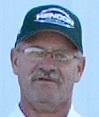 John Schwartz didn’t really want the Mendon football head coaching job when a group of players convinced him to take it before the 1989 season. And his first contract started out on a napkin. The rest is history.
Mendon won its 11th MHSAA football championship this fall, downing Fowler 33-0 in the Division 8 Final, to tie for third-most football titles won by one program. Schwartz has coached in the program for all 11, including 10 as head coach, and his record of 236-39 gives him a winning percentage of .858, tops in the MHSAA record book. He recently was selected as this year’s recipient of the high school Duffy Daugherty Award, annually given for career contributions to the game. He follows recent winners Ralph Munger of Rockford and Herb Brogan of Jackson Lumen Christi.
His Mendon teams have had just one losing season. And although he retired a year ago after 36 teaching middle school science, and then fought off cancer over the summer, he has no plans to leave his post on the Hornets’ sideline.
How would you characterize your program?
I think we have very good coaches and I think the kids respect the coaches, and they know the coaches think more of them than just being football players. They care about them. We have their attention, and what we really try to do is form a team concept as soon as we can. We try to stay away from giving any one person too much recognition. We don't give out MVP awards at the end of the year. It's a program where we're all in it together: coaches, kids and community. We try to get the best out of the kids, give the kids the best shot we have at being the best we can be.
How does a small school continue to reload every season?
My first year there, the first thing I did as a head coach was I started the junior high program. I think that's where everything starts. We even have the younger kids called the rocket kids, and those coaches come in and talk about (football) terms so when kids move from one level to another there's no re-teaching. Everyone has an ego, coaches have egos, and they like to do some things differently. But we don't have that. They do what we do. We give them a lot of flexibility, but we have certain drills we want to run. By the time we get them, these kids are in tune with what we are doing. The summer program also is something I started my first year as head coach too. ... It means that during the season we can concentrate more on teaching than conditioning.
You went from 3-6 in 2006 to 12-0 in 2007. Explain how you bounced back.
The losing season we had, we didn't have a lot of kids, and our two best kids were hurt early in the season and couldn't play. We never did bounce back. Even in that season, we were ahead at halftime in all but one game. We just didn't have enough to come back and pull the game out, and we had some very tough games. It wasn't a good season, but I thought those kids played awfully hard for what we had. We got a lot of experience, and it paid off the following year.
Our JVs practice with the varsity. When I work with inside linebackers, I work with (grades) 9-12. Kids learn quicker from kids than from coaches, as far as I'm concerned. ... Football's really changed. It's become a lot more complex. I think we have to delegate more and more every year so we can stay with the changes. It's too much for one person. I remember my first three, four or five years it was just three of us at the varsity level. The other two, neither one taught at the school. We were pretty successful right off the bat, and we started getting more and more interest from people. Now 9-12 we have seven coaches, and we have three at the junior high, and all the coaches but two have played for me. They know what I expect, what I'm looking for, what I want. ... And they want to win. I'd be lost without those guys.
Are there certain seasons that have meant more than others?
The first year I took the job, in 1989, we went undefeated and won a state title. A lot of those kids are very good friends of mine yet, and they're pretty special to me. They were a big boost to my program. In the '95 year, my son was a sophomore on that state title team. I remember a lot about that team.
They all have something they did very well. They either threw the ball well or played great defense or had a big line. When I hear a year now, I think about those teams.
You grew up in a small town (Colon) and have taught and coached in a small town. Was that important for you to do?
I've never taught anywhere else. I never felt I really had a reason to leave. I've gone through at least six superintendents since I've been there. The fourth or fifth said to me, "The only thing that bothers me about Mendon is these people think an awful lot of winning. There are other things." He asked me, "How do you feel about it?" I said, if they didn't feel that way, I wouldn't be here.
Who was your biggest coaching influence?
I would say Morley (Fraser, Jr., under whom Schwartz was an assistant for three seasons). Years before I got there, Mendon was pretty good in the early 70s, and then in the mid 70s football wasn't very good. I was the JV coach the first year, and the second year after two games they brought me up to varsity. The best thing I did was I told them I would not take the head job, but I'll assist. I knew (Fraser) was the kind of person and personality we needed there. It wasn't necessarily all of his football knowledge, but his energy and excitement that he brought to the game.
You said during the Finals postgame press conference that you'd battled cancer during the summer. How did you come back, and did you ever think that might be time to step down?
Everything's fine. I had coaches that took over. At the same time that that happened, I was retiring. If you retire in Michigan, you can't be at the school for one month. So I couldn't be at summer weights all the way through June. So my coaches did all the summer weights. But I had no intention of stepping down. If something (bad) came down ... but once they said they got it, everything went as normal.
After a championship season, how do you ramp things back up for the next fall and a new group of players?
When we go to the playoffs, we take all the JVs unless there are couple who don't want to go. They experience that and get an extra five weeks of practice if we win a state title. And they're excited about it. They want to do that. They’ve' tasted it, and they want a part of that the next year. We remind them it's not what you did, it's what can you do for me now. ... This is your year.
We talk about winning state championships from day one. A lot of people say we shouldn't do that, but why not? Isn't that the ultimate goal? I can't imagine telling a team we think we could be 7-2 this year. We expect to be 9-0 every year. Of course, that's not going to happen. But at same time, I think the losses make you better the following week. We've won state titles where we haven't won the league title. ... You get better.
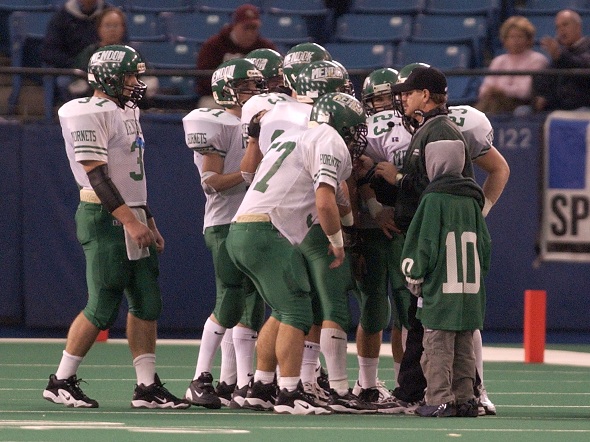
PHOTO: Mendon coach John Schwartz talks things over with his players during the Hornets' 21-14 win over Decatur in the 2002 Division 7 Final at the Pontiac Silverdome.
Building Beginning as Okemos Follows 1st-Year Coach Scott-Emuakpor
By
Geoff Kimmerly
MHSAA.com senior editor
August 9, 2022
OKEMOS – The football lay on the turf, landing there before the play had really begun, and the most booming voice from the tallest man on the field yelled a reassuring, “It’s OK. Let’s go,” followed the next play by “Go again,” and then “Figure it out.”
 An hour earlier, first-year Okemos varsity football coach Efe Scott-Emuakpor had been on the phone asking a parent to bring the helmet and practice jersey one of his players had left at home. Nearby, another small group also stood helmetless as they hadn’t yet gotten the pre-participation physical required to join their friends on the field.
Those are typical first-day glitches no matter the school, and fall practices for all sports began Monday at 750 high schools across the state.
But those relatively minor symptoms are what Scott-Emuakpor is focused on treating in the immediate term as he takes on one of the most serious rebuilding efforts in Michigan high school football.
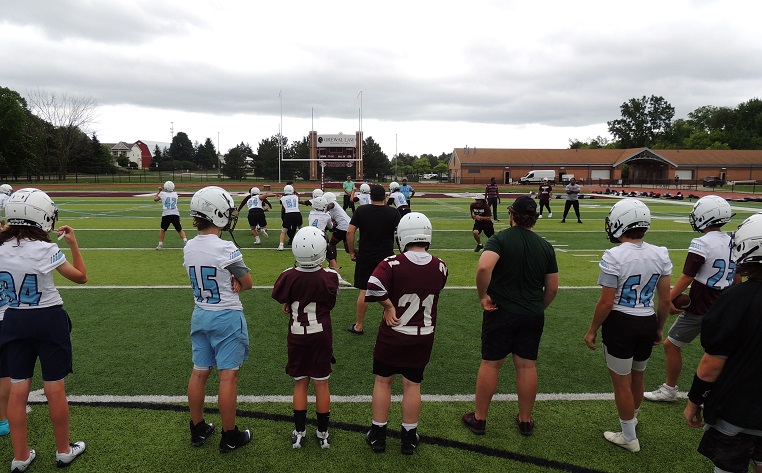
“This is progress,” Scott-Emuakpor said halfway through his team’s first practice, looking out at 39 players on Okemos’ game field – 33 more than showed up for his first offseason workout.
“We’d like to have everything right now. But it’s growing. It’s slowly growing.”
And after Monday, Okemos is one step closer to what would be an incredible turnaround story.
The Wolves have not won since Week 2 of the 2019 season, a stretch of 23 games. After scoring on an 84-yard run during the first quarter of last fall’s opener against Mason, Okemos didn’t score again the rest of the season.
Standing 6-foot-3, and still only a few years from his last college game as a receiver at Ball State University, Scott-Emuakpor looks capable of stepping back into a huddle at a moment’s notice. A little more than a decade ago, in 2011, he was beginning a senior season at East Lansing that would see him cap his varsity career in the MHSAA record book with 134 catches, gaining 1,624 yards, over three seasons. He also was an all-leaguer in basketball and Finals placer in high jump before joining the Cardinals.
 After graduating from Ball State with a computer science bachelor’s degree, and on the way to earning his master’s in business from Saginaw Valley State University, Scott-Emuakpor came home and has worked nearly six years as a business systems analyst with Red Cedar Solutions Group on efforts including the MI School Data website.
But that’s just his fulltime job. Scott-Emuakpor also co-founded a clothing line, Live For Today, and over the last five seasons served as a volunteer assistant coach with his hometown Trojans – who have made the MHSAA Playoffs six seasons running.
He'd never applied for a head coaching job. He’d never really considered coaching at that level. In fact, he was pretty happy with how assisting at East Lansing for longtime coach Bill Feraco fit into his schedule and other pursuits.
But Scott-Emuakpor also is a studier. And as a past rival and co-member of the Capital Area Activities Conference Blue, he and East Lansing saw Okemos plenty.
The Wolves had made the playoffs as recently as 2018, and won their first playoff game that season since 2011. Scott-Emuakpor had played against Okemos’ Taylor Moton, now considered one of the NFL’s top offensive tackles. And the school has had loads of success in other sports, annually ranking among the Lansing area’s best in just about all of them and coming off a statewide Division 1 championship in boys soccer from last fall.
“I paid attention to how things have been around here. And I know what they could be capable of,” Scott-Emuakpor said. “This program was once a good program that was very well-respected; I respected them playing against them in high school. They had great athletes. I think my senior year we beat them by one point (20-19 in 2011). So we had good battles.
“I just saw where they’re at. … We have some good kids around here, and I know there’s more in the school not playing. Maybe when they’re sophomores, juniors, they’ll come out. I think I’m capable of getting that interest up, getting them out on the field and just building something.”
 Raj Singh is a senior this fall, one of only five or so Scott-Emuakpor is expecting to come out this week. He’s also a near all-A student, will play some quarterback and safety along with his receiver spot, and was the guy bringing carloads of classmates to workouts over the summer as he joined his coach in recruiting prospective players.
Singh is following his older brother Joe Singh, an admittedly “smaller than everyone” offensive lineman who earned all-league honors as a senior in 2017. When Joe Singh told his younger brother that playing under the lights on a Friday night is a feeling unlike any other, the idea stuck – which is why it made sense when Raj Singh fractured his wrist in Week 2 last season but was back by Week 7 despite a cast covering one hand.
Watching Singh catch passes one-handed last season during East Lansing’s 49-0 win over Okemos stuck with Scott-Emuakpor. Joe Singh had told his little bother that all that matters is having more heart than his opponent and a fighting spirit – in other words, being the type of player Scott-Emuakpor will rely on to get Okemos up and succeeding again.
“I’ve been playing football since I was 6 years old. It’s just been a dream of mine to be at this moment,” Raj Singh said.
“Coach Efe is bringing in a lot of new aspects, and that’s been very helpful to make it different than last year – make us feel a little more at home this year. Compared to last year, he’s brought a lot of structure. We’ve been really coming together as a family … and it just shows Coach Efe wants to build a community around here.”
The process is about more than building stronger, faster bodies and learning football skills and technique. The Wolves aren’t talking a lot about last year, but there’s something there to overcome – and Scott-Emuakpor started working on that soon after he was hired at the end of March.
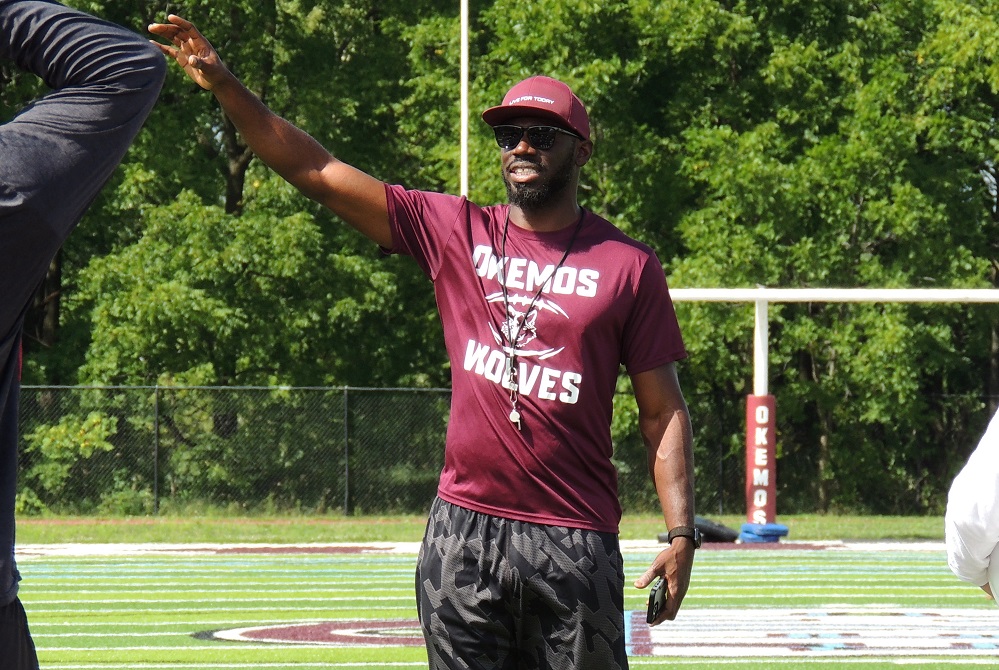 “In the springtime, we were fortunate enough to get in the weight room and I was able to see kids put up good weight and do some things. I’d tell them, ‘You’re actually strong. You’re actually a fast kid,’” Scott-Emuakpor said. “But when you’re not successful for so long, and the way they were losing last year, it was easy for them to not feel confident, not feel they were able to ultimately get the job done. And so I was just there working on minds.”
Last season was going to be uphill for Okemos no matter what. A mid-summer coaching change brought on by a major fulltime job promotion for the former coach led to an interim staff, players leaving the program, and an applaudable effort to just keep teams on the field.
Scott-Emuakpor has surrounded himself with a staff that includes a pair of his past coaches growing up in East Lansing, past players from when he was coaching there and others with winning experience playing at DeWitt and Williamston.
In addition to what he learned playing and coaching under Feraco, Scott-Emuakpor brings a ton of insight from his experiences at Ball State; he had only one catch during his college career while battling injuries, but he spent that time on the sideline observing his coaches and taking mental notes. Just Sunday, he was pulling from the 2012-13 Ball State football handbook a few details to incorporate into his work in progress with the Wolves.
Okemos will have varsity and freshman teams this fall, and the majority of players at Monday’s combined practice were juniors and sophomores – so recruiting remains ongoing. But Singh said the number of classmates who did come out Monday exceeded his expectations – and that just added to the excitement of starting again.
“If you walk through the school, you’ll see some guys, you’ll (say), ‘OK, what does that guy do?’ You find out he plays (only) lacrosse, or only wrestles, where in other areas, other schools, they might do everything because that’s what they do, what they’ve grown up doing” Scott-Emuakpor said. “I’ve been trying to rebuild that connection, that love for football. A lot of them are very intrigued; I feel like some of them are kinda peeking and saying, ‘What’s going on? This new coach seems to be young and interesting.’ And I’ve just been trying to stay focused on the process and not get too far ahead of myself.”
 Geoff Kimmerly joined the MHSAA as its Media & Content Coordinator in Sept. 2011 after 12 years as Prep Sports Editor of the Lansing State Journal. He has served as Editor of Second Half since its creation in January 2012, and MHSAA Communications Director since January 2021. Contact him at [email protected] with story ideas for the Barry, Eaton, Ingham, Livingston, Ionia, Clinton, Shiawassee, Gratiot, Isabella, Clare and Montcalm counties.
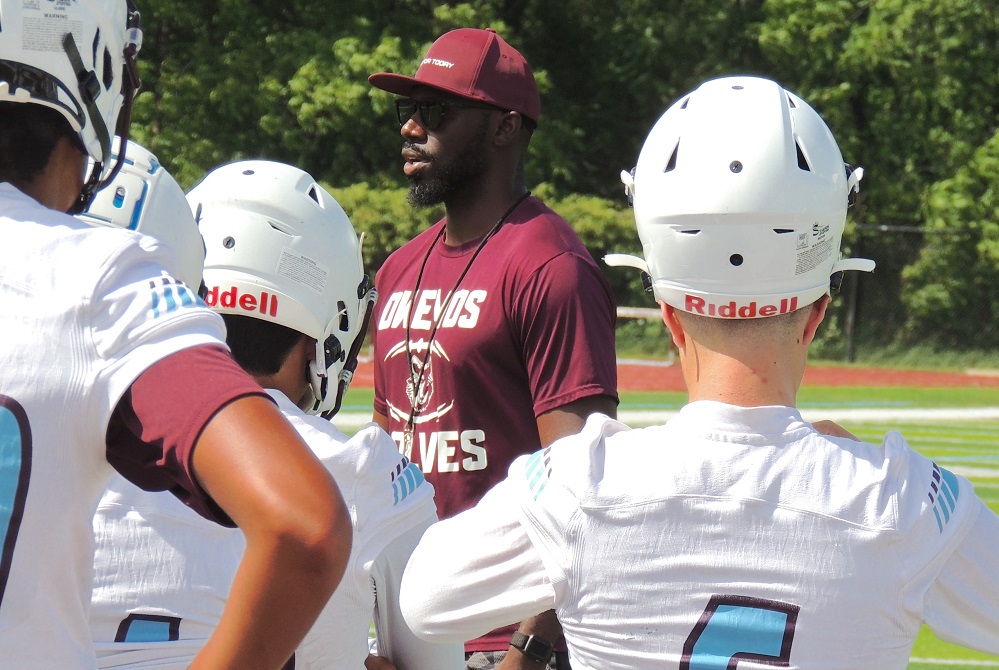
PHOTOS (Top) First-year Okemos varsity football coach Efe Scott-Emuakpor, middle, huddles up his players during Monday's first day of practice. (2) Scott-Emuakpor confers with senior Raj Singh on blocking from his receiver position. (3) The Wolves work on offense during the first part of their Monday session. (4) Scott-Emuakpor speaks with his team at the start of the workout. (Photos by Geoff Kimmerly.)