


MHSA(Q&)A: NFL official Ronald J. Winter
July 19, 2012
By Brian Spencer
Second Half
 Kalamazoo's Ron Winter has officiated in the National Football League for nearly two decades, and became a referee in 1999. But long before he joined the highest level of the game, he got his start on Michigan's high school fields.
Winter has officiated that sport at all three levels and also high school and college basketball. He's also served as a source of knowledge for officials around the state -- and an example for those hoping to start at the high school level and climb to the pros.
Winter remains registered as an MHSAA official, as he's been for 42 years. An associate professor emeritus of human performance and health education at Western Michigan University, Winter was appointed earlier this month to serve a two-year term on the Governor's Council on Physical Fitness, Health and Sports. The council focuses on increasing physical activity and health improvements.
He served on the WMU faculty first beginning in 1969 and then again from 1992-2008. Winter earned bachelor and master's degrees at Michigan State University.
Did you play any sports in high school or college?
I played football, basketball, baseball, and track in high school. However, once I got to Michigan State University, I started playing lacrosse. A couple guys that lived near me played lacrosse and asked me to come out to throw the ball around. After throwing with them a couple times they asked me to come out for the team. I ended up playing lacrosse for MSU for four years.
How did you decide to choose football as the sport you would officiate?
I started officiating as a student at MSU in their intramural program, officiating touch football and basketball. The next logical step was to then officiate in the high school leagues. From there, I began to proceed to all the different levels.
Are there specific requirements for becoming an NFL official?
The biggest requirement is experience. The progression that I went through went like this:
After officiating high school games, I went to the MIAA (Michigan Intercollegiate Athletic Association). They (MIAA) were looking for people that had 3-5 years of experience at the high school level. From there I went to the Mid-Continent conference. I wasn’t able to go to the Mid-American Conference because I was employed at Western Michigan University.
From there I went to the Big Ten. The Big Ten was looking for people with 5 to 10 years of experience in high school and people that had experience at different positions as an official. I ended up officiating in as a Big Ten football official for 10 years and a Big Ten basketball official for 15 years. I then submitted an application to the National Football League. Coincidentally, the NFL was scouting officials, and had followed me for four years before they finally asked me to be a part of the staff. The NFL decides on who they want to pursue through recommendations and personal interest. They look for personality traits as well as how (officials) carry themselves through different situations.
What has been your favorite level to officiate; High school, college or professional?
I enjoyed officiating all of them, but for different reasons.
I found high school to be the most fascinating because it’s all about the kids; they are playing the game for the love of the game. That is the purest sense of the sport. I loved being involved with kids simply because they love the game.
I found the Big Ten to be most exciting because of the kind of atmosphere that exists on a Big Ten campus on a Saturday afternoon. It’s electric. You don’t get that same sense or the same feel on Sunday afternoon in a pro stadium.
I found the NFL to be most intense. The NFL really has three or four different levels of play during the season. There is preseason play, the first third of the season, the second third of the season, and the last five games of the season. Each level is ramped up another notch as the season progresses. Playoffs are entirely different all together. In terms of the intensity and pure speed of the game, there is nothing like the NFL playoffs.
How important is getting along with your fellow officials on the field?
It’s imperatively important if you want to have a smooth and well-run game. This doesn’t mean that you have to buddy-buddy off the field, but on the field you have to be committed to one goal. We spend two or three hours on meetings Saturday afternoon to go over rules tests, tape, and more to prepare for the next game (and) to get over rough patches that develop on a personal level in a previous week. I need to know that the other six guys are focused and thinking about football like me. Everyone has to have confidence in one another. We spend plenty of time on Saturday to get to the point that we need to on Sunday.
What has been the most exciting game you’ve officiated?
I’ve been in plenty of exciting games from NFL playoff games, to the first Orange Bowl game, to the Rose Bowl, to the Division III Hope vs. Calvin basketball game, to when Indiana played Purdue in basketball. All of them were incredible to be a part of. During the Indiana vs. Purdue game, the arena was electric. The players, coaches, fans were intense. Everybody is totally focused on the game. Each coach had a tremendous respect for one another. Neither one wanted to show up or embarrass their counterpart. This game wasn’t that drastically different at the Division III level, however. The intensity of both was very similar.
Are there games that you get excited to officiate more than others, presently?
Not in terms of specific teams. It really just depends on the circumstances, of course. Pittsburgh vs. Baltimore is an intense game. The Jets vs. Patriots game is great. There are clearly rivalries that are very exciting to be a part of. The level of play and intensity of the athletes in the NFL is unmatched and can provide excitement every week.
What is the most difficult aspect of being a NFL official?
I would say that preparation and being able to maintain intensity on the field on Sunday are key aspects. The preparation is difficult because it’s time-consuming. It is a misconception that we simply show up on Sunday to work the game. By the time Sunday rolls around, I’ve spent over 20 hours during the week trying to prepare for a Sunday game. It isn’t hard in terms of physical labor, but difficult in terms of a time commitment. You have to have an understanding family to be in the occupational field that I am in.
Do you have any advice for aspiring officials who hope to make it to the league?
Practice, practice, practice. Be able to work any game at any level and get as much experience as you can. Be a good partner on the field. It takes time; it isn’t something that just happens. Like anything else, it takes practicing your trade to be able to make it to the top level.
Anticipation High as Statewide Football Eyes Turn to History-Chasing Mason
By
Geoff Kimmerly
MHSAA.com senior editor
August 8, 2023
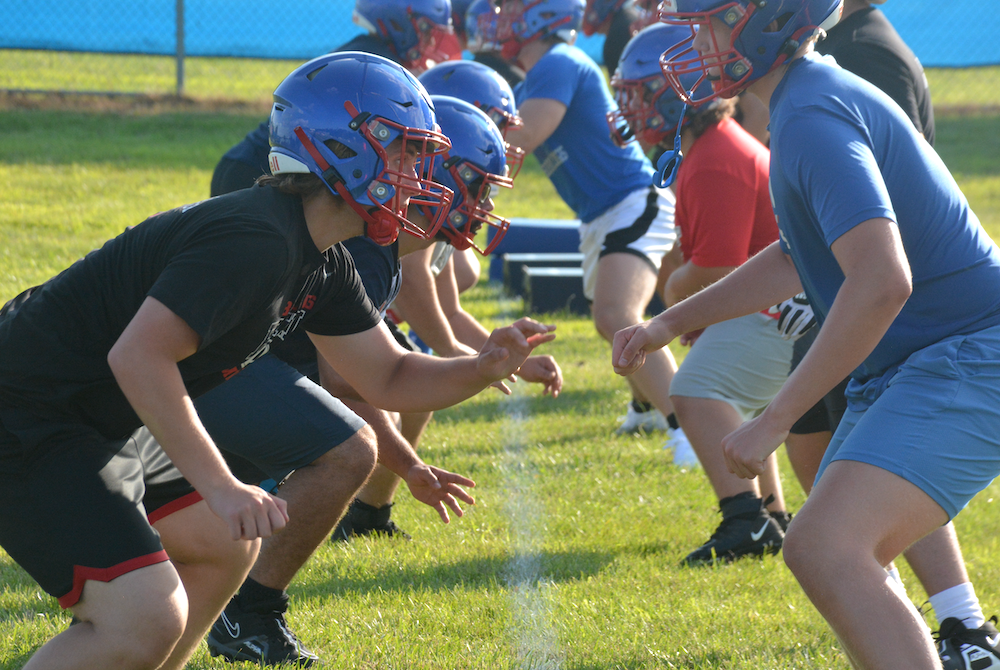
MASON – The drone lightly buzzing overhead during the final hour of Mason’s first practice was providing coaches another point of view as another season got underway Monday evening.
 But those shouldn’t be the only eyes watching the Bulldogs these days.
Two years ago, the Bulldogs started grabbing attention with a run of eight straight wins that landed them a first Regional championship with a stunning 20-17 win over frequent contender Bloomfield Hills Brother Rice.
A statewide audience began focusing in last season on the 8,200-resident town just south of Lansing as Mason returned to the Division 3 Semifinals and finished 12-1, setting a school record for wins with the only loss coming to eventual champion Detroit Martin Luther King for the second-consecutive season.
The Bulldogs return nine starters on offense and eight on defense this fall, led in part by two four-year varsity players and three in their third seasons on the top squad. Not tuning in would be a mistake – and mean missing out on potentially another historic effort.
“It started when we beat the Brother Rice team two seasons ago. That kinda kicked off a little bit of a spark for us here at Mason, and the energy just became the difference,” said senior lineman Nick Saade, one of those three-year varsity standouts. “You could just tell. All of our coaches have been at the weight room every day, giving us harder workouts as each year progresses. We’ve increased everything. The energy is there, all the seniors are back. We’re ready to go.”
Practices in nine sports started for an estimated 95,000 athletes across 750 MHSAA member high schools Monday. And Mason football got a running start. On what felt like the most comfortable first day of practice weather-wise in recent memory, there was no sign the Bulldogs were aiming to sit comfortably after what they’d accomplished the last two seasons.
So many experienced returnees means less to teach the greater group and an opportunity for coaches to start game-planning and focusing on details they might not get to usually until the first third of the season is done.
The program has had plenty of success over the years, including a stretch of 14 winning seasons over 15 from 2002-16. But the combined 39-6 record over the last four seasons is unmatched in Bulldogs history and made Mason a place to be for local media Monday as expectations – and anticipation – likely have never been higher.
“Expectations are high, no question about it – and it’s exciting,” said seventh-year coach Gary Houghton, whose only sub-.500 finish came his first season in 2017. “These guys love a challenge, our coaches love a challenge. … We feel like we have a blueprint that leads to success, and we’re going to stay to that blueprint.
“We’ve tweaked some little things, but the core of what we do, we’re going to continue to do. With the added experience we have coming back, I think we have an opportunity to take it to another level.”
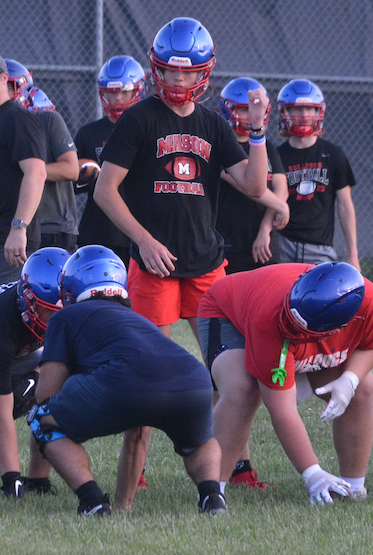 Mason took a solid offense to nearly unstoppable last season, upping its per-game scoring average 12 points to 43 per game. Junior Cason Carswell should begin approaching Mason career passing records in his third season as the starter after setting single-season school records with 2,403 yards and 34 scores through the air last fall in making the Division 3-4 all-state second team.
The Bulldogs return all but one receiver among last year’s starting skill players, with senior running back AJ Martel entering his fourth season on varsity after running for 1,273 yards and 20 scores a year ago behind a line that returns Saade among three starters.
The defense was two points better per game last fall than in 2021 while facing another tough playoff slate, giving up 15 points per game. The entire linebacking group returns, with senior Kaleb Parrish having been named the Lansing State Journal Defensive Player of the Year last season. Senior Derek Badgley and junior Logan Doerr also received postseason all-area recognition at linebacker, as did seniors Tyler Baker and Cole Ries in the defensive backfield and senior Grant Gilchrist and junior Sam Corey up front. Junior Collin Winters, also a soccer player, was an all-area kicker last fall.
The energy Monday was undeniable. Houghton loves the chemistry this group has developed over the last three seasons, starting as a young team grew together during that 2021 run. He credits rebuilding the program’s culture, undertaken in several ways purposefully, as putting this team in this position to put the last two years of experiences and learning toward another championship opportunity.
“Just stay confident. Know you can get the job done. Just trust your teammates,” Carswell said he has learned most.
“We all have huge hopes. A couple of years ago, it was like, ‘Let’s make the playoffs. Let’s make a big run.” Now it’s let’s go for it all.”
 Geoff Kimmerly joined the MHSAA in Sept. 2011 after 12 years as Prep Sports Editor of the Lansing State Journal. He is a senior editor of MHSAA.com's editorial content and has served as MHSAA Communications Director since January 2021. Contact him at [email protected] with story ideas for the Barry, Eaton, Ingham, Livingston, Ionia, Clinton, Shiawassee, Gratiot, Isabella, Clare and Montcalm counties.
PHOTOS (Top) Linemen work on one-on-one drills during Mason’s first football practice Monday evening. (Middle) Third-year starting quarterback Cason Carswell lines up under center. (Photos by Geoff Kimmerly.)