


Mixed Messages
November 27, 2013
One of the very few enjoyable aspects of waiting in an airport is the guiltless time it allows me to visit its bookstores and page slowly through some of the old classics I vaguely remember and the new releases I can’t wait to read.
Two months ago in one of the terminals of Sky Harbor Airport in Phoenix, my attention went quickly to a prominent display of books about football. Five titles were mostly critical of the game, focusing on the sport at the major college and professional levels. Down at the bottom of the display was one title that addressed the positive value of football to students, schools and communities.
One month ago, while I was eating breakfast, the television news reported on the results of new research about youth concussions. While the narration mentioned multiple sports, the video was mostly of football. I saw that story repeated on another television channel that evening. I wondered, how many times on how many channels did how many people get this gift of the latest youth concussion statistics for all sports presented in football-only wrapping paper?
The public is getting mixed messages about school-sponsored football. The problem of college and professional football is not the problem of school-sponsored football. And what problems of head trauma that do exist in school sports are not exclusively problems of football.
In fact, school-sponsored football has never been freer of serious injury than it is today – that’s true whether we are talking about heads, necks, knees or nicks. It’s the result of the most careful and cautious rules making, coaching and officiating ever. And it’s safer – not less so – as we ever more quickly assess and refer injuries to ever more educated and capable health care professionals.
1st & Goal: 2026 Week 8 Review
By
Geoff Kimmerly
MHSAA.com senior editor
October 19, 2026
Week 8 of this Michigan high school football season was billed to be spectacular, with league-deciding matchups all over the state.
 Spectacular was just the start.
In fact, as happens every week, more headliners emerged than originally anticipated. Read on for several as we next prepare for regular-season finales and playoff selection over the next five days.
Bay & Thumb
HEADLINER Grand Blanc 28, Davison 21 The Bobcats clinched a third-straight Saginaw Valley League South championship as these rivals decided the title for the third-straight season. The next time they play each other for a football title will be similar but different; this also was the last game for both before they join the Oakland Activities Association next fall. Click for more from the Flint Journal.
Grand Blanc wins 3rd consecutive SVL Crown with 28-21 thriller over Davison in the @ABC12WJRT #HighlightZone Week 8 Game of the Week https://t.co/P4JqO9t8mc
— Justin Dierkes (@DierkesTV) October 17, 2026
Watch list Frankenmuth 41, Saginaw Swan Valley 22 The top challenger has shifted the last few seasons, but Frankenmuth (7-1) remains the Tri-Valley Conference Red champion as the Eagles won their 78th consecutive league game dating back to 2014 while handing the Vikings (7-1) their lone loss.
On the move Burton Bendle 39, Flint Elite 0 After sharing the Genesee Area Conference title a year ago, these two met to decide it again with Bendle (8-0) avenging last season’s 34-8 loss to clinch a share and earn a chance to finish as outright champion this week. Goodrich 49, Fenton 14 Goodrich (8-0) finished its third-straight Flint Metro League overall championship run against a familiar opponent as these two have faced off in the deciding game all of the last three seasons. Sanford Meridian 28, Gladwin 13 The Mustangs (8-0) added the Jack Pine Conference overall championship while earning an opportunity this week to finish the regular season perfect for the first time since 2015.
Greater Detroit
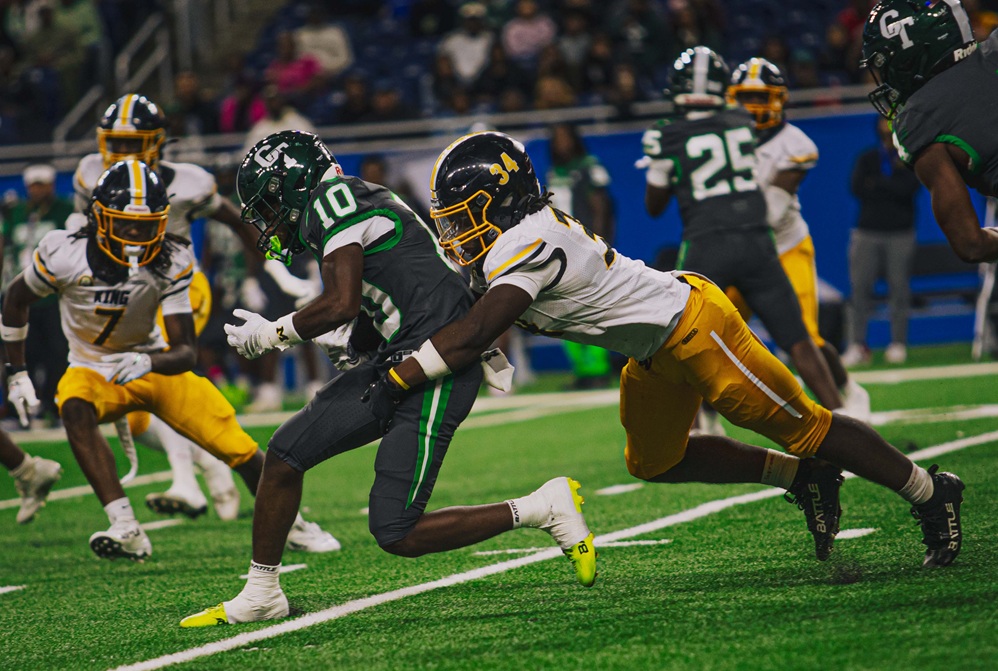
HEADLINER Detroit Cass Tech 21, Detroit Martin Luther King 20 For the second time in four seasons, these two played a city championship rematch that came down to a single point – and Cass Tech (8-0) prevailed with a fifth-straight Detroit Public School League title game victory, adding to its Week 4 20-7 PSL Blue win over the Crusaders (7-2). Click for more from the Detroit Free Press.
THAT CONNECTION WAS DIALED IN. 📞🔥 Donald Tabron (@donaldtabronII) and Peyton Robinson (@7PRobinson) linked up for a pair of touchdowns in Cass Tech's (@Detroit_CTFB) victory! Powered by @MIArmyGuard https://t.co/BdkjbmFqkY
— STATE CHAMPS! Michigan (@statechampsmich) October 17, 2026
Watch list Harper Woods 28, Clarkston 13 Harper Woods (7-1) is undefeated since losing its season opener to Cheslea, and this OAA Red/Blue crossover of league champions ended with the Pioneers celebrating a second win in two years over the Wolves (7-1).
On the move Detroit Edison 30, Ecorse 20 Edison (7-1) clinched the Charter School Conference Gold championship outright with a perfect run through the league schedule, handing Ecorse (7-1) its lone defeat. Walled Lake Western 42, South Lyon East 14 Western (7-1) maintained its position among three teams tied for first in the Lakes Valley Conference, and knocked East (6-2) out of that mix. Detroit Central 8, Detroit Denby 6 These two met for the second-straight week, this time for the PSL Gold city championship, and with another low-scoring result after Central (7-1) defeated Denby (5-3) seven days earlier 6-2.
Mid-Michigan
HEADLINER Grand Ledge 28, DeWitt 14 The Comets claimed the Capital Area Activities Conference Blue title outright by downing DeWitt (6-2) in this winner-take-all matchup, and also avenged last season’s 59-7 loss that ended up deciding the league championship. Grand Ledge (8-0) is one of eight undefeated teams left in Division 1. Click for more from the Lansing State Journal.
🏈MOST-WATCHED EVENT last week: Anthony Baker’s TD run sealed Grand Ledge’s 28-14 win over DeWitt and earned the Comets a league title. Subscribe & watch all the action on @NFHSNetwork >> https://t.co/MMNs3IcM1v #Football #WatchNow #Stream #NFHSNetwork #MHSAA Powered by @CallSam https://t.co/ZHfXvlK9FV
— MHSAA (@MHSAA) October 19, 2026
Watch list Hastings 54, Mason 49 The Saxons started this season 1-2, but they’ve won five straight and this was certainly the most notable of the run as the Bulldogs (7-1) haven’t let any other opponents come within 12 points.
On the move Ithaca 35, Fowler 0 The Yellowjackets (8-0) have outscored their opponents by a combined 412-26, and in this one shut out a Fowler team that has scored 42 or more points five times during its 6-2 start. Mount Pleasant 34, Midland 10 The Oilers (7-1) clinched a share of the SVL North title, but will be rooting for Midland (4-4) this week to defeat Dow – which with Traverse City West also can clinch a share. Lake Odessa Lakewood 31, Olivet 21 Lakewood (7-1) has reached seven wins for the first time since 2018 and is up to No. 5 on the Division 5 playoff-points list, with its only loss to undefeated Portland by three points.
Northern Lower Peninsula
HEADLINER Traverse City West 27, Bay City Western 26 After putting themselves in position to claim a share of the SVL North title in Week 7 with a two-point win over league leader Mount Pleasant, West maintained that possibility in similar fashion. The Titans (5-3) scored during the final minute in this one and face rival Traverse City Central this week hoping to become a league champion as well. Bay City Western (3-5) faces Bay City Central seeking to move back into the Division 3 playoff field after falling out of the top 32. Click for more from the Traverse City Record-Eagle.
Watch list East Jordan 13, Frankfort 0 The Red Devils’ defense posted its second shutout this fall as East Jordan (7-1) clinched a share of the Northern Michigan Football Conference championship. Frankfort (5-3) also ranks among the top 20 on the Division 8 playoff-points list, so these two could meet again.
On the move Charlevoix 9, Elk Rapids 0 The Rayders (6-2) do not have a game this week but finished the regular season with three straight shutouts, this one to stay ahead of the Elks (5-3) for second place in the Northern Shores Conference. Kingsley 50, Kalkaska 6 Kingsley (8-0) locked up, outright, the first NSC football championship. Harbor Springs 41, Johannesburg-Lewiston 0 Harbor Springs’ ascension the last two seasons has been speedy and impressive, from going a combined 0-26 from 2023-25 to setting up a matchup with East Jordan this week for a share of the NMFC title.
Southeast & Border
HEADLINER Saline 35, Temperance Bedford 21 Saline finished a repeat run through the Southeastern Conference Red with this winner-take-all championship clincher against the previously undefeated Kicking Mules (7-1). The Hornets (8-0) can finish a first perfect regular season since 2021 with a win this week over Lake Orion. Click for more from the Ann Arbor News.
Watch list Monroe Jefferson 8, Monroe St. Mary Catholic Central 6 By nearly the slimmest of margins, Jefferson (8-0) clinched the Huron League title in another winner-take-all matchup against a previously undefeated opponent. The Bears will face Clinton this week seeking to finish a first perfect regular season since 1993.
On the move Clinton 24, Adrian Madison 21, Hudson 26, Ida 0 With these victories, Clinton and Hudson broke a four-team tie for first in the Lenawee County Athletic Association, finishing as co-champions. Hanover-Horton 36, Manchester 30 The Comets (7-1) clinched the overall Cascades Conference championship for the second-straight season, coming back from a 30-12 deficit to catch Manchester (6-2). Jackson Lumen Christi 28, Detroit Country Day 27 Lumen Christi (7-1) held on to set up a winner-take-all for the Catholic High School League AA title this week against co-leader Dearborn Divine Child.
Southwest Corridor
HEADLINER Edwardsburg 59, Vicksburg 27 The Eddies (8-0) are Wolverine Conference champions for the first time since 2022, clinching a share with this victory and earning an opportunity to finish as outright title winner this week against Niles. Edwardsburg had broken 40 points five times this fall entering the night but scored its season high in handing Vicksburg (7-1) its only loss. Click for more from the Niles Daily Star.
Watch list Cassopolis 34, Saugatuck 14 A Week 1 loss to Decatur ended up derailing the Rangers’ Southwest 10 Conference title hopes, but there are more championship opportunities ahead as Cassopolis (7-1) moved up to No. 20 in Division 7 playoff points by sending Saugatuck to 5-3.
On the move Parchment 41, Lawton 34 The Parchment/Richland Gull Lake co-op improved to 5-3, two more wins than those two schools combined for last season. Bronson 42, Reading 16 Bronson (6-2) opened this season 1-2 falling to the top contenders in the Big 8 Conference, but has won five straight to jump up to No. 16 on the Division 7 list. Portage Northern 46, Kalamazoo Loy Norrix 13 Portage Northern (5-3) has climbed all the way to No. 16 on the Division 2 playoff points list with four wins over its last five games including two straight over Division 1 opponents.
Upper Peninsula
HEADLINER Kingsford 21, Menominee 14 Kingsford has accomplished plenty throughout its storied history, but this must go down as one of the program’s most memorable wins over the last three decades as the Flivvers clinched the winner-take-all outright championship in the Western Peninsula Athletic Conference Copper by ending Menominee’s 21-game winning streak. Kingsford (8-0) can finish a perfect regular season this week against another league champion in Marquette. Click for more from My UP Now.
Watch list Marquette 19, Petoskey 10 The Sentinels (6-2) are Big North Conference champions now outright after ending Petoskey’s pursuit to earn a share. These two could see each other again though, with Marquette No. 18 on the Division 3 playoff-points list and Petoskey (5-3) remaining at No. 26.
On the move L’Anse 34, Hancock 26 The Purple Hornets (4-4) leaped back into the Division 8 playoff mix, jumping 11 spots to No. 26 on that playoff list after breaking a two-game losing streak. Bark River-Harris 45, Manistique 16 The Broncos (7-1) finished a West-PAC Iron outright title run and will conclude the regular season against Menominee. Calumet 44, Gladstone 28 The Copper Kings (5-3) bounced back from a Week 7 loss as they build toward the Division 6 playoffs.
West Michigan
HEADLINER North Muskegon 21, Ravenna 13 Make that 28 wins in 28 chances for North Muskegon in the West Michigan Conference Rivers, as the Norsemen came back and held on in this winner-take-all matchup to clinch a fifth-straight league title. Ravenna (6-2) led 13-0 at halftime before North Muskegon began climbing back. Click for more from the Local Sports Journal.
Watch list Grand Rapids Kenowa Hills 35, Lowell 21 A winner-take-all is set in the River Cities Alliance as Kenowa Hills (7-1) will take on Coopersville this week for the outright league championship. The Knights had to get past third-place Lowell (5-3) to make that happen and scored the most points the Red Arrows have given up this fall.
On the move Grand Rapids Catholic Central 21, Holland Christian 20 (OT) The Cougars (7-1) eluded a major scare from Holland Christian (3-5), with that one deciding point also giving Grand Rapids Catholic Central the Ottawa-Kent Conference Black title outright. East Grand Rapids 28, Middleville Thornapple Kellogg 27 EGR (6-2) was right there waiting for a Catholic Central slip but finished second in the O-K Black by edging third-place MTK (6-2) by the same margin. Hudsonville 17, Rockford 14 Hudsonville got past its longtime rival to hold onto hope of grabbing a share of the O-K Red title from Week 9 opponent East Kentwood, which clinched a share Friday against Holland West Ottawa. (Caledonia remains in the mix as well.) The Rams (4-4) still control their ability to extend their record playoff streak to 32 straight seasons, as they sit No. 24 on the Division 1 playoff-points list.
8-Player
HEADLINER Mendon 28, Climax-Scotts 24 The Hornets (8-0) scored the only points of the fourth quarter with 6:11 to play to push past Climax-Scotts (6-2) and clinch the outright Southern Central Athletic Association Red title. The game-winner was Zak Iobe’s fourth touchdown run of the game, and he finished with 104 yards rushing. Click for more from WTHD.
Watch list Waldron 48, Pittsford 28 Waldron (5-3) upended Pittsford in the SCAA Blue, cementing a third-place tie in the league for the Spartans but leaving Pittsford (5-3) to share the championship with Litchfield – which the Wildcats had defeated the week before. It was Waldron’s first win in five games against Pittsford as 8-player opponents.
On the move Gaylord St. Mary 42, Pickford 0 The Snowbirds (8-0) have six shutouts in seven games on the field (one win was a forfeit), but this certainly was the most impressive as Pickford (6-2) entered averaging 41 points per game. Powers North Central 42, Felch North Dickinson 34 The Jets (6-2) picked up an important win as they moved up to No. 12 on the Division 2 playoff list, and they also pushed last season’s Division 2 runner-up North Dickinson (4-4) down to No. 18 and out of the potential field with one week to play. Marion 64, Onekama 6 Marion (8-0) will have an opportunity to finish the regular season perfect this week thanks to avenging last year’s 22-point defeat against the Portagers (6-2).
MHSAA.com's weekly “1st & Goal” previews and reviews are powered by MI Student Aid, a division within the Department of Lifelong Education, Advancement, and Potential (MiLEAP). MI Student Aid encourages students to pursue postsecondary education by providing access to student financial resources and information. MI Student Aid administers the state’s scholarship and grant programs that help make college Accessible, Affordable and Attainable for you. Click to connect with MI Student Aid and find more information on Facebook and Twitter @mistudentaid.
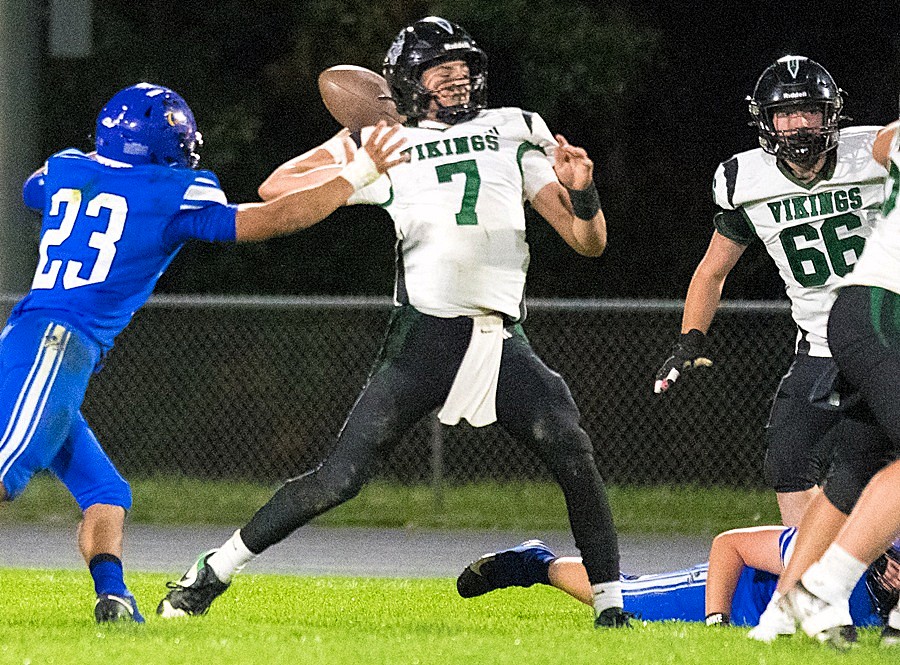
PHOTOS (Top) Detroit Cass Tech's Peyton Robinson (10) attempts to pull away from King's Gerald Thomas (34). (Middle) Grayling's Jaden Peters (7) winds up to throw a pass during his team's 42-0 win at Bath. (Cass Tech/King photo by Olivia B. Photography. Grayling/Bath photo by TCP Photography.)