

St. Mary Erases Doubts, Ends Ithaca Run
November 28, 2014
By Bill Khan
Special for Second Half
DETROIT — The players and their coach insisted they were playing for their own glory, not to deprive Ithaca of further greatness.
Monroe St. Mary would've savored an MHSAA Division 6 football championship regardless of the opponent, regardless of the historical backdrop.
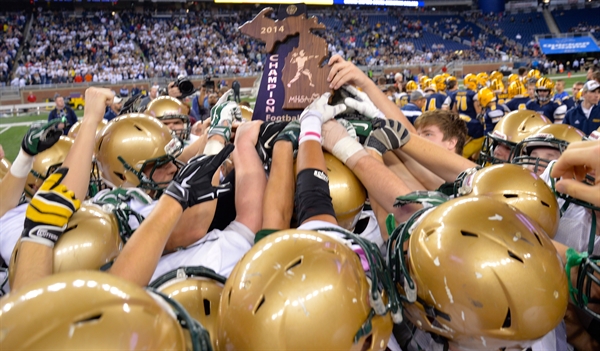
But when the clock expired on the Falcons' 22-12 victory over Ithaca on Friday at Ford Field, once they'd secured their first title since 1991, there was a little extra pride among the St. Mary players.
Yeah, it was pretty special to beat a team with a nation-leading 69-game winning streak and four consecutive Division 6 championships.
"At the beginning of the week, we didn't really think about that," St. Mary senior linebacker David Howey said. "The coach just kept preaching there's 48 minutes left in high school football. That's a pretty cool win, though, beating the nation's longest winning streak in high school football. It's pretty cool. When we told people that's who we were going to play, they'd doubt us, and that just fueled me even more."
There was also a bit of a revenge motive for St. Mary (13-1), which lost 45-35 in the Division 6 final when the Yellowjackets' string of MHSAA titles began in 2010.
"It makes it a little more sweet, but it's just awesome," said senior John Lako, who ran for two touchdowns and made seven tackles with a sack at linebacker. "I was actually at the game when we lost to them in 2010. Just to see they were that close, it feels like we finally wrote the end of the book."
Ithaca coach Terry Hessbrook hasn't had to deliver a postgame speech to his players following a loss since a 47-16 setback to Montague in a 2009 Division 6 Semifinal. From the start of 2010, the Yellowjackets assembled a winning streak that ranks 13th all-time in national high school football history. The streak included 24 consecutive playoff victories. Ithaca was trying to tie the record of five straight MHSAA titles shared by Farmington Hills Harrison (1997-2001) and East Grand Rapids (2006-10).
Ithaca had to come from behind in its previous two games just to keep the streak alive and return to Ford Field. The Yellowjackets trailed Madison Heights Madison 27-19 heading into the fourth quarter of the Regional Final before winning 41-27.
They made a stop on fourth down from the 4-yard line with 13 seconds left to preserve a 20-16 Semifinal victory over Boyne City, which took an early 14-0 lead.
"We've had maybe more talented teams, I'm going to be honest, and that's no knock on this football team," Hessbrook said. "But I've never coached a football team that has more heart and more resiliency, and that's going back to the teams we've had in the last four or five years. I don't care what team you put out there, this team will fight you every step of the way. I couldn't be more proud. We came up short. We missed a few opportunities. We came up a few plays short. One play in the kicking game, one play here or there on offense, we win that game, and we win it going away."
 Ithaca (13-1) had only three victories with a margin of fewer than 10 points during the winning streak. Missed extra points by opponents played a major role in two of those games, a 22-19 overtime victory over Montague in the 2011 Regional Final and a 21-20 victory over Montrose in a 2013 Semifinal.
Ironically, points after touchdown were critical in the outcome of Friday's championship game.
Monroe St. Mary's edge in conversions began following the first touchdown of the game, a 2-yard run by Lako that capped an opening drive that milked the first 8:15 off the clock. An off-sides penalty by Ithaca on the extra point attempt moved the ball close enough to the goal line to make a two-point attempt more feasible. Justin Carrabino ran untouched around the right side to give St. Mary's an 8-0 lead.
Ithaca tried to make up the difference following its first touchdown, an 11-yard pass from Jake Smith to Spence DeMull with 9:20 left in the second quarter, but the two-point pass fell incomplete to leave St. Mary's up 8-6.
Special teams loomed even larger with 7:11 left in the second quarter when Troy Hilkens forced a fumbled punt return. The ball popped up to Travis Vuich, who returned it 19 yards for a touchdown. Phillip Lehmann's extra point made it 15-6.
"It was a great feeling," Vuich said. "The guys did their job on the punt filling the lanes. The ball just popped right up."
Ithaca found the end zone for a second time on a 2-yard run by Smith with 33 seconds left in the first half. The extra-point attempt hit the upright, leaving the Yellowjackets down by a 15-12 margin despite matching St. Mary's two touchdowns.
"I hope that all those young people who were standing on our sideline understand what a small margin for error there is when you play for a state championship and understand how much work goes into it," Hessbrook said.
An Ithaca offense that averaged 43 points a game wouldn't score again, as St. Mary came up with huge defensive stops in the second half.
On fourth-and-one from the St. Mary 21, Ithaca was stopped in the backfield by Justin LaPlante and finished off by Darius Marks for a 1-yard loss with 2:29 left in the third quarter.
Ithaca marched to St. Mary's 19 on its next possession, but Bryce Windham (also the Falcons' quarterback) intercepted a pass after a reverse.
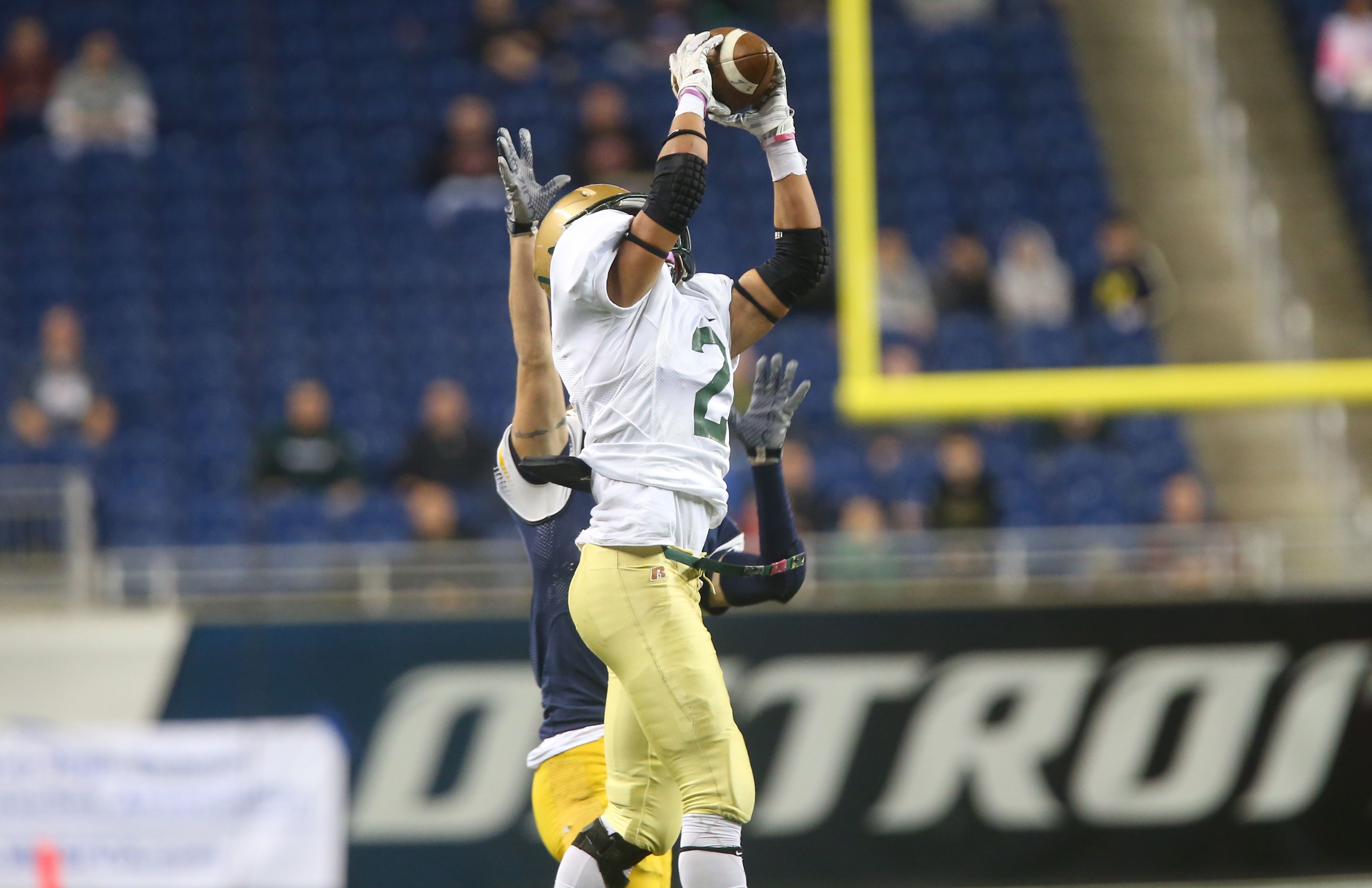
St. Mary's took over at its own 2-yard line with 10:19 remaining and was able to milk the clock down to 2:46 before punting. Ithaca got the ball at its own 20 for one final attempt to keep its winning and championship streaks alive. On second and 10, Lako sacked Smith for a 12-yard loss with 2:19 to go. On fourth-and-22, Marks intercepted a pass with 1:51 remaining and returned it to the 5.
Two plays later, Lako wrapped up the victory with a 3-yard touchdown run with 1:41 left.
Ithaca threw four incompletions on its final possession, and St. Mary kneeled out the clock.
"We won today because of our defense," St. Mary coach Jack Giarmo said. "Offensively, we struggled a little bit, but defensively the kids just did a fantastic job battling."
Ithaca outgained St. Mary, 262-182, but had three costly turnovers. Smith ran 18 times for 90 yards and a touchdown while completing 14 of 29 passes for 147 yards, one touchdown and one interception. DeMull caught nine passes for 108 yards and a touchdown.
Vuich made two clutch catches for first downs when St. Mary took 7:33 off the clock following Windham's interception. Vuich caught three passes for 38 yards, accounting for more than half of Windham's 71 yards on 7 for 12 passing.
LaPlante had nine tackles, including two for losses, to lead St. Mary's defense. Reeser had a game-high 12 tackles for Ithaca.
PHOTOS: (Top) Monroe St. Mary Catholic Central players raise their first MHSAA football championship trophy since 1991 on Friday. (Middle) St. Mary defensive back Darius Marks (2) snags an interception in front of an Ithaca receiver. (Click for action photos and team photos from Hockey Weekly Action Photos.)
VIDEO HIGHLIGHTS:
SMITH TO DEMULL FOR THE SCORE - Ithaca scores its first touchdown in the second quarter, with Jake Smith finding Spence DeMull in the end zone for the score.
FALCON FINDS GOOD FORTUNE - On its drive following the first Ithaca TD, Monroe St. Mary Catholic Central punts and a loose ball on the return finds its way into the hands of Travis Vuich, who took it 19 yards for what proved to be the winning points.
Watch the entire game and order DVDs by Clicking Here.
1st & Goal: 2025 Week 8 Preview
By
Geoff Kimmerly
MHSAA.com senior editor
October 16, 2025
A sense of urgency builds throughout the football regular season – and we’re right on schedule again this fall, although we might be reaching the peak even a little early with another week of games still to play.
 Week 8 has it all – a pair of matchups featuring undefeated teams with league titles on the line, several more winner-take-all championship showdowns, and of course plenty of games that could decide who’s in and who’s home when playoff brackets are plugged in Oct. 26.
In addition to following scores on the MHSAA Scores page and watching games on the NFHS Network, you’ll also want to keep a close eye this weekend on the Playoff Point Summary page as it will give you a real-time look at which teams are still in the hunt to continue playing in November.
Bay & Thumb
Davison at Grand Blanc WATCH
Grand Blanc took back the upper hand in this rivalry last season with a 55-49 win after Davison swept regular-season and playoff matchups in 2022 and 2023. These two easily could face off in the postseason again next month as well, but first this meeting will end either with Grand Blanc winning the Saginaw Valley League South outright or Davison claiming a share with one more league game to play. Neither has had a league game closer than 21 points this fall.
Keep an eye on these FRIDAY Harrison (6-1) at Gladwin (4-3), Elkton-Pigeon-Bay Port Laker (6-1) at Harbor Beach (7-0) WATCH, Freeland (6-1) at Frankenmuth (6-1) WATCH. SATURDAY Fenton (5-2) at Goodrich (7-0) WATCH.
Greater Detroit
Detroit Martin Luther King (5-2) vs. Detroit Cass Tech (7-0) at Ford Field WATCH
This will be the sixth season in a row these two will meet for a second time in a city championship game, and two of the last three seasons the series has ended in a split. Cass Tech won the first meeting this fall 27-22 in Week 4. That game was played over two days, with Cass Tech taking a 27-0 lead into the stoppage in the middle of the third quarter but King scoring all 22 points when the teams reconvened the following day.
Keep an eye on these FRIDAY Farmington (6-1) at Clarkston (6-1) WATCH, Grand Ledge (6-1) at Detroit Catholic Central (7-0), Detroit Pershing (5-2) vs. Detroit Denby (5-2) at Ford Field WATCH, Detroit Edison (6-1) at Ecorse (6-1).
Mid-Michigan
Howell (6-1) at Brighton (6-1) WATCH
For the second season in a row, these two will meet in the final week of Kensington Lakes Activities Association West play to decide some portion of the league championship. A year ago, Howell won 36-14 to finish an outright title, and then defeated the Bulldogs again 35-33 in a Division 1 District Final. This time, Brighton is undefeated in league play and Howell has a loss – but with the possibility of a Highlanders’ victory creating a three-way shared championship between these two and Northville.
Keep an eye on these FRIDAY Ithaca (6-1) at Fowler (5-2) WATCH, New Lothrop (5-2) at Ovid-Elsie (5-2), Charlotte (4-3) at Portland (7-0), Midland (4-3) at Mount Pleasant (7-0) WATCH.
Northern Lower Peninsula
Jackson Lumen Christi (4-3) at Traverse City St. Francis (6-1), Saturday
St. Francis is coming off its only loss, 63-38 to reigning Division 5 champion Pontiac Notre Dame Prep a week ago – but that also followed a pair of close wins that resulted in the Gladiators winning the Northern Michigan Football Conference Legends championship. Things obviously don’t get easier this week in this preview of a possible Division 6 playoff showdown. The reigning Division 6 champion Titans do have a win over Notre Dame Prep, 54-34 back in Week 2, and went on to share the Catholic High School League AA title.
Keep an eye on these FRIDAY Boyne City (5-2) at Charlevoix (7-0) WATCH, Sanford Meridian (5-2) at Ogemaw Heights (6-1) WATCH, Kingsley (5-2) at Kalkaska (5-2) WATCH, Beal City (7-0) at LeRoy Pine River (5-2).
Southeast & Border
Macomb Lutheran North (7-0) at Ann Arbor Father Gabriel Richard (7-0)
There are multiple league championship deciders in the southeastern part of the state this week, but this is one of only two matchups statewide of undefeated teams. The winner claims the CHSL Intersectional 1 title outright, with Lutheran North seeking to finish a third-straight perfect run through the league and FGR seeking its first perfect league run since 2009. The Mustangs have given up only 48 points this season, but might see its greatest challenge from a Fighting Irish offense that has scored at least 42 points in every game and at least 50 in six.
Keep an eye on these FRIDAY Monroe St. Mary Catholic Central (6-1) at Monroe Jefferson (7-0), Ypsilanti Lincoln (6-1) at Chelsea (6-1) WATCH, Temperance Bedford (4-3) at Saline (6-1) WATCH, Napoleon (5-2) at Michigan Center (7-0) WATCH.
Southwest Corridor
White Pigeon (6-1) at Decatur (5-2)
Although White Pigeon’s loss to Bronson last week took a bit of the punch out of this matchup, it’s still packed with possibilities. A Decatur win would give the Raiders an outright Southwest 10 Conference title, while a White Pigeon victory would create a three-way share among them. The Chiefs have won the last two meetings, including 14-6 a year ago, and had given up only 12 points over their first six games before allowing 32 to Bronson. Decatur defeated Bronson in Week 2, 26-20 in double overtime.
Keep an eye on these FRIDAY Hastings (5-2) at Coldwater (6-1) WATCH, Williamston (7-0) at Dowagiac (5-2) WATCH, Paw Paw (4-3) at Three Rivers (4-3) WATCH, Edwardsburg (6-1) at Vicksburg (4-3) WATCH.
Upper Peninsula
Menominee (7-0) at Kingsford (6-1) WATCH
This matchup has title implications in the Western Peninsula Athletic Conference Copper for the third season in a row, and is a winner-take-all for the second straight. Kingsford has won 18 straight league games, including 14-12 over Menominee a year ago, and the Flivvers’ only loss this season was 21-18 to Escanaba in their season opener. The Maroons haven’t played a game closer than 10 points this season and is seeking its first win over Kingsford since 2022.
Keep an eye on these FRIDAY West Iron County (3-3) at Bark River-Harris (5-1) WATCH, Gladstone (3-4) at Calumet (5-2) WATCH, Negaunee (4-3) at Houghton (2-5).
West Michigan
Grand Rapids Catholic Central (7-0) at Grand Rapids Northview (5-2)
Northview can’t catch Grand Rapids Catholic Central in the Ottawa-Kent Conference Black. But the Wildcats can break up the Cougars’ perfect season and prevent them from claiming the league title outright. Catholic Central claimed a share last week against Holland Christian and sits a game ahead of East Grand Rapids after winning their Week 4 meeting 10-7. Northview won last year’s matchup 12-3 on the way to claiming the O-K Black title outright, and bounced back from two midseason losses with a win over Grand Rapids Ottawa Hills last week.
Keep an eye on these FRIDAY Hudsonville Unity Christian (7-0) at Grand Rapids South Christian (4-3) WATCH, East Kentwood (5-2) at Grandville (4-3), Howard City Tri County (5-2) at Kent City (7-0) WATCH, Wyoming Kelloggsville (5-2) at Wyoming Godwin Heights (6-1).
8-Player
Merrill (6-1) at Blanchard Montabella (7-0) WATCH
Montabella has enjoyed some of its most consistent success the last two seasons and carries a 10-game league winning streak into this winner-take-all for the Mid-State Activities Conference Blue title. To repeat, the Mustangs must go through Merrill, which gave them their closest league game in 2024, a 20-12 win. The Vandals are seeking their first league championship since 2022 and could also see Montabella in the Division 1 playoffs.
Keep an eye on these FRIDAY Powers North Central (5-2) at Gogebic (7-0) WATCH, Waldron (5-2) at Pittsford (6-1) WATCH, Climax-Scotts (6-1) at Mendon (7-0) WATCH, Bridgman (6-1) at New Buffalo (7-0).
MHSAA.com's weekly “1st & Goal” previews and reviews are powered by MI Student Aid, a division within the Department of Lifelong Education, Advancement, and Potential (MiLEAP). MI Student Aid encourages students to pursue postsecondary education by providing access to student financial resources and information. MI Student Aid administers the state’s scholarship and grant programs that help make college Accessible, Affordable and Attainable for you. Click to connect with MI Student Aid and find more information on Facebook and Twitter @mistudentaid.
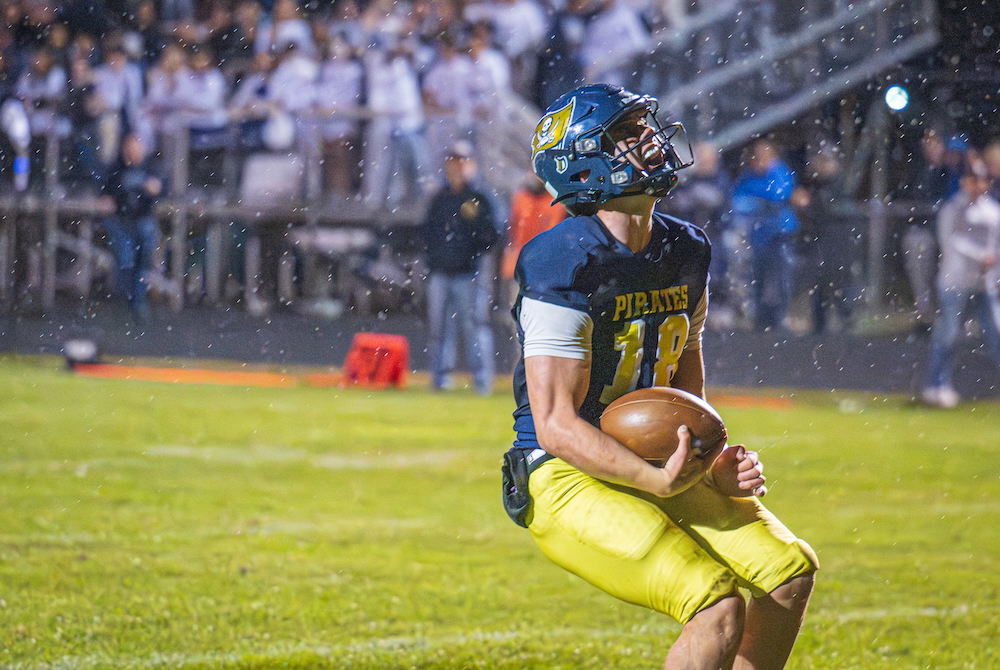
PHOTO As the rain falls, Pewamo-Westphalia's Ty Thelen celebrates a score during his team's win last week over Fowler. (Photo by Jim Pivarnik.)