

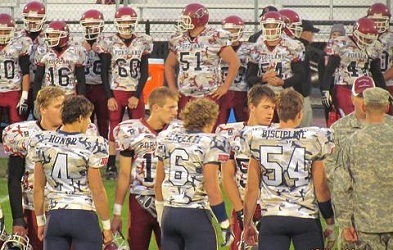
(VIDEO) Wounded Warrior Project: DeWitt vs Portland
October 13, 2011
DEWITT -- The meeting of two state-ranked teams always will ratchet up a typical football night. Both communities, naturally, want to see which is better on the field.
But during the hour before the opening kickoff Oct. 14 of DeWitt’s game against Portland, those teams and their supporters together recognized a grander cause. The night was dedicated to the Wounded Warrior Project, which aids U.S. soldiers (and their families) who have suffered service-related injuries and illnesses.
Rain washed out some planned attractions, but the evening certainly was memorable. Both teams wore camouflage jerseys and each sent its captains to the pre-game coin toss with an honorary captain representing the military. A number of other service personnel were involved – including a local color guard that presented a 30-foot flag for the national anthem.
It’s understandable if people’s visions of wars and our military are focused an ocean away. But connections hit close to home. DeWitt’s honorary captain, Lansing’s U.S. Army Spc. Jacob Shumway, recently returned from a deployment and has been in the service for two and a half years. He’s a 2003 Lansing Everett graduate, and his mother Susan Land is the principal at Lansing Eastern. His cousins Ethan and Collin Rennaker start for DeWitt, and he walked alongside them for the pregame flip. Shumway plans to attend Lansing Community College and study digital graphic design.
Both teams are considered contenders for their respective state titles next month; DeWitt is ranked No. 7 in Division 3, while Portland is No. 4 in Division 5. And they played like it – Portland prevailed 22-20 in overtime.
A great game, no question. But similarly significant was a preliminary figure of more than $11,000 raised for the WWP.
For more about the Wounded Warrior Project visit http://www.woundedwarriorproject.org.
NFHS: Reserve Fridays for HS Football
August 9, 2017
Special from NFHS
In an effort to re-emphasize that Friday nights in the fall should be reserved for high school football, the National Federation of State High School Associations (NFHS) has adopted a resolution that urges schools and teams at the college and professional levels to honor that longstanding tradition and schedule games on other days.
The NFHS membership, composed of state high school associations in the 50 states plus the District of Columbia, has adopted the following resolution:
“Be it RESOLVED that every Friday night during the fall in America is ‘High School Football Night.’
“Be it FURTHER RESOLVED that college and professional football teams should refrain from scheduling contests on Friday nights. Such restraint would be an investment in their own future success. It would also demonstrate that high school football has value well beyond the field of play. Schools, communities and scholastic teams for girls and boys all benefit when football is strong.
“THEREFORE, the National Federation of State High School Associations urges all parties to observe the central premise of this resolution.”
Although some major college football games have been played on Friday nights for about 20 years, the numbers continue to increase. This year, more than 50 major college football games will be played on Friday nights, including eight on Sept. 1 – the Friday night before Labor Day weekend. Most recently, the Big Ten Conference joined a growing number of conferences that has scheduled a handful of games on Friday nights.
“The value of tradition cannot be understated,” said Bob Gardner, NFHS executive director. “Friday nights offer communities a traditional time and place to congregate and support their students. If a major college football game was scheduled in the area on a Friday night, it could affect attendance at the high school game or cause the game to be moved to another day. In addition, many of the Friday night college games are televised, which could result in lower attendance at high school contests nationwide.
“We believe retaining Friday nights for high school contests is a plus for colleges as well, as they reap the benefits of healthy programs at the high school level.”