

Young to Lead BCAM's Next Generation
By
Tom Markowski
Special for Second Half
November 30, 2018
PLYMOUTH – The Basketball Coaches Association of Michigan recently celebrated its 42nd year – and starting Jan. 1, BCAM will welcome just its fourth executive director.
 Tom Hursey, 74, will step down as executive director and hand the gavel over to Dan Young, Hursey’s assistant since 2010.
Young, 50, has been on the BCAM Board of Directors since 1999 and a BCAM member since 1994. He was a boys varsity head coach for 15 years spread over three schools and most recently coached the girls program at Salem (2016-18). He also coaches the boys and girls golf teams at Plymouth.
BCAM got its start in the early 1970s when Hursey, then the boys varsity head coach at Midland High; Ron Vondette, then the boys varsity coach at Carrollton; and other coaches in the Midland-Saginaw area formed the Mid-Michigan Basketball Coaches Association. Hursey and Vondette quickly learned that coaches throughout the state were interested in forming an association, and in 1976 the Michigan High School Basketball Coaches Association was formed. Seven years later, the name changed to what it is known as today – BCAM.
The goal of BCAM and its members is simple – to improve and help the sport grow at all levels.
But the challenges Young faces are quite different from those Hursey confronted when he became executive director in 1997. College recruiting has intensified over the past 20 years, and student-athletes transferring from one high school to another also has become more of a concern for BCAM and the Michigan High School Athletic Association.
In addition, Young said there are other topics his association is currently addressing.
“The buzz right now is seeding,” Young said. “And there’s a committee looking at adding two more games to the season, over the holidays (teams are currently limited to 20 regular season games). Tom and I will meet with (a representative from) the MHSAA to discuss the June camps.”
Though just in its preliminary stages, BCAM, in cooperation with the MHSAA, is seriously considering sponsoring a one-day camp for the top players in the state regardless of class. This is in response to the recommendations made last April by a commission led by Condoleezza Rice, the former U.S. Secretary of State, to aid college coaches in the recruitment of student-athletes. Simply put, the NCAA is attempting to limit how much influence AAU basketball has on the recruitment of high school students, and thereby allow high school coaches to have more influence over their players.
These camps, like the MHSAA/BCAM-sponsored Reaching Higher, allow a large number of players, often more than 100, to receive coaching from high school coaches with college coaches in the gym to evaluate. These also feature speakers who address topics such as entrance tests and what it takes to succeed at the next level, academically and athletically.
Young said the next version could be a two-day event, but he does have some concerns.
“We don’t want to disrupt team camps,” he said. “We’d like to run it with the culture of a team camp. It’s still in its early stages, but I think we’d like to get the top 100 or so players, those that are Division I type of players, and have coaches like (Michigan State coach) Tom Izzo, (Michigan coach) John Beilein, Greg Kampe from Oakland and others be there. Maybe it’ll lasts eight hours. Maybe six. We’d have guest speakers, too.
“It’s possible we’d only invite 60 or 70. We’d take the seniors being recruited by Division I schools, as well as the juniors and sophomores.”
 The camp discussion is an example of why the transition is sure to be a smooth one. Hursey and Young are of one mind on the vast majority of issues BCAM faces. Though a generation apart, they see eye-to-eye on matters of importance. They discuss which battles should be fought and those they should avoid.
In many ways the transition is similar to that which took place within the MHSAA recently with Mark Uyl taking over for Jack Roberts as executive director. Uyl, 25 years Roberts’ junior, has stated that Roberts has left a legacy, and that he hopes to follow up on that legacy.
“Now that Mark Uyl has taken over, like Dan, a new generation has taken over,” Hursey said.
Hursey and Young are hoping seeding will be introduced within the boys and girls tournaments in the next year or two.
On the subject of transfers, Hursey and Young support the new rule instituted by the MHSAA, which states, in part, that a student who transfers will be ineligible for one full school year at the new school in any sports she or he participated in the previous year at the former school (but eligible immediately in all other sports).
Another concern with regard to transfers is the increasing numbers of top-level players leaving the state and enrolling at prep schools, like Findley Prep in Nevada and others. The most recent top player is Mark “Rocket” Watts who left Old Redford Academy in Detroit and is now enrolled at Spire Academy in Ohio. Watts was considered one of the top candidates for the Mr. Basketball Award, sponsored by BCAM.
Beyond educating players and coaches, and possibly parents, Hursey and Young say there’s little they can do from preventing parents from taking their child out of state.
“It’s a sign of the times,” Hursey said. “Dan and I met with Izzo and we talked for two hours about this. Izzo opened our eyes about it. Take the Old Redford (student). They offer him a beautiful dorm to live in, three square meals and the chance to travel around the country. How are we supposed to compete with that? Izzo said they’re playing 30-to-40 games but that only 10 or so are against the best teams. Those are the ones you see on TV.
“There are a lot of positives for staying with your high school. There’s a lot to be said about high school sports being played at a certain level. And there’s nothing like a Friday night basketball game played in front of 2,000 fans and the place rocking. We just have to keep with what we’re doing. We have to educate the coaches. Some of these fly-by-night operations don’t concentrate on the academic part of school. Yeah, we might lose some of our best players, but there are a lot of good players in this state and there still is great basketball being played. This is not just happening in Michigan. We met with the National (High School) Basketball Coaches Association. It’s a problem throughout the country. How can we compete with millionaires?”
Young said BCAM will continue to do what it does best, and that’s to serve coaches throughout the state and promote and help to improve the game through its many clinics and camps. The website, www.bcam.org, has been improved and updated recently, and provides members and nonmembers alike valuable information.
 Tom Markowski is a correspondent for the State Champs! Sports Network and previously directed its web coverage. He also covered primarily high school sports for the The Detroit News from 1984-2014, focusing on the Detroit area and contributing to statewide coverage of football and basketball. Contact him at [email protected] with story ideas for Oakland, Macomb and Wayne counties.
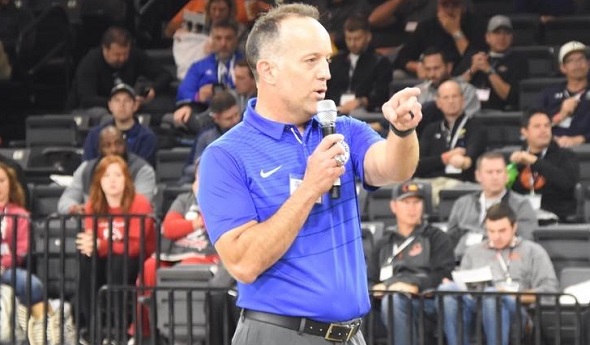
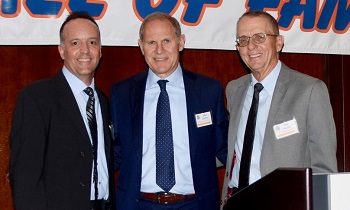
PHOTOS: (Top) Incoming BCAM executive director Dan Young speaks during an event. (Middle) Young and longtime BCAM executive director Tom Hursey, far right, with University of Michigan men’s basketball coach John Beilein. (Photos courtesy of Dan Young.)
Jenna Maki Show Opens Ishpeming's Breslin Run to Rave Reviews
By
Keith Dunlap
Special for MHSAA.com
March 21, 2024
EAST LANSING — It was the Jenna Maki Show in the first Division 4 Semifinal at Michigan State University’s Breslin Center on Thursday.
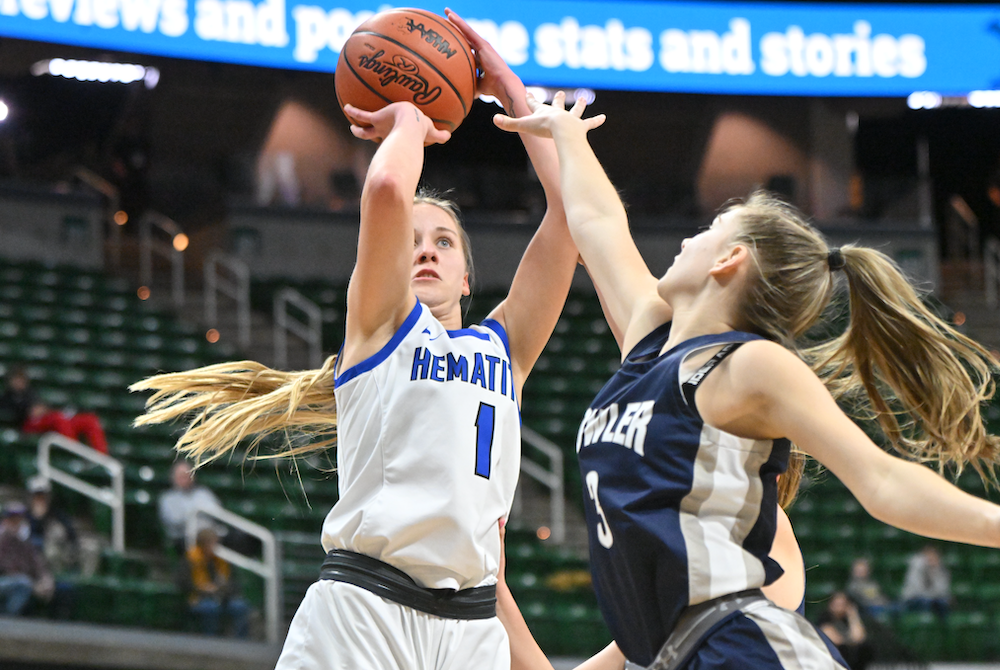
The Ishpeming senior put on quite a display, scoring a game-high 30 points for the Hematites in a 75-40 defeat of Fowler.
For most of the game Maki was keeping scoring pace with the Eagles by herself. She had 22 points at halftime to Fowler’s 19, and 29 points at the end of three quarters to Fowler’s 27.
The 5-foot-10 guard sat for most of the fourth quarter, finishing 11 of 22 from the field and 7 of 11 from the free-throw line.
“Obviously watching film and breaking down what they do as a defense and their whole game, we all did that together as a team,” Maki said. “I just tried to play as hard as a I could to break through.”
Maki eclipsed 1,000 career points earlier in the year, and with her last point Thursday became the school’s all-time leading scorer. Ishpeming head coach Ryan Reichel credited her with making a major transformation before the season started – one that has helped Ishpeming advance to a championship game for the first time.
“She changed as a player,” Reichel said. “She went from a me player to a we player over this past summer. We’re not in this position without her change as an athlete.
“She started on varsity all four years, and we’ve often had to look to her to do everything. She went from wanting to score 1,000 points to wanting to play in the Breslin Center.”
 Fowler has been to the Semifinals five straight seasons and has played several great players at Breslin Center. But head coach Nathan Goerge admitted Maki stood out.
“(Maki) is a special player, and we knew it from watching film,” Goerge said. “We had a difficult time containing her. Our help defense struggled a little bit. When you go up against someone like that, it’s usually a recipe for disaster.”
In addition, Ishpeming’s full-court pressure defense wreaked havoc all game on Fowler, forcing the Eagles into 34 turnovers.
“When you only get one day (between Quarterfinals and Semifinals), it’s really hard to mimic the chaos we provide,” Reichel said.
Sophomore Jenessa Eagle flanked Maki by scoring 14 points for Ishpeming (27-1) which will try and complete its dream season in the championship game at 10 a.m. Saturday.
Ishpeming hadn’t won a Regional title since 1974 before this run, and Reichel said his team has tried to pay tribute to that 1974 team in several ways.
Reichel said those players weren’t awarded a trophy from administrators back in 1974, so members of that team helped accept the trophy when this year’s squad won its Regional last week.
“They were able to get pictures with this team and kind of relive that journey that they deserved 50 years ago,” Reichel said. “They deserved that more than anybody. Now, they are living through our kids. They are ingrained on this team and are a part of this with us.”
Despite Fowler playing its fifth-straight Semifinal and Ishpeming appearing in its first since 1974, Ishpeming certainly didn’t show signs of jitters from the opening tip, jumping out to a 16-4 lead midway through the first quarter.
Ishpeming eventually held a 23-6 lead when the quarter was over, making 10 of its 20 shots from the field and forcing 11 Fowler turnovers over the first eight minutes.
The Hematites continued to grow the lead during the second quarter, taking a 42-17 lead with 51 seconds remaining until halftime.
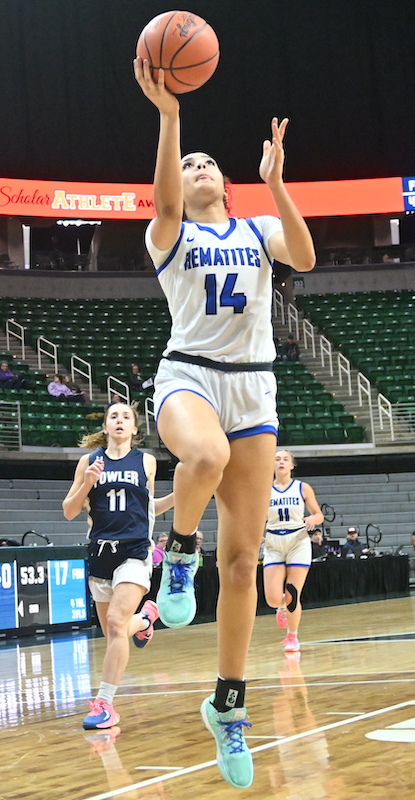
PHOTOS (Top) Ishpeming’s Jenna Maki (1) puts up a shot over the outstretched arm of Fowler’s Sage Myers. (Middle) Mya Hemmer (14) finishes a break for the Hematites. (Photos by Hockey Weekly Action Photos.)