


Be the Referee: Abnormal Course Condition
By
Paige Winne
MHSAA Director of Brand Management
October 1, 2024
Be The Referee is a series of short messages designed to help educate people on the rules of different sports, to help them better understand the art of officiating, and to recruit officials.
Below is this week's segment – Abnormal Course Condition - Listen
We’re on the golf course today and our approach into 18 has gone from bad to worse. Or has it?
Our shot lands in a puddle, in the middle of a bunker, which certainly isn’t good. But because water in a bunker is an abnormal course condition, we’re allowed free relief.
We’re able to go to the nearest spot of relief, no closer to the hole, and drop within a club’s length of that spot while still playing from the bunker.
Or relief can be taken outside of the bunker, no closer to the hole, and within line of the shot – but a penalty stroke is added.
So you have two options if you find water inside a bunker; only one requires you to take a penalty stroke.
Of course the best course of action is to avoid the bunkers all together!
Previous 2024-25 Editions
Sept. 25: Tennis Nets - Listen
Sept. 18: Libero - Listen
Sept. 10: Cross Country Uniforms - Listen
Sept. 3: Soccer Handling - Listen
Aug. 24: Football Holding - Listen
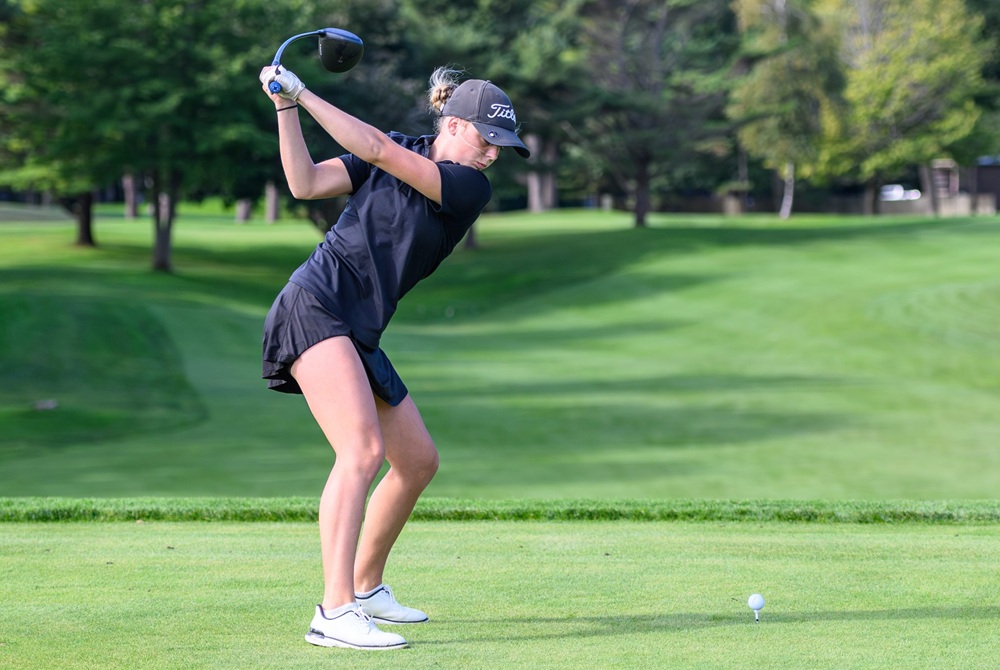
Performance of the Week: Muskegon Reeths-Puffer's Sophia McCollum
October 2, 2026

Sophia McCollum ♦ Muskegon Reeths-Puffer
Senior ♦ Golf
McCollum, the reigning Lower Peninsula Division 2 individual champion, won the Greater Muskegon Athletic Association individual title Sept. 22 for the third-straight season. She carded a 77 to also lead Reeths-Puffer to the team victory as the Rockets scored a 354 to outpace runner-up Montague by six strokes.
After tying for 17th as a sophomore, McCollum won last year’s LPD2 Final by four strokes and is gearing up for her team’s Regional on Tuesday at Lincoln Golf Club in Muskegon. She will be continuing her golf career at the college level but has not publicly announced where at this time; she is interested in studying nursing or education at that next destination. She’ll also be returning to the track for the Rockets next spring after taking last season off but running primarily middle distance as a freshman and sophomore.
@mhsaasports ⛳️🏌️♀️ POW: Sophia McCollum #ReethsPuffer #Golf #Champion #PerformanceOfTheWeek #MHSAA @sophia.mccollum1 @sophiamccollumgolf ♬ original sound - MHSAA
@mhsaasports ⛳️ POW: Sophia McCullom #TikTalk #FunFacts #Golf #PerformanceOfTheWeek #MHSAA @sophia.mccollum1 @sophiamccollumgolf ♬ original sound - MHSAA
Follow the MHSAA on TikTok.
MHSAA.com's "Performance of the Week" features are powered by MI Student Aid, a division within the Department of Lifelong Education, Advancement, and Potential (MiLEAP). MI Student Aid encourages students to pursue postsecondary education by providing access to student financial resources and information. MI Student Aid administers the state’s 529 college savings programs (MET/MESP), as well as scholarship and grant programs that help make college Accessible, Affordable and Attainable for you. Connect with MI Student Aid at www.michigan.gov/mistudentaid and find more information on Facebook and X @mistudentaid.
Past 2026-27 honorees
Sept. 25: Jenna Middleton, Kingsley volleyball - Read
Sept. 18: Caden Livermore, Grandville cross country - Read
(Action photo courtesy of the Local Sports Journal.)