

History in the Making - New and Old
By
Geoff Kimmerly
MHSAA.com senior editor
October 24, 2013
Last week’s MHSAA Lower Peninsula Girls Golf Finals marked the 42nd anniversary of the association’s sponsorship of the sport, and we've been researching some of the first and finest performances from the tournament's history – coincidentally, as a current player added a small touch with a big shot Saturday.
 Read on to learn more about that feat and the first team to hoist an MHSAA girls golf championship trophy. And speaking of trophies, we've also got the story behind one of the oldest football traveling prizes still making the rounds in the Upper Peninsula.
An Ace Arrives
Fenton’s Madi Shegos finished her 2013 Finals by making history at Michigan State’s University’s Forest Akers East, a frequent MHSAA Finals site over the last two decades.
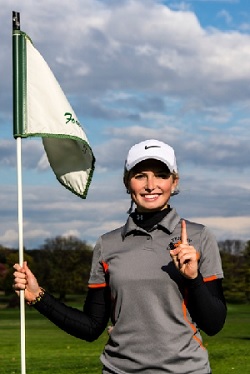 The course redesigned its 18th hole from a short par-4 to a par-3 this season. And Shegos became the first to score it a hole-in-one, doing so during the second round of the Division 2 Final.
Retired longtime East Lansing coach George Jones, also a longtime assistant at the Finals and the taker of the photo at right, added: “Madi Shegos did something almost every golfer around the world never gets a chance to do or if given the chance, doesn't do.
“Sure, every par three at Forest Akers and nearly every other par three around the world has had an ace, but on Friday Madi was the very first to accomplish this on the newly-constructed 18th hole on the East Course. No one else will ever be the first. This honor goes to Madi Shegos, a sophomore at Fenton High School.”
Shegos improved six strokes during her second round to shoot a 103 on Saturday as Fenton finished fifth in Division 2 for the second straight season.
First to Reign
Although Lower Peninsula girls golf was played during the spring for its first 35 years, and Upper Peninsula girls golf remains in the spring to this day, the first girls MHSAA championship tournament actually took place during the fall of the 1972-73 school year – with Pickford claiming the first title by winning the Upper Peninsula Final by three strokes over Escanaba on an October day at Lake Bluff Country Club.
Thanks to some quick work by Pickford athletic director Chuck Bennin and one of the four players on that championship team who now teaches at the high school, we'll soon be adding results of that tournament to our growing archives at MHSAA.com.
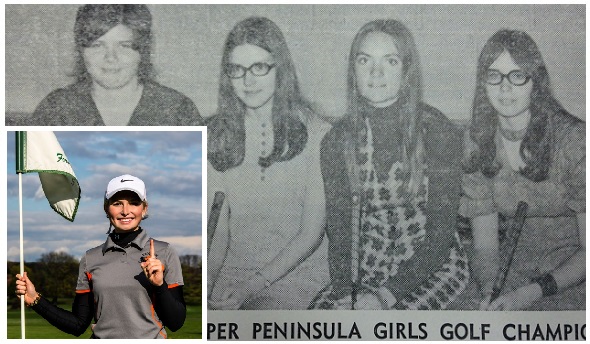
Here's a quick flashback from that inaugural 9-hole event: The Panthers were led by Patsy Nayback’s 49, which was good for second place individually. Joni Hamilton and sisters Bonnie and Kathleen MacDonald rounded out the lineup and are pictured above. Ishpeming’s Marge Farley shot a 44 to finish as medalist.
Another fun fact from that October day: The Escanaba Daily Press reported that in the boys MHSAA Final, Pickford’s Kevin Hamilton recorded an eagle on the par-5, 472-yard third hole, with his second shot running through a sand trap, up the green and into the cup.
The Lower Peninsula Girls Finals teed off for the first time the following spring, with Bloomfield Hills Lahser defeating East Grand Rapids by a stroke at Grand Ledge’s Troy Hills Golf Course.
Wanted: More Finals Archives
For the majority of MHSAA sports, we’ve published on MHSAA.com results, box scores, etc., for most of our Finals dating to at least the late 1990s. For years prior, we've begun filling in with what we can gather from our formerly-published Books of Champions and MHSAA Bulletins.
But realizing there are complete copies of results out there in scrap books, trophy cases, newspaper archives and the like, we’d love to gather as many as possible to add to the site.
If you’ve got results from an MHSAA Finals in any sport that aren't showing at MHSAA.com or that can augment our current collection, please email me at [email protected].
First of many
Certainly the most prevalent prize awarded for winners of Michigan’s high school football trophy games is some version of a “little brown jug.” And this weekend, the oldest of the jugs will be on the line when Newberry faces Sault Ste. Marie.
They first played for the trophy in 1925, with the original jug replaced by the current version in 1934. Sault Ste. Marie leads the series 58-33-5 including 46-28-5 in games for the Jug.
Below is an excerpt from a brief history of the trophy researched by Ron Pesch:
In the state’s Upper Peninsula, Newberry High School first played Sault Ste. Marie on the gridiron in 1911 and, for the most part, they have squared off annually since 1923. To commemorate the battle between these schools, legend has it that in 1925, a Newberry druggist donated a Jug to serve as a trophy. The prize was to be retained by the winning team until the next meeting would determine ownership. The idea, of course, came from the Michigan-Minnesota rivalry.
In 1934, for reasons unknown, a new jug debuted. Fittingly, that game between the rivals ended in a 7-7 tie.
Over the years, the rivalry has generated many classic contests between the larger school from the Soo and the smaller Newberry district. The series was interrupted in 1940 and 1959, and then went on a five-year hiatus between 1999 and 2003. As school officials recognized the importance of the series to the residents of the area, the rivalry was resumed in 2004 when the Blue Devils joined Newberry in the Straits Area Conference.
PHOTOS: (Background) The members of the 1972 Pickford girls golf team, as they appeared in the January 1973 MHSAA Bulletin. (Foreground and below) Fenton’s Madi Shegos stands with the flag after drilling the first hole-in-one at the redesigned No. 18 at Forest Akers East during last weekend’s Lower Peninsula Division 2 Final.
Century of School Sports: Everything We Do Begins with Participation
By
Geoff Kimmerly
MHSAA.com senior editor
March 5, 2025
For 100 years the MHSAA and its member schools have trumpeted the many benefits of educational athletics. The list of positive reasons to play has only grown.
But every idea and effort to make school sports excellent starts with one underlying theme that has served as a primary motivation from the beginning:
Participation.
The MHSAA long has been driven by a desire to see as many students participate in sports as possible, within a framework of rules that intentionally makes that opportunity so valuable that playing for the school team becomes the dream for thousands of kids all over our state.
And MHSAA member schools have a long history of succeeding at that mission.
A few comparisons and a decent share of context are necessary to explain how. We will dive into some numbers, but these two points sum up the story:
The total number of high school students in Michigan has been shrinking annually over several years – high-school aged population in this state is down 21 percent since 2006-07. But the numbers of students playing sports at MHSAA schools has grown three straight years and has declined by only 13.5 percent over the same stretch of time.
Michigan participation in high school sports annually outpaces where it ranked nationally in high school-aged population. We may have fewer students than some states, but more of them are playing more sports for their schools.
How do we know all this?
Every spring since 1971, the MHSAA has reported how many athletes from member schools participate – by sport – as part of a survey from the National Federation of State High School Associations (NFHS). Those numbers are crunched by the NFHS for all 50 states and Washington, D.C., and over the last several years the MHSAA has taken that data and then compared how Michigan participation stacks up to state populations of people aged 14-17.
(The NFHS collects data on all school sports, whether they receive state association sponsorship or not. Participants also are counted once for every sport they participate in, so two-sport athletes are counted twice, three-sport athletes are counted three times, etc.).
For this narrative’s sake, let’s start with the 1977-78 school. By then, several girls sports had begun to receive MHSAA sponsorship and also had a few years to get established and grow. For that school year, the MHSAA reported 242,616 participants. Just under a decade later, for 1985-86, that total had grown to 265,227 (and a few more girls sports had been added), and those totals continued to rise during the 1990s reaching 295,858 in 2000-01.
A key high point came in 2006-07, when the MHSAA reported 320,479 total participants in all sports at member schools including 313,093 in MHSAA-sponsored sports. The grand totals then shifted downward slowly once again – but in proportion to falling student enrollment at MHSAA member schools, which has dropped nearly 113,000 students (21 percent) since that notable year. It’s also fair to make an educated guess – because students are counted once for every sport played – that a trend toward sport specialization also affected those numbers to some degree.
Fast forward to today. For the 2023-24 school year, there were 270,664 participants in MHSAA sports, plus another 19,920 in sports not sponsored by the association (weight lifting, etc.). So while Michigan hasn’t approached 300,000 participants in more than a decade, the total for MHSAA sports this past year was only 13.5 percent fewer than that 2006-07 season – again, compared to 21-percent fewer students at those schools. And the even better news? Participation has increased three straight years coming out of the COVID-19 pandemic.
Another telling comparison is how Michigan participation continues to compare nationally.
Going back to at least the 2012-13 school year – not counting 2019-20 and 2020-21, when the NFHS survey was suspended because of COVID-19’s effect on school sports – Michigan consistently has ranked either seventh or eighth in participation nationally, falling past that ranking only once to ninth. For 2023-24, Michigan ranked eighth for participation.
Meanwhile, Michigan ranked ninth nationally for high school-aged population from 2012-13 through 2015-16 before sliding into its current 10th spot on that list. So for this past school year, participation at MHSAA member schools ranked two spots ahead of its ranking for high school-aged population.
The first step to receiving the benefits of school sports is getting out there and playing them. And Michigan high schoolers are continuing to do so – both at rates that compare well historically over the last 50 years, and compared to states across the country of similar sizes. This has long been a point of MHSAA pride, and will continue to be a primary focus of its work.
Previous "Century of School Sports" Spotlights
Feb. 25: Slogans & Logos Remain Unforgettable Parts of MHSAA History - Read
Feb. 19: MHSAA Tickets Continue to Provide Fan-Friendly Value - Read
Feb. 11: We Recognize Those Who Make Our Games Go - Read
Feb. 4: WISL Conference Continues to Inspire Aspiring Leaders - Read
Jan. 28: Michigan's National Impact Begins at NFHS' Start - Read
Jan. 21: Awards Celebrate Well-Rounded Educational Experience - Read
Jan. 14: Predecessors Laid Foundation for MHSAA's Formation - Read
Jan. 9: MHSAA Blazes Trail Into Cyberspace - Read
Dec. 31: State's Storytellers Share Winter Memories - Read
Dec. 17: MHSAA Over Time - Read
Dec. 10: On This Day, December 13, We Will Celebrate - Read
Dec. 3: MHSAA Work Guided by Representative Council - Read
Nov. 26: Finals Provide Future Pros Early Ford Field Glory - Read
Nov. 19: Connection at Heart of Coaches Advancement Program - Read
Nov. 12: Good Sports are Winners Then, Now & Always - Read
Nov. 5: MHSAA's Home Sweet Home - Read
Oct. 29: MHSAA Summits Draw Thousands to Promote Sportsmanship - Read
Oct. 23: Cross Country Finals Among MHSAA's Longest Running - Read
Oct. 15: State's Storytellers Share Fall Memories - Read
Oct. 8: Guided by 4 S's of Educational Athletics - Read
Oct. 1: Michigan Sends 10 to National Hall of Fame - Read
Sept. 25: MHSAA Record Books Filled with 1000s of Achievements - Read
Sept. 18: Why Does the MHSAA Have These Rules? - Read
Sept. 10: Special Medals, Patches to Commemorate Special Year - Read
Sept. 4: Fall to Finish with 50th Football Championships - Read
Aug. 28: Let the Celebration Begin - Read