

Be the Referee: Track & Field Exchange Zones
By
Sam Davis
MHSAA Director of Officials
May 16, 2023
Be The Referee is a series of short messages designed to help educate people on the rules of different sports, to help them better understand the art of officiating, and to recruit officials.
Below is this week's segment – Track & Field Exchange Zones - Listen
Let’s work in an exchange zone today – and see how much we know about this area during relay races at track & field events.
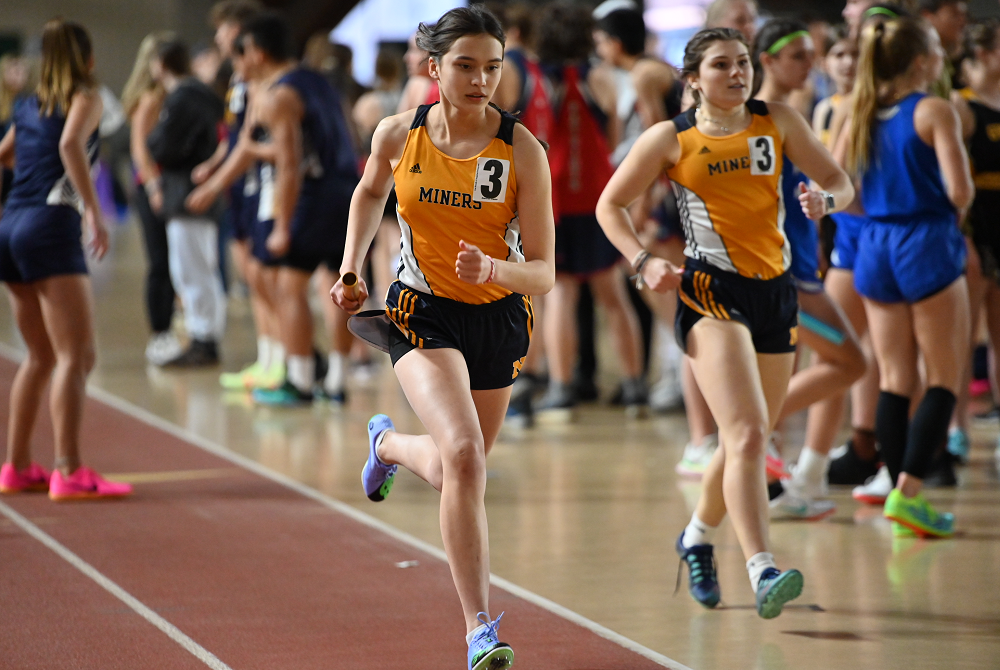
First: Exchange zones are now 30 meters in length. Previously, they were 20 meters with a 10-meter acceleration zone. But now, it’s just one 30-meter area. Runners must start inside the zone.
Now, what happens if the baton is dropped during an exchange? There are a couple of outcomes:
► If the baton is passed or dropped outside of the exchange zone – that relay team is disqualified.
► If the baton is dropped inside the zone, the runner can pick it up and re-join the race.
► If it’s dropped inside the zone but rolls out of the zone, either runner can retrieve it, return to the exchange zone and then restart his or her race – provided they don’t interfere with an opponent.
Previous Editions:
May 9: Girls Lacrosse Self-Start - Listen
May 2: Baseball/Softball Overthrow - Listen
April 25: Fifth-Quarter/Third-Half Rule - Listen
April 18: Soccer Referee in Play? - Listen
April 11: Softball Strikeout - Listen
March 14: Basketball Instant Replay - Listen
March 7: Hockey Overtime - Listen
Feb. 28: Baker Bowling - Listen
Feb. 21: Ski Finish - Listen
Feb. 14: Swimming Touchpads - Listen
Feb. 7: In or Out-of-Bounds in Wrestling - Listen
Jan. 31: Over the Back - Listen
Jan. 24: Competitive Cheer Judges - Listen
Jan. 17: More Lines - Listen
Jan. 10: On the Line - Listen
Jan. 3: Basketball Measurements - Listen
Dec. 13: Pregame Dunks - Listen
Dec. 6: Gymnastics Judges - Listen
Nov. 22: Football Finals Replay - Listen
Nov. 15: Back Row Illegal Blocker - Listen
Nov. 8: Swim Turn Judges - Listen
Nov. 1: Soccer Referee Jersey Colors - Listen
Oct. 25: Cross Country Tie-Breaker - Listen
Oct. 18: Soccer Shootouts - Listen
Oct. 11: Safety in End Zone - Listen
Oct. 4: Football Overtime Penalty - Listen
Sept. 27: Kickoff Goal - Listen
Sept. 20: Soccer Timing - Listen
Sept. 13: Volleyball Replays - Listen
Sept. 6: Switching Sides - Listen
Aug. 30: Play Clock - Listen
Aug. 23: Intentional Grounding Change - Listen
PHOTO: Negaunee's Nori Korsman gets the handoff from teammate Olivia Lunseth to run the third leg of the winning 1,600 relay at April's Superior Dome Invitational. (Photo by Cara Kamps.)

Senior Standout Aiming to Add to Grass Lake & Family Fame
By
Doug Donnelly
Special for MHSAA.com
August 17, 2021
GRASS LAKE – What will Lexus Bargesser do for an encore?
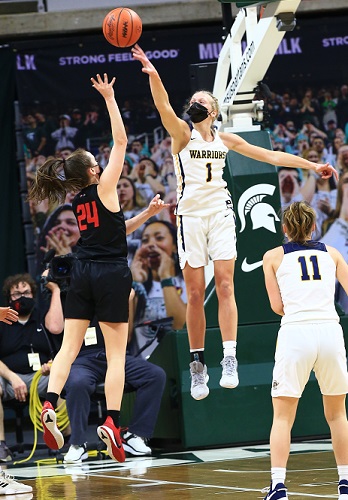
 The Grass Lake senior had an unbelievable junior year, leading the Warriors to their first-ever MHSAA Finals basketball championship, in Division 3, then winning three events to pace Grass Lake’s team title at the Lower Peninsula Division 3 track & field championship meet. She spent her summer on the basketball circuit, traveling the country to compete against top competition.
As she embarks on her senior year of high school, Bargesser is looking forward to having fun, working hard – and bringing home more hardware.
“It was pretty amazing,” she said this summer. “Everything came together and worked out.”
The Bargesser family certainly could have been called the first family of Grass Lake sports over the last few years – in the least for track & field – and Lexus is likely to add a few more highlights during 2021-22. She won’t play a sport for Grass Lake this fall as she’s prepping for basketball season and a hopeful encore to last winter’s achievement. But next month she will begin making college visits and could make a decision before the 2021-22 basketball season begins.
“I don’t really have a timeline,” she said. “I’m looking forward to the season and helping the younger girls on the team grow. I’m excited for it.”
Grass Lake’s Bargesser surge began with 2020 grad Xavier, who’s currently playing basketball at Alma College.
Second-oldest Brennen Bargesser made a splash last school year as a senior both on the basketball court and track, during the spring winning three individual events and running on a first-place relay to lead the boys team to a Finals title as well.
 “My older brother and my younger sister are insane athletes,” Brennen said. “I’m the middle child and just wanted to make a name for myself.”
Lexus Bargesser had won the 100 and 200 dashes as a freshman at the 2019 Finals, then burst onto the national prep basketball scene with an amazing summer that saw colleges from across the country start offering her scholarships.
Their parents also are part of the mix. Father David Bargesser coached the Warriors boys basketball team last season and was an assistant to the girls team. Mother Lori Bargesser was the scorekeeper for the boys team.
Sports is the common bond that links the entire family.
“We’re a really close family,” Lori said. “We’ve always just played sports. That’s what we did. We were in the yard from the time I can remember.”
David, who played basketball and golfed in college, and Lori are from upstate New York. They originally moved to Belleville, then landed in Jackson when he accepted a job at the Michigan Department of Corrections. The family has lived in Grass Lake for about 25 years.
“When I got off work, we’d go outside and play basketball or throw the football,” he said. “From the time I can remember, we were always outside playing something.”
Lori said the organized sports started through a local YMCA.
“Xavier was probably 3 or 4 years old,” she said. “David helped coach. Ever since they started, they were always in at least two sports. It was hectic at times, with practice schedules and everything. It was weird when one of them could drive because they could take themselves to practice.”
Xavier, being the oldest, was the first to play organized sports. Brennen soon followed.
“Basketball is very important in my family,” Brennen said.
“As soon as they could walk, they had a basketball in their hands,” Lori said.
 Lexus showed her basketball talent and poise from a young age.
“Basketball was the thing that took off for her,” her father said. “I remember realizing how fast she was on the basketball court. I didn’t realize how fast she was.”
One of the first colleges to offer was UCLA.
“Once one started offering, they all took notice,” David said. “It was a fun two weeks where everyone started calling. She’s would get 4-5 calls in an hour and a half.”
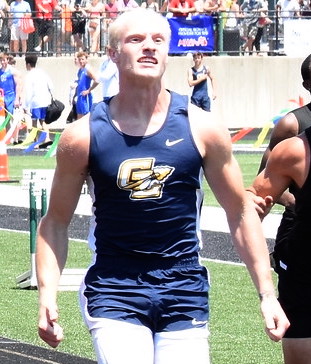
The Bargessers might have had the best day for any one family in state track & field history. Along with both Grass Lake teams winning championships, Brennen won the 100 with a time of 11 seconds, the 200 in 22.6 and the 400 in 49.10. He also anchored the 400 relay that came in first with a time of 44.43.
Lexus repeated as LPD3 champ in both the 100 with a time of 12.12 and the 200 in 25.30. (She had won both in 2019, and the 2020 season was canceled due to COVID-19.) She set an LP Division 3 meet record with a time of 55.54 in the 400, then helped the 400 relay place second with a time of 4:11.54.
Between the two siblings were seven first places, one runner-up finish and two team championships.
“When Brennen won that first race, I was so happy for him,” Lori said. “He had worked so hard. Lexus had won before, but he never had. That was a great moment.”
The seeds of those championships were formed during the spring of 2020 when in place of their season Brennen and Lexus trained together almost every day.
“It’s insane to think (about) what we were able to accomplish,” Brennen said. “She’d run the 100 and win it, then I’d run the 100 and win it. I got so excited for her, then I had to run my race. In the conference meet I jumped (early) and was disqualified. I was nervous at the state meet that I would do that again.”
Lexus and Brennen have always been close. Training together brought them closer.
“We spent all summer running together,” Brennen said. “She was my pacer. She was helping me get my times in.”
Their dad was confident that both could accomplish what they set out to do at this spring’s Finals because he had watched their times closely all summer.
“Going into the year, I was checking times and seeing what other kids were doing,” David said. “I knew both had a chance to do it in all three events. It was definitely the goal. It helped them by training together. Brennen really was into lifting, and I think that helped Lexi get into it. The two of them were always training together, pushing each other.”
 Doug Donnelly has served as a sports and news reporter and city editor over 25 years, writing for the Daily Chief-Union in Upper Sandusky, Ohio from 1992-1995, the Monroe Evening News from 1995-2012 and the Adrian Daily Telegram since 2013. He's also written a book on high school basketball in Monroe County and compiles record books for various schools in southeast Michigan. E-mail him at [email protected] with story ideas for Jackson, Washtenaw, Hillsdale, Lenawee and Monroe counties.
PHOTOS: (Top) The Bargesser family celebrated a championship-loaded Lower Peninsula Division 3 Finals; pictured from left: father David, Brennan, Xavier, Lexus and mother Lori. (Middle) Lexus Bargesser (1) gets a hand up on defense during Grass Lake’s 52-50 win over Kent City in April’s Division 3 Final. She finished with 16 points, 10 rebounds and five steals. (Below) Brennen Bargesser crosses the line first in the 100 at the Finals in June. (Top photo courtesy of the Bargesser family; Brennen Bargesser photo by Jason Ruggles.)