

Sturgis Girls Strong Again After 1st Finals Win, Surging in Repeat Pursuit
By
Scott Hassinger
Special for MHSAA.com
May 12, 2026
STURGIS – Sturgis girls track & field coach Lesley Starkey recalls working with a special group of young athletes a few years back in the Girls on the Run Program.
 She is now reaping the rewards of that group's early introduction to running.
After winning the 2025 MHSAA Lower-Peninsula Division 2 Finals championship, Sturgis is off to another fabulous start this spring.
Led by seven returning runners who competed at the Finals a year ago, the Trojans haven't missed a beat despite losing some big-time contributors off that squad.
Sturgis has continued to thrive, completing the Wolverine Conference dual-meet season with a 7-0 mark and earning first in Friday's league meet in Vicksburg to capture a second-consecutive outright conference title.
Now the Trojans' attention shifts to repeating as Regional, St. Joseph County and Finals champions. The Trojans host their Regional on Friday.
Starkey, a native of Albion and a University of Michigan graduate, knew her team had the potential to do something out of the ordinary last season.
"We knew this group was special. I had watched these girls from the time they were in elementary school, junior high and they were very composed once they got to high school," said Starkey, a distance-running standout when she competed for the Wolverines.
The Trojans' coach used a situation at the 2025 Finals meet as an example when describing her athletes’ resolve.
"We were thrown a curveball last year at state with only one coach being allowed down on the infield during the meet. I decided that person should be Elton Raines, our sprint and relay coach,” Starkey said. “Our girls proved it wasn't necessary to have all us coaches there. They showed great maturity by doing it all on their own.”
J.B. Starkey, Lesley's husband, also grew up in Albion and then competed for Albion College in the steeplechase. Lesley teaches at Congress School in Sturgis, while J.B. is a physical education instructor at the high school and also the boys track & field coach. The couple have two children – 10-year old son Henry and daughter Alice, an eighth grader.
Sturgis' team was powered last season in the sprints and relays by now-Michigan freshman Keyanna O'Tey, who recently broke the Wolverines' record in the 200-meter dash at 23 seconds in the Duke Twilight Meet in Durham, N.C.
"Keyanna was home and came down and led our warmups at one of our practices. That shows that track & field is a path to something bigger in life than just sports," Lesley Starkey said.
 Depth is once again a major strength at Sturgis with more than 50 athletes on the squad. The Trojans are especially strong in the relays and swept all four at the conference meet.
"Our relay teams have been huge for us this season. Our distance runners have also been a big focus, along with our hurdlers. Those kids have really stepped up and scored a lot of points in those areas," Starkey said.
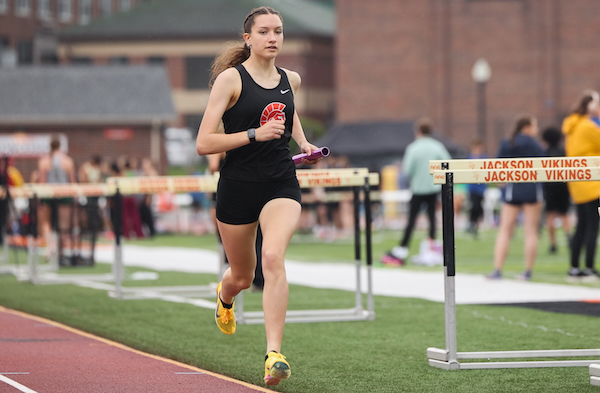
Sturgis’ senior-dominated 3,200-meter relay of Sydney Bir, Tessa Hatt, Kinder Smith and Berkley Holtz has posted the second-fastest time in LP Division 2 this spring at 9:25.03 after earning third in the state as juniors.
"Winning state in the 3,200 relay has been in the back of our mind all year and we want to break our school record again. We have very good runners, and the coaching staff really pushes us. The girls before us set high standards and I believe we want to prove we can do that as well," said Bir, who will continue running at University of Wisconsin-Oshkosh and plans to study education with the intent of becoming a teacher and coach.
Among Bir's other goals before she's done with her prep career are to qualify for the Finals in the 400, in which she owns a personal-best time this year of 59.97.
Unlike most of her teammates, Smith concentrates solely on the four relay events.
"I really enjoy the relays because I'm so diverse in my running. I can go run a good 800 time in the longer relay and come back with a good 100-meter dash time in the 400 relay,” she said. “Everything can be individual in this sport, but we all know what we have to do to show up and get the job done for the team. No one complains, we just kind've lift one another up. It takes hard work and determination to get this done."
Smith will run for Spring Arbor University next and pursue a career as a nurse practitioner.
Sturgis' coach is excited about the Trojans' chances at the Finals in multiple events, especially the 3,200 relay.
"Sydney, Tessa, Kinder and Berkley are the most hungry event group of anyone on our team. They want to show what they can do. All four of them are college-bound runners. I've enjoyed working with them since they were really young, and its been so much fun," Starkey said.
Hatt signed recently to run cross country and track at North Central College, where she will study psychology with plans to obtain a degree in pediatric pre-occupational therapy.
"I used to want to be a teacher, but I became interested in helping kids in a different way," Hatt said.
In addition to the 3,200 relay, Hatt concentrates on the open 1,600 and 800 as well. She qualified for the Finals her junior year in the 800.
"We added Kinder to the 3,200 relay last year, and we all just really clicked. Since then we have all just done our part, and everything we do is to obtain the goal of winning state,” Hatt said. “Sydney gets out to such a strong start for us before she gives the baton to me. I try to maintain that. Kinder is faster than most teams’ third-leg runners, and Berkley does such a great job of chasing.”
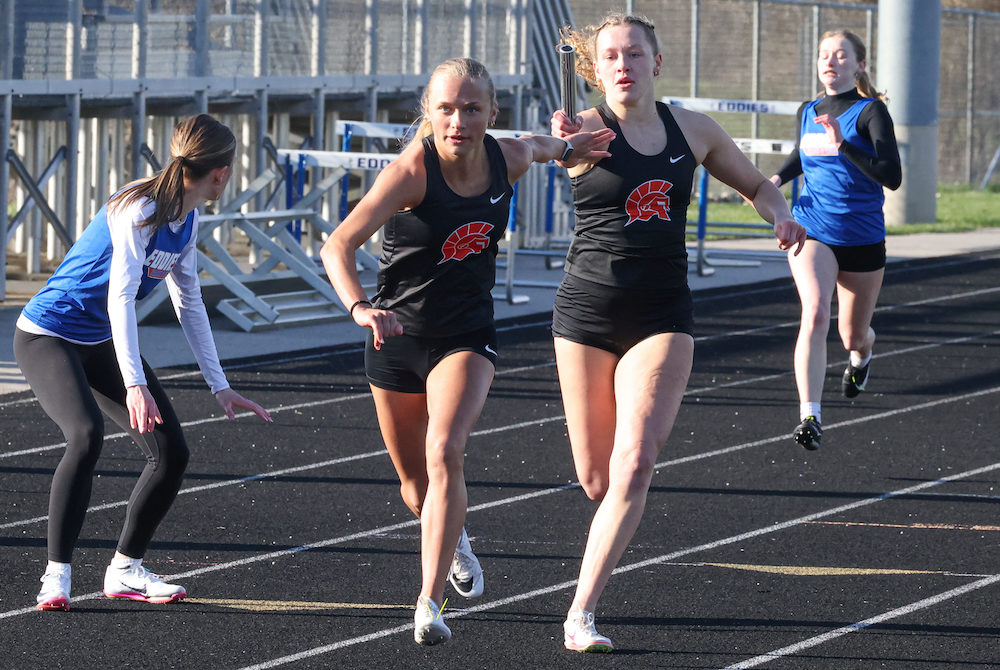
Smith, Holtz and Bir team up with sophomore Olivia Green in the 1,600 relay, where the Trojans rank fourth in 4:10.01. Sophomore Addison Eicher, Smith, freshman Madelyn Oswald and senior Angela Cary are rated fifth in the 400-meter relay (50.87). Eicher, Cary, Bir and Smith comprise the team’s fourth-ranked 800-meter relay (1:47.21). The quartet already have met the Finals-qualifying time.
Cary has shined brightly in the high jump, where she is tied for third-best at 5-foot-5. She also long jumps (16-1) and competes in the two relays.
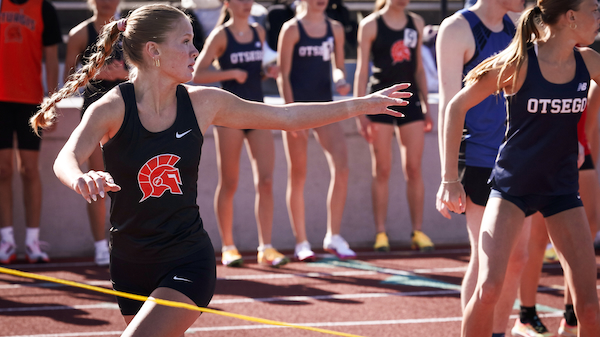 "As a junior I was only about a quarter inch off the school record in the long jump. I've been working on my landing, and that's a big key to reaching my goals there," she said.
"As a group we all enjoy spending time together. Our close connection is a big thing with this team. It helps to avoid any drama. We definitely are looking forward to Regionals and winning state again."
Holtz recently broke Ann Marie Arseneau's 10-year school record in the 3,200-meter run with a time of 11:09.63.
"I was feeling really good that day and just went for it. They had combined the boys and girls races and I ran with one of my friends from the guys team. It was a little unexpected considering I hadn't ran the 3,200 since I was a freshman. The meet was against Otsego, so we were just trying to score as many points as possible to win," said Holtz, who has prospered following a late-season ankle injury as a junior that required offseason surgery.
Holtz credits Sturgis' success on the track to her team's strong work ethic and a solid coaching staff.
"Our success is built on great teamwork. We all work well together and lift each other up. Our coaches put in a great deal of effort and that encourages us to give 100-percent effort during practice and running faster times," said Holtz, who plans to study nursing at U-M.
Holtz also owns Sturgis' school record in the open 800 (2:16).
Oswald is also a rising star in the pole vault with a personal-best effort of 9-9.
"Madelyn is a very versatile kid who has made a very big impact so far," Starkey said.
While Sturgis is relatively young in the throws, junior Vivian Massey – last year's Division 2 adaptive shot put champion, returns for her third season and is primed to repeat. She is a two-time Finals qualifier and placer.
"We graduated some good kids last season, but the leadership our current seniors bring to practice every day has helped shape our younger kids. It shows that they can be just as successful if they are willing to put in the work as well,” Starkey said. “This is a real driven group who are super positive, and they celebrate each other's success. Their main goal is to build on the program's success. We have great team chemistry and a lot of these girls run cross country, play basketball and the opportunity to spend time so much time together has created a tight bond.”
 Scott Hassinger is a contributing sportswriter for Leader Publications and previously served as the sports editor for the Three Rivers Commercial-News from 1994-2022. He can be reached at [email protected] with story ideas for Berrien, Cass, St. Joseph and Branch counties.
PHOTOS (Top) Sydney Bir, right, hands off the baton in the 800-meter relay to senior teammate Kinder Smith during a meet. (Middle) Berkley Holtz carries the baton during her leg in the 3,200-meter relay. (Below) Senior Tessa Hatt prepares to take the baton from a teammate during the 3,200-meter relay this season against Otsego. (Photos provided by Sturgis Public Schools.)
Elk Rapids' Schulte Sisters Splitting Finals Weekend Between Tennis, Track
By
Tom Spencer
Special for MHSAA.com
June 2, 2023
Today began with a bye for Elk Rapids’ Jaida and Brynne Schulte as the Elks returned to the Lower Peninsula Division 4 Girls Tennis Finals in Kalamazoo.
 They’re planning to say bye to their tennis teammates, though, when the first day of competition is over. The Elks will have to advance to Saturday without them.
That goodbye is just fine with tennis coach Keith Schulte. And, it will be more than fine with the Elk Rapids track & field team – which will be happy to say hello to the sister pair as they head to their LPD3 Finals in Kent City.
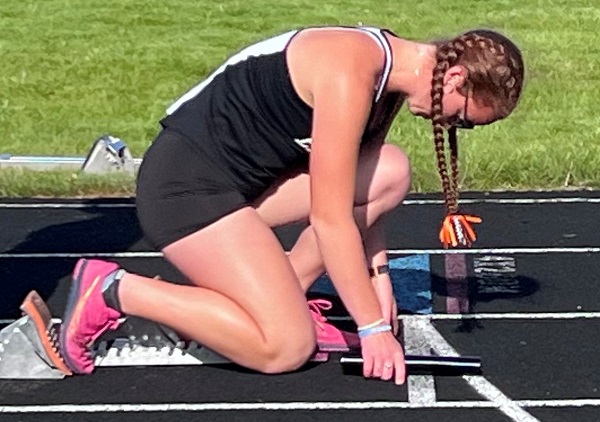
Regardless of how they fare today, the Schulte sisters will run Saturday.
Coach Schulte, who teaches strength and conditioning at Elk Rapids, is also the father of Jaida and Brynne. Today’s he’s beaming with pride, and not just for his tennis team’s success. He’s proud of all the student-athletes and their successes this spring, including the girls soccer team moving on to Regionals with a 2-0 win Thursday over Boyne City.
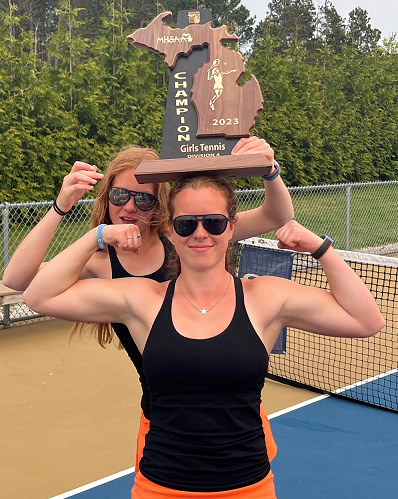
And while all this is going on, he should have a moment or two to just be Dad. Jaida and Brynne teamed up to win the No. 2 doubles title at their Regional as the Elks tied for first place with Traverse City St. Francis two weeks ago. Then the Schulte girls captured first place in the Regional track meet to qualify for Saturday’s Finals. Brynne won the 1,600 and 3,200, and Jaida’s 3,200 relay team took first to move on.
 Coach Schulte hasn’t had much time to pause and soak in the moment of his daughters’ qualifying for two Finals competitions during the same season.
“I didn’t think much of it until now,” the fourth-year coach said. “I’ve always just challenged my kids to do something difficult and not be scared to fail.
“They’ve just kind of found the balance on making this stuff happen,” he continued. “It is a pretty cool opportunity if you can go to two state championships.”
Getting to today’s Tennis Finals is a story full of success. The Elks’ first year under Schulte was halted after a week of practice due to the pandemic. The second year saw the team looking at a season with just nine potential players, but recruitment efforts resulted in the 2021 Elks managing to qualify for the Finals for the first time in their history.
Elk Rapids went on to win the Regional championship in 2022. And then, after graduating six athletes, the Elks were able to repeat this spring with a valiant effort resulting in the co-championship with their conference rival St. Francis.
Dual-sport standouts, while rare, aren’t entirely unheard of – especially at the state’s smaller schools where athletes frequently are needed to fill rosters in multiple sports during the same season. In fact, the Schultes aren’t even alone on their tennis team – sisters Ryleigh and Haleigh Yocum also are playing doubles today but softball on Saturday.
The Yocums won the Regional title at No. 2 doubles and also are slated to be the Elks’ first two batters as they take on Mancelona as one of the favorites to win a Division 3 District title on the softball diamond.
“I do feel bad for them – it’s states,” said 14-year veteran softball coach Erin Merchant. “I do want them to have that opportunity.
“I hope they go far,” she continued. “But then deep down, I’m like, ‘We need them Saturday.’”
Tim Nance and Jesse Way are in their first year co-coaching the boys and girls track teams at ER. They’re pleased the Schultes are prioritizing track while enjoying tennis.
 “I think it is remarkable how resilient, laid back and casual the girls are about their success,” Nance said. “I would say it hasn’t compromised their talent, hard work and success.
“I think it has worked out great,” he continued. “I am selfish and I want them to myself only, but I am happy they can have two successes.”
The Elks will have Ayva Johnstone at No. 1 singles, Kelly Minidis and No. 2, Morgan Bergquist at No. 3 and Jasmine King at No. 4 this weekend. They also will have No. 1 doubles Chloe Taylor and Caroline Best and No. 4 doubles Tessa Nico and Portia Beebe, in addition to the Yokums and Schultes.
Jaida Schulte is a junior. She’s one of the recruits who joined to help the Elks get to their first Tennis Finals in 2021. Bergquist and Beebe were recruits in 2022.
Tennis is the favorite sport today for those three, but track and cross country are right up there for Jaida thanks to the opportunity to run with her freshman sister Brynne.
Jaida is hoping to at least match her personal-record split of 2:36 in the 3,200 relay Saturday. But her goal was first to win all of her doubles matches Friday and see the tennis team finish top-five in its division.
“Brynne loves track, and I love the challenge of running,” Jaida said. “I don’t think I would have the experience of running track or cross country without Brynne.”
Coaches saw very little disruption, if any, with their track, softball and tennis teams this spring with the Yocums and Schultes dual-sporting. The Schultes were able to get track and tennis practice or competition most every day.
“I prioritized track,” Brynne said. “I also got a lot of hitting time in for tennis.
“I would go to track practice first, and as soon as I would be done I would run over to the tennis courts and hit with my sister for a half an hour before going home,” she continued. “It has been worth it.”
 Tom Spencer is a longtime MHSAA-registered basketball and soccer official, and former softball and baseball official, and he also has coached in the northern Lower Peninsula area. He previously has written for the Saginaw News, Bay County Sports Page and Midland Daily News. He can be reached at [email protected] with story ideas for Manistee, Wexford, Missaukee, Roscommon, Ogemaw, Iosco, Alcona, Oscoda, Crawford, Kalkaska, Grand Traverse, Benzie, Leelanau, Antrim, Otsego, Montmorency, Alpena, Presque Isle, Cheboygan, Charlevoix and Emmet counties.
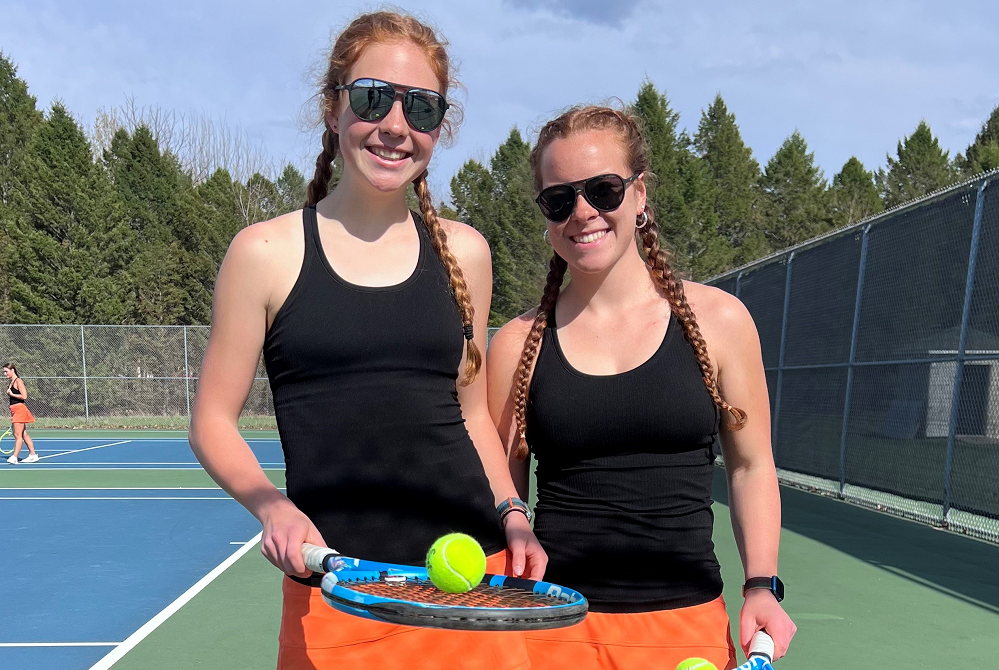
PHOTOS (Top) Elk Rapids sisters Brynne (left) and Jaida Schulte have teamed up at No. 3 doubles for the tennis team this season. (Middle) Brynne Schulte sets to start a track relay. (Below) The Schultes helped the Elks to their first two Regional titles in tennis, including their second straight this spring. (Photos courtesy of Jaclyn Schulte.)