

Be the Referee: Volleyball Unplayable Areas
By
Paige Winne
MHSAA Director of Brand Management
November 14, 2023
Be The Referee is a series of short messages designed to help educate people on the rules of different sports, to help them better understand the art of officiating, and to recruit officials.
Below is this week's segment – Volleyball Unplayable Areas - Listen
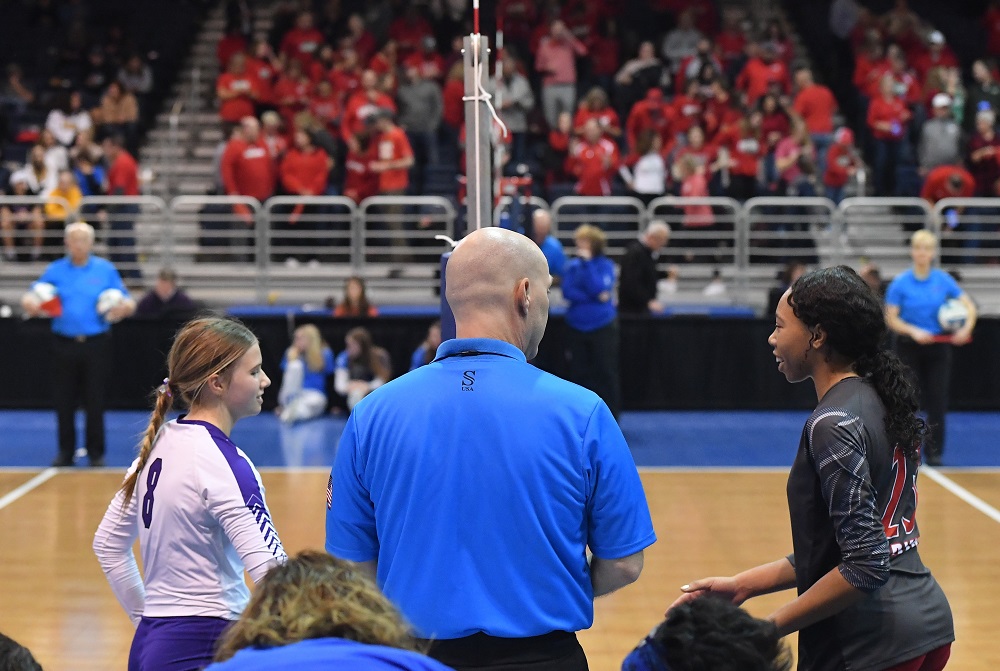
We’re on the volleyball court today when my teammate’s second touch sends the ball towards the bleachers, still on our side of the net. I take off running to attempt to hit it over and jump onto the first row of the stands in order to reach it. I am able to volley the ball over the net, and remarkably it falls to the floor untouched for a point. Or is it?
It is not. The bleachers are not a playable area in volleyball, so my hit wouldn’t count. It would actually be a point for the other team. Despite my best parkour efforts, it’s all for naught.
With player safety in mind, there are other unplayable areas in volleyball including the area behind the benches and the space between the benches and scorer’s table.
Before each match, the officials go over playable and unplayable areas with both coaches.
Previous Editions
Nov. 7: Pass/Kick Off Crossbar - Listen
Oct. 31: Cross Country Interference - Listen
Oct. 24: Soccer Overtime - Listen
Oct. 17: Tennis Spin - Listen
Oct. 10: Blocked Kick - Listen
Oct. 3: Volleyball Double & Lift - Listen
Sept. 26: Registration Process - Listen
Sept. 20: Animal Interference - Listen
Sept. 13: Feet Rule on Soccer Throw-In - Listen
Sept. 6: Volleyball Jewelry - Listen
Aug. 30: Football Rules Similarities - Listen
Aug. 23: Football Rules Differences - Listen

Team of the Month: Gladwin Volleyball
By
Geoff Kimmerly
MHSAA.com senior editor
November 15, 2022
Tony Wetmore hadn’t arrived yet the last time Gladwin’s varsity volleyball team won a Jack Pine Conference championship. But he had a trustworthy witness able to give a first-hand account of what his Flying G’s have been chasing over the last 40+ years.
 Wetmore’s mother and junior varsity coach Jane Wetmore, then Jane Huber – played on that last league championship volleyball team. She also was the one who got her son into coaching; he started his Gladwin tenure as the freshman volleyball coach teaching a sport he admittedly didn’t know much about himself.
But Mom clearly was onto something.
Less than a decade later, Wetmore has just finished up his sixth season as Gladwin’s varsity coach – and his team has finished its first league championship season since 1978, earning the MHSAA/Applebee’s “Team of the Month” honor for October.
Gladwin has been hovering in contention much of the last decade, but this team had all the ingredients to end the drought. Start with senior outside hitter Erin Breault and senior setter Delaney Reynolds – Breault broke the school’s single-season and career kills records this season, and Reynolds broke the same records for assists. Additionally, Breault led the JPC in kills, and junior middle Lizzie Haines led the league in hitting percentage.
But that high-caliber talent also was surrounded by several contributors who helped Gladwin push past longtime nemesis Beaverton and into the top spot.
“I felt like the whole season I could split the team in half, and one team could take first in the conference and the other team could take like fourth. I just felt like we were that deep where we were good and we could practice at a pretty high level, which was really cool,” Wetmore said.
“It’s obviously linked together, the assist record breaker and the kill record breaker on the same team,” he added. “And I think the thing that really pushed us over the edge this year is we had so many different attackers that were really, really good. My outside hitter Erin broke the record, she led the league in kills. My middle hitter led the league in hitting percentage. Both of those are reflective of our ability to get the ball to our attackers, which is the setter’s main job – but our back row played really well also all season, so a super-big team effort for all of them.”
The Flying G’s were able to win the Jack Pine in large part because they became the first league opponent since 2018 to defeat annual power Beaverton – Gladwin swept the pair of matches against its rival, and those remain Beaverton’s only league defeats over the last five seasons.
The Flying G’s had been building toward this. They won their District in 2018, and then finished second in the JPC in 2019. The team was only .500 in 2020, but came back to finish 29-5 last season and 29-10 this fall.
Wetmore brought Breault, Reynolds and senior libero Delaney Conley up to varsity as sophomores that 2020 season. Breault, Reynolds and Haines earned all-region honors this season, and Wetmore was named his region’s Coach of the Year by the Michigan Interscholastic Volleyball Coaches Association. (Conley, a standout softball player, has signed to continue playing that sport at Saginaw Valley State.)
More quickly than hoped, of course, Gladwin made its season-ending exit in District play again. But the Flying G’s don’t plan on the prior good times coming to an end.
True, the seniors who will graduate are part of a class that’s been long-anticipated across all sports – another example this fall has been the football team, 12-0 and playing in a Division 5 Semifinal on Saturday.
Wetmore expects his volleyball seniors’ impact to last as younger players who watched them succeed this fall take their turns on the court with a larger idea of what’s possible.
“(It’s) just getting over the hump. Talk about our goals – every year trying to win the conference championship but we can’t get there. Every year since 2018, trying to beat Beaverton but we can’t do it. Districts, we’d won every once in a while … we won in 2011, so from 2011-15 we couldn’t get over it, but in (20)16 we got a District and then we got the next two,” Wetmore said. “When you break that barrier, it makes it easier to realize you can do things.”
Past Teams of the Month, 2022-23
September: Negaunee girls tennis - Report