

Flashback 1980: Thrilling Conclusions
June 2, 2020
By Ron Pesch
Special for Second Half
With all Spring sports canceled for 2020 because of the COVID-19 pandemic, it’s been a season of recalling fond memories as we all sit and wait for the return of high school athletics in Michigan.
This time we’re diving 40 years deep to the Baseball and Softball Finals from 1980, which saw five of eight championship games decided by two runs or fewer and mostly on late-inning dramatics while played at various parks across the Lower Peninsula.
Here’s a flashback to the 1980 championship rounds:
BASEBALL
A strong argument could be made that Matt Costello’s ninth-inning heroics rank among the top moments in MHSAA tournament history.
In the days when the state Semifinals and Finals were played on the same day, and split across four separate sites spread across the state, an impressive 1,025 fans turned out for the Class A title game between Royal Oak Kimball and Grosse Pointe North, hosted at Wyandotte’s Memorial Park.
For Kimball, it was the fourth appearance in the state title game. The Knights, led by coach Frank Clouser, had appeared in the Class A title game for three straight years, 1971-1973, earning a championship in 1972 with a 3-1 win over Detroit Western.
It was the first appearance in the Finals for North and coach Frank Sumbera. Earlier in the year, the Norsemen had been the top-ranked team in the Michigan High School Baseball Coaches Association Class A poll, but the squad hit a mid-May speedbump. Within five hours, North dropped two games, falling to St. Clair Shores Lakeview, 6-5, then 3-2 to Harper Woods, which was undefeated and ranked No. 1 in Class C. North rebounded, and finished the regular season as the top team in the Class A rankings with a 23-4 mark.
North opened the championship game scoring with three quick runs in the first inning. Kimball made it 3-1 in the bottom half of the inning, then grabbed a 4-3 lead in the third as 6-foot-4 senior Dave Kopf, (a 32nd-round draft pick of the Detroit Tigers one week earlier) crushed a three-run homer. North tied the game at 4-4 in the sixth when junior Bill Babcock led off with a double, moved to third on a sacrifice, then scored when the throw to first base on Keith Schatko’s suicide squeeze bunt went wild. Following a pop out, Costello picked up his first RBI on the day, on a double over the left fielder’s head that scored Schatko, giving North a 5-4 lead.
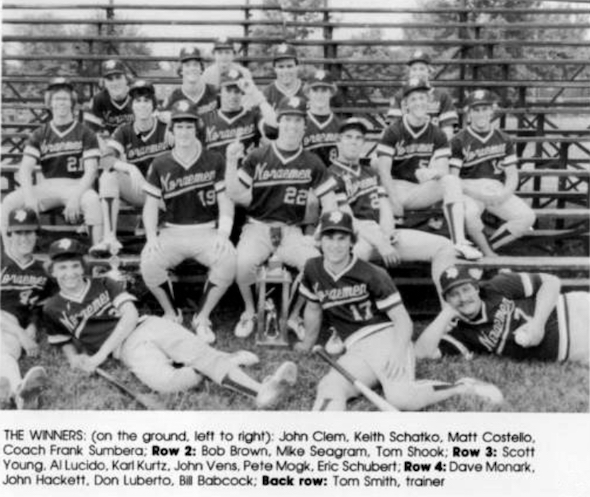 Babcock, who had tossed a 2-0 no-hitter earlier in the day in the Norsemen’s Semifinal against Wayne Memorial, replaced starter Tom Shook in the bottom of the sixth inning. Following a walk, Kimball’s Scott Sturley smashed a two-out triple to tie the game, 5-5.
Neither team could push across a run in the last inning of regulation play. Kimball threatened in the bottom of the eighth, notching a leadoff double. But the danger ended when North catcher Mike Seagram picked off the runner.
Sumbera told Wright Wilson of the Grosse Pointe News that the play was the “turning point of the game.”
Singles by Babcock and Scott Young and a walk by Al Lucido in the top of the ninth inning set the stage for Costello.
“I had Matt swinging away because they were charging their infielders all the time, so we were playing for the hit,” said Sumbera to the Detroit Free Press following the title contest.
“I was just trying to get the run in when I went up there,” stated Costello, who “cracked a 2-2 pitch over the left field fence, more than 365 feet away.”
“When I hit it I knew it was going to be a home run. That was the greatest.”
Costello finished with three hits and an MHSAA championship game-record five RBIs, a mark that stood alone until Jacob Holt from Muskegon Catholic Central tied the record 35 years later, in 2015.
Trailing 9-5, Kimball loaded the bases in the bottom of the ninth inning and scored a run on a two-out wild pitch. But a pop-out to first ended the rally, and North grabbed a 9-6 win and its first diamond title.
Sumbera , who had taken the reins of the North program in 1973, would lead the Norsemen to a second title in 2006. Today, he ranks third in all-time baseball victories in Michigan after a 45-year coaching career.
Flint Powers downed Mount Pleasant 8-7 in a Class B thriller, played at Lansing’s Municipal Park. Mount Pleasant grabbed a 2-0 lead in the bottom of the second inning, before Powers’ Jim Morrissey popped a two-run homer to knot the game in the fourth. The Chargers added two more runs in the top of the fifth, but Mount Pleasant shortstop Bob Lee followed in the bottom of the inning with a two-run shot that tied the game at 4-4.
Powers took a 7-4 lead in the sixth inning and upped the lead to 8-4 on a Mike Morgan bases-loaded single in the seventh. With the game on the line, Mount Pleasant’s Scott Tuma blasted a two-out, three-run homer to cut the margin to 8-7. Morgan, who tossed a five-hit shutout complete game for Powers in its win over Farmington Hills Harrison earlier in the day, allowed two more runners before striking out pinch-hitter Todd Tuma to end the game.
Rain delayed the second Class C Semifinal game and postponed the championship contest until Monday, June 16. Leading 5-0 after three innings, Dundee finished off Lansing Catholic Central 7-2, then topped Parchment 3-1 for its first and only baseball crown. Norm Pentercs, who would later pitch at Grand Valley State, struck out 11 and allowed only four hits in the title game. Those games were played at Broome Park in Flint.
A seventh-inning walk-off bases-loaded single by Scott Trudell broke a 1-1 deadlock to give Grass Lake a 2-1 win over Muskegon Western Michigan Christian in Class D, hosted at Marshall High School. David Knoll allowed just three hits and struck out 13 for the win. It was the second appearance in a Final on the year for WMC, which fell to Detroit East Catholic in an MHSAA basketball championship game in March.
SOFTBALL
Veronica Miller’s single with two outs in the fifth inning drove home Julie Guerra, snapping a 1-1 tie and propelling Flint Carman to a 2-1 victory over East Detroit and all-state pitcher Roxanne ‘Rocky’ Szczesniak in the Class A championship game. Linda Allen picked up her second win on the day. Earlier she tossed a shutout in Carman’s 14-0 victory over Holland West Ottawa. Szczesniak, who would later star at Wayne State, allowed only three hits in the contest after delivering a one-hitter in East Detroit’s 11-3 victory over Ann Arbor Huron in the Semifinal.
“Everything worked great for me today,” Deanne Moore told the Lansing State Journal after tossing a two-hit, 6-0 shutout in Fenton’s Class B Final victory over Grand Rapids Northview. “I knew I had to pitch strikes and my fastball was moving around. I threw a couple of changeups to keep them guessing.”
In the title game, Moore opened the scoring with a solo home run in the second inning. It was followed by a triple by Sandy Thornton, who scored when Theresa Flynn singled up the middle. Moore scored again in the fourth inning following sacrifices by Sue Mora and Flynn, for a 3-0 lead. Northview’s fate was sealed in the fifth as Fenton tallied three more on Thornton’s two-run single and a fielder’s choice by Lori Glass.
It was the third-consecutive Class B title for the Tigers. Moore, a senior righthander, finished with a 24-2 record and would go on to an All-American career at Michigan State, earning entry into MSU’s Hall of Fame in 1996.
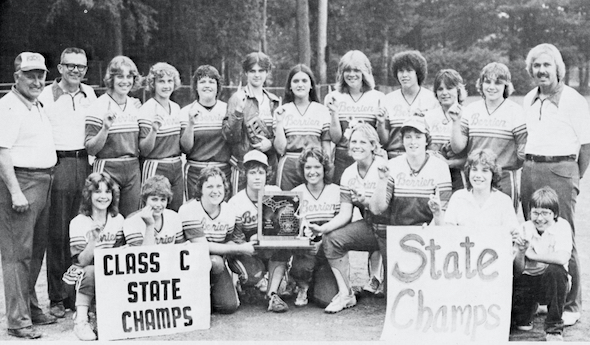
Rhonda Thran added her name to the MHSAA Championship Game Record Book, knocking in five runs as Berrien Springs routed Lakeview 11-4 in the Class C title game. Thran matched the RBI record set by DeWitt’s Cindy White in the Panthers’ Class C title victory over Center Line St. Clement in 1977. The sophomore centerfielder, along with second baseman Jan Dowell, was one of two regulars who were also starters on the Shamrocks’ volleyball team that won the Class C championship during the 1979-80 winter sports season.
 Junior Cindy DeFay fired a three-hitter in the championship. “The whole team really wanted this one. I had a good feeling that we were going to win so I was ready to play. It’s the best game I’ve pitched all year,” she told Jack Walkden of the Benton Harbor Herald-Palladium following the game. DeFay had “missed much of the first half of the season with a severely sprained ankle.”
In the Semifinal, Berrien Springs downed Leroy Pine River 10-8 and banged out 21 hits across the day’s two games, highlighted by five hits by both Rachel Roots and Sheila Duffel, followed with four by Thran.
A police escort guided the team and its retiring coach, Roy Rennhack, back into town after the games played across the state in Oak Park near Detroit – “More than 150 cars joined the caravan, which paraded the team through town atop firetrucks.”
“It was a perfect going away present,” said Rennhack.
It was truly an amazing sports year for the Shamrocks girls, who also won Regional titles in track and basketball. Between 1979 and 1985, Berrien Springs volleyball teams won five Finals volleyball titles. (Those squads were honored in the second year of the MHSAA’s Legends of the Game program in 1999).
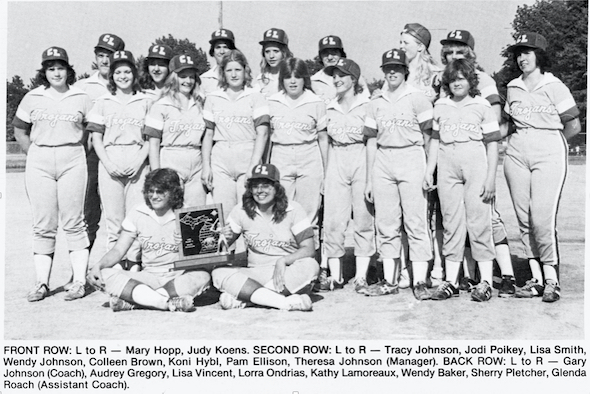
In Class D, Central Lake scored a dramatic 2-1 win over Vestaburg. In the top of the seventh inning, Vestaburg had knotted the game at 1-1 before relinquishing a walk to Pam Ellison in the bottom of the inning that set things in motion for the Trojans. Ellison stole second, then advanced to third on a sacrifice by Wendy Johnson. Following a walk to Wendy Baker, catcher Mary Hopp singled Ellison home for the win. Central Lake had finished as state runner-up to Laingsburg in 1978, then fell to Morenci 6-5 in the Semifinals in 1979.
“We were a pretty close-knit team,” said Ellison., recapping the rally.
“I had fantastic kids,” recalled coach Gary Johnson 40 years later. “We played a lot of big-time schools. I never had a second pitcher when I coached. Back then, if you had a girl who could throw a fastball you were at the top of the world. We had Judy Koens.“
Koens allowed just four-hits in the title game and along with Hopp was named to The Associated Press Class D all-state team as Central Lake finished 33-4. Koens would pitch at Central Michigan, posting stellar ERAs during her four seasons and earning all-Mid-American Conference honors in 1984 as a senior.
 Ron Pesch has taken an active role in researching the history of MHSAA events since 1985 and began writing for MHSAA Finals programs in 1986, adding additional features and "flashbacks" in 1992. He inherited the title of MHSAA historian from the late Dick Kishpaugh following the 1993-94 school year, and resides in Muskegon. Contact him at [email protected] with ideas for historical articles.
PHOTOS: (Top) Berrien Springs celebrates its 1980 Class C softball championship. (Middle) Grosse Pointe North claims the Class A baseball title in its first Finals under coach Frank Sumbera. (Below) Central Lake improves from Class D softball runner-up in 1978 to champion two years later. (Photos gathered by Ron Pesch.)
Marathon, Redemption Make Franklin's 1986 Softball Run Eternally Unforgettable
By
Ron Pesch
MHSAA historian
May 14, 2026
Tracy Lectka is celebrating a victory.
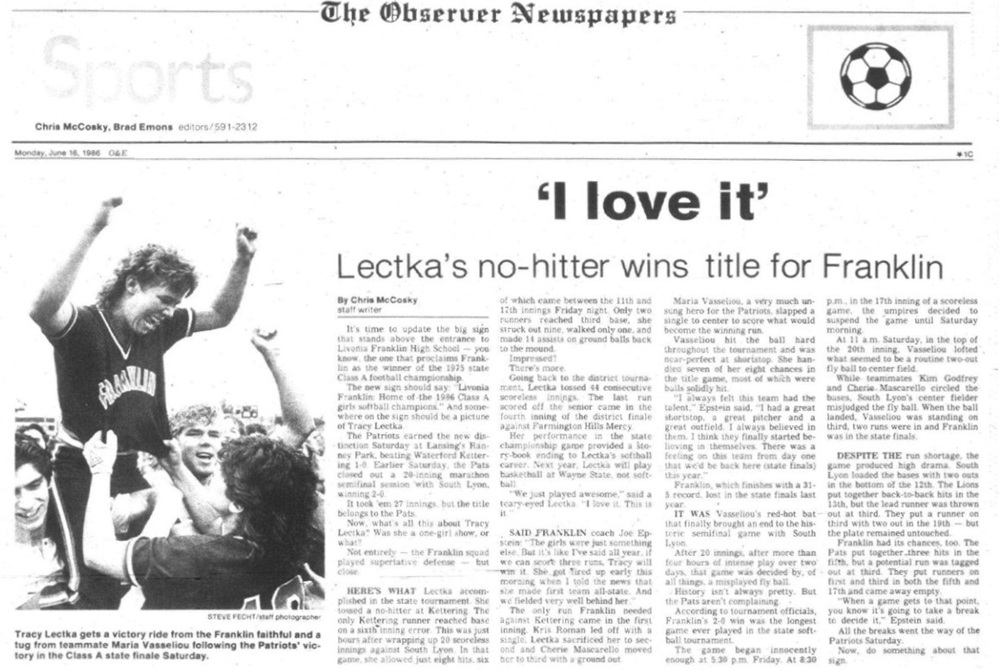
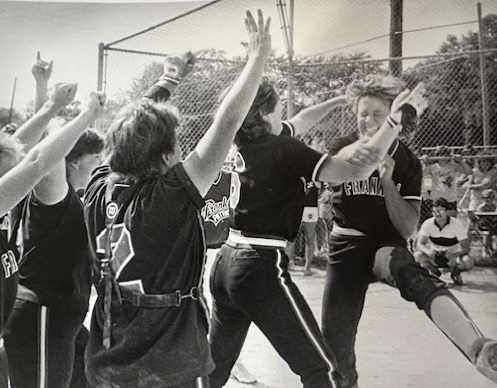
In Steve Fecht’s image found on the front page of the June 1986 Observer newspaper’s sports section, she is riding on the shoulders of ecstatic Livonia Franklin fans. Lectka’s arms are raised, and teammate Maria Vasseliou grabs at her jersey. The shot radiates the postgame celebration that came with the Patriots’ 1986 MHSAA Class A softball state championship – an honor that had slipped away a year previous.
Just as powerful is a photograph from the Observer’s Dan Dean from the 1985 run to the title game. Within, Lectka’s father Ron embraced his daughter, comforting the pain of what might have been.
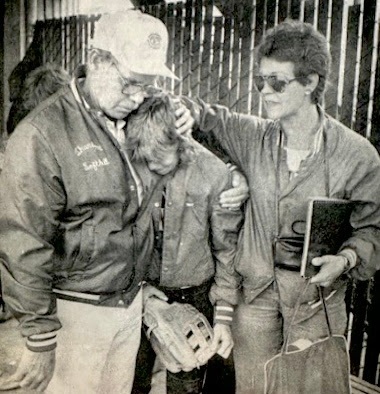 “My Dad was a huge part of my life and taught me everything I knew,” recalled Tracy. “He coached girls softball for Redford Thurston for years. … That was the most hits and runs I had given up all year. That picture speaks volumes to say the least.
“The woman next to me was our outfielder Cherie Mascarello’s mom. She was a huge supporter of the team. Never missed a game, like my mom.”
The Spring of 1985
In just his second year of coaching Livonia Franklin, Joe Epstein had built confidence among his players stressing focus and fundamentals. Lectka, a junior, emerged as an outstanding pitcher, and Epstein featured her constantly as she tossed more than 200 innings. Among Franklin’s victories were three over cross-town rival Livonia Stevenson and the state’s top pitcher, all-state senior Lisa Bokovoy. Franklin finished fourth in the Michigan High School Softball Coaches Association (MHSSCA) weekly Class A regular-season rankings.
During the tournament, Lectka tossed three consecutive four-hit shutouts, but, according to Observer staff writer Brad Emons, “was roughed up for 11 hits” in a 5-0 loss to Mount Clemens L’Anse Creuse North in the 1985 state title game. Played at Lansing’s Ranney Park, North’s star pitcher – right-hander Chris Harms (21-5) – twirled her sixth shutout of the tournament. During that Saturday lockdown, she had allowed seven hits but was “tough in pressure situations.” The Patriots had loaded the bases in the second and fifth innings but could not score.
“We just didn’t hit in the clutch,” Epstein told the Observer, “and they made it count when they had people on.”
North, 22-6 on the year, had opened the season among the state’s top-ranked teams. Harms earned second team all-state honors from MHSSCA, while Lectka was an honorable mention all-state selection. She finished the season with a 22-3 mark.
With an impressive 25-4 record, and one of the state’s top pitchers returning the following spring, Epstein vowed the team would be back.
A Shot at Redemption
With Lectka – one of three seniors – and top players Vasseliou, Cherie Mascarello, Rose Obey, Sue Ritz, Patty Wixson and Karen Schoeninger, the team was the MHSSCA’s Class A preseason favorite entering 1986. That quickly changed within the rankings when the Patriots lost their second game, 12-3, to Walled Lake Central, then dropped a double header to Garden City. A year earlier, Franklin had defeated the Cougars three times, including in a 21-inning pitching duel between Lectka and sophomore Shelly Malone, which Franklin won 1–0.
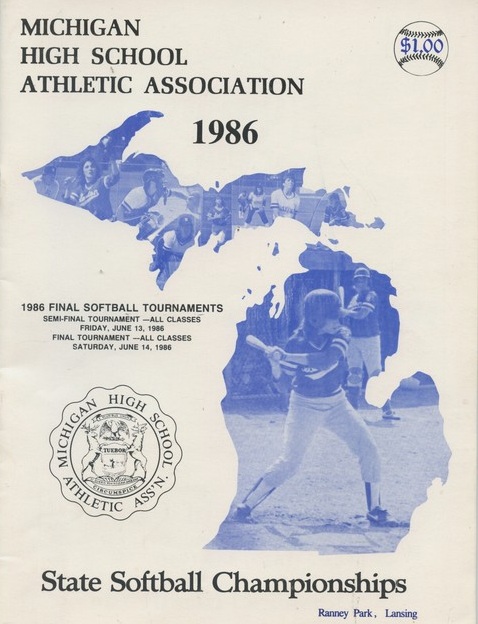 After some experimenting with the lineup, Epstein was able to right the ship. From there, things progressed with relative ease, as his team dropped just two more games against quality opponents, splitting a double header with Westland John Glenn, then dropping one of three games with a solid Plymouth Salem squad, a conference rival. The Patriots finished the regular season fifth in the final Class A rankings and eased their way through the District. They shut out both John Glenn and Belleville in the Regional to earn a trip back to Lansing for the final rounds.
Speaking just prior to their MHSAA Semifinal game with South Lyon, Coach Epstein was asked by the Observer about his squad’s chances.
The Lions, one of nine teams earning honorable mention in the MHSSCA’s rankings, were led by junior ace Andrea Nelson. They had trounced Salem, 19-4, beneath sweltering heat in their District Final. Following that win, Franklin upset fourth-ranked East Kentwood and then downed Lansing Eastern to continue the postseason run.
“I feel confident that if we beat South Lyon, we can go all the way,” said Epstein, “and I don’t go on a limb very often. … I understand there were a bunch of walks and errors (in Salem’s game with the Lions). I’ve seen some good teams have bad days.”
On the opposite side of the Class A bracket stood Waterford Kettering, a scrappy unranked squad Franklin had beat, “in an invitational tournament, 10-5,” and Grosse Pointe South, which, behind the pitching of University of Michigan-bound Lynn Vismara, had shocked both top-ranked Utica Ford and No. 2-ranked Fraser in Regional play.
“(We’re) a better hitting team than last year,” said Epstein, convinced strong pitching from other teams would not deter his crew from their quest. “And I’ve got some other kids who can swing the bat.”
Epstein’s belief would be severely tested.
The Marathon
“The game began innocently enough at 5:30 p.m.,” wrote the Observer’s Chris McCosky about Franklin’s battle with the Lions. “At 8:30 p.m. in the 17th inning, it was still scoreless. Despite the run shortage, the game (had) produced high drama. South Lyon loaded the bases with two outs in the bottom of the 12th. The Lions put together back-to-back hits in the 13th, but the lead runner was thrown out at third …
“Franklin had its chances, too,” continued McCosky. “The Pats put together three hits in the fifth, but a potential run was tagged out at third. They put runners on first and third in both the fifth and 17th and came away empty.”
 Drew Sharp, writing for the Detroit Free Press, covered what happened next.
“… Amid growing darkness at Michigan State, the umpires asked South Lyon coach Jeff Gale and Franklin coach Joe Epstein whether they wanted to continue playing at nearby Ranney Park, which (had) lights or wait until 10 a.m. Saturday.”
Epstein stated he had three players scheduled to take the ACT college entrance exam the next morning and requested the game be moved and continued. Gale wanted to wait. Because the coaches couldn’t come to a solution, the umpires were put on the spot. While the choice wasn’t an easy one, they decided play would resume at MSU in the morning.
Earlier in the day, Kettering sophomore Julie Vachon ripped a long line drive just beyond the reach of the left fielder for a game-winning grand slam, sealing a 4-3 comeback win over Grosse Pointe South.
Title Time
Come daylight, all three test-takers were ready, having skipped their scheduled appointment back home. With two outs in the top of the 20th inning, Vasseliou, the Patriots’ junior shortstop. tripled in a pair of runs to end the deadlock, sealing a 2-0 victory and sending Franklin back to the title game played later in the day at Ranney.
The Lansing State Journal’s Tom Gantert beautifully summarized the Patriots’ weekend in the paper’s Sunday edition. “Livonia Franklin High softball pitcher Tracy Lectka doesn’t ask much from her teammates. Just that they score …”
Kettering’s Vachon allowed two walks, struck out a pair, and gave up just three hits during the championship game. But Vasseliou, again facing two outs, drove in Kris Roman who had led off the first inning with a single. That gave the Patriots a 1-0 lead they would not increase or relinquish.
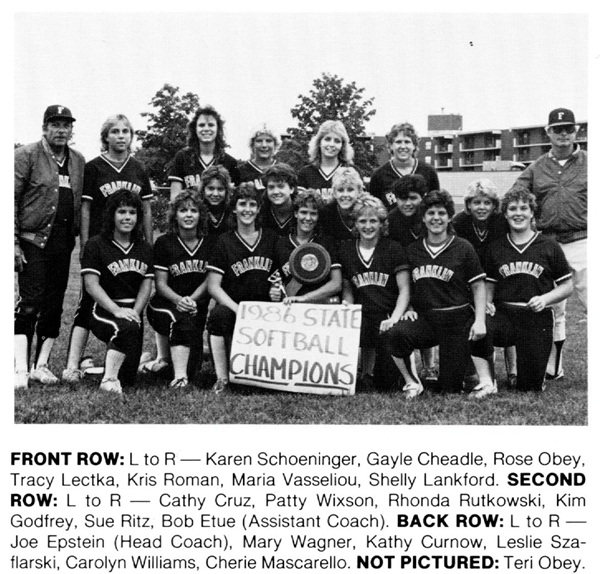 Lectka notched just a single strikeout, but, defensively, her teammates were nearly perfect. Outside a single error, her infield scooped up everything it faced from the Captains. Only three balls tossed by the senior left the infield during the title game. She finished the day with a no-hitter, extending her streak of scoreless innings allowed to 44. Franklin ended the season with a 31-5 record and the school’s second MHSAA state championship in any sport. Ten years previous, the Patriots had won the 1975 Class A football trophy.
“‘We played awesome. I love it,” a teary-eyed Lectka told the Observer. “This is it.” It was her final game on the diamond. A year earlier, she had accepted a college scholarship to play basketball – not softball – at Wayne State.
Soon after, Sports Illustrated visited the family to snap a photo of Tracy for publication in their weekly sidebar, “Faces in the Crowd.” Over 35 years later, in mid-September 2023, the softball squad, along with that football team, were inducted into Franklin’s inaugural Athletics Hall of Fame.
Epstein, who had passed away in 2012, was also honored individually that evening. He had taught in the Detroit Public Schools from 1957 to 1966 before moving to Franklin. A long-time physical education teacher, he also led Franklin’s softball team to a runner-up finish in 1990. His wife Linda joined three others to cut the honorary ribbon for the Hall.
The induction celebration brought back wonderful memories. But it was noted that a few of the team’s achievements during their runs to the Finals were missing from the MHSAA state record book.
Happily, that has now been corrected.
PHOTOS (Top) The Observer reported on Livonia Franklin’s 1986 Class A championship, including a memorable photo. (2) Ron Lectka, far left, comforts his daughter Tracy after her team’s 1985 title game loss. (3) The cover of the 1986 MHSAA Softball Finals program sets the scene for the weekend to come. (4) The Patriots celebrate. (5) Franklin poses for a team photo after the 1986 win. (Photos gathered by Ron Pesch from Observer archives and Tracy Lectka.)