

Westland John Glenn's Polk Passes 500 Coaching Wins, Looks Forward to Future
By
Doug Donnelly
Special for MHSAA.com
February 21, 2023
If you can’t beat them, join them.
 When Bill Polk was a high school wrestler at Dearborn High School, he lost his last match – at the MHSAA Finals – to a wrestler from Westland John Glenn.
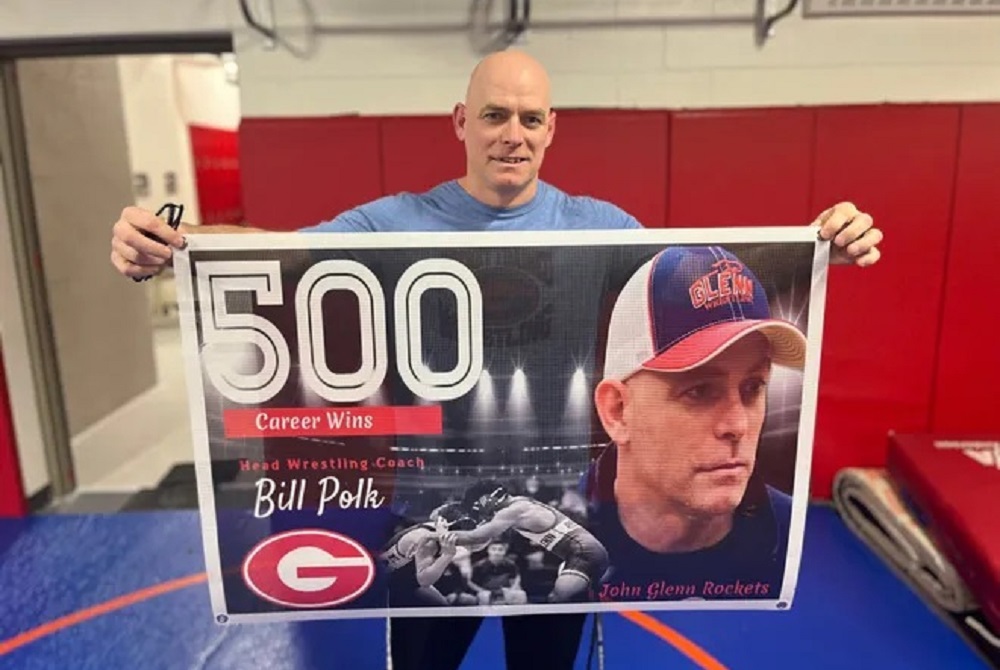
Now, 30 years later, Polk is racking up wins on behalf of John Glenn as the Rockets’ varsity wrestling coach. Earlier this season, Polk collected career victory No. 500 and sees no end in sight for his ultra-successful wrestling career.
“I still have the passion,” said Polk. “About 15 minutes after we lost in the Regionals, I was meeting with our assistants and talking about camps and jotting down our lineup for 2023-24.”
Polk has been a fixture at John Glenn since graduating from Olivet College and landing a teaching job with the Westland district. Wrestling played a role in that as well.
“The head coach that was leaving contacted me and asked if I would be willing to come in,” Polk said. “We got into a conversation about it, and I talked him into staying a little longer and helping me out. It was nice he stuck around for two years and gave me the reigns.”
His first season as head coach at John Glenn was 2000-01, when the team went a modest 9-6. The Rockets won 17 matches both of the next two winters and 27 in 2003-04.
“I thought I would be winning state titles in a couple of years,” Polk said. “I had no clue of the intricacies it took to do such a thing. It’s been a good journey.”
John Glenn has made five trips to the MHSAA Team Finals, reaching the final four once.
And, Polk added, “there have been about a dozen times where we were one match away.”
He’s done a masterful job of putting together a great foundation at John Glenn.
“It’s not easy. It took 10 years before we had our first final eight appearance. There’s a lot that goes into building a program – changing the culture, building a youth program, getting everything set in the summer. It took some time for all of that and to get buy-in.”
The sport has changed dramatically during his 25 years of coaching, from the year-round training to the tremendous impact that youth wrestling has had on the sport across the state.
“Wrestling has changed so much since then,” he said. “About 20 years ago, you took a few kids to camp and had some summer open mats. Now, the kids are coming into ninth grade ready to wrestle. It’s phenomenal. Our youth program has 90 kids involved. I couldn’t imagine that 20 years ago. What youth wrestling has grown into is absolutely crazy.”
Polk has always welcomed his former wrestlers back to contribute to the program, from youth to junior high to the varsity level. In fact, nearly all of the assistant coaches and youth coaches wrestled for him.
“The group I have now, for the most part, all wrestled for me, were super successful, are young guys and they know the system,” Polk said. “I’m there and part of it, but I’m more or less invisible now. They know what they are doing and are super passionate about it and do an outstanding job. I’m very fortunate with that.”
John Glenn won its 18th District title this year under Polk but lost 36-27 to Temperance Bedford in a Division 1 Regional Semifinal. The Rockets and Mules seem to run into each other every year, and there have been some great state tournament battles.
One of Polk’s signature dual meet wins was against the Mules.
“The first year we finally beat Bedford was huge,” Polk said. “That was a big one. That was the 2008-09 season. That was a statement that we made it and our team was known as a competitive team. The best part about that is we’ve been able to maintain that and stay near the top. We really haven’t had a lot of down years from there.”
At first, Polk’s 500th career win came and went without anyone noticing. He saw a local newspaper report about a coach that had won match No. 400, and his assistant coaches began asking how many wins he had. That was about 14 wins after No. 500, which came Dec. 14 against Dearborn Edsel Ford.
“I told those guys not to say anything and, of course, they made a big deal out of it,” he said. “It’s nice. It’s a good milestone to hit. I just didn’t want it to distract from the task at hand. I kind of feel like a small-town celebrity now. The community was pretty excited about it.”
His 2021-22 team won 32 matches, as did his 2009-10 team. This year’s squad went 29-6.
His record now stands at 522-145.
It’s fitting that he has won so many dual meets, because dual meets are one of his favorite parts about the sport. Twenty or so years ago, dual meets made up only a fraction of the season, but today they are a big part.
“It’s my favorite part – the research that goes into trying to bump guys around to win those big meets,” he said. “It’s a chess match. It’s part of what makes it fun.”
The atmosphere surrounding a big dual meet or quad, he said, can be electric.
“You can’t substitute that environment,” he said. “The team aspect is my favorite. Everyone is involved, from your all-staters to your first-year ninth graders. They can all be there and be part of it, not just four or five guys.”
Polk has coached six Individual Finals champions and nearly 90 placers as well.
As a college wrestler, Polk qualified for the nationals three times at Olivet and was team captain his senior season. It was sometime during his junior year that he realized he wanted to remain with the sport after college.
“I just started thinking I wanted to be involved,” he said. “I didn’t know it at the time or what, but coaching was something that started interesting me. I hadn’t been involved in the sport for very long at that time. I wasn’t a youth wrestler or anything. I’m still very passionate about it.”
Polk just turned 49. He has no plans to step away from coaching anytime soon.
“I love it. I’m fortunate to be in a good place surrounded with good people. I’m still having fun. I still really enjoy it,” he said. “I’m going to keep going. I don’t know if I will be one of those guys who are in it 40-50 years, but I’m going to go for a while.”
 Doug Donnelly has served as a sports and news reporter and city editor over 25 years, writing for the Daily Chief-Union in Upper Sandusky, Ohio from 1992-1995, the Monroe Evening News from 1995-2012 and the Adrian Daily Telegram since 2013. He's also written a book on high school basketball in Monroe County and compiles record books for various schools in southeast Michigan. E-mail him at [email protected] with story ideas for Jackson, Washtenaw, Hillsdale, Lenawee and Monroe counties.
PHOTO Westland John Glenn coach Bill Polk holds up a banner honoring his 500th victory. (Photo courtesy of the Westland John Glenn athletic department.)
Performance: Walled Lake Central's Ben Freeman
March 10, 2017
 Ben Freeman
Walled Lake Central senior – Wrestling
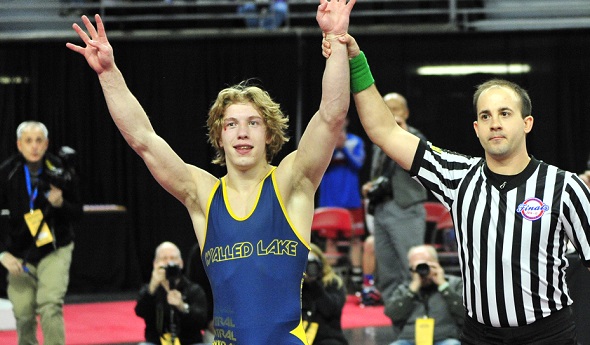
Freeman joined one of the elite groups of individual champions in any MHSAA sport Saturday when he defeated Birmingham Groves’ Colin Takata by technical fall, 24-7, to win the Division 1 championship at 140 pounds – and become the 22nd wrestler in MHSAA history to finish his career with four Individual Finals titles. In doing so, Freeman also capped a 34-0 season and 167-0 career in earning the Michigan Army National Guard “Performance of the Week.”
His previous three championships came at 103 pounds in 2014, followed by a 125-pound title and then the win at 135 last winter. He won every event he entered over four seasons but one; as a freshman he was injured in a semifinal victory at a tournament and was unable to take the mat for the championship match. As a senior he had 28 wins by either tech fall or fall despite getting a slow start to this season after a broken ankle kept him off the mat until January. Although he had only a few close calls at the high school level, he’s taken his losses in national competition – but had plenty of success there as well, earning multiple All-America honors while winning a USA Wrestling folkstyle national title, finishing USA Wrestling freestyle and FloNationals runner-up and third at USA Wrestling Greco-Roman Nationals.
 Freeman was coached during high school by his father, Al Freeman (who wrestled collegiately at University of Nebraska), and also watched closely the match right before his at The Palace of Auburn Hills last weekend as his junior brother Nick won his first title, at 135 pounds. Ben carries a 3.6 grade-point average and will continue his academic and wrestling careers at University of Michigan.
Coach (and Dad) Al Freeman said: “He works hard at it of course, like all serious athletes do. He might get an edge because he’s always been a student of the sport. His matches are live practicing for him, where he attempts to execute techniques and strategies to score as many points as possible. He has won many matches where he came off the mat very disappointed in himself because this or that technique didn’t work well enough. I think that he is one of the best. But I think there are many others whose records aren’t as stellar who are also up there with the best. Mis-timed injuries, illness, etc. can derail any of us no matter how good we are. Ben’s experienced this at some national tournaments. In fact, at this year’s state tournament he got sick the day before. Luckily being the last weight class on Thursday gave him just enough time to recover enough to perform. You need both a lot of preparation and a little luck at the top level.”
Performance Point: "During the season, I couldn't really think about all of that (four-title talk)," Ben Freeman said. "If I started thinking about that stuff, I thought I might psych myself out. So I tried to take each tournament one at a time, not look too far ahead. I definitely thought about (missing out on a fourth title). Obviously that crosses your mind. It happens to a lot of people who are dominant for three years, and the fourth year they lose to someone no one thought they would. I tried to keep that in mind and not underestimate anyone so that wouldn't happen."
 No. 22: "It doesn't even seem real. I look up to all of those guys; I can't picture myself being part of that group (of four-time winners). Right after ... there were just so many emotions. I didn't even know what to think. Now that it's a week later, it's setting in. I'm sure the more time that goes by, and just realizing it, it's going to set in more."
Brotherly love: "It was super cool. I'm really proud of him. I know he deserves it. I know he could've won as a freshman, could've won last year too, but things don't always work out. I'm happy he finally got over that hump. I'm sure it's a lot of relief off his chest, and it makes it easier for him to (win again) next year."
Coach Dad: "Sometimes it was tough, especially when I was little, and obviously it's really tough for him to change hats and go between being Coach and being Dad. Obviously it's two different roles, but we've worked it out pretty good. I know at practice I have to treat him like Coach, and at home he's my dad. It's tough, but there are a lot of positives to it too. He's just around all the time. If I ever have any questions, I can ask him ... and get a lot quicker responses."
State of wrestling: "My favorite part is everyone (in Michigan) kinda knows each other. I've met a lot of great people all over the state, just practicing and going to tournaments with them. All the wrestlers I've found are really great people. I'm not sure if it's because they're like me, or just great people in general, but I've made a lot of close friendships through it, all over Michigan."
- Geoff Kimmerly, Second Half editor
Every week during the 2016-17 school year, Second Half and the Michigan National Guard will recognize a “Performance of the Week" from among the MHSAA's 750 member high schools.
The Michigan Army National Guard provides trained and ready forces in support of the National Military Strategy, and responds as needed to state, local, and regional emergencies to ensure peace, order, and public safety. The Guard adds value to our communities through continuous interaction. National Guard soldiers are part of the local community. Guardsmen typically train one weekend per month and two weeks in the summer. This training maintains readiness when needed, be it either to defend our nation's freedom or protect lives and property of Michigan citizens during a local natural disaster.
Previous 2016-17 honorees:
March 2: Joey Mangner, Chelsea swimming & diving – Read
Feb. 23: Isabelle Nguyen, Grosse Pointe North gymnastics – Read
Feb. 16: Dakota Hurbis, Saline swimming & diving – Read
Feb. 2: Foster Loyer, Clarkston basketball – Read
Jan. 26: Nick Jenkins, Detroit Catholic Central wrestling – Read
Jan. 19: Eileene Naniseni, Mancelona basketball – Read
Jan. 12: Rory Anderson, Calumet hockey – Read
Dec. 15: Demetri Martin, Big Rapids basketball – Read
Dec. 1: Rodney Hall, Detroit Cass Tech football – Read
Nov. 24: Ally Cummings, Novi volleyball – Read
Nov. 17: Chloe Idoni, Fenton volleyball – Read
Nov. 10: Adelyn Ackley, Hart cross country – Read
Nov. 3: Casey Kirkbride, Mattawan soccer – Read
Oct. 27: Colton Yesney, Negaunee cross country – Read
Oct. 20: Varun Shanker, Midland Dow tennis – Read
Oct. 13: Anne Forsyth, Ann Arbor Pioneer cross country – Read
Oct. 6: Shuaib Aljabaly, Coldwater cross country – Read
Sept. 29: Taylor Seaman, Brighton swimming & diving – Read
Sept. 22: Maggie Farrell, Battle Creek Lakeview cross country – Read
Sept. 15: Franki Strefling, Buchanan volleyball – Read
Sept. 8: Noah Jacobs, Corunna cross country – Read
PHOTOS: (Top) Walled Lake Central's Ben Freeman on Saturday has his arm raised for the fourth time at an MHSAA Individual Finals. (Middle) Freeman attempts to pin Groves' Colin Takata during their championship match. (Click to see more at HighSchoolSportsScene.com.)