

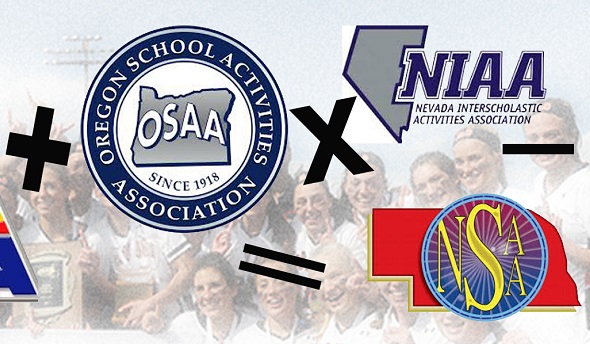
Add, Subtract, Divide, Multiply: MHSAA Not Alone
July 25, 2017
By Rob Kaminski
MHSAA benchmarks editor
This is the third part in a series on MHSAA tournament classification, past and present, that will be published over the next two weeks. This series originally ran in this spring's edition of MHSAA benchmarks.
As the MHSAA faces its most recent classification task with 8-Player Football, and opinions continue to swirl about as to the method, timeframe, location and other procedures, a look around the country provides plenty of company among state association brethren factoring variables into their own equations.
In the Pacific Northwest, the Oregon School Activities Association Football Playoffs are under public scrutiny as leadership ponders a five or six classification format beginning with the 2018-19 school year.
The OSAA has crowned six champions on the gridiron since 2006-07. Many of the state’s smaller schools would like to keep it that way, while larger schools lean toward a five-classification system, citing larger leagues, ease of travel and credibility to state championships as the advantages.
Still others would prefer more than six classes, pointing to safety issues and the opportunity to increase participation numbers as positives.
Moving southeast of Oregon, the Nevada Interscholastic Activities Association recently voted to hold serve on a classification proposal that was volleyed to the membership.
However, changes still could be forthcoming by as early as the 2018-19 season which would add a fifth classification in more populated southern Nevada while allowing northern schools to participate in four classifications. Such divisions could mean no state championship for the fifth class in southern Nevada.
Because of that, the NIAA wants equal numbers of schools in each classification on both ends of the state. Complicating the issue is the fact that the 24 largest schools in the state, by enrollment, are all in Clark County in Southern Nevada.
Across Nevada’s border into Arizona, charter schools are asking the Arizona Interscholastic Association to reconsider classification that was voted upon and approved in September 2015. That agreement called for the largest 33 percent of charter schools by enrollment to be placed in the state’s largest school classification, 3A, the middle 33 percent into 2A, and the smallest 33 percent into 1A.
Less than two years later the charter schools have had a change of heart and have asked to be considered the same as other Arizona public schools and be placed appropriately by enrollment beginning with the 2018-19 school year.
The situation in Arizona further illustrates how the public/private debate that all state associations have faced throughout existence now has the added dynamic of rapidly growing charter schools in today’s educational system, along with virtual school enrollment.
In the nation’s heartland, Nebraska has retooled its football classifications by using enrollment of boys students only in its schools rather than total enrollment. The Nebraska School Activities Association football-playing schools will kick off the 2018 season using this alignment.
Nebraska has three classes of 11-player football, with the smallest class divided in two, Class C-1 and C-2. The state also will have 8-player football for boys enrollments under 47, and the NSAA will sponsor a new 6-player tournament in 2018 for schools with 27 or fewer boys.
“This is a good proposal because some schools have a sizable imbalance between the number of boys and girls, and there’s a large gap (in enrollment) between the largest and smallest schools in Classes A and B,” NSAA executive director Jim Tenopir said. “I think this addresses both of those concerns.”
Swimmers in Georgia, meanwhile, will feel like they are moving with the current, rather than upstream in 2017-18, as the Georgia High School Association recently doubled the number of team championship events from two to four.
Swim enthusiasts can also count on longer days at the finals, as the top 30 finishers from the prelims will advance to the finals instead of 20, and all championship events will have three heats versus two.

Representative Council Approves Field Hockey Framework, Adds to Ice Hockey Schedule
By
Geoff Kimmerly
MHSAA.com senior editor
March 21, 2025
The Representative Council of the Michigan High School Athletic Association approved a series of proposals during its Winter Meeting on March 21 in East Lansing that lay the groundwork for the inaugural MHSAA-sponsored girls field hockey season that will be played this fall.
The Council approved four proposals put forth by the Field Hockey Committee, including one that set the first practice date for this upcoming season as Aug. 11, 2025, with the first contest date Aug. 15 and the first MHSAA Final to be played Oct. 25. Another approved proposal implements MHSAA Handbook regulations setting contest limits for teams at 18 dates and four scrimmages, introducing the fifth-quarter rule and creating guidelines for multi-team tournaments and cooperative programs.
The Council also approved a proposal for a single-division MHSAA Girls Field Hockey Tournament with four Regionals. The Michigan Power Ratings formula will be used to identify the top four teams statewide during the regular season, and those teams will receive top seeds and be placed one apiece in each Regional, with the rest of the Regional assignments then based on geography.
The final Field Hockey Committee proposal approved by the Council adopted overtime procedures for MHSAA Tournament play – 6-on-6 with goalies and 1-on-1 with an attacking player and a goalie – that will be optional for regular-season bracketed tournament play.
Two more Council actions will affect scheduling for the 2025-26 winter season.
In ice hockey, the Council voted to increase the number of regular-season games allowed to 27 with one scrimmage, approving an Ice Hockey Committee proposal that requested the addition of two contests.
To alleviate a Finals facility issue for competitive cheer, the Council approved a Competitive Cheer Committee proposal that adjusts the season calendar for the 2025-26 season only and places the MHSAA championship meets one week later. The first competitive cheer practice date will be Nov. 10, 2025, the first contest date Nov. 24, with Districts now scheduled for Feb. 20-21, 2026; Regionals for Feb. 28 and Finals for March 6-7 at McGuirk Arena at Central Michigan University. CMU has hosted the MHSAA Competitive Cheer Finals the last three seasons, but is scheduled to host the 2026 Mid-American Conference Indoor Track & Field Championships during the MHSAA’s previously scheduled Competitive Cheer Finals dates.
Dates for the 2026-27 and future competitive cheer seasons will return to their previously-approved schedule, with Finals to be held during the last Saturday (and previous day Friday) in February.
The Council also voted to make permanent the “AD Connection Program” that has been piloted the last two school years and matches first-year high school athletic directors with recently-retired mentors, who provide assistance to those new administrators as they transition into athletic administrator roles. The program connected 248 first-year athletic directors with mentors during its pilot period.
The Representative Council is the legislative body of the MHSAA. All but five members are elected by member schools. Four members are appointed by the Council to facilitate representation of females and minorities, and the 19th position is occupied by the Superintendent of Public Instruction or designee.
The MHSAA is a private, not-for-profit corporation of voluntary membership by more than 1,500 public and private senior high schools and junior high/middle schools which exists to develop common rules for athletic eligibility and competition. No government funds or tax dollars support the MHSAA, which was the first such association nationally to not accept membership dues or tournament entry fees from schools. Member schools which enforce these rules are permitted to participate in MHSAA tournaments, which attract more than 1.4 million spectators each year.