

Add, Subtract, Divide, Multiply: MHSAA Not Alone
July 25, 2017
By Rob Kaminski
MHSAA benchmarks editor
This is the third part in a series on MHSAA tournament classification, past and present, that will be published over the next two weeks. This series originally ran in this spring's edition of MHSAA benchmarks.
As the MHSAA faces its most recent classification task with 8-Player Football, and opinions continue to swirl about as to the method, timeframe, location and other procedures, a look around the country provides plenty of company among state association brethren factoring variables into their own equations.
In the Pacific Northwest, the Oregon School Activities Association Football Playoffs are under public scrutiny as leadership ponders a five or six classification format beginning with the 2018-19 school year.
The OSAA has crowned six champions on the gridiron since 2006-07. Many of the state’s smaller schools would like to keep it that way, while larger schools lean toward a five-classification system, citing larger leagues, ease of travel and credibility to state championships as the advantages.
Still others would prefer more than six classes, pointing to safety issues and the opportunity to increase participation numbers as positives.
Moving southeast of Oregon, the Nevada Interscholastic Activities Association recently voted to hold serve on a classification proposal that was volleyed to the membership.
However, changes still could be forthcoming by as early as the 2018-19 season which would add a fifth classification in more populated southern Nevada while allowing northern schools to participate in four classifications. Such divisions could mean no state championship for the fifth class in southern Nevada.
Because of that, the NIAA wants equal numbers of schools in each classification on both ends of the state. Complicating the issue is the fact that the 24 largest schools in the state, by enrollment, are all in Clark County in Southern Nevada.
Across Nevada’s border into Arizona, charter schools are asking the Arizona Interscholastic Association to reconsider classification that was voted upon and approved in September 2015. That agreement called for the largest 33 percent of charter schools by enrollment to be placed in the state’s largest school classification, 3A, the middle 33 percent into 2A, and the smallest 33 percent into 1A.
Less than two years later the charter schools have had a change of heart and have asked to be considered the same as other Arizona public schools and be placed appropriately by enrollment beginning with the 2018-19 school year.
The situation in Arizona further illustrates how the public/private debate that all state associations have faced throughout existence now has the added dynamic of rapidly growing charter schools in today’s educational system, along with virtual school enrollment.
In the nation’s heartland, Nebraska has retooled its football classifications by using enrollment of boys students only in its schools rather than total enrollment. The Nebraska School Activities Association football-playing schools will kick off the 2018 season using this alignment.
Nebraska has three classes of 11-player football, with the smallest class divided in two, Class C-1 and C-2. The state also will have 8-player football for boys enrollments under 47, and the NSAA will sponsor a new 6-player tournament in 2018 for schools with 27 or fewer boys.
“This is a good proposal because some schools have a sizable imbalance between the number of boys and girls, and there’s a large gap (in enrollment) between the largest and smallest schools in Classes A and B,” NSAA executive director Jim Tenopir said. “I think this addresses both of those concerns.”
Swimmers in Georgia, meanwhile, will feel like they are moving with the current, rather than upstream in 2017-18, as the Georgia High School Association recently doubled the number of team championship events from two to four.
Swim enthusiasts can also count on longer days at the finals, as the top 30 finishers from the prelims will advance to the finals instead of 20, and all championship events will have three heats versus two.
Care for Students Drove Forsythe Honoree Isom's Work for Nearly 40 Years
By
Geoff Kimmerly
MHSAA.com senior editor
March 10, 2025
For 39 years, Kris Isom poured herself into education and educational athletics as a teacher, coach, class advisor, athletic director, league president and advocate statewide as a remember of the Representative Council of the Michigan High School Athletic Association.
To celebrate nearly a lifetime of contributions – including several that continue to impact this state’s student-athletes – Isom has been selected as the 2025 honoree for the MHSAA’s Charles E. Forsythe Lifetime Achievement Award.
The annual award is in its 48th year and named after past MHSAA Executive Director Charles E. Forsythe, the Association's first full-time and longest-serving chief executive. Forsythe Award recipients are selected each year by the MHSAA Representative Council, based on an individual's outstanding contributions to the interscholastic athletics community at the local, regional and statewide levels. Isom will be honored during the MHSAA Boys Basketball Division 4 Final on March 15 at Michigan State University’s Breslin Student Events Center.
 Isom retired at the close of the 2023-24 school year after 38 at Adrian Madison and one at Clinton, where she attended high school and then began her teaching career before moving to Madison and becoming a pillar locally and statewide for nearly four decades.
In addition to serving as part of the MHSAA’s Council from 2008-23, Isom served as the president of the Tri-County Conference for more than two decades, on top of all the daily responsibilities that come with serving as a school athletic director. She also was one of the few athletic directors who also coached every year at some level, leading teams in basketball, volleyball, sideline cheer, softball and track & field.
“What I miss the most is the interaction with the kids. The coaching of course, but then everyday them coming into the office or giving me a hug or asking me what’s up,” Isom said. “It’s not always the athletes you intermingle with; it’s the kids in need, and even today when I see them or run into them, I get a hug or thank you, and that makes it all worth it.”
Isom has been recognized several times in the past for her contributions. She received the MHSAA’s Women In Sports Leadership Award in 2019, after previously being honored with an MHSAA Allen W. Bush Award in 2016 to recognize her behind-the-scenes contributions to school sports. She also was named Region 6 Athletic Director of the Year in 2000 by the Michigan Interscholastic Athletic Administrators Association (MIAAA).
During her time at Madison, she saw several of her school’s athletic programs enjoy success. Among recent highlights, Madison’s competitive cheer team finished Division 4 runner-up in 2022, the girls track & field team won a Lower Peninsula Division 3 Finals championship in 2017 and finished runner-up in 2016, and the 2016 volleyball team reached the Class C Semifinals with her daughter Rachel a contributor.
Kristen Isom indeed was a significant contributor to MHSAA work from a behind-the-scenes point of view, as she was a frequent host of District, Regional and Quarterfinal competitions and also MHSAA Coaches Advancement Program (CAP) sessions at her school. She also has been a longtime member of the MIAAA and National Interscholastic Athletic Administrators Association.
“For nearly four decades, Kristen Isom served as an excellent example of how to navigate the daily challenges of athletic administration while making a difference in the lives of her students and an impact on educational athletics on a larger scale as well,” said MHSAA executive director Mark Uyl. “She often showed a way forward as the MHSAA worked through complex topics, and always with the best interests of students first and foremost.”
A graduate of Clinton High School, Isom received her bachelor’s degree in science and teaching certification in physical education and health in 1984 from Michigan State University. She earned her master’s in elementary education in 1986 from Eastern Michigan University and also has completed graduate courses from Fresno Pacific University.
In addition to the MIAAA and NIAAA, Isom also has been a member of the Michigan Association for Health, Physical Education, Recreation and Dance (MAHPERD) and the Michigan State University Alumni Association. She’s been active with the Clinton United Church of Christ and Land & Lakes Ladies Club in various service efforts, and participated in local Meals on Wheels and roadside cleanup projects.
Isom is married to her husband Jerry, and she’s also maintained her real estate license for 30 years and is continuing in that work.
“Obviously (the Forsythe Award) being a high achievement, and being nominated by your peers, it doesn’t get any better than that. They know everything that goes into this job,” Isom said. “I think, like my daughter said, most people said you got paid to go watch games – that’s a perception many people have and that’s OK, because everybody’s job has ups and downs.
“But to have done something 38 years, at the same place, there must have been something you’re doing right, and you must have enjoyed it. And it’s hard to find that. It kinda makes you feel like everything you’ve done was worthwhile, that you made a difference in someone’s life.”
Past recipients
1978 - Brick Fowler, Port Huron; Paul Smarks, Warren
1979 - Earl Messner, Reed City; Howard Beatty, Saginaw
1980 - Max Carey, Freesoil
1981 - Steven Sluka, Grand Haven; Samuel Madden, Detroit
1982 - Ernest Buckholz, Mt. Clemens; T. Arthur Treloar, Petoskey
1983 - Leroy Dues, Detroit; Richard Maher, Sturgis
1984 - William Hart, Marquette; Donald Stamats, Caro
1985 - John Cotton, Farmington; Robert James, Warren
1986 - William Robinson, Detroit; Irving Soderland, Norway
1987 - Jack Streidl, Plainwell; Wayne Hellenga, Decatur
1988 - Jack Johnson, Dearborn; Alan Williams, North Adams
1989 - Walter Bazylewicz, Berkley; Dennis Kiley, Jackson
1990 - Webster Morrison, Pickford; Herbert Quade, Benton Harbor
1991 - Clifford Buckmaster, Petoskey; Donald Domke, Northville
1992 - William Maskill, Kalamazoo; Thomas G. McShannock, Muskegon
1993 - Roy A. Allen Jr., Detroit; John Duncan, Cedarville
1994 - Kermit Ambrose, Royal Oak
1995 - Bob Perry, Lowell
1996 - Charles H. Jones, Royal Oak
1997 - Michael A. Foster, Richland; Robert G. Grimes, Battle Creek
1998 - Lofton C. Greene, River Rouge; Joseph J. Todey, Essexville
1999 - Bernie Larson, Battle Creek
2000 - Blake Hagman, Kalamazoo; Jerry Cvengros, Escanaba
2001 - Norm Johnson, Bangor; George Lovich, Canton
2002 - John Fundukian, Novi
2003 - Ken Semelsberger, Port Huron
2004 - Marco Marcet, Frankenmuth
2005 - Jim Feldkamp, Troy
2006 - Dan McShannock, Midland; Dail Prucka, Monroe
2007 - Keith Eldred, Williamston; Tom Hickman, Spring Lake
2008 - Jamie Gent, Haslett; William Newkirk, Sanford Meridian
2009 - Paul Ellinger, Cheboygan
2010 - Rudy Godefroidt, Hemlock; Mike Boyd, Waterford
2011 - Eric C. Federico, Trenton
2012 - Bill Mick, Midland
2013 - Jim Gilmore, Tecumseh; Dave Hutton, Grandville
2014 - Dan Flynn, Escanaba
2015 - Hugh Matson, Saginaw
2016 - Gary Hice, Petoskey; Gina Mazzolini, Lansing
2017 - Chuck Nurek, Rochester Hills
2018 - Gary Ellis, Allegan
2019 - Jim Derocher, Negaunee; Fredrick J. Smith, Stevensville
2020 - Michael Garvey, Lawton
2021 – Leroy Hackley Jr., Byron Center; Patti Tibaldi, Traverse City
2022 – Bruce Horsch, Houghton
2023 – Karen Leinaar, Frankfort
2024 – Sean Jacques, Calumet
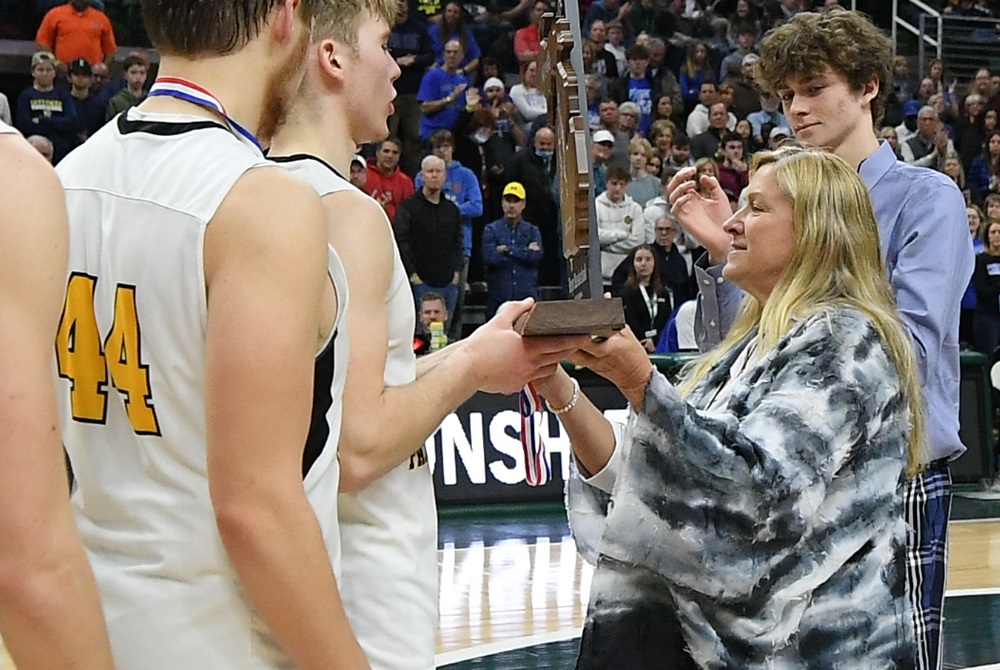
PHOTO Retired Adrian Madison athletic director Kristen Isom presents the Division 4 finalist trophy to Ewen-Trout Creek in 2022. (Photo by Andrew Frushour.)