

4 Thrusts: In Motion, On Track in 2013-14
December 20, 2013
By Jack Roberts
MHSAA Executive Director
During the fall of 2012 at Update meetings across Michigan, we described “Four Thrusts for Four Years” – four health and safety emphases that would help us keep student-athletes healthier and also get a seat for Michigan’s policies and procedures for school sports on the train of best practices – an express train that is moving faster than we've ever seen it toward more cautious practice and play policies and more educational requirements for coaches.
At this December’s meeting, the MHSAA Representative Council examined a first quarter report card – what’s been accomplished during the first year.
It has been a remarkably strong start, but it’s only a start.
The first thrust, improving management of heat and humidity, received a boost last March when the Representative Council adopted a “Model Policy for Managing Heat and Humidity.” It has been promoted in print, online and at face-to-face meetings; and the response of schools has been nothing short of outstanding.
This rapid acceptance by school administrators and coaches reflects their appreciation for a clear policy that identifies the precise conditions that call for adjustments in activities, and lists specific actions to be taken when temperature and humidity combine to reach un-safe levels. Gut and guesswork are gone.
The second thrust, raising expectations for coaches’ preparedness, is being advanced in three ways.
In May, the Representative Council adopted the requirement that by the 2014-15 school year, schools must attest that, prior to established deadlines, all assistant and subvarsity coaches at the high school level have completed annually the same MHSAA rules meeting required by all varsity head coaches or, in the alternative, one of the free online sports safety courses posted on or linked to MHSAA.com and designated to fulfill this requirement. This popular change is only the first component of this critically important second thrust.
The second component is this. The Representative Council voted in December to require by 2015-16 that MHSAA member high schools certify that all of their varsity head coaches of high school teams have a valid (current) CPR certification, with AED training as a recommended component.
As this requirement was discussed at constituent meetings, the question was frequently raised: “Why just head coaches?”
“Why indeed,” is our response. If a school has the will and resources, it most certainly should make CPR a requirement of all its coaches, as some school districts have required for many years.
CPR training is conveniently available near almost every MHSAA member school in Michigan. Still, the MHSAA will begin offering CPR certification (with AED training) on an optional basis as an extension of Level 1 of the Coaches Advancement Program (CAP) during 2014-15.
The third component of this thrust is scheduled to go before the Representative Council in March. The proposal is that all individuals hired for the first time as a varsity head coach of a high school team, to begin those coaching duties after July 31, 2016, must have completed the Coaches Advancement Program (CAP) Level 1 or 2.
The MHSAA will track compliance and prohibit varsity head coaches from attending their teams’ MHSAA tournament contests if they fail to complete this requirement, beginning in the 2016-17 school year.
In cases of very late hiring, schools may substitute two online courses of the National Federation of State High School Associations – “Fundamentals of Coaching” and “First Aid, Health and Safety.” However, that coach must complete CAP Level 1 or 2 within six months of the hiring date.
These feel like big steps to some people in MHSAA member schools – “too expensive” or “another obstacle to finding qualified coaches,” some say; but these are baby steps.
This barely keeps pace with national trends. Michigan’s tradition of local control and its distaste for unfunded mandates has kept Michigan schools in neutral while schools in most other states have made multiple levels of coaching education, and even licensing or certification, standard operating procedure.
The three initiatives to upgrade coaches education in this critical area of health and safety over the next three years only nudges Michigan to a passing grade for what most parents and the public expect of our programs. We will still trail most other states, which continue to advance the grading curve.
And for a state association that is among the national leaders by almost every other measure, it is unacceptable to be below average in what is arguably the most important of all: promoting athlete health and safety by improving the preparation of coaches.
The third health and safety thrust is a focus on practice policies to improve acclimatization and to reduce head trauma; and the fourth thrust is a focus on game rules to reduce head trauma and to identify each sport’s most injurious situations and reduce their frequency.
Because of the critical attention to football on all levels, peewee to pros, our first focus has been to football with the appointment of a football task force which has effectively combined promotion of the sport’s safety record at the school level and its value to students, schools and communities with probing for ways to make the sport still safer.
The task force proposals for practice policies are receiving most attention and will receive Council action in March (and will be published on Second Half over the next few weeks). But the task force also has assisted MHSAA staff in developing promotional materials that are already in use, and the task force pointed MHSAA staff to playing rules that need emphasis or revision to keep school-based football as safe as possible.
During 2013-14, all MHSAA sport committees will be giving unprecedented time to the topics of the third and fourth thrusts and, when necessary, a task force will be appointed to supplement those sport committee efforts.
Frequently Asked Questions About CPR Certification
Q. Who is authorized to provide CPR certification?
A. The MHSAA does not dictate which organization must provide the CPR education and certification. However, the Michigan Department of Human Services lists the following organizations that are approved to provide CPR training:
- American CPR Training: www.americancpr.com
- American Heart Association: www.americanheart.org
- American Red Cross: www.redcross.org
- American Safety and Health Institute: www.hsi.com/ashi/about
- American Trauma Event Management: www.atem.us
- Cardio Pulmonary Resource Center: 517-543-9180
- Emergency Care and Safety Institute: www.ecsinstitute.org
- EMS Safety Services: www.emssafety.com
- Medic First Aid: www.medicfirstaid.com
- National Safety Council: www.nsc.org
- Pro CPR: www.procpr.org
Q.
A. $0 to $75.
Q. How long does certification take?
A. Two to five hours.
Q. How long does the certification last?
A. Generally, two years.
Q. Does the MHSAA specify the age level for the CPR training?
A. No. Generally, the course for adults alerts candidates of the necessary modifications for children and infants, and vice versa.
Nearly 25 Years After Leading Unexpected Run, Morton Directing Life-Changing Mission
By
Keith Dunlap
Special for MHSAA.com
August 11, 2026
Nearly a quarter century after presiding over arguably one of the most improbable boys basketball state championships in Michigan history, the same fight and underdog mentality still exists for Tim Morton.
 Back in 2002, Morton was the head boys basketball head coach at Auburn Hills Avondale, which produced a Hollywood-type run during that season’s Class B tournament.
Unranked and without a future Division I college player in the lineup, a Yellow Jackets team headlined by seven seniors went on a quest that stunned many statewide observers.
Avondale avenged the disappointment of not getting out of the District round the previous year and then recorded a stunning upset of a highly-ranked Flint Southwestern team in their Regional Final, winning in double overtime. But after squeaking out a six-point win over a solid Williamston team in a Quarterfinal and earning an 11-point win over Comstock Park in the Semifinals, surely midnight was going to strike for Cinderella in the championship game. After all, Avondale was up against a powerful Grand Rapids South Christian team which had multiple future Division I college players on its roster.
It didn’t matter as Avondale, led by tough-as-nails captains Mike Lewis and Wes Whiteside, senior Dionte Miller and sophomore Dave Holston, completed its stunning run with a 70-65 win to capture what still stands as the program’s only Finals basketball championship.
Morton said he thought his team the previous year that couldn’t make it out of Districts was more talented, but there were intangibles the 2001-02 team possessed that couldn’t be matched.
“I think that nobody really thought that they’d have a shot,” Morton said of his team. “I think that is why we were unranked, because of what had left. But you’ve got to have something to fight for, and I think the reason was the year before. We were motivated. I think playing that underdog role, we just loved it. We won games in so many different ways and got on that roll.”
This past March, Morton and other alumni of the Avondale team certainly were thrilled to see this year’s squad advance to the Semifinals for the first time since their 2001-02 team did so. This time, the Yellow Jackets suffered a three-point Semifinal loss to eventual Class A champion Rockford.
Today, Morton is also heading another team that has an underdog mentality but is motivated to fight for each other and surrounding communities.
Morton is the multi-area director for the Southeast Michigan chapter of the Fellowship of Christian Athletes, which aims to serve kids, coaches and communities by promoting through activities faith, self-esteem, serving others and being the best version of yourself.
The organization has roughly 50 student-led “huddles” that meet at high schools or middle schools, where students can have a safe haven to talk about problems, promote successes, go over scripture and bond during a challenging time of life.
Through volunteers and other staff members, the organization also conducts camps throughout the state for coaches, athletes and others to learn from each other and grow as leaders.
The chapter will have its annual golf outing Sept. 28 at Oakland University’s Sharf Golf Course.
“We just want to be really good at cultivating those relationships, making sure that we’re following up with people, and sharing what the Lord is doing so people feel like they can be connected to something bigger than themselves.”
 Playing for something bigger than themselves certainly worked for the 2002 team, and Morton said there is a 25th anniversary reunion in the works for next spring.
But while he nor anyone else in the Avondale community will forget that run in 2002, these days Morton is spearheading a team he said is playing for an even greater purpose, one he tried to describe to a group of youth football coaches in Flint during a recent gathering.
“I had only about 15 to 20 minutes to share with these guys,” Morton said. “I shared that we won a state title in 2002 and I was driven to be the best coach I could possibly be. A lot of great things happened, and the state championship happened. I’m on my way home from the state championship and we’re watching the video, and it’s crazy because this fear came over me. How are we going to do this again?
“Every coach that puts his or her full identity in the performance of the team, that’s scary and that’s not good. I got out six years later because of that fear. The most important relationships of my life were not good because I had to be validated by the performance of my team. That conversation kind of led into, “Why are you coaching? Why are you doing what you are doing? I wanted them to be motivated to be the best versions of themselves, for those kids, their wives and children. That’s why I’m in FCA. That’s my cause to fight for.”
2026 Made In Michigan
Aug. 7: Significance of Historic Run, Relationships Formed Live On for 1973 Unity Champs - Report
Aug. 4: Work Ethic Continues to Drive Van Dyk's Endeavors as Co-Owner of Family Farm - Report
July 24: Hackett Mentor's Care Sparked Lifetime in Hoops for BCAM President White - Report
July 24: Mackey Leaving Court with 500+ College Hoops Wins, Many More Lessons Shared - Report
July 16: Country Day Two-Time Champ Moore Building Perennial Winner at Harvard - Report
July 9: Multi-Sport Career at TC West Helps Gillis Thrive as Pro in Game She Once Left Behind - Report
July 2: Inspired by Home, Eager to Give Back, Spencer Hosts Hoop City Alumni Games - Report
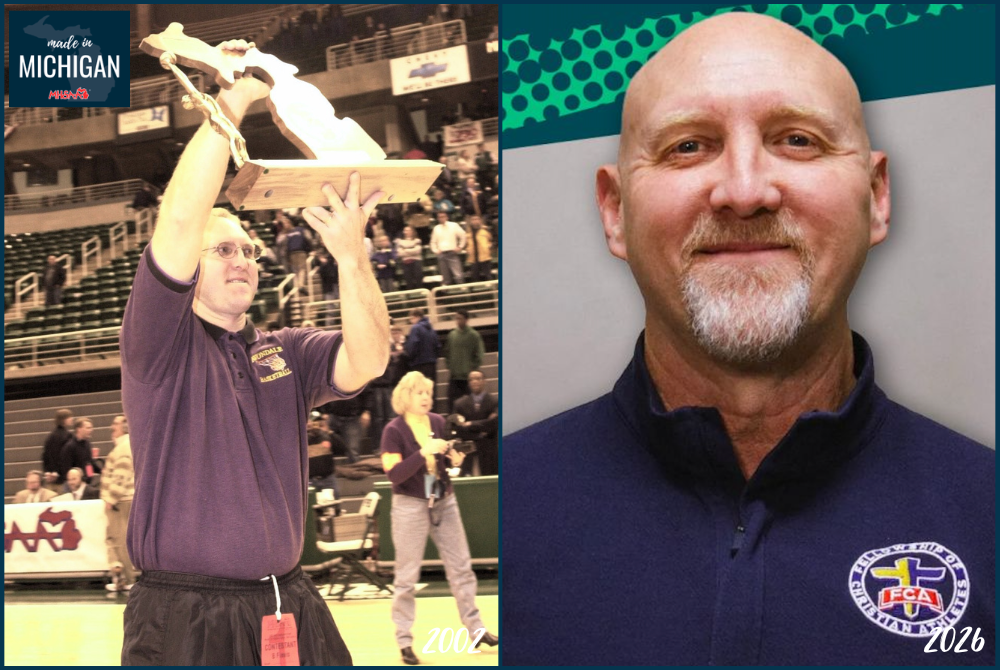
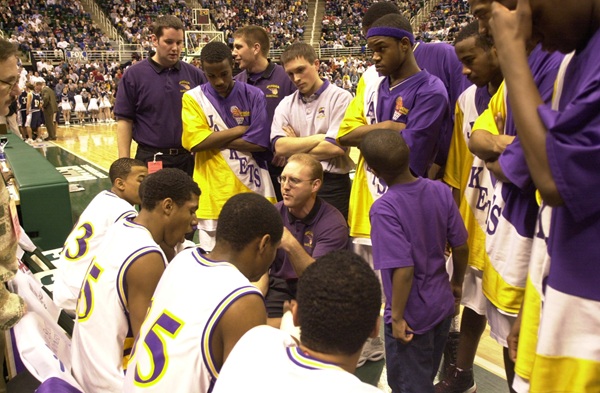
PHOTOS At left, Tim Morton raises the Class B championship trophy in 2002. At right, Morton now a director for Fellowship of Christian Athletes. (Middle) Morton, kneeling, speaks to his team during the championship win at Breslin Center. (MHSAA archives)