

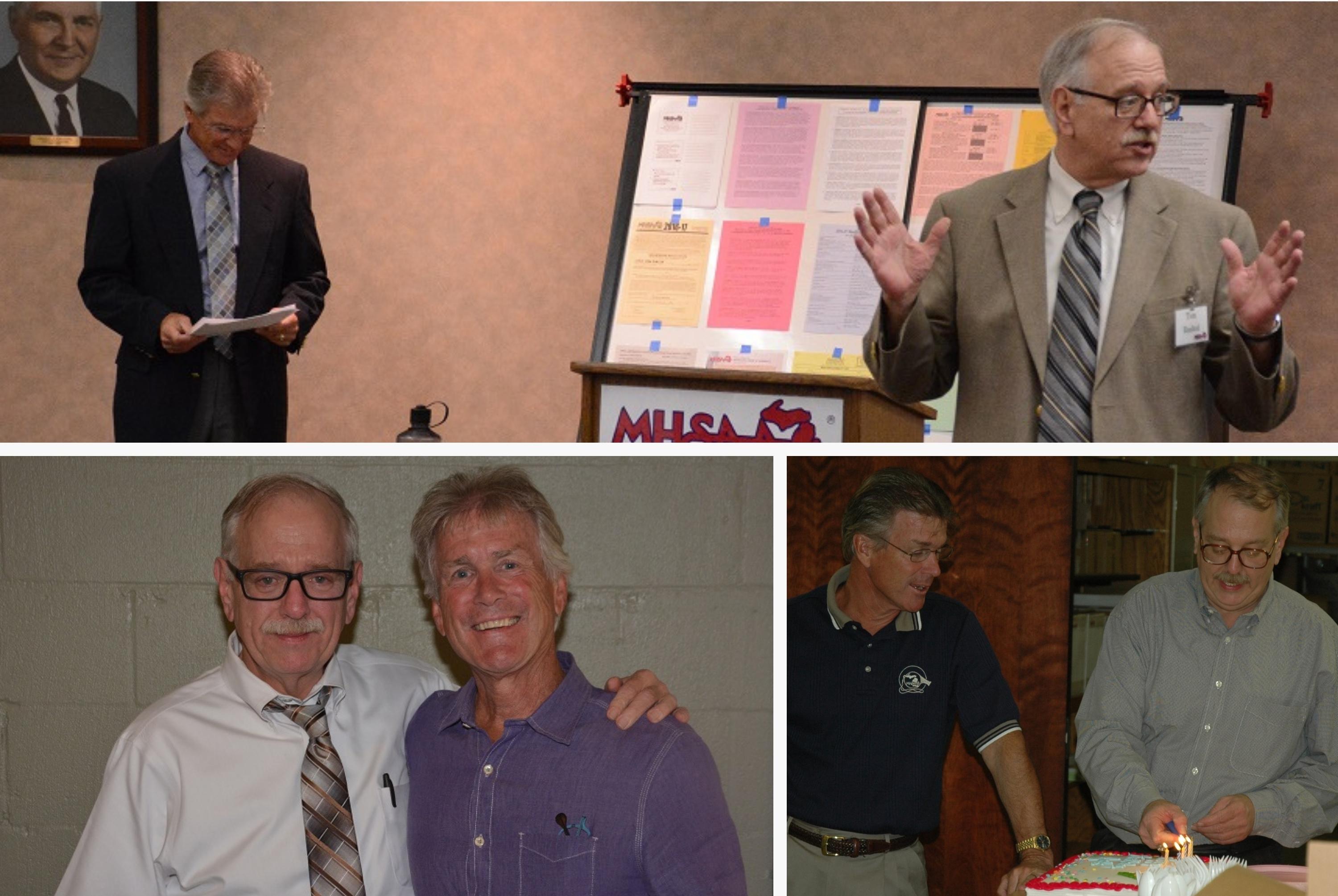
Jack Roberts, on Tom Rashid: One More Call
By
John E. (Jack) Roberts
MHSAA Executive Director, 1986-2018
December 9, 2021
More than a decade ago, with his knowledge, I placed in my “Will & Instructions Upon Death” that Tom Rashid was to be the one and only person to speak at my funeral or memorial service. A short number of years later, Tom told me that I was to do the same for him. Obviously, we knew that we could not both keep our promise to the other. But I must say, if Tom does not actually show up for my funeral, that will be the first time he has not kept a promise to me.
I understand there will be a time in the future, when the weather warms and COVID wanes, when school administrators across Michigan can gather in force to show their respects to Tom, and when I will provide the eulogy that Tom asked of me. But Tom’s recent death reminds us how uncertain life can be and suggests that I say some things now, before it’s too late.
Tom was the unparalleled master of award presentations; and for more than a dozen years he wrote and delivered polished praise on award recipients at the annual conference of the Michigan Interscholastic Athletic Administrators Association. My tribute now isn’t an awards presentation or hall-of-fame induction, so I won’t recount the particulars of Tom’s career; but what you will see here is the importance of Tom’s life … the themes that distinguish him from any other person I’ve known.
Tom comes from a large, complicated and compassionate family of parents, aunts, uncles, brothers, sisters, nephews and nieces who mourn his loss at levels few of us can fathom. Over the years, and for many years, he was the caretaker for several family members; and he was generous with all of them. My hope for each family member now – and for many days, weeks and months to come – is that you are at peace. Tom’s pain is over; and his place in eternity is secure. Tom purchased a reserved seat.
Tom often joked that his only good habit was prayer. That’s not really true, of course. But for as long as I’ve known Tom, he talked to God many times a day; and I’ve always had the feeling that he talked to God the same way he talked to us: bluntly, forcefully, passionately, honestly, loudly, making very plain what he had on his mind.
Tom was a rigorous practitioner of his devout Catholic faith; and, the God whom Tom believed in is a big God … the president, general manager and head coach of a huge, diverse team whose game plan is a large, loving Gospel of limitless parameters and possibilities. I have no doubt that, both in times of need and not, members of the Roberts family – including both my parents, my sister, my wife and our children and grandchildren – have been specific in his petitions to God. I have no doubt that Tom’s daily prayers included many of you, and your loved ones as well.
In addition to Tom’s immediate family is the even larger and even more complicated family Tom developed through a long, illustrious career in Michigan school sports administration: a full 25 years with the Archdiocese of Detroit, until 2003, when I invited him to join me at the MHSAA office in East Lansing.
During my 32 years as the executive director of the MHSAA, I never saw another like Tom … never, anywhere. He talked to anybody, anytime of the day or night, about any question or problem they might have. Usually, Tom didn’t need to give me notes reviewing his telephone conversations. From my adjacent office, and given his forceful voice, I could hear Tom’s every word, very clearly.
Tom had the ability to anticipate what I might need and take care of it without my asking. It is no exaggeration to say that Tom would do anything for me. For example, Tom’s reluctance to travel and his fear of flying are well known to many of you. I believe the one and only time that Tom flew in an airplane was in 2003, when I ordered him to fly to Texas so that he might receive the highest award of the National High School Coaches Association. He had never flown before; he has never flown since.
Most remarkable was not merely Tom’s unselfish, unlimited, legendary availability to athletic administrators at any hour of the day or night, nor his experienced, learned grasp of the subject matter in answering their calls. What was more remarkable was his effort to help school administrators through their hard times. On many occasions these callers had made an error of commission or omission. They had made a mistake or an oversight; and Tom was supremely compassionate in guiding them through the local fallout from disappointed athletes and disgruntled adults. Secure in himself and our mission to be servant-leaders, Tom very often shared or completely shouldered unjustified blame so others would not. He gave cover to countless local school administrators every year of his MHSAA career so that those administrators might survive and even thrive in their careers.
Among my remarkably loyal MHSAA staff, Tom still stands out. And he earned the enduring loyalty of those with whom he worked. I think especially of his successor at the Archdiocese of Detroit, Vic Michaels: I doubt that more than two days ever passed between their almost daily telephone conversations … usually in the morning … for the full 15 years that my office was next to Tom’s at the MHSAA. I have never, ever been witness to anything like that; and I know there is no one in our good work who misses our dear colleague more than Vic.
But most remarkable of all was Tom’s ability to turn an adversary into an ally. He could have a knock-down, drag-out argument with a person one day, and by the next day, and for years to come, that person was Tom’s greatest advocate and admirer.
Well … maybe second-greatest advocate and admirer. Because no one in athletic administration – no one – loved Tom more than I. And no one in our work told him this more than I did.
I have written often about my admiration and affection for Tom. I have spoken both publicly and privately of it, on many occasions. But let me say it one more time, here, as we celebrate his life, and mourn our loss …
Tom and I provide proof that opposites attract, and we tag-teamed MHSAA’s leadership. One of us was very outgoing and vocal, the other more reserved and reticent. One of us was loud, the other more subdued. One of us was more comfortable on the phone, the other with the pen. One of us had no idea what to do with apostrophes, while the other would put them in the correct places. One of us was more spontaneous and extemporaneous, the other a more detailed planner and measurer of consequences. One of us hated to travel, the other sent messages to him from distant oceans and continents every year on Christmas or New Year’s Day to thank him for his life and service. But in our hearts, where one’s core values are harbored, we were almost identical twins.
I doubt that any two people who were side-by-side in the workplace for 15 years expressed their gratitude for each other more than we did, nor any two co-workers who said “I love you” to one another as often as we did. We each felt in deep debt to the other for myriad gifts and gestures that improved our careers and our lives.
Over the years, Tom and I developed the strategy of making one more telephone call before we made a final decision in a difficult matter … making one more call that sometimes made a difference in the controversial decision we had to make or in how that decision was accepted by those it affected. Tom loved to be the one to make those calls. And, sometimes, that “one more call” made all the difference.
Throughout my adult life, whenever I’ve attended a funeral or memorial service, I’ve found myself asking what it is I should learn and try to emulate from the life of the deceased. If you should find your mind and heart doing anything like that now, may I suggest these two answers.
First, Tom’s life and death remind us that we should not delay a single day in telling those with whom we work that we appreciate them and are grateful for what they do. And, if it is true and you are able, say you love them. Tom did this more often than anyone I’ve known.
And the second message is this. Tom’s life stands for faithfulness … faithfulness to his God, faithfulness to his family, faithfulness to his colleagues and friends, and faithfulness to his work and the mission of not just amateur athletics, but particularly school-operated, educational athletics. His was a steadfast faithfulness, never-a-day-off faithfulness, you-come-first faithfulness.
So Tom, my dear friend, once again I say, “I love you.”
And, “Rest in peace, Tom. God knows, you rarely rested in life.”
I would give anything for just one more call.
Taorminas Recognized by Lake Orion for Hall of Fame-Level Contributions in Several Roles
By
Keith Dunlap
Special for MHSAA.com
October 1, 2026
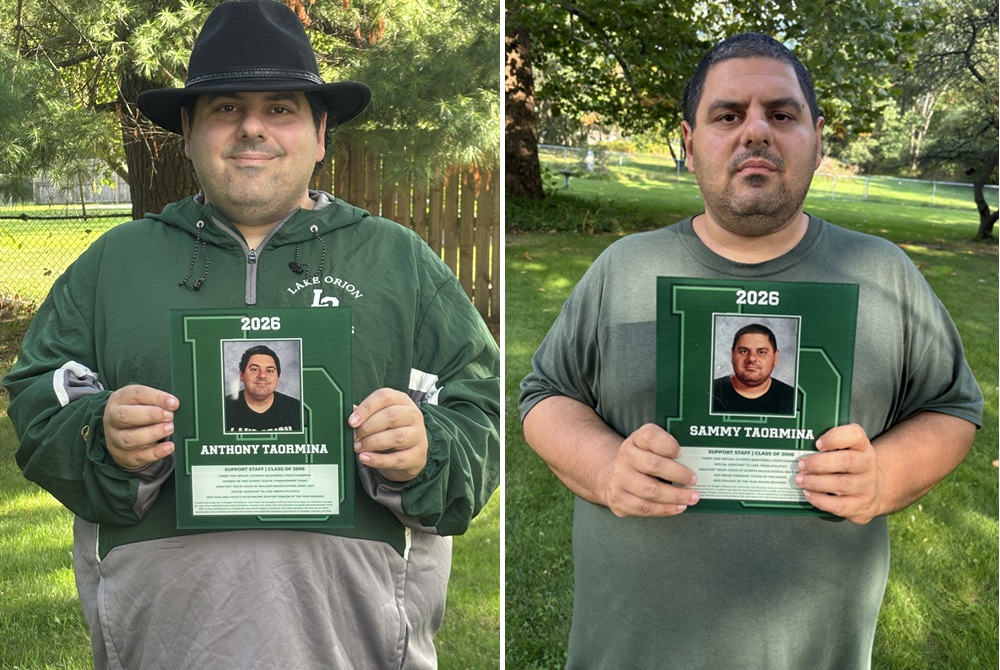
LAKE ORION — Sammy and Anthony Taormina are two fantastic examples that you don’t necessarily have to be a great athlete in high school to have a Hall of Fame impact on a school and sports community.
 Twin brothers, the Taorminas are 2006 graduates of Lake Orion High School who were members of the football and track & field teams (Sammy competed in both sports, Anthony in track) but neither stacked stats or accolades most all-state and future college athletes accumulate in high school.
Still, it was a no-brainer when Lake Orion athletic director Chris Bell and a committee chose the Taorminas to become part of the school’s first Hall of Fame class last week.
Simply put, there have been few who have had a bigger impact and served in more roles for the school than the Taorminas over the past two decades.
Both have been statisticians for teams, clock operators, announcers, mentors, and promoters of the school and athletic department. Sammy even has spent time inside a Dragon costume as the school’s mascot.
They regularly host a podcast called “OAA Now,” where coaches from around the league call in to chat and give insight on their teams. The two also have a blog where they regularly break coaching news.
During the spring, both have served as middle school track coaches, mostly presiding over throwers.
More importantly, both work for the district as middle school aides, with their friendliness and knowledge regularly mentoring kids to become better students and people.
“When you make an impact on someone’s life for the positive, then you know you’ve done your job,” Anthony Taormina said.
Students and communities are drawn to the Taorminas not only for how much they help, but because they have overcome obstacles and adversity during their lives. Both have navigated autism and related challenges.
“I originally did not want to be a mentor, but I became one,” said Anthony Taormina, who like Sammy is also a graduate of Oakland University and who served as a team manager for Oakland men’s basketball coach Greg Kampe.
That first Lake Orion Hall of Fame class also included 20 athletes, the 1990 wrestling team that won a Class A championship, and longtime track & field and cross country coach Stan Ford.
Despite all the great athletes inducted such as Mr. Baseball Award winner Randy Frye, Mr. Soccer winner Billy Weaver, all-state girls basketball player Bethany Watterworth and all-state running back Marques Stevenson, the most popular inductees were likely the Taorminas, who five years ago also were named Citizens of the Month by Orion Township.
During a football pregame ceremony Friday before Lake Orion played Rochester Adams, the Taorminas got the loudest ovation from the crowd, likely because both current students and alums know them well.
Sammy Taormina said they found out the news from Bell in August after leaving a doctor’s appointment.
“At first I was like, ‘Please don’t call me, I’m in the doctor’s office,’” he said. “Then I called back and he told me the news we were going into the Hall of Fame. We were just very ecstatic about it.”
Now, the two will have plaques displayed in the school halls for all to see, although students will still love seeing their real faces each and every day.
The Taorminas are as much a part of the fabric and identity of Lake Orion as the Dragon or lake itself, and plan on continuing to put kids first in everything they do for years to come in every role they serve.
“I would always encourage kids to be the best they can be,” Anthony Taormina said. “That’s all you can ask in this game we call life. It’s not a bad thing to be a manager or support staff person because you can be successful while not being a student-athlete. I’ve had a lot of students that may or may not have been athletes, but they end up helping me and Sammy out on several occasions, whether it be on the (score)book or on the (game) clock. Those type of things. I’m extremely proud of that.”

Keith Dunlap has served in Detroit-area sports media for more than two decades, including as a sportswriter at the Oakland Press from 2001-16 primarily covering high school sports but also college and professional teams. His bylines also have appeared in USA Today, the Washington Post, the Detroit Free Press, the Houston Chronicle and the Boston Globe. He served as the administrator for the Oakland Activities Association’s website from 2017-2020. Contact him at [email protected] with story ideas for Oakland, Macomb and Wayne counties.