

Casting Lines for Future Tournaments
August 12, 2016
By Jack Roberts
MHSAA Executive Director
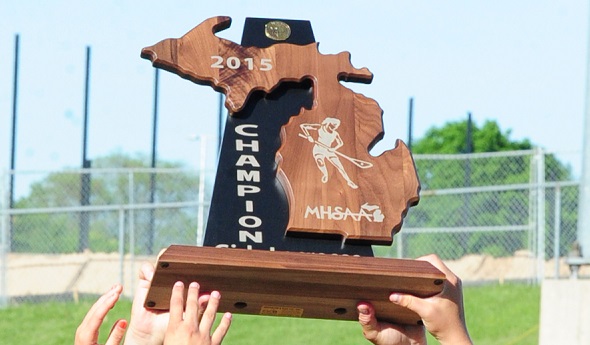
The MHSAA is best known to the public for the tournaments it conducts to conclude the fall, winter and spring seasons each school year.
These tournaments, the first and largest program of the MHSAA, have survived the Vietnam War, the Korean conflict and two World Wars. They have survived the technology bubble, the housing collapse, the energy crisis and the Great Depression.
MHSAA tournaments existed at the dawn of aviation and at the time of our nation’s lunar landing. Popes, presidents and governors have changed and changed again and again, and MHSAA tournaments roll on year after year.
But the sense of tradition and permanence and inevitability of MHSAA tournaments doesn’t dissuade us from asking questions about our tournaments, even some of the most basic questions. Here are two.
Question #1
I have long been and will always be an advocate for a Ryder Cup format for the MHSAA Golf Finals, and a team tennis approach to the MHSAA Tennis Finals; but 90 years of tradition is hard to overcome. Might this be a more exciting format? Could it be co-ed? Could it reverse the decline in boys tennis participation, and increase girls golf participation? Wouldn’t it be fun to try?
Periodically, the International Olympic Committee requires each of the designated Olympic sports to defend its status, to state its case why the sport should remain a part of the Olympic program. Then, after a series or votes that retain one sport at a time, the IOC drops the sport that makes the weakest case. It does so to make room for one of the previously unlisted sports that makes the best case for inclusion.
This would appear to keep the existing Olympic sports on their toes, and to keep the Olympic movement fresh and reflective of modern trends in sports.
While I would not enjoy the controversy, I can see the potential for some positive results if the MHSAA were to invoke the same policy for determining the 14 tournaments it will provide for girls and the 14 for boys.
This might cause us to consider more deeply what a high school sport should look like, or at least what an MHSAA tournament sport should stand for.
On the one hand, we might be inclined to drop tournaments for those sports that involve mostly non-faculty coaches and non-school venues, or require cooperative programs to generate enough participants to support a team, or resort almost entirely to non-school funding, or cater to individuals more than teams.
Or perhaps this process would cause policymakers to forget traditional thinking and ask: “In this day and age, should we shake off traditional notions of sport and consider more where modern kids are coming from?” That might mean fewer team sports and more individual sports, more “extreme” sports like snowboarding and skateboarding, and more lifetime sports, meaning not just golf and tennis and running sports, but also fishing and even shooting sports.
Currently, MHSAA policy states that the MHSAA will consider sponsorship of a tournament series for any sport which 64 member schools conduct on an interscholastic basis as a result of action by the governing boards of those schools.
Should the only question be how many schools sponsor a sport, or must an activity also have certain qualities and/or avoid certain “defects?” What should an MHSAA tournament sport look like and stand for?
Question #2
Bristling from criticism that his association is a money-grabbing exploiter of children, my counterpart in another state said, “If we were running our programs just to make money, we would do very many things very differently.” I knew exactly what he meant.
Because we care about the health and welfare of students, because we mean what we say that the athletic program needs to maximize the ways it enhances the school experience while minimizing academic conflicts, and because we try to model our claim that no sport is a minor sport when it comes to its potential to teach young people life lessons, we operate our programs in ways that make promoters, marketers and business entrepreneurs laugh, cry or cringe.
If money were the only object, we would seed and select sites to assure the teams that attracted the most spectators had the best chance to advance in our tournaments, regardless of the travel for any team or its fan base. If money were the only object, we would never schedule two tournaments to overlap and compete for public attention, much less tolerate three or four overlapping events. If money were the only object, we would allow signage like NASCAR events and promotions like minor league baseball games.
Those approaches to event sponsorship may not be all wrong; they’re just not all right for us. And we will live with the consequences of our belief system.
During a typical school year, more than 20 percent of the MHSAA’s 2,097 District, Regional and Final tournaments lose money. Not a single site in golf, skiing or tennis makes a single penny. In no sport did every District, Regional and Final site have revenue in excess of direct expenses.
In fact, in only three sports – boys and girls basketball and football – is revenue so much greater than direct expenses overall that it helps to pay for all the other tournaments in which the MHSAA invests.
That’s right: invests. When we present our budget to our board, we talk about the MHSAA’s investment in providing tournament opportunities in all those sports and all those places that cannot sustain the cost of those events on their own. How much is this investment worth to students, schools and society?
These two are core questions that require our focus far in advance of talk about scheduling, site selection, seeding and the myriad matters that too often hijack our time and attention.
Not Even Sky Seems Limit as Richards Keeps Calvary Sports Soaring
By
Tom Kendra
Special for MHSAA.com
January 4, 2024
Bradley Richards believes that life is all about trying new things, setting bigger goals and pushing yourself to new heights – in his case, literally.
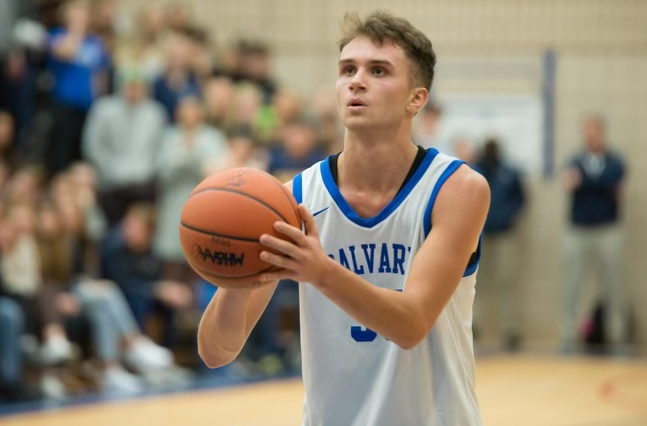
 Richards, now a 6-foot-5, 190-pound junior basketball standout at tiny Fruitport Calvary Christian, played on the school’s fifth-grade team when he was in second grade.
He remembers staring longingly at the rim in those days and dreaming about dunking, before making that dream a reality by throwing one down in February of his seventh-grade year.
While his three older sisters - Taylor, Allyson and Kelsey - were leading the Calvary girls basketball program to new heights, he vowed he would do the same with the boys program someday.
Bradley and his teammates accomplished that goal last spring, winning the school’s first boys District basketball title despite a roster with no seniors.
This season, Calvary came flying out of the gate with a 5-0 start and is now 5-2 heading into Friday’s home game against Saugatuck.
“It’s been a lot of fun,” said Bradley, who averages 29 points and 14 rebounds per game. “Our school is so small that we’re more like a family. It’s not about me. I’m just so happy for our school and all of the guys on the team.”
The next goal is to repeat as District champions and try to win a Regional title, before setting his sights at clearing 7 feet in the high jump this spring.
“I’m going to try to get past that this year,” said Bradley in his typical humble, matter-of-fact fashion.
One thing his father and fourth-year Fruitport Calvary Christian boys basketball coach Brad Richards has learned is to not put anything past his only son, the youngest of his four children.
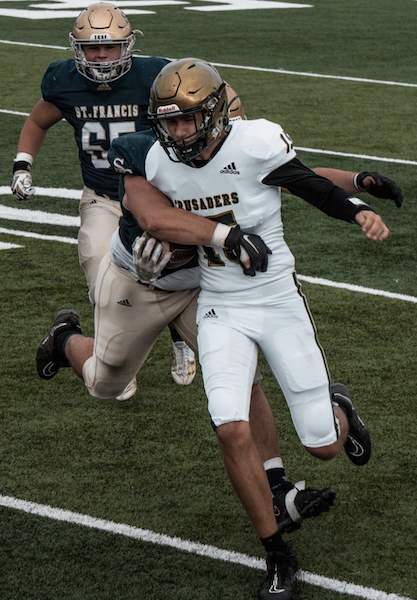
Bradley displayed an interest in music as a young boy and now sings in the school’s worship group and plays the saxophone, piano and guitar. Last fall, he played high school football for the first time as part of a cooperative agreement with Muskegon Catholic Central and wound up starting at wide receiver and defensive back for the state powerhouse program.
“He’s blessed and he’s gifted – yes,” said his father, who also coached all three of his girls during their Calvary Christian basketball careers. “But he works so hard.
“Bradley sets goals and works toward them. He’s always looking for the next thing to do.”
True to his school
One thing he doesn’t like to do is media interviews. Specifically, he doesn’t like calling attention to himself.
“He is pretty quiet and would rather have his teammates get the attention,” said his mother, Joy.
Fruitport Calvary Christian is one of the smallest schools on the entire Lakeshore with 51 students in grades 9-12, and just 17 boys in the high school.
 The Eagles take great pride in their ability to compete against much larger schools. They made a huge statement during the first full week of December with three convincing victories over bigger schools.
That week started on Tuesday, Dec. 5, with Calvary’s first-ever boys basketball win over neighbor Fruitport, a Division 2 school that competes in the Ottawa-Kent Conference Blue. Bradley scored 35 points with 14 rebounds in that game, with clutch free throws by role player Eric Dubois Quayle sealing the win.
Two days later, Richards scored 36 points with 17 rebounds in a win over Grand Rapids Sacred Heart.
Calvary then capped the 3-0 week Friday with a victory over Kent City, another Division 2 school, as Bradley scored 36 points with 18 rebounds.
Calvary is led by the “big three” of juniors Richards and Quinn Swanson and senior Sam Zelenka. Swanson, the team’s second-leading scorer with 17 points plus six rebounds and three assists per game, injured his knee last week against Schoolcraft and his health will have a huge bearing on the team’s success going forward. Zelenka is the top defender and averages 11 points, eight assists and seven rebounds.
The other starters are junior workhorse Zach McFarren, who owns the school’s shot put and discus records and has played all but six minutes over the team’s seven games, and senior Nolan Ghezzi.
Richards, already a two-time Associated Press all-state selection who even made the Basketball Coaches Association of Michigan all-state team as an eighth grader, has seen every gimmick defense to try and shut him down, including box-and-twos and triple teams. He credits his experience in football and track with helping him deal with it.
“There is usually a quick guy in front of me and a big guy behind me,” said Bradley, who scored a career-high 47 points in a game last season. “Football has really helped me, because I’m not as scared of the contact. The high jumping has helped me to elevate and get my shot off.”
Great heights
Jim McHugh is a high jump legend from Pentwater who went on to become a two-time national champion in the event at Hillsdale College, and he now coaches West Michigan athletes in the event.
The first time he worked with Bradley Richards, in April of last year, he knew he had something special on his hands.
“Bradley went up and literally hurdled the bar at 5-11,” said McHugh. “I was in shock. I said to myself: ‘This is gonna be a heck of a ride.’ The kid is a generational talent.”
The coaching of McHugh paid immediate dividends, as Bradley improved from a top jump of 6-1½ as a freshman to 6-6½ in last year’s Regional meet. Then came the Division 4 Finals at Hudsonville a few weeks later.
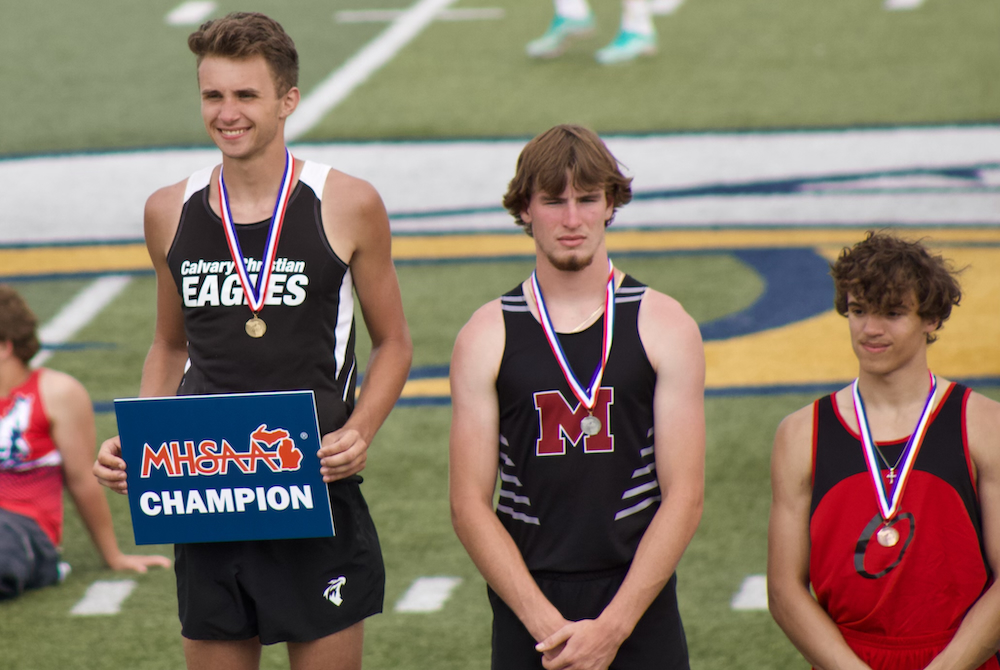
Bradley won the first track Finals championship for Fruitport Calvary with a leap of 6-10 – which was 3 inches higher than anyone else in any of the four Lower Peninsula divisions and entire Upper Peninsula that day – and caught the attention of college scouts from across the country.
 The following week, he competed at the New Balance Outdoor Nationals in Philadelphia and placed second with a jump of 6-8.24.
McHugh shudders to think of how high his prodigy can soar. He has his sights set on the Division 4 Finals record of 6-10½ (Kurt Schneider, Auburn Hills Oakland Christian, 2009), the Muskegon-area record of 7-0 (Steve Paulsen, Fremont, 1998) and the all-division/class Finals record of 7-1 (John Payment, Brimley, 1989).
“God has given him incredible talent, but he also has the desire it takes,” said McHugh, who is also working with another Division I college high jump prospect in Hart junior Addison Hovey. “I gave him a workout plan, and he has done every bit of it. He has cleaned up his diet, done the cold showers and the cold bathtubs, everything. I’m excited to see the results.”
Richards, whose first love was basketball, admits he is smitten with the high jump and seeing how high he can soar.
Now, when asked about his favorite athletes, he still mentions Michael Jordan and Kevin Durant, but he also includes Olympic gold medalist high jumper Mutaz Barshim of Qatar – who made news by not taking additional jumps at the 2020 Olympics in Japan, thereby sharing the gold medal with Gianmarco Tamberi of Italy.
“I just respect that so much, sharing the gold medal,” Bradley said.
Decision time
Now the Bradley Richards recruiting saga has begun and, for him, it’s not just about choosing what school – it’s also about choosing what sport.
“I would like to do both, play basketball and high jump in college, if possible,” Bradley said.
That would certainly be a possibility if Bradley follows in his family’s footsteps at Cornerstone University. His father was a basketball standout at Cornerstone, which is where he met Joy, and all three of his sisters played for the Golden Eagles. (Kelsey is currently a student assistant for this year’s team.)
Playing both may not be possible if he pursues high jump at the Division I level, where Michigan and Illinois are among schools actively recruiting him.
“I know at some point I’m going to have to make a decision, but I don’t have to right now,” said the 17-year-old Bradley. “So it doesn’t do me any good to sit and stress about it all the time.”
Instead, he is focused on more immediate goals.
The first is figuring out a way for his basketball team to snap a two-game losing skid and get positioned for another postseason run.
Then it will be trying to clear the magical high jump number of 7-0, and beyond. And don’t forget football, where he would love to start off his senior year by helping Muskegon Catholic improve on its 6-5 record from a year ago and make a run at the school’s 13th state football championship.
Only after all of that will it be college decision time.
“It’s not an easy choice, and it will take a lot of prayer and discernment,” admitted Richards, who will look for help from his immediate family and his school family in making his choice. “I’ll figure it out. I usually do.”
 Tom Kendra worked 23 years at The Muskegon Chronicle, including five as assistant sports editor and the final six as sports editor through 2011. E-mail him at [email protected] with story ideas for Muskegon, Oceana, Mason, Lake, Oceola, Mecosta and Newaygo counties.
PHOTOS (Top) Fruitport Calvary Christian’s Bradley Richards stands atop the podium after winning the high jump last spring at the Lower Peninsula Division 4 Finals. (Middle) Richards lines up to shoot a free throw. (Below) Playing as part of a cooperative with Muskegon Catholic Central, Richards works to get away from a Traverse City St. Francis tackler. (Track photo courtesy of Joy Richards; basketball and football photos courtesy of Local Sports Journal.)