

Get Prepped for a Fantastic Finale
May 24, 2013
By Geoff Kimmerly
Second Half editor
We love this time of year. And not just because school is nearly out for summer.
There’s little argument that the week ahead is the most exciting of each MHSAA school year. And you’ll want to set your bookmarks for MHSAA.com and Second Half for updated results and coverage not just next week – but through the rest of this spring season.
 The MHSAA.com Score Center is our home for scores from all District softball, baseball and soccer games, which begin Tuesday. You also can view real-time brackets for every District by going to the “Sports” page for each, and updated brackets for lacrosse by visiting our girls and boys pages for that sport as well.
In the Lower Peninsula, we’ll have same day or next morning results as golf Districts are played, and first-day results from next weekend’s Girls Tennis Finals on May 31 – followed by final results at the conclusion of play June 1. We’ll post Finals results for Upper Peninsula golf and tennis as we receive them Wednesday and Thursday, and then results for all seven Lower and Upper Peninsula Track and Field Finals as they come in June 1.
But results are only the start. As we have during the fall and winter, Second Half will provide coverage including photos from every MHSAA Final – beginning with Wednesday’s Upper Peninsula Girls and Boys Golf and Boys Tennis Finals. Keep an eye on Second Half throughout the week, or follow the Second Half feed on the cover page of MHSAA.com.
Transfer rule clarification
We released Monday the actions our Representative Council took earlier this month at its Spring Meeting, including an addition to the athletics-related portion of our transfer rule. Based on some questions we’ve received and read, here’s some further explanation of what will be installed for 2014-15:
The longer period of ineligibility for athletes who transfer because of athletics is not new. This has previously existed for cases in which a school could prove that it lost a student to another school purely for sports-related reasons.
What’s new is what must be proven and by whom for the longer ineligibility period to take effect. Now, a school that lost a student does not have to file a report with the MHSAA for the case to be considered. As long as one of a set of offending activities can be verified – including practicing, competing or training with a member of the new school’s coaching staff during summer or non-school sports activities or seasons – that student will have to sit 180 days instead of the usual period of roughly a semester. The 15 exemptions that allow a student to be eligible immediately – like making a full move to a new district or a student’s school closing – may still apply.
So, to conclude: The longer athletics-related ineligibility period is not new, just how athletics-related transfers are considered and reported. Click to read the full release.
Kickoff is coming
And that means we’re collecting varsity football schedules.
In fact, we have most of them thanks to our athletic directors, their secretaries, coaches and many others who chip in to help us keep complete and accurate information throughout the season.
But there are still plenty of steps in getting ready for August – and a huge one is locking down correct leagues for our teams this season, especially as schools continue to switch things up.
Check out your school’s schedule page by click on the “Schools” button in the menu bar at the top of MHSAA.com and searching for your school. Once on the school page, click the blue “Boys” button next to football. The schedule will appear in the middle of the page, with standings to the left.
See an error in a schedule or the standings? Email me at [email protected]. I thank you in advance.
Kramer’s words of wisdom
Long before Roy Kramer served as athletic director at Vanderbilt University, commissioner of the Southeastern Conference and creator of the Bowl Championship Series (BCS) for Division I college football, he coached multiple sports at East Lansing High School.
He recently was named winner of this year’s Duffy Daugherty Award, given in honor of the former Michigan State University coach to a valued coach or contributor to college football. The award, presented in East Lansing, is among those recognized by the College Football Hall of Fame.
Kramer finished his acceptance speech with a stirring endorsement of the sport that brought the crowd of more than 300 to its feet. If you’re a fan, former or current player or coach, see below.
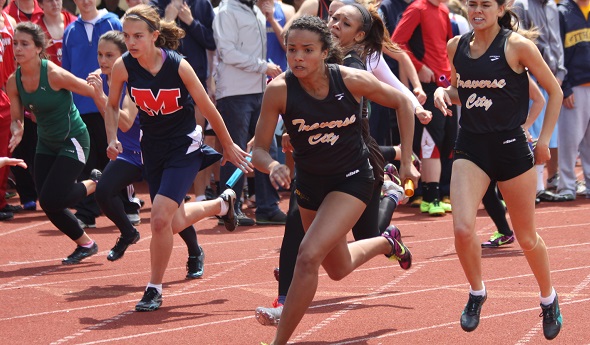
PHOTO: Athletes race toward the finish of a relay during this spring's Alma College Invitational. (Click to see more at HighSchoolsSportsScene.com.)
Generations of Dedication, Pride Fuel Milford's 34-Year Regional Hosting Run
By
Steve Vedder
Special for MHSAA.com
May 22, 2026
It may seem a bit of a stretch on the surface, but it makes perfect sense to Brian Salyers.
How can planning a wedding feature work much along the same lines as a school hosting an MHSAA Lower Peninsula Regional track meet for 34 straight seasons?
Easy, contends Salyers. Both take an immeasurable amount of planning.
"I have a couple friends who planned a wedding," said Salyers, Milford's girls track coach. "I told them I'd hosted a track meet, and they're so much alike. There are so many things you entrust other people with. There is so much work to be done, you're hoping things go smoothly."
Like a wedding, Salyers said Milford takes great pride in the event's final outcome. The meet's philosophy includes more than being a stepping stone of funneling deserving athletes along to the MHSAA Finals. At Milford, Salyers said organizers have worked diligently for more than three decades to ensure the participants not only leave with lifelong memories, but also that the meet brings together an entire community.
Volunteers from the school work alongside Milford natives not connected in any way to a track program in a multitude of roles from timing races to rototilling and raking long jump pits, selling dogs and T-shirts and taking tickets. Alumni from up to 45 years ago faithfully return to the school to pitch in whenever needed while also taking a moment to rehash old memories with former track teammates.
 Put it all together, Salyers said, and the meet is special.
"It's a melting pot," Salyers said of the mostly unpaid volunteers who work the meet. "It's like, who can come and do it this year? It's not always a fluid list because we pull from such a large group."
The large group has been banding together since 1993. Started by former Mavericks track and cross country coach Gene Balawajder, the school hosted its first Regional in 1988. After moving to a nearby site for a couple years, the Regional landed back at Milford for keeps 34 years ago. Whether it was those first Regionals in the late 1980s or the three and a half decades since, Salyers said the school and community's philosophy hasn't wavered: Take care of the athletes foremost, but also bring the community together to ensure that care happens by organization, identifying issues and swiftly taking action to solve problems.
Milford athletic director James Marszalek said the school handily recruits about 30 people for various positions, only a "handful," he said, who are paid. He said the key to ensuring a smooth meet begins with the volunteers and longtime meet organizer Chris Ceresa, a former athletic director and current assistant coach.
"The No. 1 thing is making sure we have competent people in the right positions and that we make sure it's a day the kids will remember," he said. "But it definitely takes an army."
Ceresa said much of the meet's success comes down to planning and the unselfishness of alumni. For instance, at this year's meet there were five alumni working the long jump, four on the throwing events and two on both the high jump and pole vault as well as many involved as timers.
Ceresa begins recruiting for the following year's Regional at the current event. There he seeks commitments from officials and event workers 12 months in advance.
"We take it very personally; the staff is very committed to the meet," he said. "If you talked to our colleagues at other schools, I think they would tell you they love to come here. It's quite a spectacle, a matter of pride."
The meet even features an unofficial system of where and how volunteers are used. Meet newcomers typically start out in smaller roles, eventually working themselves into the meet's most prestigious position: being an official timer for races. Unfortunately, when the meet became the last Regional in the state to go to electric timing more than a dozen years ago, there was no need for about 20 volunteers who worked as hand timers at the finish line.
 Milford boys track coach Eric Hincka ran in the meet as a junior and senior before graduating in 1998. He said while some Regionals typically run more smoothly than others, because of the hours upon hours of organization and the quality of the volunteers, the Milford event annually draws praise from visiting coaches and participants. And that's no accident, he said.
"Every year you hear horror stories of meets which have problems," he said. "We try our best to see that everything is done right so we don't run into problems. We want to honor the kids – it's our philosophy and we take pride in it.
"At Milford, it's multi-generational. Gene as the founder set the standard, and we're just trying to follow in his footsteps."
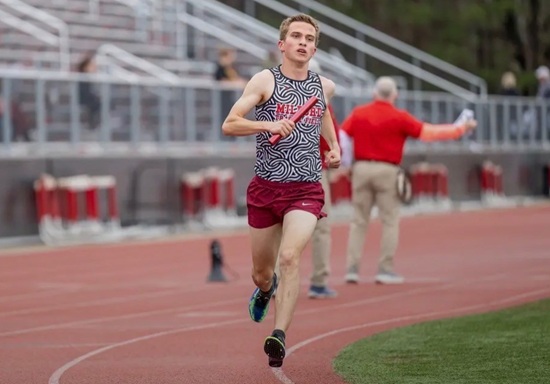
The athletes notice, Milford senior distance runner Kyle O'Rourke said. Headed to run at Michigan State next season, O'Rourke's pedigree in the meet is three-generational. His grandfather has clerked and also made T-shirts for volunteers while O'Rourke has had an older brother and sister run at the Regional. His mother also ran in the meet.
"It's touching for me to see all the old alumni to come back and work; a highlight of the season," said O'Rourke, a six-time all-stater in track and cross country. "They treasured their time here, and now many of them are part of a community that unites to make this meet run well.
"Yeah, it comes in handy (competitive-wise) that this meet is home for us. But there is also a certain pride in us hosting it. I think we all take pride in how we conduct ourselves at the Regional."
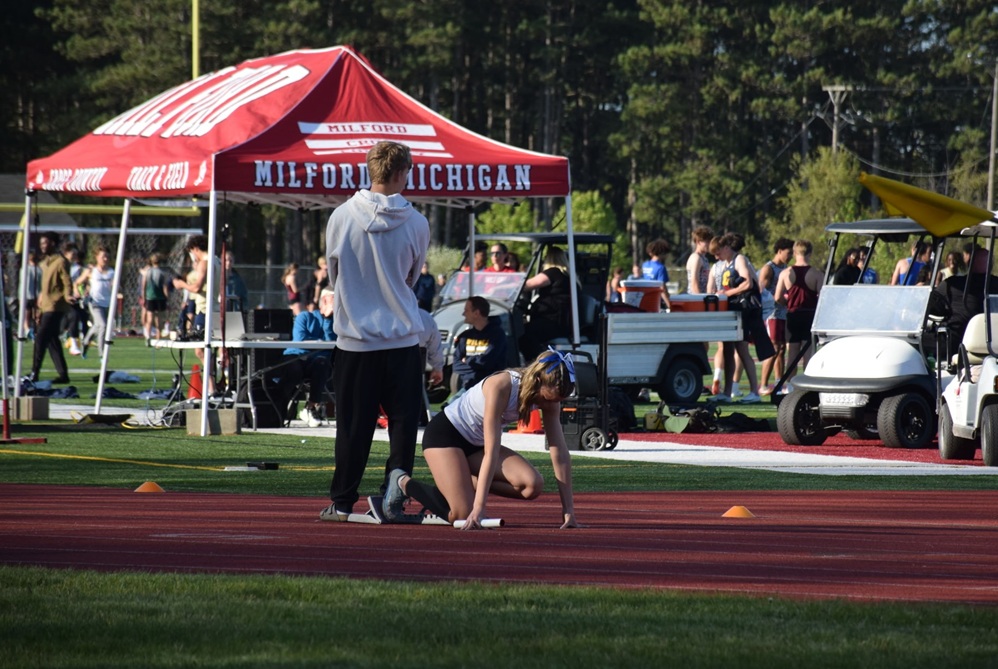
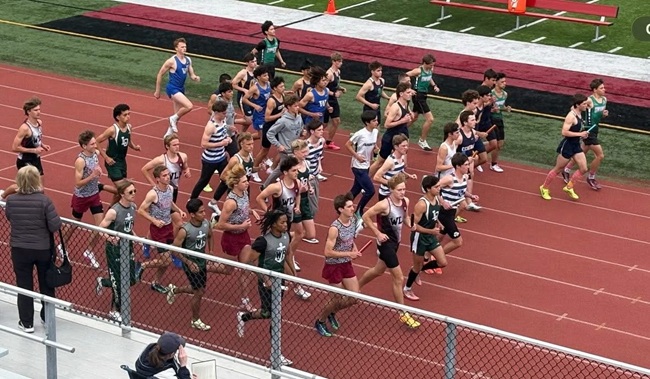
PHOTOS (Top) A relay runner sets up in a starting block during the Lower Peninsula Division 1 Regional hosted by Milford on May 15. (Middle) Runners move toward the starting line before their relay. (Below) Milford’s Kyle O’Rourke rounds a curve during a relay. (Photos courtesy of the Milford athletic department.)