

122 Schools Recognized as HEARTSafe
May 15, 2015
The Michigan departments of Health and Human Services (MDHHS), and Education (MDE); American Heart Association (AHA); Michigan High School Athletic Association (MHSAA); and Michigan Alliance for Prevention of Sudden Cardiac Death of the Young (MAP-SCDY) have awarded 122 schools in Michigan with the MI HEARTSafe School designation which recognizes schools that are prepared to respond to cardiac emergencies.
“Sudden cardiac death claims the lives of more than 300 Michigan children and young adults between the ages of one and 39 years of age each year,” said Dr. Eden Wells, chief medical executive of MDHHS. “Implementation of CPR and an automated external defibrillator (AED) within 3-5 minutes is crucial for increasing the chance of survival. Cardiac arrest is often unexpected and frightening, and I’m pleased to see so many of our schools taking preventative measures to address this health issue.”
Between 1999 and 2009 in Michigan, there were 3,134 young individuals between 1 and 39 years of age who died of sudden cardiac death. Of those, 246 were between 5 and 19 years of age. In its second year, the MI HEARTSafe Schools designation is Michigan’s commitment to reducing the number of sudden cardiac death in our youth. Last year was the first year of the program, and 40 schools were designated in Michigan.
“MDE is proud to support MI HEARTSafe schools,” said State Superintendent Mike Flanagan. “Ensuring schools are prepared for sudden cardiac emergencies through planning, training, and AEDs is an important part of having safer learning environments for students, staff, and the community.”
Public Act 12 of 2014 requires all schools (grades kindergarten to 12) to have a cardiac emergency response plan in place. This designation recognizes 122 schools that have taken steps above and beyond to prepare to respond in the event of a cardiac emergency, and is awarded for a period of three years. Click for the list of designated schools.
“The Michigan High School Athletic Association is proud to partner with the state of Michigan to promote the MI HEARTSafe Schools program,” said Jack Roberts, executive director of the Michigan High School Athletic Association. “It’s important we all do our part to help schools prepare for unexpected emergencies to keep children in our communities safe.”
In order for a school to receive a MI HEARTSafe designation, it must perform at least one cardiac emergency response drill per year, have a written medical emergency response plan and team, have current CPR/AED certification of at least 10 percent of staff, have accessible, properly maintained and inspected AEDs with signs identifying their location and ensure pre-participation sports screening of all student athletes using the current physical and history form endorsed by the Michigan High School Athletic Association.
Schools that meet all of the requirements will be able to apply for the MI HEARTSafe School designation each year. Click for more information about the MI HEARTSafe Schools program.
89 Schools Fill 2020-21 Parade of Champions
By
Geoff Kimmerly
MHSAA.com senior editor
June 24, 2021
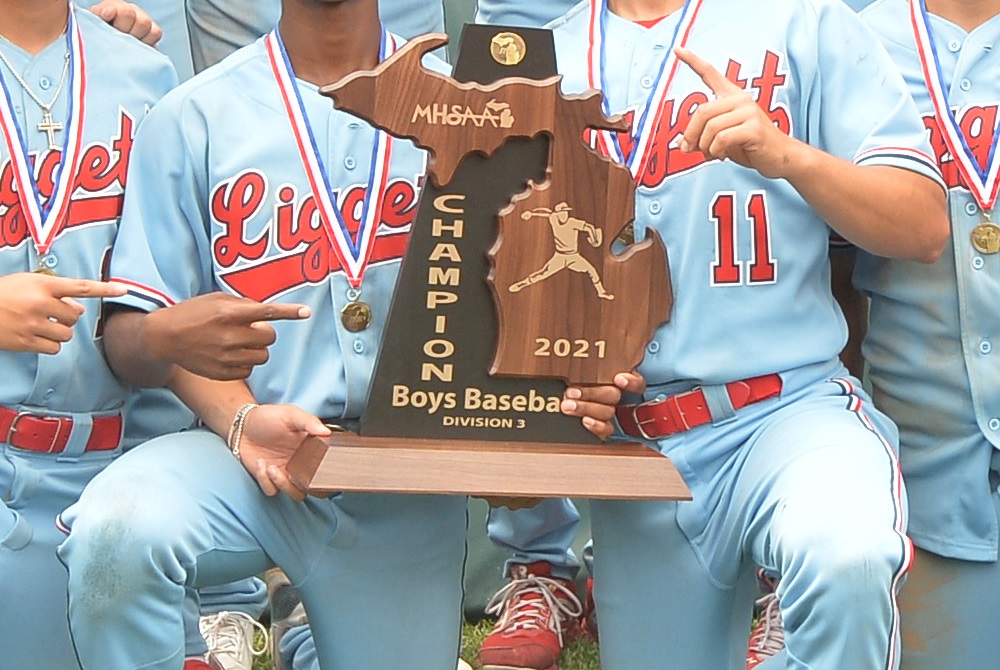
A total of 89 schools won one or more of the 132 Michigan High School Athletic Association team championships awarded during 2020-21, with two teams earning the first Finals championship in any sport in their schools’ histories.
Detroit Douglass celebrated its first MHSAA Finals championship by winning the Division 4 boys basketball title to conclude the winter, and Owosso claimed its first by earning the Division 2 softball championship this spring.
A total of 27 schools won two or more championships this school year, paced by Marquette’s five won in boys cross country, boys golf, boys swimming & diving, and both girls and boys track & field. Ann Arbor Pioneer and Grass Lake were next both with four Finals championships. Pioneer won in girls cross country, girls and boys swimming & diving and girls tennis, and Grass Lake was a champion in girls basketball, boys bowling and girls and boys track & field. Grass Lake also had participants on the Jackson Area girls gymnastics team that won its first Finals title.
Nine schools won three MHSAA Finals championships: Bloomfield Hills Brother Rice, Bloomfield Hills Cranbrook Kingswood, Bloomfield Hills Marian, Detroit Country Day, East Grand Rapids, Grand Rapids Catholic Central, Hudsonville, Petoskey and West Iron County. Winning two titles in 2020-21 were Adrian Lenawee Christian, Birmingham Seaholm, Carson City-Crystal, Detroit Catholic Central, Dollar Bay, Grand Blanc, Grand Rapids Forest Hills Northern, Grosse Pointe Woods University Liggett, Ishpeming, Kalamazoo Hackett Catholic Prep, Montague, Norway, Richmond, Rockford and South Lyon.
A total of 39 teams won first MHSAA titles in their respective sports. A total of 42 champions were repeat winners from either 2019-20 or 2018-19 for sports that did not award championships in Winter or Spring 2020 because of cancelations due to COVID-19. A total of 15 teams won championships for at least the third-straight season, while six teams extended title streaks to at least four consecutive seasons. The Rockford girls lacrosse and Lowell wrestling programs own the longest title streaks at eight seasons.
Sixteen of the MHSAA's 28 championship tournaments are unified, involving teams from the Upper and Lower Peninsulas, while separate competition to determine titlists in both Peninsulas is conducted in remaining sports.
Click for a sport-by-sport listing of MHSAA champions for 2020-21.