


2015 Bush Awards Honor 4 Veteran ADs
By
Geoff Kimmerly
MHSAA.com senior editor
June 8, 2015
Four athletic directors with a combined 103 years of service to high school athletes – Kalamazoo Hackett’s Michael Garvey, Livonia Churchill’s Marc Hage, Pewamo-Westphalia’s Barry Hobrla and Saginaw Heritage’s Peter Ryan – have been named recipients of the Michigan High School Athletic Association's Allen W. Bush Award for 2015.
Al Bush served as executive director of the MHSAA for 10 years. The award honors individuals for past and continuing service to prep athletics as a coach, administrator, official, trainer, doctor or member of the media. The award was developed to bring recognition to men and women who are giving and serving without a lot of attention. This is the 24th year of the award, with selections made by the MHSAA's Representative Council.
“All four of this year’s honorees have been leaders in Michigan’s educational athletic community for more than two decades, making impacts both easily visible and behind the scenes with their guidance and expertise,” said John E. “Jack” Roberts, executive director of the MHSAA. “We are grateful to all four for their service and pleased to honor them with the Bush Award.”
 Garvey, in his 21st school year as an athletic director, made some of his earliest educational impacts on the wrestling mat and was named the Michigan Wrestling Association’s state Coach of the Year in 1990 after leading Lawton to the Lower Peninsula Class D championship. He began his educational career at Marian Central Catholic in Woodstock, Ill., in 1981, then came to Lawton in 1985 and served there as athletic director from 1994-99. He then served as athletic director at Delton Kellogg from 1999-2006 and at Otsego from 2006-2010. He is finishing his fifth school year as Hackett’s athletic director.
Garvey is an active member of the Michigan Interscholastic Athletic Administrators Association and National Interscholastic Athletic Administrators Association. He has served on the faculty for the NIAAA’s Leadership Training Institute and as Michigan’s coordinator for the program, and also as the MIAAA’s 2nd vice president and as co-commissioner of the Kalamazoo Valley Association.
He’s been named a Regional Athletic Director of the Year by the MIAAA and received its George Lovich State Award of Merit. He’s a long-serving member of the MHSAA’s Wrestling Committee and has hosted numerous tournament events, and also has served as an MHSAA official for more than two decades registered for wrestling, baseball, softball, basketball, track & field and cross country. Garvey completed high school at The American School in London, England, and earned bachelor and master’s degrees from Western Michigan University.
“Mike Garvey is able to draw from his experiences as a successful coach and teach others to lead and achieve,” Roberts said. “His contributions to the MHSAA have been ample as a tournament host and knowledgeable voice on the Wrestling Committee, as he’s able to bring a valuable perspective of someone who has worked on the mat and in the athletic director’s role as well.”
 Hage previously worked as an advertising account executive before making a decision to instead teach and coach. A graduate of Livonia Churchill, he returned in 1990 after also teaching at Holt and Berkley. He became Churchill’s athletic director in 1996. Hage has been a member of the MIAAA and NIAAA since becoming an administrator, and twice was named the MIAAA’s Athletic Director of the Year for his region. He also has received the Lovich State Award of Merit.
Hage served as president of the former Western Lakes Activities Association and then the current Kensington Lakes Activities Association while also hosting numerous MHSAA tournament events. He has served as an instructor and presenter at MIAAA conferences and also for the Michigan Association for Health, Physical Education, Recreation and Dance.
He also remains active in a number of community efforts and previously served as coordinator of Special Olympics at Michigan State University and of the American Heart Association’s Jump Rope for Heart in Southfield, and as an instructor in lifeguarding and water safety for the American Red Cross. He earned bachelor’s degrees in communications and later physical education and a master’s in education from Michigan State University, and also studied at Thomas M. Cooley Law School.
“Marc Hage continues to be a valuable advocate for high school athletics, not only in his community but on a statewide level,” Roberts said. “His contributions to school sports at various levels have been numerous and influential, especially during his tenures as president of multiple leagues and as a presenter to his colleagues.”
 Hobrla has served as an athletic director for 29 years at Algonac, Lake Central, Ind., at Lowell from 1994-2013, and currently at Pewamo-Westphalia. He’s also served as a registered official for basketball, cross country and track & field.
Lowell added teams for girls soccer, ice hockey, boys and girls bowling, and boys and girls lacrosse while under Hobrla’s leadership. He also served as a host for MHSAA Finals in boys soccer from 1995-2006, track & field for three seasons and cross country for two.
Hobrla has served as an instructor for the MHSAA’s Coaches Advancement Program and also the National Federation Interscholastic Coaches Education Program. He served on a number of MIAAA committees and on its executive board from 2008-13, and was named a regional Athletic Director of the Year in 2006. Also while at Lowell, Hobrla served on committees for Cascade Township Parks & Recreation and the Lowell Area Trailway. He earned both bachelor and master’s degrees from Michigan State University after graduating from Lansing Everett High School.
“Barry Hobrla has worked to expand opportunities for student-athletes, and always keeps their interests in mind,” Roberts said. “As an instructor for the Coaches Advancement Program, and through his various leadership positions with the MIAAA, he continues to pass on this proper perspective for school sports to his colleagues in the field.”
 Ryan is in his 17th year with Saginaw Township Community Schools and 24th total as an athletic director. He previously served for Alma from January 1992-March 1993 and Portland from April 1993 through August 1997 before moving on to Saginaw Heritage.
A member of the MHSAA Representative Council, Ryan was named Athletic Director of the year in 2008 by the MIAAA, which also named Heritage an Exemplary Athletic Program in 2003. Ryan was an Athletic Director of the Year finalist in 2009 for the National High School Athletic Coaches Association, and was named Midwest Athletic Director of the Year in 2010 by the National Association of Sport & Physical Education.
Ryan served on the MIAAA Executive Board from 2003-07 and as its president in 2006-07, and served as MIAAA president in 2005. He’s also served on the MHSAA’s Audit and Finance Committee and hosted more than 150 tournaments during his tenures as an athletic director. Ryan also has served as the Saginaw Valley League executive director since 1999. He remains a board member for the Dow Event Center Arena, Theater and First Merit Park Amphitheater, and on the sport and recreation committee for the Saginaw Chamber of Commerce. Ryan graduated from Iron Mountain High School and then with bachelor and master’s degrees from Central Michigan University.
“Pete Ryan’s leadership and influence in educational athletics have been commendable, and his expertise in a wide range of topics has made him someone we can turn to on a variety of subjects,” Roberts said. “I watched as he served effectively during the early years of his career, and have been thankful for his contributions as he’s continued on and served with our Representative Council.”
Parade of Champions 2015-16
By
Geoff Kimmerly
MHSAA.com senior editor
June 23, 2016
By Geoff Kimmerly
Second Half editor
Seven schools hoisted Michigan High School Athletic Association team championship trophies for the first time this school year, as 99 schools total won one or more of the 130 Finals championships awarded during 2015-16.
Teams earning the first MHSAA championship in any sport for their schools were Sterling Heights Parkway Christian in baseball, Detroit Henry Ford in boys basketball, Ypsilanti Arbor Prep in girls basketball, Tawas and Clarkston Everest Collegiate in boys golf, Burton Genesee Christian in boys soccer and Bloomfield Hills in boys tennis.
A total of 37 teams won their first MHSAA titles in their respective sports. A total of 50 champions were repeat winners from 2014-15 – and 25 of those won for at least the third straight season, up from 16 that accomplished the same feat a year ago. Still, championships were more spread out this school year; the 99 schools winning at least one title were nine more than in 2014-15.
The Birmingham Brother Rice boys lacrosse team has the longest title streak of 12 seasons, while the Ann Arbor Greenhills boys tennis team has won eight straight titles for the second-longest streak overall. The Gibraltar Carlson competitive cheer and Marquette girls track & field teams share the longest girls winning streaks with six straight championships apiece.
Marquette again claimed the most MHSAA team titles, six, winning in Division 1 boys skiing and Division 1 girls skiing, Upper Peninsula Division 1 girls cross country, Upper Peninsula boys swimming & diving, and Upper Peninsula Division 1 boys track & field and girls track & field. Ishpeming won five titles, and four more schools won at least three titles – Grand Rapids Forest Hills Central, Ithaca, Negaunee and Rockford (including the championship won by the combined Rockford/Sparta girls gymnastics team.)
Sixteen of the MHSAA's 28 championship tournaments are unified, involving teams from the Upper and Lower Peninsulas, while separate competition to determine titlists in both Peninsulas is conducted in remaining sports.
For a sport-by-sport listing of MHSAA champions for 2015-16 - Click Here (PDF)
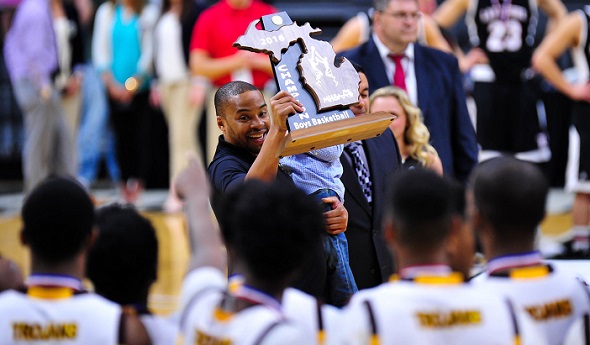
PHOTO: Detroit Henry Ford boys basketball coach Kenneth Flowers hoists his team's Class B championship trophy this winter.