

Brush Up on the New Transfer Rule
July 18, 2019
By Rob Kaminski
MHSAA benchmarks editor
Eligibility under the new “sport-specific” transfer rule begins this coming fall after circulating extensively for nearly one school year.
Unless one of the stated 15 exceptions is met, participation during the 2018-19 school year determines eligibility for 2019-20.
The new rule adopted by the Representative Council at its May 2018 meeting has found support among most audiences. A transfer student’s eligibility in 2019-20 is based upon that student’s participation from this past school year (2018-19). It will be paramount for administrators and coaches to have awareness of the sports a transfer student participated in during the previous school year.
The long-standing 15 Exceptions to immediate eligibility, such as a full and complete residential change or a student moving between divorced parents by completing of an Educational Transfer Form, did not change.
One might call the rule on the way out “The Fourth-Friday Transfer Rule.” Under this old rule, when a student enrolled at the new school determined his or her eligibility. Under the new Sport Specific Transfer rule, what a student played in the previous season determines eligibility.
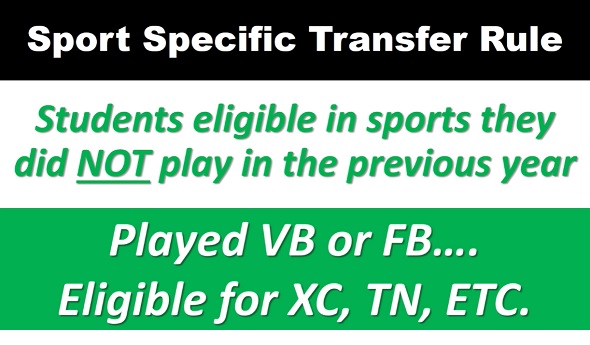
The Council passed a more lenient rule on the one hand and more restrictive on the other. The more lenient aspect is a change that finds a transfer student ELIGIBLE in any sport in which he or she did not participate in a game or a scrimmage in the previous school year.
The more restrictive portion tends to discourage students who change schools for sports reasons. A transfer student who did play a sport in the previous season – and who does not meet one of the 15 Exceptions – is NOT ELIGIBLE in that sport for the next season. If a student changes schools in mid-season, the student would be ineligible for the rest of that season in that sport and the next season for that sport.
Participation under this and other rules means playing in an interscholastic game or scrimmage after starting the 9th grade at any high school. It does not mean practice, but entering an interscholastic game, meet or scrimmage in any way. It also may involve more than one sport, so a three-sport athlete who does not have a residential change and transfers would be ineligible in those sports during the next school year – but eligible for any other sport. It also means a student cut from a team – one who never entered a scrimmage or game – may transfer and play without delay for that new school’s team. It may also mean that a student who meets one of the stated exceptions such as a residential change but enrolls in a school other than her or his school of residence, would have eligibility in sports not played in the previous year.
The new rule will tend to discourage students from changing schools for sports because they would be ineligible in any sport they have played in school the previous season for that sport. It will increase participation for some students who were otherwise not eligible under the current rule.
It is always best to contact school athletic directors who can connect with the MHSAA to verify eligibility prior to enrollment.
If the student’s new school requests in writing, the MHSAA Executive Committee may approve a waiver that reduces the period of ineligibility to 90 scheduled school days at the new school if the change of schools was for compelling reasons demonstrated with outside documentation having nothing to do with sports, curriculum, finances, and school demographics. The Executives Committee also has authority to approve immediate eligibility.

PRIVIT to Assist in Health History Effort
May 16, 2016
By Geoff Kimmerly
Second Half editor
The Michigan High School Athletic Association has announced an agreement with PRIVIT to streamline the process for the management and collection of physical health history and consent forms required for participation in high school sports. The MHSAA has designated PRIVIT’s solution, called Privit Profile, as the electronic alternative to paper forms beginning with the 2016-17 school year.
Migrating the paper process to Privit Profile will help high schools better facilitate the process of collecting personal health history information from athletes, and it will save time and costs associated with managing the paper process.
Privit Profile includes the MHSAA’s health history questionnaire and is built on PRIVIT’s patented, secure, and HIPAA (Health Insurance Portability and Accountability Act) compliant technology. The additional MHSAA forms also are included in the implementation and provide MHSAA member schools the flexibility to further tailor Privit Profile to their process. Taking the paper-based process and transitioning it online will provide athletic trainers and coaches more time to focus on Michigan’s student-athletes.
Within Privit Profile, parents of student-athletes easily complete the medical history questionnaire and take printed copies to the student-athlete’s physical exam. In subsequent years, parents only will have to update the information in Privit Profile, as opposed to completing all of the paper-based forms again.
“It has become necessary for increased detail in the requirements to participate in school sports,” said MHSAA Executive Director John E. “Jack” Roberts. “We desire more comprehensive health histories for students and more education of parents and students regarding the risks of participation, as well as the intangible rewards of competing in educational athletics. Streamlining for collection and storage of documents is a priority.”
Gathering more detailed Health Histories – including an upgrade of the previous pre-participation physical form – was the first focus of the ongoing MHSAA 4 H’s of Health and Safety effort taken up before the start of the 2009-10 school year (the other three H’s stand for Heads, Heat and Hearts).
The MHSAA will begin rolling out Privit Profile throughout local high school athletic departments beginning this month. Use of Privit Profile by schools is voluntary.
“As the importance of pre-screening athletes continues to sweep the nation, more and more state high school athletic associations are adopting Privit Profile to better manage student-athlete health information,” said Jeffrey Sopp, CEO of PRIVIT. “We are excited to be partnering with MHSAA and to be able to provide Privit Profile to schools and participants in Michigan for the 2016-17 school year. We’re looking forward to helping MHSAA member high schools and improving a manual process for years to come.”
PRIVIT® was established in 2009 and provides cloud-based patented technology for the collection, distribution, and analysis of personal health information. Considered a world-class leader in electronic pre-participation evaluations, Privit Products offer clients a more secure and standard method for acquiring and sharing the personal health information required for participation in organized sports and activities. With offices in London, Ontario and Columbus, Ohio, PRIVIT® fosters lasting relationships with physicians, athletic trainers, sports medicine organizations and international sports teams. To learn more about PRIVIT® and its Products, visit www.privit.com.