

New Math: Division & Multiplication Problems
July 25, 2017
By Jack Roberts
MHSAA Executive Director
This is the second part in a series on MHSAA tournament classification, past and present, that will be published over the next two weeks. This series originally ran in this spring's edition of MHSAA benchmarks.
High school tournament classifications went viral before there was social media and most of us knew what “viral” meant.
Much as a virus infects computers today or has created epidemics of disease around the world for centuries, high school tournament classification – once introduced – tends to spread uncontrollably. Once started, it tends to keep expanding and rarely contracts.
While we are still some distance from providing every team a trophy as a result of expanding high school tournament classification across the country, there is criticism nevertheless that we are headed in that direction – a philosophy which is supposed to exist only in local youth sports for our youngest children.
Michigan could be blamed for all this. Michigan is generally accepted as the first state to provide different classifications for season-ending tournaments for different sized schools. It started a century ago. Today, every state has various classifications for its tournaments in most if not all sports. And it is a bit ironic that Michigan – creator of the classification chaos – more than most other states has kept the number of tournament classes or divisions under control.
Yes, there is evidence that tournament classifications have expanded over the years in Michigan, especially with the relatively recent introduction of tournaments in football and the late 1990s’ move from classes to divisions in most MHSAA tournaments. But the MHSAA Representative Council has held true to its word when it expanded the playoffs for football from four classes to eight divisions: this is needed because of unique factors of football, factors that exist in no other sport; and all other sports should be capped at a maximum of four classes or divisions.
Kentucky is the preeminent defender of single-class basketball. All of its 276 high schools compete for the single state championship for each gender. In Indiana, there are still open wounds from its move in 1998 from one to four classes for its 400 schools in basketball.
Multi-class tournaments have tended to increase the number of non-public school champions, which some states are trying to lower through enrollment “multipliers,” and also tend to increase the number of repeat champions, which some states are trying to affect with “success factors” which lift smaller schools into classifications for larger schools if they take home too many trophies.
While there is considerable evidence that state tournaments do as much bad as good for educational athletics, state associations persist in providing postseason tournaments because, on balance, the experiences are supposed to be good for student-athletes. And once we reach that conclusion it is just a small leap to believe that if the tournaments are good for a few, they must be better for more – which leads to creating more and more tournament classifications. One becomes two classes, then three, then four and so forth.
While the argument is that more classifications or divisions provides more students with opportunities to compete and win, it is undeniable that the experience changes as the number of tournament classifications expands. It is not possible for state associations to provide the same level of support when tournament classifications expand to multiple venues playing simultaneously. For example, there is less audio and video broadcast potential at each venue, and less media coverage to each venue. Focus is diluted and fans diminished at each championship.
No one can argue reasonably that today's two-day MHSAA Football Finals of eight championship games has the same pizazz as the one-day, four-games event conducted prior to 1990.
In some states the number of divisions has grown so much that it is difficult to see much difference between the many season-ending state championship games and a regular-season event in the same sport.
It is a balancing act. And Michigan has been studying that balance longer than any other state, and charting a steadier course than most.
Addition by Division
The shift to Divisions for MHSAA Tournament play in numerous sports has added up to a greater number of champions for teams and individuals across the state. Following are the sports currently employing a divisional format, and the procedures for determining enrollment and classification.
In 23 statewide or Lower Peninsula tournaments, schools which sponsor the sport are currently divided into nearly equal divisions. They are:
- Baseball - 4 Divisions
- Boys Bowling - 4 Divisions
- Girls Bowling - 4 Divisions
- Girls Competitive Cheer - 4 Divisions
- LP Boys Cross Country - 4 Divisions
- LP Girls Cross Country - 4 Divisions
- LP Boys Golf - 4 Divisions
- LP Girls Golf - 4 Divisions
- Ice Hockey - 3 Divisions
- Boys Lacrosse - 2 Divisions
- Girls Lacrosse - 2 Divisions
- Boys Skiing - 2 Divisions
- Girls Skiing - 2 Divisions
- LP Boys Soccer - 4 Divisions LP
- Girls Soccer - 4 Divisions
- Girls Softball - 4 Divisions
- LP Boys Swimming & Diving - 3 Divisions
- LP Girls Swimming & Diving - 3 Divisions
- LP Boys Tennis - 4 Divisions
- LP Girls Tennis - 4 Divisions
- LP Boys Track & Field - 4 Divisions
- LP Girls Track & Field - 4 Divisions
- Wrestling - 4 Divisions
Lists of schools for each division of these 23 tournaments are posted on MHSAA.com approximately April 1. Listings of schools in Upper Peninsula tournaments for their sports are also posted on MHSAA.com. The lists are based on school memberships and sports sponsorships in effect or anticipated for the following school year, as known to the MHSAA office as of a date in early March.
In football, the 256 schools which qualify for MHSAA 11-player playoffs are placed in eight equal divisions annually on Selection Sunday. Beginning in 2017, the 8-player divisions will be determined in a like manner on Selection Sunday as well, with 32 qualifying schools placed in two divisions.
Schools have the option to play in any higher division in one or more sports for a minimum of two years.
The deadlines for "opt-ups" are as follows:
- Applications for fall sports must be submitted by April 15
- Applications for winter sports must be submitted by Aug. 15
- Applications for spring sports must be submitted by Oct. 15
Subsequent to the date of these postings for these tournaments, no school will have its division raised or lowered by schools opening or closing, schools adding or dropping sports, schools exercising the option to play in a higher division, or approval or dissolution of cooperative programs.
When the same sport is conducted for boys and girls in the same season (e.g., track & field and cross country), the gender that has the most sponsoring schools controls the division breaks for both genders.
VanderVelde Officiating Tree Branches Into 2nd Generation, Top-Tier College Football
By
Steve Vedder
Special for MHSAA.com
February 28, 2025
Mike VanderVelde always knew the apple wasn't going to fall far from the tree.
The longtime West Michigan football and basketball official correctly guessed that his son, Michael, who had accompanied his father to countless Friday night football games before he was even out of elementary school, would eventually pick up the family mantle of officiating. VanderVelde said he saw in his young son many of the key attributes an official must possess: a keen eye for details, an overwhelming desire to improve, patience and a love of sports.
Put it all together, and VanderVelde has seen his son evolve into one of the nation's top NCAA football officials.
"I think it was just like with any kid, he liked the competition," said Mike VanderVelde, who retired three years ago at the age of 78 after officiating in the Grand Rapids area for 61. "I guess it would be crazy to say now, but even then there was something about Michael that was going to make him a good official. It wasn't (following) me."
Michael, a Grandville High School and Hope College graduate, has gone from working middle school football games to make extra money in college to officiating eight college bowl games, including this year's Sugar Bowl national quarterfinal Jan. 2 in New Orleans and the semifinal Jan. 9 at the Orange Bowl in Miami. VanderVelde's first bowl game was the 2017 Bahamas Bowl, and he also officiated the 2024 Rose Bowl, the national semifinal between eventual champion Michigan and Alabama.
 Before reaching those heights, Michael said some of his earliest sporting moments came when he was a ball boy jogging along the sideline while his father was working on the field. VanderVelde figures he was barely 8 years old, but he remembers being taught by his father to pay attention to detail. He also considers his father a major influence in his decision to pursue football officiating at the highest level.
"I'd buy that, absolutely. I loved spending time with my dad on Friday nights. That was definitely a common bonding time,” Michael VanderVelde said. “I'd see the smile on his face and see his passion for football. I'd see subtle little hints, and I'd pick up on that. The seed was definitely planted.”
Even as a youngster who was yet to see middle school, Michael said he understood the necessity of being where he was supposed to be as a ball boy. It was one of his first lessons in accepting responsibility and that actions had consequences.
"I would hand the ball to the umpire and pay attention to the game, and do what they needed me to do," he said. "And then I'd hang out with the crew after the games. Just being around the game and watching and being close to it, I loved it."
Both VanderVeldes entered officiating on the ground floor. Mike began doing YMCA fifth and sixth grade and church league basketball games at Grand Rapids' Franklin Park during the 1950s. He eventually graduated to working about 75 high school football and basketball games a year along with officiating Great Lakes Intercollegiate Athletic Conference and Michigan Intercollegiate Athletic Association football games. VanderVelde also coached football, tennis and junior high basketball at Wyoming Kelloggsville High School for 30 years.
"I've always been involved with athletics; I've really enjoyed it," Mike said. "I always thought of (officiating) as a challenge. I wanted to see what I could do. It intrigued me, trying something new. It just clicked with me, and I kept going and I never really stopped."
The younger VanderVelde also started at the youngest levels, officiating fourth through sixth-grade football games before he graduated from high school in 2003. Then to make extra money while in college, VanderVelde took on freshman, junior varsity and his first varsity football game at Saranac. He eventually worked high school basketball games before moving to Colorado and doing Southland Conference games for three years beginning in 2013. VanderVelde went on to work for three years in the Mountain West Conference and now officiates Big 12 games while living in Louisiana.
While many fans often fail to grasp the pressures an official faces while working major college football bowl games, VanderVelde said he's thrilled to reach that elite level of officiating.
 "It's a blast," he said. "To be there with other officials and doing things like working with the replays, getting the calls correct, 11 on 11 football and being on the biggest stage, I love it."
As for the recently completed college season, VanderVelde was honored that the NCAA – in a rare break from tradition – chose his crew to work back-to-back Notre Dame games in the Sugar and Rose Bowls. The NCAA typically will not assign the same crew to the same team two weeks in a row. It was an extraordinary gesture signaling the high esteem in which the crew is held, not only by the NCAA but with the blessing of all teams involved.
"It's tough to work back-to-back games like that, but I think the crew did an excellent job," he said. "There was no controversy, and I think we felt comfortable being assigned those games."
Considering his officiating success, VanderVelde said there is one step yet to take, one more hurdle to leap: the NFL. VanderVelde. who works United Football League games in the spring, has been part of the league's Mackie Development Program for the last two years. He's already worked Hula Bowl games and would gladly consider moving along to working on Sundays.
"I'd love to have that opportunity if it was ever presented to me," he said. "It'd be cool, but there are no guarantees. You know that snap by snap, you're only as good as your last game. But it's something I'd like to do some day.
"In football all you can do is look at your next assignment and try to do it well. It's exciting, but you're always trying to go on to the next game without a hitch."
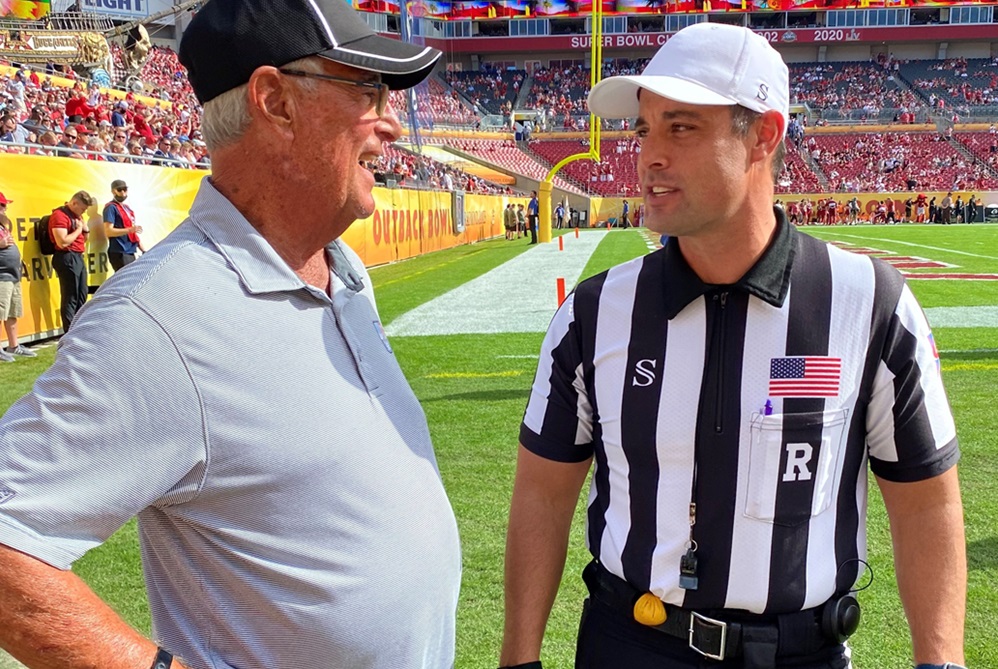
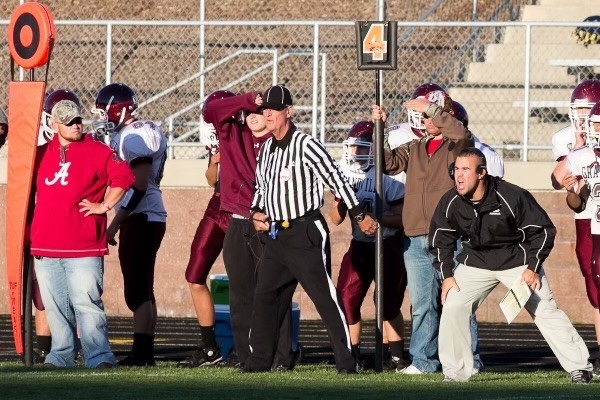
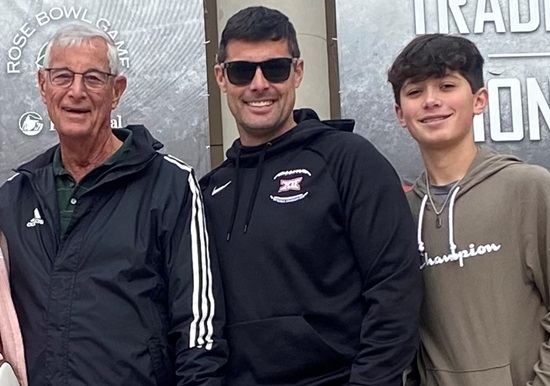
PHOTOS (Top) Longtime MHSAA official Mike VanderVelde, left, and son Michael share a moment during Michael’s officiating assignment at the 2021 Outback Bowl in Tampa Bay, Fla. (Middle) Mike VanderVelde officiates a Grandville High school game. (Below) From left: Mike VanderVelde, Michael VanderVelde, and Michael’s son Hayden. (Photos provided by the VanderVelde family.)