

New Math: Division & Multiplication Problems
July 25, 2017
By Jack Roberts
MHSAA Executive Director
This is the second part in a series on MHSAA tournament classification, past and present, that will be published over the next two weeks. This series originally ran in this spring's edition of MHSAA benchmarks.
High school tournament classifications went viral before there was social media and most of us knew what “viral” meant.
Much as a virus infects computers today or has created epidemics of disease around the world for centuries, high school tournament classification – once introduced – tends to spread uncontrollably. Once started, it tends to keep expanding and rarely contracts.
While we are still some distance from providing every team a trophy as a result of expanding high school tournament classification across the country, there is criticism nevertheless that we are headed in that direction – a philosophy which is supposed to exist only in local youth sports for our youngest children.
Michigan could be blamed for all this. Michigan is generally accepted as the first state to provide different classifications for season-ending tournaments for different sized schools. It started a century ago. Today, every state has various classifications for its tournaments in most if not all sports. And it is a bit ironic that Michigan – creator of the classification chaos – more than most other states has kept the number of tournament classes or divisions under control.
Yes, there is evidence that tournament classifications have expanded over the years in Michigan, especially with the relatively recent introduction of tournaments in football and the late 1990s’ move from classes to divisions in most MHSAA tournaments. But the MHSAA Representative Council has held true to its word when it expanded the playoffs for football from four classes to eight divisions: this is needed because of unique factors of football, factors that exist in no other sport; and all other sports should be capped at a maximum of four classes or divisions.
Kentucky is the preeminent defender of single-class basketball. All of its 276 high schools compete for the single state championship for each gender. In Indiana, there are still open wounds from its move in 1998 from one to four classes for its 400 schools in basketball.
Multi-class tournaments have tended to increase the number of non-public school champions, which some states are trying to lower through enrollment “multipliers,” and also tend to increase the number of repeat champions, which some states are trying to affect with “success factors” which lift smaller schools into classifications for larger schools if they take home too many trophies.
While there is considerable evidence that state tournaments do as much bad as good for educational athletics, state associations persist in providing postseason tournaments because, on balance, the experiences are supposed to be good for student-athletes. And once we reach that conclusion it is just a small leap to believe that if the tournaments are good for a few, they must be better for more – which leads to creating more and more tournament classifications. One becomes two classes, then three, then four and so forth.
While the argument is that more classifications or divisions provides more students with opportunities to compete and win, it is undeniable that the experience changes as the number of tournament classifications expands. It is not possible for state associations to provide the same level of support when tournament classifications expand to multiple venues playing simultaneously. For example, there is less audio and video broadcast potential at each venue, and less media coverage to each venue. Focus is diluted and fans diminished at each championship.
No one can argue reasonably that today's two-day MHSAA Football Finals of eight championship games has the same pizazz as the one-day, four-games event conducted prior to 1990.
In some states the number of divisions has grown so much that it is difficult to see much difference between the many season-ending state championship games and a regular-season event in the same sport.
It is a balancing act. And Michigan has been studying that balance longer than any other state, and charting a steadier course than most.
Addition by Division
The shift to Divisions for MHSAA Tournament play in numerous sports has added up to a greater number of champions for teams and individuals across the state. Following are the sports currently employing a divisional format, and the procedures for determining enrollment and classification.
In 23 statewide or Lower Peninsula tournaments, schools which sponsor the sport are currently divided into nearly equal divisions. They are:
- Baseball - 4 Divisions
- Boys Bowling - 4 Divisions
- Girls Bowling - 4 Divisions
- Girls Competitive Cheer - 4 Divisions
- LP Boys Cross Country - 4 Divisions
- LP Girls Cross Country - 4 Divisions
- LP Boys Golf - 4 Divisions
- LP Girls Golf - 4 Divisions
- Ice Hockey - 3 Divisions
- Boys Lacrosse - 2 Divisions
- Girls Lacrosse - 2 Divisions
- Boys Skiing - 2 Divisions
- Girls Skiing - 2 Divisions
- LP Boys Soccer - 4 Divisions LP
- Girls Soccer - 4 Divisions
- Girls Softball - 4 Divisions
- LP Boys Swimming & Diving - 3 Divisions
- LP Girls Swimming & Diving - 3 Divisions
- LP Boys Tennis - 4 Divisions
- LP Girls Tennis - 4 Divisions
- LP Boys Track & Field - 4 Divisions
- LP Girls Track & Field - 4 Divisions
- Wrestling - 4 Divisions
Lists of schools for each division of these 23 tournaments are posted on MHSAA.com approximately April 1. Listings of schools in Upper Peninsula tournaments for their sports are also posted on MHSAA.com. The lists are based on school memberships and sports sponsorships in effect or anticipated for the following school year, as known to the MHSAA office as of a date in early March.
In football, the 256 schools which qualify for MHSAA 11-player playoffs are placed in eight equal divisions annually on Selection Sunday. Beginning in 2017, the 8-player divisions will be determined in a like manner on Selection Sunday as well, with 32 qualifying schools placed in two divisions.
Schools have the option to play in any higher division in one or more sports for a minimum of two years.
The deadlines for "opt-ups" are as follows:
- Applications for fall sports must be submitted by April 15
- Applications for winter sports must be submitted by Aug. 15
- Applications for spring sports must be submitted by Oct. 15
Subsequent to the date of these postings for these tournaments, no school will have its division raised or lowered by schools opening or closing, schools adding or dropping sports, schools exercising the option to play in a higher division, or approval or dissolution of cooperative programs.
When the same sport is conducted for boys and girls in the same season (e.g., track & field and cross country), the gender that has the most sponsoring schools controls the division breaks for both genders.

East Kentwood Friends Continuing to Excel as NCAA Champ, Pro Soccer Keeper
By
Steve Vedder
Special for MHSAA.com
August 8, 2022
Maia Perez and Gabriela Leon saw it coming.
In fact, the two 2017 East Kentwood all-staters each predicted remarkable post-high school success for each other long before graduation.
Perez was a four-year letterwinner as a soccer goalkeeper who led the Falcons to the Division 1 Semifinals as a sophomore and now plays professionally in Los Angeles. Leon, an all-state pole vaulter in high school, recently became University of Louisville's first NCAA champion in that event.
The two say the success doesn't come as a surprise to either, that part of that success can be explained because they continually pushed each other athletically at East Kentwood.
"Obviously there are a lot of good athletes at East Kentwood, and she was one of those amazing athletes," Perez said of Leon. "When she accomplished something, I wanted to do something big, too. I was all-state in soccer, she was all-state in track, and it was nice to have someone push you, even on days when you didn't feel like being pushed."
Leon credits Perez for helping her grasp the difference between toiling as an ordinary athlete and rising to an elite status as early as the ninth grade.
"When you see high-caliber athletes in the state finals, I think you see the struggles that others don't see," Leon said. "I saw what she was doing, and I learned from that. I learned, and I think she did too, that you have to work hard to be good, to achieve your goals. There is definitely mutual respect between us."
 The two met as freshmen and quickly became friends. They originally had soccer in common as both played junior varsity as freshmen before Perez was promoted to varsity later that spring. The teammates began hanging out together off the field, be it at the beach or while taking the school's advanced physical education class together. By the time they were sophomores, however, it had become apparent that Perez's future – despite being a good basketball player – would remain in soccer, while Leon – who had also lettered in volleyball and cross country – narrowed her focus to track.
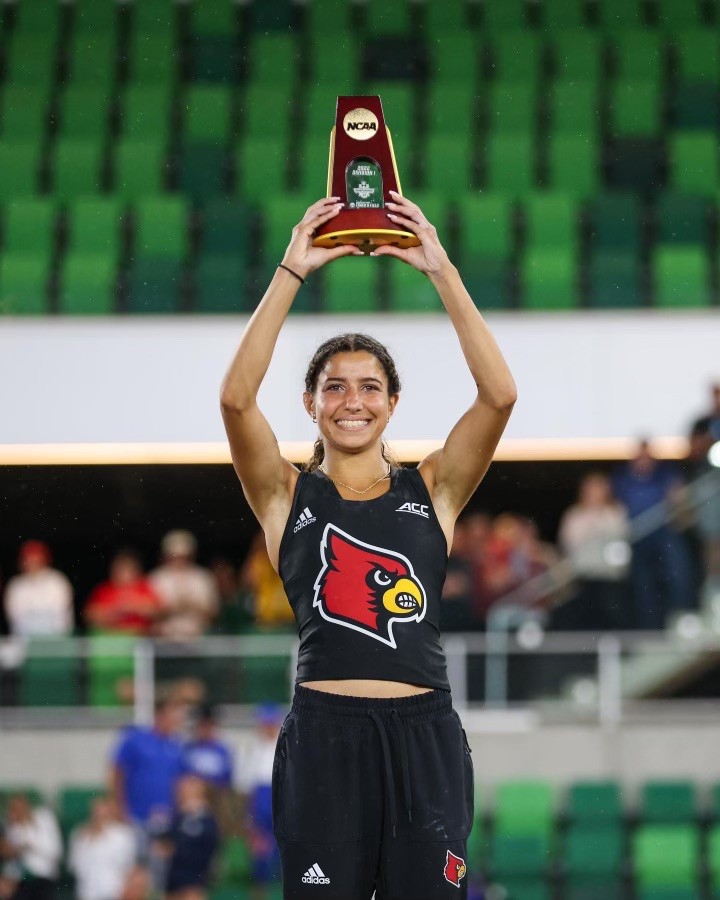
Both excelled after leaving East Kentwood. Leon had earned her first top-eight MHSAA Finals places as a sophomore, and as a senior placed fourth in pole vault, third in long jump and ran on the fourth-place 400 relay and third-place 1,600 relay as East Kentwood finished third in Lower Peninsula Division 1. Her high school personal records were 13 feet in pole vault and 18-11 in long jump (with a wind-aided 19-7). She broke Louisville's indoor and outdoor records in the pole vault as a sophomore and never looked back. She won the 2022 NCAA outdoor championship in June with a jump of 15-feet, one inch (4.6 meters) while becoming just the fourth collegian ever to amass three clearances over 4.6 meters.
Perez was a three-time Ottawa-Kent Conference Red soccer pick in high school who helped the Falcons in 2015 to their best postseason finish, when they lost to 1-0 in a Semifinal to eventual Division 1 champ Saline. She went on to play at University of Hartford after attracting interest from other programs including Western Michigan, Coastal Carolina and Pittsburgh. She wound up playing every minute of all 37 of her starts as a sophomore and junior while missing just 45 minutes over 19 games as a freshman. COVID-19 wiped out the program's season when Perez was a senior. Still, she is eighth on the school's all-time saves list with 206 while ranking 10th in shutouts with 12.
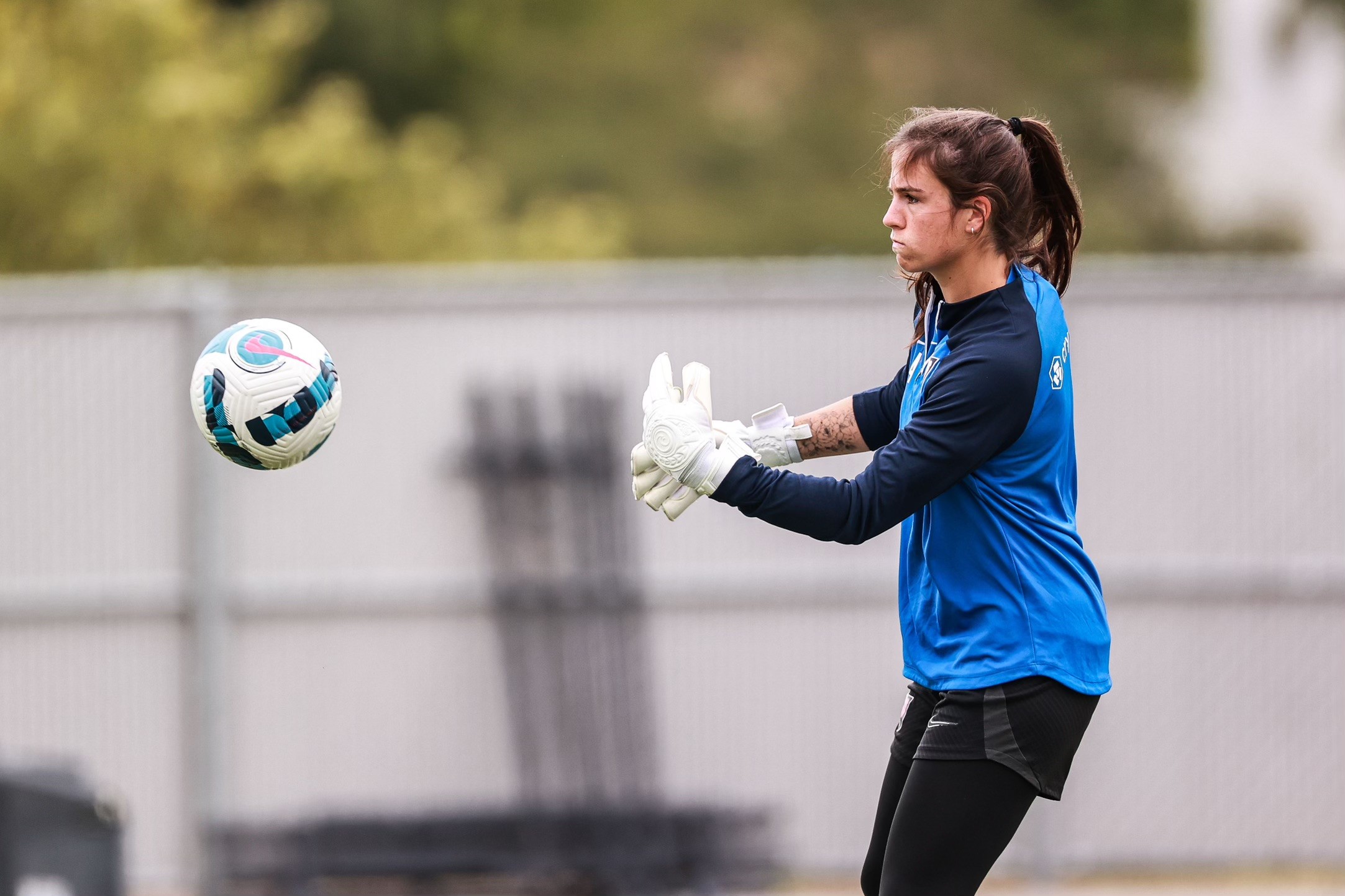
Following college, Perez was signed by the Los Angeles-based Angel City FC of the National Women’s Soccer League. While she wasn't drafted by any NWSL club, Perez impressed coaches enough during a tryout to land a spot on the team's "Discovery List" as the youngest of three goalkeepers.
"Things have been going real well for me there," Perez said. "I feel like I've improved a ton."
While Perez credits Leon with pushing her as an athlete, she said the two didn't necessarily dwell on what they accomplished in high school. They did, however, compare notes on the similarities it took for both to succeed, both physically and mentally.
"We didn't necessarily talk about (honors) a lot," Perez said. "We both knew what each other accomplished, and I don't think we need to talk about it. But I just knew one day she would be really good in track."
 Leon said the trait which stuck out about Perez in high school was her competitive drive. She hated to lose, Leon said.
"She was always a very impressive athlete," Leon noted. "She always had (success) in her because she was a real hard worker. Going into high school you could see her work ethic. We had a mutual friendship, and I saw what a work ethic and being humble could do for you."
As for herself, Leon, like many athletes, explored playing many sports. But she always came back to track.
"I always wanted to be the best athlete I could be," she said. "I was never just satisfied with just doing something. I always had this deep desire to perform to the best of my ability."
Perez remembers the first sport which interested her was skateboarding. In fact, the first time Perez met then-East Kentwood coach John Conlon, she told him she was only marginally interested in soccer. Conlon, who led East Kentwood’s girls and boys programs to a combined 654 wins and the boys varsity to five Division 1 championships, quickly made a convert of Perez.
"It's funny how things work out," Perez said. "I was looking for something that I could really be a part of, and now it's my job and I'm so happy I can say I'm getting paid for something I really like."
2021-22 Made in Michigan
Aug. 3: 3-Time Finals Champ Cherishes Memories, Considering Golf Future - Read
Aug. 1: Lessons Learned on Track Have Jibowu's Business Surging to Quick Success - Read
July 28: Running Set Life's Stage for Grosse Pointe South's Record-Setting Meier Sisters - Read
July 25: 2005 Miss Basketball DeHaan Cherishing Newest Title: 1st-Time Mom - Read
July 21: Championship Memories Still Resonate with St. Thomas Star Lillard - Read
July 14: Portage Central Champ Rolls to Vanderbilt, Writing Next Chapter in Alabama - Read
July 12: Coaching Couple Passing On Knowledge, Providing Opportunities for Frankfort Wrestlers - Read
June 30: Hrynewich's Star Continuing to Rise with Olympic, Pro Sports Arrivals - Read
PHOTOS (Top) Clockwise from left, Gabriela Leon competes for the East Kentwood and University of Louisville track & field teams, and Maia Perez plays soccer for East Kentwood and trains for the NWSL's Angel City FC. (Middle) Leon holds up her NCAA championship trophy in June. (Below) Perez is one of three keepers for Angel City FC. [Photos courtesy of East Kentwood's athletic department (2017 soccer), Run Michigan (2017 track & field), the Louisville athletic department (2022 track & field) and Will Navarro/Angel City FC (2022 soccer).]