


Be the Referee: Correcting a Down
September 10, 2015
This week, MHSAA assistant director Mark Uyl discusses how officials at the high school level have the authority to correct an error in what down is being played.
Be The Referee is a series of short messages designed to help educate people on the rules of different sports, to help them better understand the art of officiating, and to recruit officials.
Below is this week's segment - Correcting a Down - Listen
For anyone who has followed football for a long time, perhaps the most famous “5th down” game was back in 1990 between Colorado and Missouri.
In that game, the officials mistakenly gave Colorado an extra down while trailing by four points. On the “fifth down” play, Colorado scored a touchdown on the final play of the game to win 33-31.
Under high school rules, the officiating crew has the ability to correct an error of the wrong down as long as it is done before the next snap. For example, if the crew realizes a team has been given an extra down, that play would be nullified and the ball would correctly go over to the other team.
Past editions:
Sept 3: Spearing - Listen
Aug. 27: Missed Field Goal - Listen
Be the Referee: Hockey Overtime
By
Paige Winne
MHSAA Marketing & Social Media Coordinator
March 7, 2023
Be The Referee is a series of short messages designed to help educate people on the rules of different sports, to help them better understand the art of officiating, and to recruit officials.
Below is this week's segment – Hockey Overtime - Listen
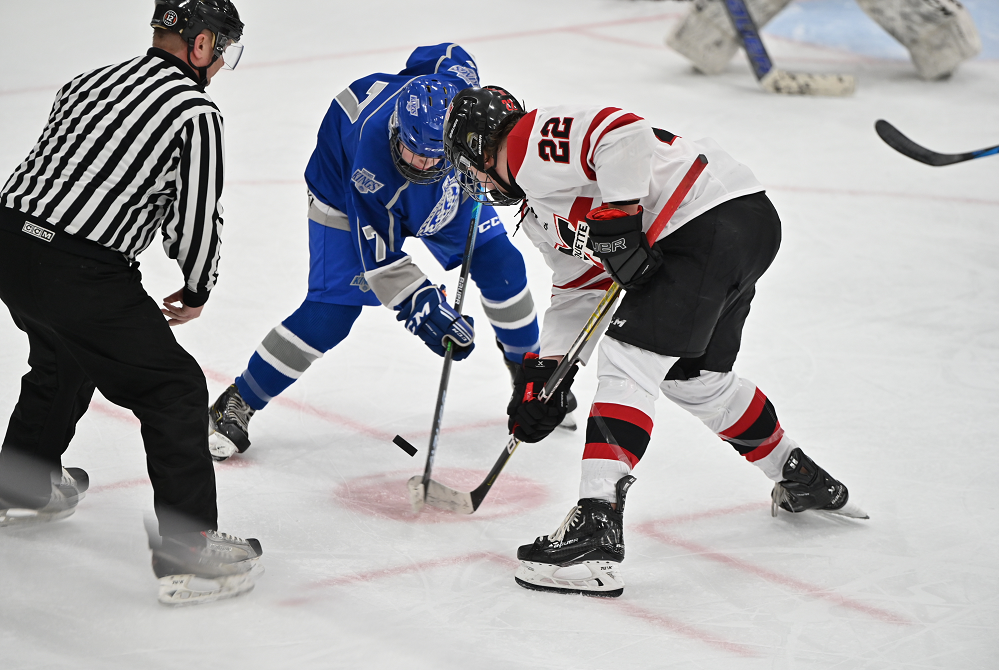
There may be nothing more exciting than overtime hockey in the playoffs. So what happens in the MHSAA Ice Hockey Tournament when a winner cannot be determined after three periods?
If a game is tied at the end of regulation, sudden victory overtime is played for a maximum of four, 8-minute overtime periods. If someone scores a goal in one of those periods, they win – game over.
But if it’s still tied after four overtime periods, then the fifth overtime period and any additional overtime periods are played 4 on 4 until a winner is determined.
Let’s say a team starts the fifth OT with two players in the penalty box. Then that period will start 5 on 3 until the penalties expire. Then, at the first stoppage – teams revert to 4 on 4.
Previous Editions:
Feb. 28: Baker Bowling - Listen
Feb. 21: Ski Finish - Listen
Feb. 14: Swimming Touchpads - Listen
Feb. 7: In or Out-of-Bounds in Wrestling - Listen
Jan. 31: Over the Back - Listen
Jan. 24: Competitive Cheer Judges - Listen
Jan. 17: More Lines - Listen
Jan. 10: On the Line - Listen
Jan. 3: Basketball Measurements - Listen
Dec. 13: Pregame Dunks - Listen
Dec. 6: Gymnastics Judges - Listen
Nov. 22: Football Finals Replay - Listen
Nov. 15: Back Row Illegal Blocker - Listen
Nov. 8: Swim Turn Judges - Listen
Nov. 1: Soccer Referee Jersey Colors - Listen
Oct. 25: Cross Country Tie-Breaker - Listen
Oct. 18: Soccer Shootouts - Listen
Oct. 11: Safety in End Zone - Listen
Oct. 4: Football Overtime Penalty - Listen
Sept. 27: Kickoff Goal - Listen
Sept. 20: Soccer Timing - Listen
Sept. 13: Volleyball Replays - Listen
Sept. 6: Switching Sides - Listen
Aug. 30: Play Clock - Listen
Aug. 23: Intentional Grounding Change - Listen