

Yale Kohler's Krazies Rise to Roar
January 27, 2015
By Geoff Kimmerly
Second Half editor
YALE – The magnitude of last season’s Boys Basketball District Final gave Yale’s “Kohler's Krazies” a glimpse of their potential as a booming student cheering section.
But a 90-minute delay during that eventual overtime loss to Imlay City showed junior Karli Klocke how a collection of her classmates watching a basketball game could impact their entire school.
 The game was forced into an unexpected break after humidity in the gym made the floor too slippery. The teams went to their locker rooms during clean-up, and many of the 1,000 fans in the sold-out stands took their seats.
And despite the wait, all of more than 100 Krazies stayed through the final buzzer.
“I just like how it brought everybody, all grades, together,” Klocke said. “And during that hour and a half, we were all sitting there together. We’ve never been a group that’s usually been all together.”
Ten months later, the Krazies have ridden the momentum of that March evening – and grown into a top-five contender for this season’s Battle of the Fans IV championship.
Yale hosted the latest MHSAA finalists visit Friday for its boys basketball game against Almont. Reigning champion Beaverton was the first tour stop, Jan. 16, with Buchanan scheduled for this Friday and then St. Johns and Dowagiac over the next three weeks leading up to the naming of this year’s champion Feb. 20. The public may vote for its favorite on the MHSAA’s Facebook, Twitter and Instagram sites beginning Feb. 17, with the MHSAA Student Advisory Council taking results into consideration when selecting the champion after the vote has concluded.
The Krazies were first-time BOTF applicants this winter, following the transformation of a section that existed on a much smaller and informal scale over the last half-decade.
The former Kohler’s Kids, then Kohler’s Krew and Krew 2.0 before becoming the Krazies for 2013-14 – all in recognition of boys hoops coach Garnett Kohler – previously was a group of 20-40 upperclassmen who gathered to cheer on the team.
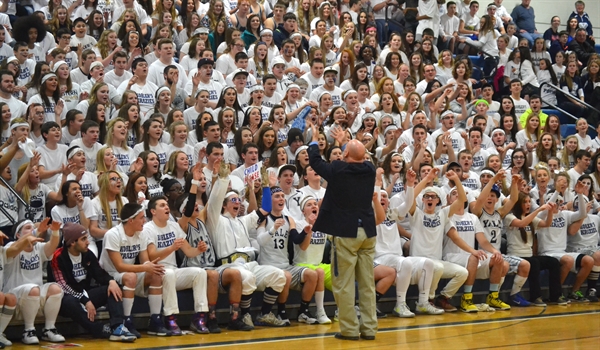
With last season’s District turnout helping fuel the effort, new section leaders this fall began organizing a section that would be more inclusive – encouraging the entire student body to take part – and have enjoyed immediate results. The Krazies swelled to an estimated 450 and filled a quarter of Yale’s gym to the rafters for Friday's girls and boys hoops doubleheader.
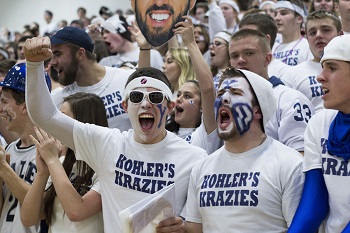 There hasn’t been anything complicated about Yale’s campaign; it’s as simple as trying to get more students to watch games together. And the Krazies have a rather straightforward goal for each game night; they don't stop cheering, aside from halftime, from the opening tip until the final buzzer – even when Yale's lead tops 20 points.
“This is such a new thing, everybody’s so excited about it and they just want to be a part of it,” junior Kaylee Schiffelbine said.
The Krazies took steps toward formalizing last season, when a group of four seniors sold T-shirts and created some of the favorite cheers. But their vision for the section was “small,” senior Spencer French said, and he and a few others began talking over the summer about how to expand it.
For starters, the section would no longer be about juniors and seniors only. Over two weeks this fall, the Krazies sold 210 section T-shirts – three times more than the year before. They started Facebook and Twitter feeds to get the word out, and parents joined in the social media loop; the Krazies’ BOTF application video enjoyed more than 1,000 views in just a few days after it was posted and now has been watched more than 5,000 times.
“Even with the video, (we thought) it would be cool to get top five (of BOTF),” senior Robert Vinckier said, “but getting the video shared around, it gets more people in the game, and they see how fun it is.
“We’re such good friends with the players on the team, so we’d go to the game whether we had a student section or not. But we might as well have more fun while we’re watching them play.”
The section’s rallying cry for 2013-14 could’ve been summed up as “wear your shirt and show up.”
“Wear your shirt and show up” should now include the word “early.” Although the girls varsity game Friday didn’t begin until 6 p.m., the first Krazies showed at 4:30 to secure seats closest to midcourt and the floor.
And the Krazies are a basketball cheering section in the literal sense. They cheered, nearly non-stop, through the end of a mostly one-sided 68-46 win by their boys team. Of course, they mixed some creative frills – bowling using the Bulldog mascot to knock down a group of fans, and the first superintendent-led roller coaster in BOTF tour history – but those merely kept the mood amped during breaks in play.
The objective is simple as well – be loud. Loud enough that an opposing player tweets that the section is “crazy.” Loud enough to encourage a rumor the Krazies won’t be allowed to cheer at a rival’s gym later this season. Loud enough to force an opponent’s point guard to motion to his bench because he can’t hear his coach yelling in the plays. Loud enough that Yale’s coach and players also had to come up with hand signals so they could communicate over the blare.
“Loud” would’ve been an understatement Friday. The Krazies’ roar, heard standing on the opposite side of Yale’s gym, registered noticeable decibels above the norm for a high school game.
French admits he didn’t know what they were taking on when he and a group of about 10 began meeting twice a week in late October armed only with ideas and what senior Steven Jordan calls “unwritten rules of sportsmanship.” But they forged strong relationships with principal Paul Flynn and athletic director Maureen Klocke (no relation to Karli), who have provided plenty of input while trusting the leaders to police the group when it’s rarely necessary. Leaders run ideas past administrators first, and that has allowed for what leaders feel is a bit more leniency.
Their classmates, meanwhile, have followed the lead and made good on last year’s potential.
“In high school, there are groups. Some groups aren’t going to be there (at games),” French said. “But it’s those kids who are coming out and saying, ‘Hey, what can we do? Can we do this? Are we wearing this? Can we do a costume night?’ That’s been the coolest thing for me. There’s people that I would never think would go to a basketball game, and they come up to me and say, ‘Hey, what can I do to help?’”
Spencer admits he was a bit anxious before the first boys basketball game this winter – until 115 students showed. The school’s athletic booster club has since donated $100 for gift cards to give out as prizes, and the student council supplied a sling shot Friday to send free shirts into the crowd.
“When we started off this year, a lot of people didn’t think it would be that big of a deal; it would just be another student section,” he said. “But as we’ve progressed throughout the season, people realized this is a big deal.
“We weren’t that tight-knit beforehand. Slowly but surely as the season has progressed, the parents, student organizations and administration all have been brought closer together. And we’re not even halfway through the season yet.”
PHOTOS: (Top) Yale superintendent Ken Nicholl leads the roller coaster during Yale's boys basketball game Friday against Almont. (Middle) Kohler's Krazies cheer numbered 450 for the MHSAA visit. (Top photo by Lisa Depelsmaeker, middle by Katie Priehs.)
Change Does Frankfort's 'Cage' Good
February 5, 2014
By Geoff Kimmerly
Second Half editor
FRANKFORT – Senior Christian Purchase, a Frankfort basketball player, remembers sitting in his school’s cheering section as a freshman and thinking he’d hate to be on the other team.
It wasn’t because his Panthers were winning the game. Instead, Purchase put himself in an opposing player’s shoes, at the free throw line, trying to shoot while half of Frankfort’s student body yelled “Everyone is watching you!”
 “My heart broke for them,” said junior Madison Stefanski, also a varsity player. “They would stand there to shoot their free throws, and they would look at you. And it’s just like, ‘I’m sorry.’ That’s scary, a whole student section yelling that at you.”
Frankfort students call them “You” cheers, and they made up the section’s entire repertoire before this winter. But instead of chanting, “You can’t do that” this season, the Panthers are proving you definitely can ... change an entire cheering culture.
This year’s smallest Battle of the Fans finalist – with only 152 students – admits to its negative past. But “The Cage” also has embraced its positive present and future as it works to renew its reputation and change the tone across its corner of the Lower Peninsula.
“You just need a couple people to start it, a couple positive people. And they’ll tell people, and everybody will get really excited,” Frankfort senior Allison Evans said.
“Because I feel like everyone knows that’s (negative cheering) is wrong,” Stefanski continued, “but it just takes a few people to say, ‘We could change it. Why not?’ And then it all just started.”
Frankfort on Monday was the third stop on this year’s Battle of the Fans III tour. MHSAA staff and Student Advisory Council members already have visited Buchanan and Bridgman, and will head to Traverse City West on Friday and finish at Beaverton on Feb. 14. Public voting on the MHSAA’s Facebook, Twitter and Instagram sites will take place Feb. 18-20, with the Student Advisory Council taking that vote into consideration when selecting the champion.
The winner will be announced on Second Half on Feb. 21 and honored with a championship banner during the Boys Basketball Semifinals on March 21 at Michigan State University’s Breslin Center.
To fully appreciate what’s new in The Cage, it’s best to start with Frankfort’s near past.
Instead of the current 80 percent turnout for home boys and girls basketball games – or closer to 100 percent plus middle schoolers for Monday’s boys game against McBain – the Panthers’ student section used to fill about halfway on its best nights.
Those who showed might stand for the first quarter, but by the third everyone was sitting – and many were yelling not the greatest stuff. And woe to the opposing player who had to take the ball out of bounds on the baseline in front of the Frankfort student section – there was no telling what might be hurled his or her way.
 The Frankfort students were having fun, but also got bored. It’s not that they felt the “You” cheers were wrong – maybe just customary – but they definitely didn’t feel right. And the negativity frequently drew the ire or opposing parents, administrators and others who remembered bad things from the past.
“Before a game would start, people would be like, ‘Watch your cheering section,’” Evans said. “And this year, it would be like, ‘You watch, and after the game tell me if you have a problem.’”
Instead, opposing athletic directors, coaches, officials and parents have congratulated leaders and athletic director David Jackson on the section’s transformation.
Purchase started considering starting a cheering section during football season. But it took another embarrassment to set The Cage in motion.
He and five or six of his buddies formed a mini section for volleyball games this fall. They were a given to show in the area of bleachers cut out of the ball at one end of the court.
But during the Panthers’ District volleyball opener, a 3-0 loss, they were figuratively pushed aside as Fife Lake Forest Area students took over.
“We kinda felt beaten,” Purchase said. And then next day, he paid Jackson a visit. “I told him I have theme ideas. I have cheers. I have kids that want to do this. Let’s get this rolling.”
Jackson gave his blessing, and teacher/coach Jaime Smith pledged plenty of support. And in a school of 150 students, word spread quickly.
A group of leaders –all athletes – began to plan while keeping an open door to anyone in the school with an idea to add. Volleyball players Evans, Stefanski and senior Zoe Bone joined Purchase and junior Ryan Plumstead, who also was in the mini section and also plays on the hoops team. Senior wrestler Jacob Chappell is a bit of a commanding presence among his classmates and was a transformative addition to the leadership group – “If Jakes wants to change, everyone changes,” Stefanski said – and “The Cage” name was thrown out randomly by another classmate.
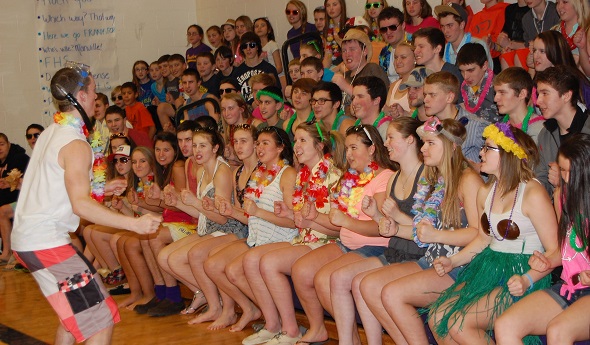
They taped step-by-step demonstration videos of cheers and dressed in theme night costumes – one in a toga, another in neon, a third in rain gear – for a pep assembly to explain not only how students would now cheer, but why they were making a switch.
Student attendance at basketball games has doubled, and The Cage also cheers on Chappell’s fledging wrestling team. Purchase and Smith visited the junior high to explain the new cheering philosophy and also motivate those grades to find the next leaders of the group.
Drama students come from practice dressed up and ready to yell. The artists are there too, and one is designing a giant Fathead decal to be added to The Cage’s already elaborate decorations. Students who had never attended a sporting event are now regulars.
There’s been only one complaint (and it’s not a bad thing) – that the section is too loud.
“When you’re out there and getting negative cheers from the other school, or even your own school, you kinda feel like you’re on your own island if you miss a shot or airball a shot,” Plumstead said. “When you’re getting positive cheers and miss the shot, and the crowd is like, ‘Yeah, go get ‘em next time,’ you shake it off and you’re back in the game.”
On occasion, a few students might try to dip back into the negative. But now they’re the ones made to feel on an island. “We tell them that’s not how we do things anymore,” Stefanski said. “We didn’t’ realize how bad it was, saying negative things, until we saw other schools do it.”
But the positive spin is starting to spread. The Cage found a few students from a neighboring school in its section during one game. Other schools are forming sections and starting theme nights – Purchase has traveled to a few to check them out – and it’s always a compliment when students from other schools tweet they wish they went to Frankfort so they could join in the fun.
All of the reaction seems to say what leaders of “The Cage” would most like to hear.
“That we turned this around completely. We changed the games, the feel, the entire environment at Frankfort,” Purchase said.
“Not only that we changed our school, but we’re changing the Northwest Conference,” Plumstead added. “Not only are we changing the culture at Frankfort, but changing it everywhere in northwest Michigan.”
Battle of the Fans III is sponsored in part by the United Dairy Industry of Michigan.
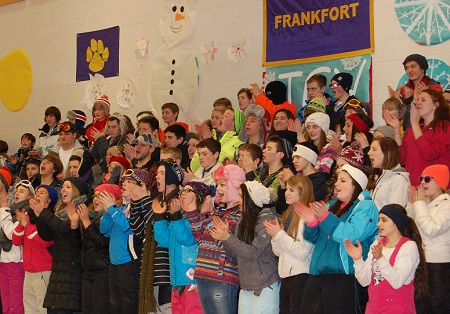
PHOTOS: (Top) Frankfort senior Jacob Chappell leads "The Cage" in a roller coaster during Monday's game against McBain. (Middle) The cheering section, still dressed for "icy" winter, cheer on the Panthers during the first half. (Photos courtesy of Jaime Smith.)