

Battle of the Fans: Frankenmuth Dance Party
January 21, 2012
FRANKENMUTH -- The hometown Eagles hosted Freeland in a boys basketball game Saturday night.
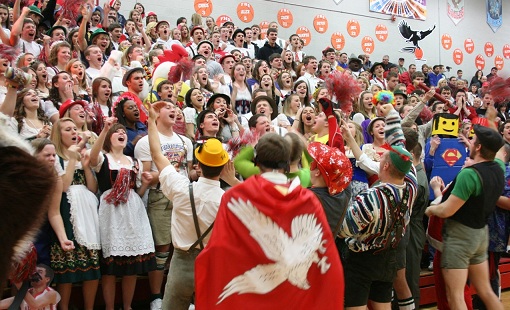
And a 250-student chicken dance broke out.
Sure, Frankenmuth calls itself “Michigan’s Little Bavaria.” And things were a little ramped up for the student section's "German Night" -- which, by the way, was scheduled long before this game was announced as the first stop on the MHSAA's "Battle of the Fans" tour.
But the rest of the dancing and singing that made up most of the game’s two hours? That’s just the usual for this “Battle of the Fans” finalist. The Eagles student section turns every boys and girls basketball game into a dance party. And everyone in the gym, regardless of allegiance, is invited.
“That is what we are best at. That is what we are known for,” Frankenmuth senior Brennan Webb said. “Since we do it for every single game, all of these other student sections expect that. And when you come to our house, that’s what you’ve got to expect.”
MHSAA staff and its 16-member Student Advisory Council members also will visit "Battle of the Fans" finalists Reese, Grand Rapids Christian, Rockford and Petoskey over the next month and shoot videos that will be part of an online vote on the MHSAA's Facebook page. The winner will be announced Feb. 24, and clips from all five videos will be shown during the Girls and Boys Basketball Finals in March at the Breslin Center.
Eagles leaders met before this season and planned out themes for all 20 regular season games plus every one through a potential MHSAA Finals run. Super Hero night was pretty cool. So was Christmas night. And of course, German night was a hit.
But mostly, it comes back to singing and dancing. Usually, the students bring the music in the form of a boom box. This time, they had a DJ complete with lights flashing over that section of stands.
Webb carries a blue notecard with cheers listed on the front and back -- in case he needs a quick reference during the game. Saturday’s sing-along included some hip-hop, a Bob Seger tune and a Christmas carol. They have chants for specific players on their team, a German chant for after successful free throws, and a breakdown for timeouts “to keep the energy up.”
“The past few years we had pretty funny energetic people,” senior Jacob Fahrenbruch said. “So it kinda took over, and we made every single person come to every single basketball game.”
Someone comes to all of them -- even if the section numbered just five for a game an hour’s drive away and the night before exams earlier this month.
Officials and opposing coaches both have paid compliments to the section for the atmosphere it creates. Students chant “Come on over” to those from opposing cheering sections -- and have had some takers. Eagles cheerers played a half-serious game of red rover with Marysville students during their teams’ volleyball Quarterfinal this fall. Just like the players, the schools’ cheering sections also did a postgame handshake. “We like to make friends,” senior Zack Robinson laughed.
An informal student section has existed for a few years. Themes were set mostly by word of mouth. A group of seniors usually led, but nothing too organized.
This winter, the Eagles got serious.
Seniors Webb, Robinson, Nick Veitengruber, Evan Escott, Jeff Hillman and Fahrenbruch make up a big part of the leadership assembly. They created a Facebook page for announcements. They also take advantage of a 15-minute weekly in-school televised news broadcast to teach cheers to their classmates.
Consider: Roughly 6,500 people live in Frankenmuth and the surrounding township. So during Saturday's halftime, when the Eagles’ student section emptied onto the floor and started chicken dancing, those fans accounted for roughly half of the student body -- and nearly four percent of the school district's population.
Frankenmuth's cheerers have caught some occasional grief from opposing fans when they go on the road. But their enthusiasm, positivity and open invite to join in has led students from other schools to say they wish they could be a part. And, of course, a little making fun of one's self goes a long way.
After a big Freeland shot Saturday, Eagles cheeres chanted, "In our faces!" And after Frankenmuth standout Kent Redford air-balled a shot, his classmates directed the usual "Air ball" chant at him -- all in good fun.
“It usually takes a while, but then we break them in,” Webb said. “That’s how we usually make friends. We make fun of ourselves. (They think) these guys are idiots, but they’re pretty funny. We’ll hang out with them.”
Highlights Return to MHSAA.tv
January 14, 2015
By John Johnson
MHSAA communications director
Weekly highlights from games produced by MHSAA members participating in the School Broadcast Program return this week to the MHSAA.tv website.
This week’s highlights package features a showdown game from last week in the Michigan Interscholastic Hockey League between undefeated Detroit Catholic Central (No. 1 in Div. 1 coaches association rankings) and once-beaten Bloomfield Hills Cranbrook Kingswood (No. 1 in Div. 3 coaches association rankings), which ended in a 1-1 tie.
A rivalry boys basketball game with Dowagiac defeating Niles, 58-55, and a North Star League girls basketball game which saw Posen top Hillman, 48-42, are the other SBP produced games from last week in the highlights package, which can be viewed below.
Last week was a busy back-to-school week for SBP schools, with video from 46 events in eight sports and another 41 games with live basketball stats, all taking place on the MHSAA.tv portal.
The School Broadcast Program gives members an opportunity to showcase excellence in their schools by creating video programming of athletic and non-athletic events with students gaining skills in announcing, camera operation, directing/producing and graphics. The program also gives schools the opportunity to raise money through advertising and viewing subscriptions.
Here’s the schedule of School Broadcast Program members planning to cover varsity competition over the next week for broadcast at MHSAA.tv (as of Jan. 12). The following will have live streaming video unless otherwise indicated:
Wednesday – January 14
Wrestling – Owosso at Haslett, 6 p.m.
Thursday – January 15
Boys Basketball – West Iron County at Calumet, 7 p.m.
Boys Basketball – AuGres-Sims at Posen, 7 p.m.
Friday – January 16
Boys Basketball – Lansing Waverly at Haslett, 6 p.m.
Ice Hockey – Detroit U-D Jesuit at Calumet, 7 p.m.
Girls Basketball – Baraga at Calumet, 7 p.m.
Boys Basketball – Midland Dow at Mt. Pleasant, 7 p.m.
Ice Hockey – Warren DeLaSalle at Bloomfield Hills Cranbrook Kingswood, 7:15 p.m.
Girls Basketball – Posen at AuGres-Sims, 7:15 p.m.
Boys Basketball – Lansing Waverly at Haslett, 7:30 p.m.
Saturday – January 17
Wrestling – Mancelona Invitational, 10 a.m.
Ice Hockey – Detroit U-D Jesuit at Calumet, 7 p.m.
Ice Hockey – Bloomfield Hills Cranbrook Kingswood at Orchard Lake St. Mary’s, 7:30 p.m.
Monday – January 19
Competitive Cheer – O-K Conference Competition @ Comstock Park, 6:30 p.m.
Boys Basketball – Atlanta at Hillman, 7 p.m.
Tuesday – January 20
Girls Basketball – Goodrich at Haslett, 7 p.m.
Boys Basketball – Fife Lake Forest Area at Mancelona, 7 p.m.
Girls Basketball – Byron Center at Comstock Park, 7 p.m.
Girls Basketball – Hemlock at Montrose, 7 p.m.
Live stats of select basketball games are also available on MHSAA.tv. Check out the MHSAA.tv website on game night to see which schools are streaming live stats, or stop by to view stats following games on an On Demand basis.
All sporting events – live or delayed - are available on MHSAA.tv on a subscription basis for their first 72 hours online. A portion of each subscription is returned to the school originating the broadcast. Subscriptions run either $9.95 for a Day Pass or $14.95 for a Month Pass. Some schools also offer Annual Passes at a discounted rate. All sporting events become available for free On Demand viewing three days after they have been posted.
To view all of the recent School Broadcast Program productions, go to MHSAA.tv, click On Demand on the nav bar of the left side of the page, and on the Filters tab at the top of next page, click on All States and then select Michigan. Schools interested in becoming a part of the School Broadcast Program should contact John Johnson at the MHSAA Office.