

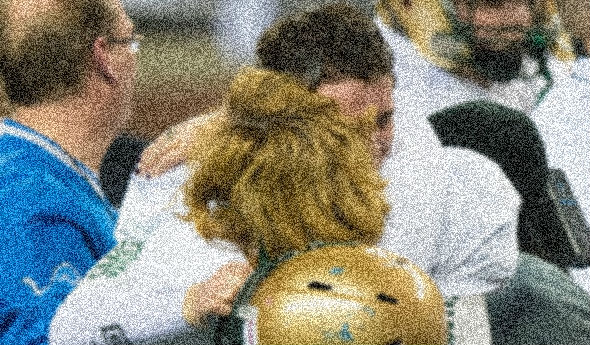
After the Game: What do you say?
April 20, 2017
 By Kevin Wolma
Hudsonville Athletic Director
“I love to watch you play.” Those are the six words a son or daughter wants to hear from his or her parents after a game.
What if your child does not play? What do you say then? Parents can’t say, “I love to watch you play” when your child does not play, nor can they say other post-competition statements like:
“Did you fight like a dog?”
“Did you have fun?”
It is hard to fight like a dog when not given the opportunity, and we all know players have more fun when they play in the game. When you google the phrase, “what to say after a game,” there are all sorts of articles written with some of them backed by research. However, when you google the phrase – “what to say when your kid does not play” – very little comes out of that search.
Why?
This is a hard and very sensitive area for most parents to come up with the right thing to say.
Before we talk about what to say in this situation, it may be more important to discuss what not to say after a game where your child does not play. Some of the comments all parents should avoid are:
“Why have you not played in the last three games? Your coach must not like you for some reason.”
“Your coach is clueless; he has no idea what he is doing.”
“You are way better than Johnny! I can’t believe he is playing more minutes than you.”
“Did you see how many mistakes Suzie made? I know if you were given the opportunity you would not make those same mistakes.”
Parents will often say these things because they are frustrated, and parents think they are comforting their child by giving them an excuse. What these comments actually do is create a divisive culture within a team. After hearing these negative comments over and over again, the athlete will eventually believe it only to see his or her attitude and effort become negatively affected over time. That athlete turns into a selfish teammate.
Now let’s put yourself in the situation where your child comes home after a game after not playing. What do you say?
The first thing you could do is talk about the game itself. Recount certain plays and make note of individuals who played well for both teams. This initial conversation takes the uncomfortable nature of the situation and sets the stage to talk about how athletes feel about not getting into the game.
There may be times when your child will not want to talk about it because he or she is upset, angry or even embarrassed. These moments of silence give the parents an opportunity to talk about the importance of being a good teammate and how an athlete can have a major impact on the team no matter what role is played. They can teach how to be the first person off the bench to congratulate or give a word of encouragement to teammates. Parents also can point out that the harder athletes work in practice, the better it is going to make the team.
In other words, we have the responsibility as parents to teach our kids the significance of living life pointed out no matter the circumstance. Living pointed out simply means to put others before yourself in everything you do. Finding ways to make the people around you the best they can be. No complaining. No excuses.
Andrew DeWitt played two years of Varsity basketball for me at Hudsonville, and he rarely had the opportunity to play. Unfortunately for him, he was a good player on two really good teams with lots of talent. He understood his role and treated practices like games – playing as hard as he could.
He would elevate the intensity of practice every day. On game nights, he was our biggest cheerleader. His impact went way beyond scoring points or getting rebounds.
Andrew’s parents were great teachers as they guided him through those tough times where it would have been easy to make an excuse or complain. Instead, they taught Andrew he could always have an influence on other people’s lives despite the role he played. What a great lesson that Andrew can carry with him for the rest of his life.
At the end of the day, one thing every parent in every situation can say that will have a positive impact is, “I love you.” Many times athletes think they are letting their parents down because of their lack of playing time. Knowing that their parents love them the same whether they play a lot or not at all has a significant impact on how the student-athlete responds to adversity, and specifically not playing in games.
I challenge all parents to use these potentially negative situations as a way to teach student-athletes valuable lessons on what it means to be a great teammate – and more importantly in teaching them to live their life pointed out. There may not be a simple six-word phrase to say when your child does not play, but there is definitely plenty to talk about.
Wolma has served as Hudsonville's athletic director since 2011 and previously coached boys varsity basketball and girls varsity golf among other teams. He also previously taught physical education and health.

Century of School Sports: 200+ Representatives Fill All-Time Council Roster
By
Geoff Kimmerly
MHSAA.com senior editor
May 6, 2025
When Plymouth-Canton Community Schools superintendent Monica Merritt attended her first meeting as a member of the MHSAA’s Representative Council on March 21 in East Lansing, she became the 203rd voting member to serve on the association’s legislative body since the first Council convened Dec. 13, 1924.
We covered how the Council is comprised in our Dec. 3 installment – “MHSAA Work Guided by Representative Council.” Briefly, the Council is the 19-member legislative body of the MHSAA. All but five members are elected by member schools. Four members are appointed by the Council to facilitate representation of females and minorities, and the 19th position is occupied by the Superintendent of Public Instruction or designee.
During a typical school year, the Council meets three times, and convened for the third time for 2024-25 this past Sunday and Monday in Gaylord.
The first Representative Council included 11 members, from Ann Arbor, Battle Creek, Detroit, Eaton Rapids, Escanaba, Flint, Grand Rapids, Ishpeming, Otsego, Petoskey and Saginaw. While it’s difficult to say how many high schools specifically have been represented over the years – for example, Detroit Public Schools as a district has one representative, and there are multiple statewide positions – it’s accurate to say at least 130 communities (made of one or more schools) have sent at least one delegate over the last century.
Total, 54 Council members have served at least a decade, and 11 of those 54 have served at least 20 years: Detroit’s George Mead (1930-62) and Roy Allen (1976-96), Gwinn’s Leo P. McDonald (1930-52), Saginaw’s Roy J. McMurray (1932-50, 1952-57), Escanaba’s Dan Flynn (1988-2010), Grand Haven's Scott Grimes (2001-24), Deerfield, Beal City, Hartford and Cheboygan’s Paul Ellinger (1985-2007); Gaylord, Benzonia and Bear Lake’s Karen Leinaar (2000-2021); Clare, Maple City and Sanford Meridian’s William Newkirk (1988-2007), Trenton and Gibraltar Carlson’s Eric Federico (1986-94, 1996-2009) and current director of physical education and athletics for the Archdiocese of Detroit Vic Michaels, who has represented non-public schools on the Council since 2003.
A total of 17 Council members have served multiple terms but not entirely consecutively, with Petoskey’s Robert Doctor the only one with two breaks; he was on the Council from 1972-80, 1988-90 and 1994-95. As noted by his 32 years above, Mead was on the Council longest, representing Detroit Public Schools during his tenure as health and physical education director.
At least eight Council members have represented multiple schools, including current member Fred Smith, who has served a combined 15 years over two tenures while employed at Comstock, Buchanan, Benton Harbor and currently Bangor.
Michigan Department of Education representatives are not counted in the totals above as they are non-voting members – but they has provided an invaluable viewpoint during Council proceedings over the years. The current MDE representative on Council is Ross Fort, who serves as special assistant to the deputy superintendent.
The photo above was taken Monday morning. Front row, from left, are MHSAA executive director Mark Uyl, Michaels (who also serves as Council secretary/treasurer), Midland athletic director and Council president Eric Albright, and Brighton athletic director and Council vice president John Thompson.
Second row, from left, are Gobles athletic director Chris Miller, Freeland Middle School principal Jennifer Thunberg, Kingsford athletic director Chris Hartman and Camden-Frontier superintendent Chris Adams.
Third row, from left: Boyne City High School principal Adam Stefanski, Harbor Springs athletic director Anna Novak, Wyoming Godfrey-Lee Public Schools superintendent Arnetta Thompson, Mt. Morris athletic director Jeff Kline and Fenton High School principal Mike Bakker.
Back row, from left: Westland John Glenn athletic director Jason Malloy, Smith, Merritt, Fort, Detroit Public Schools executive director of athletics Jay Alexander and Calumet assistant principal Sean Jacques. (Portage Northern athletic director Chris Riker is not pictured.)
Previous "Century of School Sports" Spotlights
April 29: MHSAA Programs Prioritize Health & Safety - Read
April 23: Patches Signify Registered Officials' Role in MHSAA Story - Read
April 16: Student Advisory Council Gives Voice to Athletes - Read
April 9: State's Storytellers Share Spring Memories - Read
April 2: Sharp Leadership Synonymous with MHSAA Success - Read
March 25: Athletic Directors Indispensable to Mission of School Sports - Read
March 18: 2025 Finals Begin Next Half-Century of Girls Hoops Championships - Read
March 11: Boys Basketball's Best 1st to Earn MHSAA Finals Titles - Read
March 5: Everything We Do Begins with Participation - Read
Feb. 25: Slogans & Logos Remain Unforgettable Parts of MHSAA History - Read
Feb. 19: MHSAA Tickets Continue to Provide Fan-Friendly Value - Read
Feb. 11: We Recognize Those Who Make Our Games Go - Read
Feb. 4: WISL Conference Continues to Inspire Aspiring Leaders - Read
Jan. 28: Michigan's National Impact Begins at NFHS' Start - Read
Jan. 21: Awards Celebrate Well-Rounded Educational Experience - Read
Jan. 14: Predecessors Laid Foundation for MHSAA's Formation - Read
Jan. 9: MHSAA Blazes Trail Into Cyberspace - Read
Dec. 31: State's Storytellers Share Winter Memories - Read
Dec. 17: MHSAA Over Time - Read
Dec. 10: On This Day, December 13, We Will Celebrate - Read
Dec. 3: MHSAA Work Guided by Representative Council - Read
Nov. 26: Finals Provide Future Pros Early Ford Field Glory - Read
Nov. 19: Connection at Heart of Coaches Advancement Program - Read
Nov. 12: Good Sports are Winners Then, Now & Always - Read
Nov. 5: MHSAA's Home Sweet Home - Read
Oct. 29: MHSAA Summits Draw Thousands to Promote Sportsmanship - Read
Oct. 23: Cross Country Finals Among MHSAA's Longest Running - Read
Oct. 15: State's Storytellers Share Fall Memories - Read
Oct. 8: Guided by 4 S's of Educational Athletics - Read
Oct. 1: Michigan Sends 10 to National Hall of Fame - Read
Sept. 25: MHSAA Record Books Filled with 1000s of Achievements - Read
Sept. 18: Why Does the MHSAA Have These Rules? - Read
Sept. 10: Special Medals, Patches to Commemorate Special Year - Read
Sept. 4: Fall to Finish with 50th Football Championships - Read
Aug. 28: Let the Celebration Begin - Read