

Century of School Sports: MHSAA Work Guided by Representative Council
By
Geoff Kimmerly
MHSAA.com senior editor
December 3, 2024
One of the most common misconceptions about the MHSAA over its 100-year history is that all decisions regarding school sports in Michigan are made by the staff in the East Lansing office.
The MHSAA truly is an organization built upon its membership, with its Representative Council the legislative body that has produced the rules and tournament schedules currently in place to provide structure in athletics for more than 750 high schools and hundreds more middle schools across the state.
The Representative Council is the 19-member legislative body of the MHSAA. All but five members are elected by member schools. Four members are appointed by the Council to facilitate representation of females and minorities, and the 19th position is occupied by the Superintendent of Public Instruction or designee.
The Council considers all proposals brought before it from MHSAA sport and other appointed committees that meet throughout the year, and also makes decisions on a variety of eligibility rules, postseason tournament and operational issues. The Council regularly considers 30 committee proposals during its Spring meeting alone, along with a handful of others during Fall and Winter meetings which otherwise are primarily opportunities for discussion of topics that may come up for action at a later date.
Eight representatives are elected across four regions – two apiece from the Northern Lower Peninsula, Southeastern Michigan, Southwestern Michigan and the Upper Peninsula – and also based on school enrollment, with one representative from each of those regions from the larger Class A and B-sized schools and one representative from each region from the smaller Class C and D-sized schools. There are also two statewide at-large positions, two representing junior high/middle schools, and elected representatives from Detroit Public Schools and private and parochial schools.
All Representative Council members must be representatives of a member school, as faculty or board of education members. Every Council candidate must have superintendent or principal approval in writing and be qualified for the position for which that person is running.
Elections take place every fall after names of candidates are submitted and published to the MHSAA Website by April 15 the preceding spring. Ballots are mailed to schools in September and must be postmarked no later than two weeks after they were sent by the MHSAA office. A Board of Canvassers appointed annually counts the ballots, which must be signed by the principal and superintendent of that member school (except for private and parochial schools, which require signature by the principal only).
Council members are selected by majority vote.
Terms for elected Council representatives are two years long. Appointed members also serve two-year terms and may not serve longer than two successive terms.
The Council meets three times annually. Council officers – president, vice president and secretary-treasurer – are elected during the Fall meeting for the full Council.
Five members of the Council also convene monthly during the school year to form the MHSAA’s Executive Committee, which reviews appeals of Handbook regulations by member schools. Those five include the three elected officers.
Previous "Century of School Sports" Spotlights
Nov. 26: Finals Provide Future Pros Early Ford Field Glory - Read
Nov. 19: Connection at Heart of Coaches Advancement Program - Read
Nov. 12: Good Sports are Winners Then, Now & Always - Read
Nov. 5: MHSAA's Home Sweet Home - Read
Oct. 29: MHSAA Summits Draw Thousands to Promote Sportsmanship - Read
Oct. 23: Cross Country Finals Among MHSAA's Longest Running - Read
Oct. 15: State's Storytellers Share Fall Memories - Read
Oct. 8: Guided by 4 S's of Educational Athletics - Read
Oct. 1: Michigan Sends 10 to National Hall of Fame - Read
Sept. 25: MHSAA Record Books Filled with 1000s of Achievements - Read
Sept. 18: Why Does the MHSAA Have These Rules? - Read
Sept. 10: Special Medals, Patches to Commemorate Special Year - Read
Sept. 4: Fall to Finish with 50th Football Championships - Read
Aug. 28: Let the Celebration Begin - Read
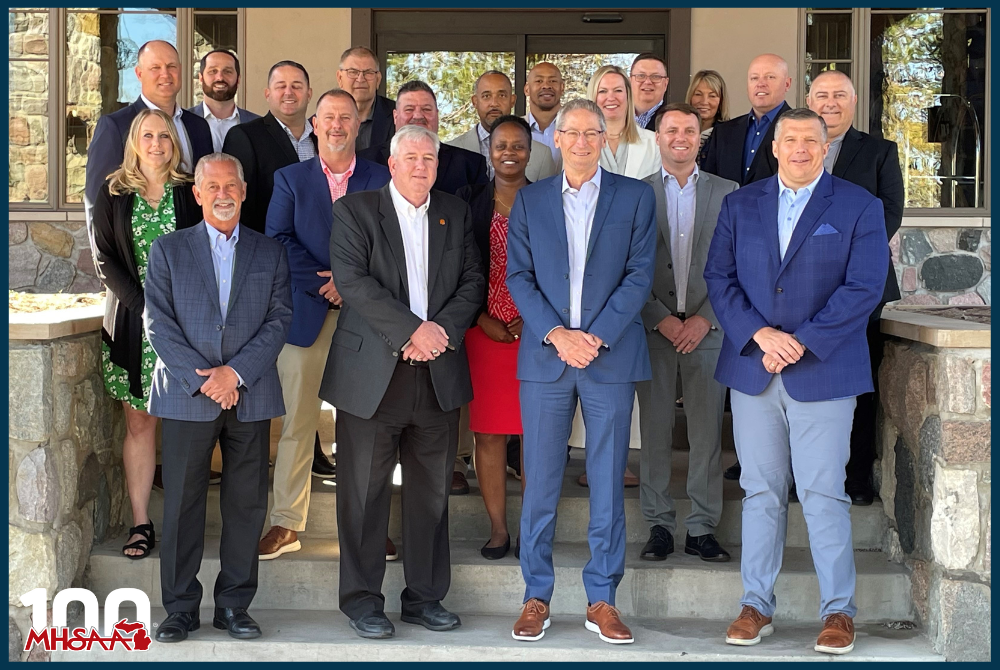
PHOTO The MHSAA Representative Council and Executive Director Mark Uyl (front row, far right) take a group photo during its Spring Meeting in May. (Photo by Jon Ross.)

NFHS Voice: Coaches, ADs Keys to Success
December 3, 2019
By Karissa Niehoff
NFHS Executive Director
This fall, one school canceled the remainder of its football season after reports of hazing surfaced. There have been several incidents of high school student-athletes using racial slurs against members of the opposing teams. As we have noted previously, there have also been multiple reports of parents verbally and – in some cases – physically abusing officials, along with several cases of coaches allegedly running up scores. And then there was the bizarre case of a suspended player appearing in a game disguised as another player.
On the positive side, there was a cross country runner who stopped at the one-mile mark of a race to assist a competing runner who had collapsed and was unresponsive. He didn’t finish the race, but he saved the life of the competing runner.
After the completion of a recent football game, one player on the winning team found his friend on the other team who had just lost his mother to cancer to comfort and pray with him. There have also been cases of schools helping other schools that were hit with tragedies, such as the fires in California.
And earlier this year a high school golfer who, after signing her scorecard, noticed on the app that her partner had entered an incorrect score for her on one hole. She could have kept quiet and retained her top-10 finish, and most likely no one would have noticed. Instead, she reported the error and was disqualified. She later was honored by her school for doing the right thing.
Fortunately, there are far more good acts of sportsmanship that happen in high school athletics and activity programs; however, the unsportsmanlike displays tend to make more headlines and sometimes overshadow the great things that are occurring.
The key individuals in schools who are responsible for making education the central theme of the athletic program are the athletic directors and coaches. If coaches are more committed to helping student-athletes become responsible citizens than helping them perfect an athletic skill, and if athletic directors are committed to an education-based philosophy, the likelihood of unsportsmanlike incidents such as those mentioned above is minimal.
What’s the measure of success for a high school coach – winning 80 percent of the games, bringing home multiple state championships, being named coach of the year several times? As long as success on the fields or courts is done in accordance with an education-based philosophy, this would be an award-winning biographical sketch.
The win-loss record aside, however, how about also considering the consistent teaching of values, character and lifelong lessons that would place his or her teams in consideration for sportsmanship awards and his or her student-athletes on the paths to successful lives after high school?
The NFHS has several free online education courses to assist coaches and athletic directors in leading an effective education-based program. “Engaging Effectively with Parents,” “Sportsmanship” and “Bullying, Hazing and Inappropriate Behaviors” are among the many courses at www.NFHSLearn.com. In addition, “Fundamentals of Coaching” is the core course that every interscholastic coach should complete.
When a school district is looking to hire a high school athletic director or coach, we would suggest finding someone more committed to an education-based philosophy than hardware in the trophy case.
Dr. Karissa L. Niehoff is in her second year as executive director of the National Federation of State High School Associations (NFHS) in Indianapolis, Indiana. She is the first female to head the national leadership organization for high school athletics and performing arts activities and the sixth full-time executive director of the NFHS, which celebrated its 100th year of service during the 2018-19 school year. She previously was executive director of the Connecticut Association of Schools-Connecticut Interscholastic Athletic Conference for seven years.