

Century of School Sports: Sharp Leadership Synonymous with MHSAA's Success
By
Geoff Kimmerly
MHSAA.com senior editor
April 2, 2025
Just as an organization often will rise and remain successful when there is consistent leadership, so is consistent leadership often a hallmark of a successful organization.
In celebrating a “Century of School Sports,” it’s no stretch to say the Michigan High School Athletic Association has been successful in its continued promotion and administration of educational athletics thanks in part to consistent excellent leadership in the form of only five fulltime executive directors, and two more directors who also took turns leading the organization through some of its most difficult moments.
Two of the MHSAA’s first four executive directors (who are retired, and therefore eligible for the honor) have been inducted into the National High School Hall of Fame by the National Federation of State High School Associations (NFHS). The first fulltime director – Charles E. Forsythe – became Michigan’s first Hall of Fame selection in 1983. The most recently-retired executive director – Jack Roberts – was selected in 2022.
All five executive directors have had monumental impacts on the direction of school sports in Michigan, not just during their time leading the MHSAA but in their various roles leading up to their service at the top of the organization. The below summaries do not come close to stating their full contributions, but merely some of the highlights for which they are most remembered:
Charles E. Forsythe (1931-42, 1945-68)
The MHSAA’s first fulltime executive director literally wrote the book on leadership of school sports programs – “The Administration of High School Athletics” was first published in 1939 and in five more editions as it became a popular college-level textbook. Previously an accomplished athlete, coach, official and athletic director, Forsythe joined the MHSAA staff in 1929 as an assistant director – and during his long tenure leading the office, school sports became part of the lifeblood of communities large and small all over the state. High school membership increased under his leadership, from 600 to 750 schools, and attendance for the MHSAA Boys Basketball Tournament – the headlining high school event of the day – increased from 126,000 for all rounds in 1930 to more than 775,000 at the time of his retirement. While advances were made in football and boys basketball, and in less-visible sports as well – all driving increased participation – the most notable work under Forsythe’s leadership made sports safer for all participants. Many of the most publicized safety initiatives came in football – including significant equipment requirements – but under his leadership the MHSAA in 1940-41 became just the second state nationally to add an accident benefit plan for participants. Forsythe died unexpectedly in December 1968, only a few months after his retirement. He is the namesake for the MHSAA’s annual lifetime achievement award.
Allen W. Bush (1968-78)
The MHSAA’s second fulltime executive director is the namesake for annual awards presented to contributors to school sports whose accomplishments are often behind the scenes and outside of the attention paid to championships and other high achievements. But Bush’s most-known accomplishments have received some of the greatest attention in MHSAA history, and deservedly so. During his tenure, the MHSAA added its first nine championship tournaments in girls sports, created the Football Playoffs and also began awarding Finals championships in baseball, ice hockey and skiing. Bush joined the MHSAA staff in 1960, serving under Forsythe as an assistant and then associate director.
Vern L. Norris (1978-86)
Norris, who died in 2018 at the age of 89, was known especially for his work with coaches and officials. He had coached at three high schools and was a tremendous official himself, having refereed the 1963 Class A Boys Basketball Final. The MHSAA’s annual Vern L. Norris Award honors an official who has been especially active in mentoring and training officials. Norris joined the MHSAA in 1963 and served under both Forsythe and Bush – the latter as associate director – also playing key roles in the creation of girls sports championships during the 1970s and expansion of those opportunities during the 1980s. He also played a significant role in rules-making nationally, contributing on several NFHS committees, and after leaving the MHSAA served as commissioner of the Great Lakes Intercollegiate Athletic Conference.
John E. “Jack” Roberts (1986-2018)
At the time of Roberts’ retirement, he was the nation’s longest-serving executive director – and with accomplishments in his state and nationally that were arguably unmatched. Under his leadership, the MHSAA grew more than 15 percent to more than 1,500 high schools and junior high/middle schools, and the state’s high school sports participation grew 10 percent and annually ranked higher than states with larger high school-aged populations. The MHSAA again became a national leader in health and safety, setting the pace in concussion care, heat management and CPR certification requirements and policies. The MHSAA also took national leads in coaches education and sportsmanship. Three girls sports and two boys sports were added to the tournament lineup during his tenure, as were 8-player football playoffs and an expansion of the 11-player tournament. Roberts had grown up studying the example of his father John, who served as executive director of the Wisconsin Interscholastic Athletic Association for 29 years, and Jack Roberts also served at the NFHS and Fellowship of Christian Athletes before taking over the MHSAA. Few have given their voice to school sports more prevalently: At the time of his retirement, Roberts had spoken in support of educational athletics in nearly every state and five Canadian providences.
Mark Uyl (2018-)
While his tenure as executive director has not yet reached a decade, Uyl already has steered the MHSAA through one of its most challenging times – the COVID-19 pandemic, which led to the cancelation of the end of the Winter 2019-20 season and all sports the ensuing spring. However, under Uyl’s direction – and while other states remained sidelined – MHSAA schools safely returned to activity during the fall of 2020-21, and despite delays completed their championship events for all three seasons that school year. Also a highly-respected game official on a national scale – and past coach and administrator in Michigan – Uyl joined the MHSAA staff in 2004 and has led the way as participation and officials registrations both have continued to rebound from significant decreases during COVID. His tenure also has seen the addition of an Individual Finals division for girls wrestling and the addition of girls field hockey and boys volleyball set for the 2025-26 school year.
Additional notes of recognition must be paid to two more leaders whose contributions came at some of the most delicate times over this successful century:
Julian W. Smith served as interim executive director while Forsythe served in the U.S. Navy during World War II. Smith – who had served on the MHSAA Representative Council for 10 years – received a three-year leave of absence from his role as principal at Battle Creek Lakeview High School and led the MHSAA through an unpredictable wartime era that included the cancelation of statewide championship events in boys basketball and track & field in 1943, but also their return a year later. He continued the promotion of physical fitness that was emphasized as a mission of school sports especially in preparation for service in the military, and during his time as executive director was named to the National Council of Physical Fitness.
Then there is Alden W. “Tommy” Thompson, perhaps the most influential yet forgotten leader in MHSAA history. Thompson had served on the Board of Control for the MHSAA’s predecessor organization, the Michigan Interscholastic Athletic Association (MIAA) and was then appointed as the first state director of interscholastic athletics, under supervision of the state superintendent and Michigan Department of Public Instruction, about three weeks before the official start of the MHSAA in December 1924.
Charles Forsythe credited Thompson with building the MHSAA “from scratch,” and legendary Lansing State Journal sports editor George Alderton praised Thompson for developing “an eligibility code that was positively fool proof,” classifying schools by enrollment to provide equal opportunities for small and large to win championships, organizing the state basketball tournament to make it financially beneficial to schools which in turn allowed them to spend to develop other sports, and giving a statewide stage to some of those less-visible sports including cross country, tennis and golf. Alderton wrote, “Tommy was the fellow who paved the way, ironed out the humps and gave the machine a push before the motor of popular interest began running.”
Forsythe served as Thompson’s assistant for two years before taking over as state director of athletics in 1931 as Thompson became the state director of physical and health education. However, both would lose their employment with the state’s department of public instruction in 1933 due to budgetary cuts – Thompson, to go on to several more pursuits in athletics, but Forsythe to remain as state director of athletics but now paid fully by the MHSAA, making him officially the association’s first fulltime executive director.
Previous "Century of School Sports" Spotlights
March 25: Athletic Directors Indispensable to Mission of School Sports - Read
March 18: 2025 Finals Begin Next Half-Century of Girls Hoops Championships - Read
March 11: Boys Basketball's Best 1st to Earn MHSAA Finals Titles - Read
March 5: Everything We Do Begins with Participation - Read
Feb. 25: Slogans & Logos Remain Unforgettable Parts of MHSAA History - Read
Feb. 19: MHSAA Tickets Continue to Provide Fan-Friendly Value - Read
Feb. 11: We Recognize Those Who Make Our Games Go - Read
Feb. 4: WISL Conference Continues to Inspire Aspiring Leaders - Read
Jan. 28: Michigan's National Impact Begins at NFHS' Start - Read
Jan. 21: Awards Celebrate Well-Rounded Educational Experience - Read
Jan. 14: Predecessors Laid Foundation for MHSAA's Formation - Read
Jan. 9: MHSAA Blazes Trail Into Cyberspace - Read
Dec. 31: State's Storytellers Share Winter Memories - Read
Dec. 17: MHSAA Over Time - Read
Dec. 10: On This Day, December 13, We Will Celebrate - Read
Dec. 3: MHSAA Work Guided by Representative Council - Read
Nov. 26: Finals Provide Future Pros Early Ford Field Glory - Read
Nov. 19: Connection at Heart of Coaches Advancement Program - Read
Nov. 12: Good Sports are Winners Then, Now & Always - Read
Nov. 5: MHSAA's Home Sweet Home - Read
Oct. 29: MHSAA Summits Draw Thousands to Promote Sportsmanship - Read
Oct. 23: Cross Country Finals Among MHSAA's Longest Running - Read
Oct. 15: State's Storytellers Share Fall Memories - Read
Oct. 8: Guided by 4 S's of Educational Athletics - Read
Oct. 1: Michigan Sends 10 to National Hall of Fame - Read
Sept. 25: MHSAA Record Books Filled with 1000s of Achievements - Read
Sept. 18: Why Does the MHSAA Have These Rules? - Read
Sept. 10: Special Medals, Patches to Commemorate Special Year - Read
Sept. 4: Fall to Finish with 50th Football Championships - Read
Aug. 28: Let the Celebration Begin - Read
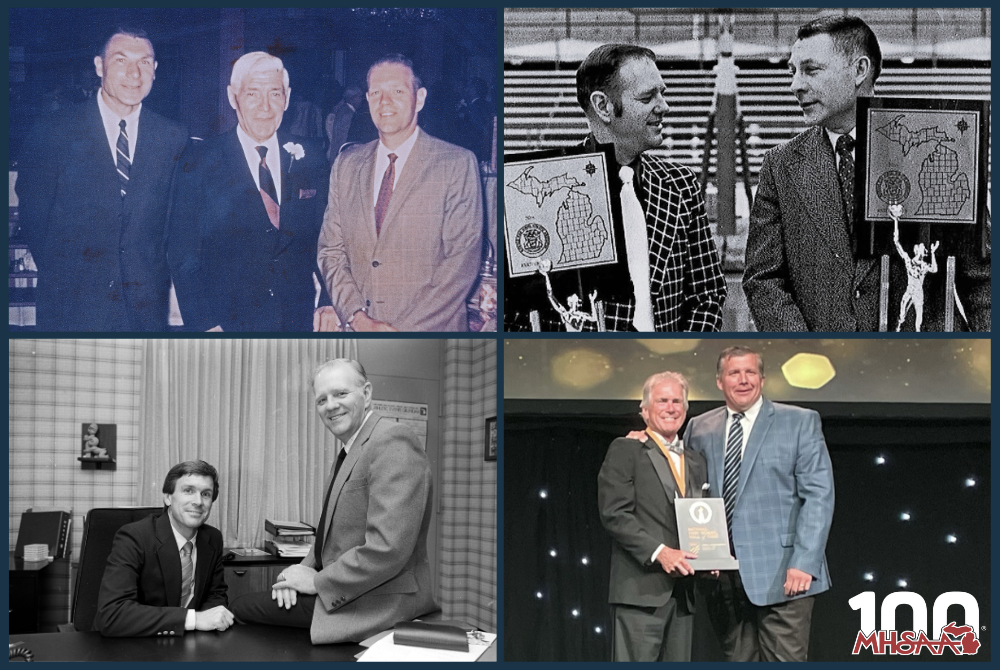
PHOTOS Clockwise from top left: (1) Left to right, Al Bush, Charles Forsythe and Vern Norris take a photo together. (2) Norris, left, and Bush hold up Finals trophies. (3) Jack Roberts, left, stands with Mark Uyl during Roberts' induction into the National High School Hall of Fame. (4) Roberts, left, and Norris sit for a photo as Roberts began his tenure after Norris retired. (MHSAA file photos.)
This Week in High School Sports: 1/22/26
By
Jon Ross
MHSAA Director of Broadcast Properties
January 22, 2026
This week's edition discusses findings from the MHSAA's most recent multi-sport participation survey, awards Game Balls to standouts in basketball and bowling, and breaks down this year's finalists class for the MHSAA/Farm Bureau Insurance Scholar-Athlete Awards.
 The 5-minute program each week includes feature stories from MHSAA.com or network affiliates, along with "Be the Referee," a 60-second look at the fine art of officiating.
"This Week in High School Sports" is powered by MI Student Aid, a division within the Department of Lifelong Education, Advancement, and Potential (MiLEAP).
Listen to this week's show by Clicking Here.
Previous 2025-26 editions
Jan. 15: Genesee's Averie Zinn & Mio's Mia McGregor, MHSAA Winter Finals schedule - Listen
Jan. 8: 2024-25 MHSAA Tournament attendance, tribute to Vic Michaels - Listen
Dec. 11: MHSAA 2024-25 participation's national ranking, 2026 Wrestling Tournament - Listen
Dec. 4: 11-Player Football Finals review - Listen
Nov. 26: Girls Volleyball, 8-Player Football, Lower Peninsula Girls Swimming & Diving Finals review - Listen
Nov. 20: NFHS Network championship schedule, Sportsmanship Summits - Listen
Nov. 13: Performance of the Week, Shelby football - Listen
Nov. 6: Lower Peninsula Cross Country Finals, Boys Soccer Finals review - Listen
Oct. 30: Mendon football's Owen Gorham, MHSAA Girls Volleyball Tournament primer - Listen
Oct. 23: Lower Peninsula Girls Golf Finals review, LP Boys Tennis Finals - Listen
Oct. 16: MHSAA Football Playoff selection, Field Hockey Finals week primer - Listen
Oct. 9: Upper Peninsula Girls Tennis Finals review, 2025 Sportsmanship Summits - Listen
Oct. 2: 2026 MHSAA/Farm Bureau Insurance Scholar-Athlete Awards, Boys Soccer Tournament - Listen
Sept. 25: Saline's record-approaching performance, SAC sportsmanship statement - Listen
Sept. 18: Athletic director training, "Block Party" volleyball report - Listen
Sept. 11: Football coaching legend Al Fracassa, MHSAA Student Advisory Council - Listen
Sept. 4: MHSAA participation rising, Harbor Springs soccer's Henry Juneau - Listen
Aug. 28: Field hockey's first season, changes to Football Playoffs, Tennis Finals - Listen