

Century of School Sports: Why Does the MHSAA Have These Rules?
By
Geoff Kimmerly
MHSAA.com senior editor
September 18, 2024
MHSAA administrators are two trips into their annual seven-stop fall tour that has become a tradition during nearly half of the Association’s “Century of School Sports” – and this year, a focus has been on answering a key question at the heart of educational athletics since long before the MHSAA was formed during the 1924-25 school year.
The MHSAA’s Update meeting series is in its 47th year and includes half-day conferences in seven locations – generally in the Kalamazoo, Metro Detroit, Grand Rapids, Saginaw, northern Lower Peninsula and mid-Michigan areas, and at Northern Michigan University in Marquette. The six Lower Peninsula sessions begin with an athletic director in-service during which MHSAA assistant directors explain recent rules changes and discuss challenges our administrators face on a daily basis (with Upper Peninsula athletic directors participating in a similar in-service during the spring).
Those in-services are followed by a session with executive director Mark Uyl, who speaks to athletic directors, superintendents, principals and school board members on a variety of topics including the MHSAA’s current objectives and ideas for the future, while also reinforcing the longstanding values that remain the bedrock of our daily work.
And that leads to the question he’s presenting across the state this fall:
Why does the MHSAA have these rules?
Frankly, the answer goes back to the beginning of school sports in Michigan – all the way back to 1895, when the first MHSAA predecessor organization was formed.
The first MHSAA Representative Council president Lewis L. Forsythe explained in his book “Athletics in Michigan High Schools – The First Hundred Years” how regulations always have been necessary:
“Eligibility rules are a necessity in interscholastic competition. It was common acknowledgement of this fact that led to the first State inter-school organization in 1895. The rules at first were few, simple and liberal. But with the passing of the years they came to be more numerous, more complex, and more restrictive, again through common acknowledgment of desirability if not of necessity.”
That necessity – and the reasoning behind it – has not changed.
Two main points explain why rules are absolutely imperative for educational athletics to thrive.
► 1. Participation – through providing as many opportunities as possible for students to play – has been the mission of school sports since their start. Rules contribute to the value of participation.
If there are requirements for children to participate in athletics – for example, an academic standard or rules that dissuade students from switching schools every year – then school sports programs mean more to all involved.
If we raise the bar, raise the standards of eligibility and conduct, we raise the value of our school sports programs. If we lower the bar, we lower the value of being part of school sports – because without rules, contest results are meaningless, and the value of participating is diminished.
► 2. We have rules where the stakes are higher, and agreement is lower – because where the stakes are highest, there is the greatest tendency for some people to try to gain an unfair advantage, and the greatest need for rules to curb possible dishonest activity.
This statement goes to the heart of the history, rationale and application of MHSAA rules. Obviously and simply put, school sports mean a lot to those who take part, and that significance is high enough to stoke disagreement – and we need rules to govern those disagreements. We have the most rules for high school sports, where championships are at stake and the possibility of disagreement is greatest.
***
Finally – and perhaps providing the strongest reinforcement of the two points above – is this:
Schools choose to make MHSAA rules their own.
Quite literally, school districts vote annually to be part of the MHSAA – and confirming this voluntary membership comes with the requirement to follow all MHSAA rules.
When schools challenge our rules, they literally are seeking to break the rules they already have committed to uphold.
These rules, and this commitment, are the strength of our organization across 752 member high schools and several hundred more middle schools and junior high schools. They have been constructed on a century of precedents and after considerations by representatives of those same member schools – representatives those schools have voted to elect every school year during the MHSAA’s history.
Previous "Century of School Sports" Spotlights
Sept. 10: Special Medals, Patches to Commemorate Special Year - Read
Sept. 4: Fall to Finish with 50th Football Championships - Read
Aug. 28: Let the Celebration Begin - Read
Century of School Sports: 200+ Representatives Fill All-Time Council Roster
By
Geoff Kimmerly
MHSAA.com senior editor
May 6, 2025
When Plymouth-Canton Community Schools superintendent Monica Merritt attended her first meeting as a member of the MHSAA’s Representative Council on March 21 in East Lansing, she became the 203rd voting member to serve on the association’s legislative body since the first Council convened Dec. 13, 1924.
We covered how the Council is comprised in our Dec. 3 installment – “MHSAA Work Guided by Representative Council.” Briefly, the Council is the 19-member legislative body of the MHSAA. All but five members are elected by member schools. Four members are appointed by the Council to facilitate representation of females and minorities, and the 19th position is occupied by the Superintendent of Public Instruction or designee.
During a typical school year, the Council meets three times, and convened for the third time for 2024-25 this past Sunday and Monday in Gaylord.
The first Representative Council included 11 members, from Ann Arbor, Battle Creek, Detroit, Eaton Rapids, Escanaba, Flint, Grand Rapids, Ishpeming, Otsego, Petoskey and Saginaw. While it’s difficult to say how many high schools specifically have been represented over the years – for example, Detroit Public Schools as a district has one representative, and there are multiple statewide positions – it’s accurate to say at least 130 communities (made of one or more schools) have sent at least one delegate over the last century.
Total, 54 Council members have served at least a decade, and 11 of those 54 have served at least 20 years: Detroit’s George Mead (1930-62) and Roy Allen (1976-96), Gwinn’s Leo P. McDonald (1930-52), Saginaw’s Roy J. McMurray (1932-50, 1952-57), Escanaba’s Dan Flynn (1988-2010), Grand Haven's Scott Grimes (2001-24), Deerfield, Beal City, Hartford and Cheboygan’s Paul Ellinger (1985-2007); Gaylord, Benzonia and Bear Lake’s Karen Leinaar (2000-2021); Clare, Maple City and Sanford Meridian’s William Newkirk (1988-2007), Trenton and Gibraltar Carlson’s Eric Federico (1986-94, 1996-2009) and current director of physical education and athletics for the Archdiocese of Detroit Vic Michaels, who has represented non-public schools on the Council since 2003.
A total of 17 Council members have served multiple terms but not entirely consecutively, with Petoskey’s Robert Doctor the only one with two breaks; he was on the Council from 1972-80, 1988-90 and 1994-95. As noted by his 32 years above, Mead was on the Council longest, representing Detroit Public Schools during his tenure as health and physical education director.
At least eight Council members have represented multiple schools, including current member Fred Smith, who has served a combined 15 years over two tenures while employed at Comstock, Buchanan, Benton Harbor and currently Bangor.
Michigan Department of Education representatives are not counted in the totals above as they are non-voting members – but they has provided an invaluable viewpoint during Council proceedings over the years. The current MDE representative on Council is Ross Fort, who serves as special assistant to the deputy superintendent.
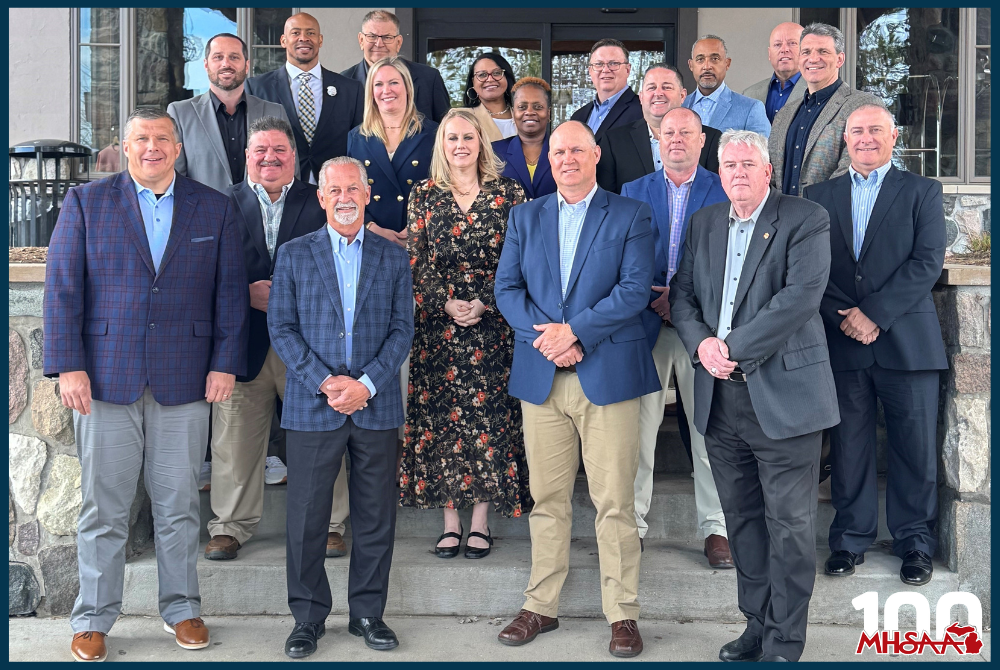
The photo above was taken Monday morning. Front row, from left, are MHSAA executive director Mark Uyl, Michaels (who also serves as Council secretary/treasurer), Midland athletic director and Council president Eric Albright, and Brighton athletic director and Council vice president John Thompson.
Second row, from left, are Gobles athletic director Chris Miller, Freeland Middle School principal Jennifer Thunberg, Kingsford athletic director Chris Hartman and Camden-Frontier superintendent Chris Adams.
Third row, from left: Boyne City High School principal Adam Stefanski, Harbor Springs athletic director Anna Novak, Wyoming Godfrey-Lee Public Schools superintendent Arnetta Thompson, Mt. Morris athletic director Jeff Kline and Fenton High School principal Mike Bakker.
Back row, from left: Westland John Glenn athletic director Jason Malloy, Smith, Merritt, Fort, Detroit Public Schools executive director of athletics Jay Alexander and Calumet assistant principal Sean Jacques. (Portage Northern athletic director Chris Riker is not pictured.)
Previous "Century of School Sports" Spotlights
April 29: MHSAA Programs Prioritize Health & Safety - Read
April 23: Patches Signify Registered Officials' Role in MHSAA Story - Read
April 16: Student Advisory Council Gives Voice to Athletes - Read
April 9: State's Storytellers Share Spring Memories - Read
April 2: Sharp Leadership Synonymous with MHSAA Success - Read
March 25: Athletic Directors Indispensable to Mission of School Sports - Read
March 18: 2025 Finals Begin Next Half-Century of Girls Hoops Championships - Read
March 11: Boys Basketball's Best 1st to Earn MHSAA Finals Titles - Read
March 5: Everything We Do Begins with Participation - Read
Feb. 25: Slogans & Logos Remain Unforgettable Parts of MHSAA History - Read
Feb. 19: MHSAA Tickets Continue to Provide Fan-Friendly Value - Read
Feb. 11: We Recognize Those Who Make Our Games Go - Read
Feb. 4: WISL Conference Continues to Inspire Aspiring Leaders - Read
Jan. 28: Michigan's National Impact Begins at NFHS' Start - Read
Jan. 21: Awards Celebrate Well-Rounded Educational Experience - Read
Jan. 14: Predecessors Laid Foundation for MHSAA's Formation - Read
Jan. 9: MHSAA Blazes Trail Into Cyberspace - Read
Dec. 31: State's Storytellers Share Winter Memories - Read
Dec. 17: MHSAA Over Time - Read
Dec. 10: On This Day, December 13, We Will Celebrate - Read
Dec. 3: MHSAA Work Guided by Representative Council - Read
Nov. 26: Finals Provide Future Pros Early Ford Field Glory - Read
Nov. 19: Connection at Heart of Coaches Advancement Program - Read
Nov. 12: Good Sports are Winners Then, Now & Always - Read
Nov. 5: MHSAA's Home Sweet Home - Read
Oct. 29: MHSAA Summits Draw Thousands to Promote Sportsmanship - Read
Oct. 23: Cross Country Finals Among MHSAA's Longest Running - Read
Oct. 15: State's Storytellers Share Fall Memories - Read
Oct. 8: Guided by 4 S's of Educational Athletics - Read
Oct. 1: Michigan Sends 10 to National Hall of Fame - Read
Sept. 25: MHSAA Record Books Filled with 1000s of Achievements - Read
Sept. 18: Why Does the MHSAA Have These Rules? - Read
Sept. 10: Special Medals, Patches to Commemorate Special Year - Read
Sept. 4: Fall to Finish with 50th Football Championships - Read
Aug. 28: Let the Celebration Begin - Read