

School Sports Reflection: Play to Learn
December 7, 2018
By Christopher Mundy
Special for benchmarks
Christopher Mundy is a graduate of Manton High School and Michigan State University and the principal of Mundy Advisors Group in Chicago. This commentary previously was published this summer in the Traverse City Record-Eagle.
What are sports really about today? And are today's parents missing the point? Time, money, effort and energy. All for what? Trophies, medals, first place, a college scholarship or that top-five draft pick and that multi-million dollar contract that come with it. Fortune and fame?
Why does American society have such an obsession with sports, and are the true values of the games being lost in the “new” modern era of sports?
What if the games kids played were for the pure values of competition, hard work, camaraderie, trust, respect, discipline, communication and relationship building? Even just expressing these words and phrases seems healthier than the win-at-all-cost, everyone-gets-a-trophy, playing for the “end game” society we currently live in.
What messages are we instilling/infusing in our future leaders? It has become a strong and consistent message across all fronts – the arms race to be the best and win at all costs.
Families sacrificing their most precious resources, time and money, for what? For the golden child, the chosen child ... that special one. A glimmer of hope that becomes a burning obsession (for the parent). Are parents attempting to right their wrongs of their playing days or relive their youth through their child? It is an easy and complex trap.
I don’t have children, but I have played sports for nearly 40 years. I have coached, officiated, watched and listened closely at all levels. A spectator with an intense passion for the lessons to learn and a strong curiosity of why and how. I guess at 45 I am old ... or maybe just old-school.
Being raised on an isolated farm in Northern Michigan with a dirt driveway and a makeshift basketball hoop created the love affair with sports. Games of pig, horse or around-the-world with my father are some of my fondest memories. He has since passed. He would always shoot with his off-hand or easy bunny shots to finish me off. And Dad always told me, if you want to play in the fourth quarter, be a 90-percent free-throw shooter and the coach has to put you in.
Baseball would entail games of rain on the roof by myself and a homemade batting tee to hit home runs into the pasture. Football was either offense-defense (three-person football, with my father as quarterback) against my older sister or breakaway running plays against my aggressive dogs; a stiff-arm was my best defense. No video games or cable television on our farm, maybe this fueled my fire or forced my hand. It sure did not make friends want to come over for sleepovers.
Small town America was a great place to be raised. I am biased in that regard. I do think it takes a village to raise a child. Sports was and is the fiber of these communities; it was reality TV before reality TV, and what Friday Night Lights was based on. Kids playing a game for a common goal. It could not be more simple or pure. They are called “games” for a reason. When did we start taking it so seriously? Where did we go wrong?
In high school, we were pretty good. You put kids together since kindergarten and they kind of know and trust each other, they know each other’s strengths and weaknesses. They know more than this. They know each other’s families. And extended families. They pretty much know everything about each other. Which family is broken and which one may have a little more love at their dinner table. Good or bad, this is the reality of being raised in a small town.
Our basketball team was so good we received a top-five ranking, and legendary Detroit Free Press writer Mick McCabe compared us to Hickory, Indiana, in the movie “Hoosiers.” No Hollywood ending for Manton in 1991 though.
This is where the lessons of sports become real; the harsh reality of your childhood fantasies begin to fade, and fade quickly. The hours spent in that driveway will lead to no state championships. The early morning trips to the gym to play against your adult coaches would lead to no college scholarships. And the thousands of hours in the weight room lifting, jumping rope and wearing ankle weights would lead to no multi-million dollar contract. Devastating. Crushing. The end?
No. This is just the beginning.
This is the beginning of life’s toughest lessons being learned. This is where the sweat of your youth meets the tears of maturity, leading to a wisdom that is worth more than any trophy. Maturity is processing these challenging life lessons, learning from them and moving on. If you do not let go of these failures, the burdens can lead you to a life of regret or maybe becoming that aggressive parent trying correct his or her shortcomings through a son or daughter. You know these parents from your kid's games, and I hope you are not one of them.
It has often been stated more is learned from losing than winning. The lessons from failure burn deep, etched into our soul, this pain more powerful than the glory of victory. These lessons and scenarios easily translate to our personal relationships and work life. Memorable. Powerful anecdotes that become part of us. Part of or history. Part of our story. Erase these chapters from our lives, and what are we left with? A shell of a person. A half-written book. A journey half-walked. Perspective with no depth.
These kinds of lessons can’t be learned in a textbook, cannot be explained by a parent or modeled by a teacher in a classroom. The field, the court, the rink is where these lessons are learned. Where family values are refined. Manners are taught. And respect is earned.
Or is it?
This is the crossroads we are at as a society. I cannot think of any other vehicle that offers so much potential and opportunity for the building of character. It starts with the family. And where does it go from there? School, church, a job. The military. A fraternity. Volunteering? An internship or apprenticeship? A civic organization?
Nope. Sports.
Sports is the most dynamic and able tool to build character. The kind of character we need right now as a country and society. Polished. Refined. Character with a sharp edge. An edge called courage. But the reality is sports has become about money, power and control. Are these qualities desirable? Have they corrupted the innocence of sports? Do we worship false idols? Is this generation entitled? Have we given them too much? Made it to easy?
Are the kids having fun? What do the kids want? Do kids have and show a genuine passion for a sport? Have we dared to ask them? Have we prepped them with the appropriate answer? Or do we answer for them? Do we hear them OR do we listen to them? To clarify, listening is an active process of hearing and then processing. Coach Tom Izzo starts each basketball camp with, “Learn to listen ... and listen to learn.” It is that simple.
I do think communication is vital to this process. Communication between all parties: athletic directors, coaches, parents and players. Governing bodies. All stakeholders. A real and raw dialogue on what we collectively want out of sports. Because somehow we have gotten lost, and the many headlines and feature stories confirm the crossroads where we’ve arrived.
Do we as leaders, adults, parents care enough to look into the mirror and ask the tough questions? Or is it just easier to proceed as is? If you believe sports has a larger impact than trophies, medals and ribbons, a larger value than money, then I encourage you to start the conversation with those around you. Our communities’ futures depend on these conversations.
We may soon reach a point of no return, and this would be a catastrophic failure for our generation. When playing for the “love of the game” is just a marketing tagline and not a real opportunity for our kids. For our children’s sake, I hope this is not the case. I know I am a better athlete, better professional and better human from all the losses in my life.
Play hard. Play to compete. Play with passion. Play to learn.
Lifelong Hawkeye: Joostberns Continues Legacy of Service in Hamilton
By
Zach Harig
Hamilton Community Schools
September 19, 2025
For nearly half a century, the voice behind Friday night football games in Hamilton has belonged to one man: Loren Joostberns.
A 1970 graduate of Hamilton High School, Joostberns has worn many hats in his hometown – teacher, coach, announcer, scorekeeper, school board member – but all of them share a common thread: a deep commitment to giving back to the community that raised him.
“This is my 45th year of announcing football games for Hamilton,” Joostberns said proudly, his voice carrying the same warmth that has welcomed fans to Hawkeye Stadium for decades. “I’ve done some volleyball, a lot of wrestling, occasionally some basketball, but mostly the scorebook in basketball for 44 years, and I do announce baseball in the spring now, which has been fun.”
With so much experience and history from the community, Joostberns is regularly asked to serve as the voice of many school district and community videos. His voice is arguably the most recognizable in town. From morning coffee at the round table at the local restaurant in town, to school board meetings, to microphones all around the district, Joostberns is seen and heard no matter where he goes around Hamilton.
Building a life in Hamilton
Not many can claim that they have been involved in a school district before it was even a school district.
However, Joostberns can make that claim as he was in kindergarten in 1957-58, with Hamilton becoming its own school district on June 23, 1958. He then continued in the school district as a student through graduation.
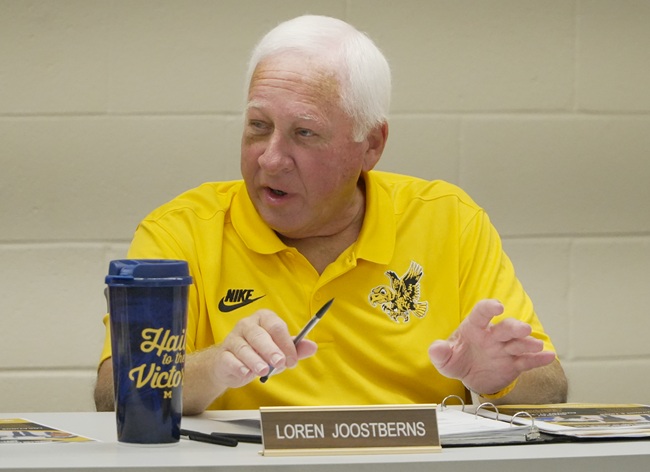 After graduating from Hamilton and then Hope College, Joostberns returned to the district as a teacher. He taught for 30 years, then continued his connection to the classroom as a substitute teacher for another nine. Today, he remains an active part of Hamilton Community Schools as Board of Education secretary, now in his 13th year of service.
Through it all, he has found joy in staying close to athletics. Since announcing his first football game in 1981, he’s become a fixture at sporting events year-round. His passion is not about statistics or wins and losses – it’s about making sure young athletes have the best possible experiences.
“I think one thing is, what can you do to contribute to kids having good experiences?” he said. “That’s one thing I always keep in the back of my mind. You want to do what you can to help kids have positive experiences, and if that contributes in a small way, then it’s worth it.”
Of course, Joostberns admits there’s a little fun in the job, too. “You’re in the center of the action. I’ve got the best seat in the house for football, and for basketball you’re at center court. You get to know the officials, get to know people from other schools, and it’s a good way to be involved.”
Memories from the press box
The Hamilton facilities Joostberns works in today look nothing like what he started with in the early 1980s. He chuckled as he recalled the first press box from which he worked.
“In football, if you would have seen what we had in Hamilton back in 1981 and 1982 compared to what we have now in terms of facilities, it’s incredible,” he said. “The press box was a little green building basically on stilts that swayed with heavy winds, and it held six people – two coaches from each team on either side and an announcer and timer in the middle. You were elbow to elbow and you felt in a precarious position because you didn’t know if the press box was going to stand up or not.”
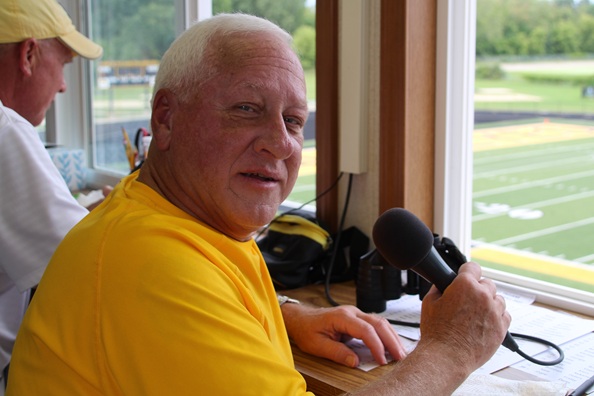 That humble start makes him especially proud to see how the district has grown its athletic facilities and opportunities for students.
While Joostberns has devoted his life to Hamilton, he also holds a special passion for the University of Michigan. He has been a season ticket holder for 51 years, attending countless games at “The Big House” in Ann Arbor. The dual loyalties complement one another: Hamilton football on Fridays and Michigan football on Saturdays.
But no matter how big the stage gets, his heart always comes back to Hamilton. “At Hamilton, we have always prided ourselves in trying our best to do the best we can for kids, to do things the right way,” Joostberns said. “That’s why I’ve stayed involved for so long.”
Lasting Legacy
Few communities can point to someone who has continuously served across so many different roles for more than four decades.
Joostberns’ contributions can’t be measured in titles or statistics, but rather in the memories he has helped shape – whether it’s an athlete hearing his name announced before a big play, a student remembering him as a teacher, or a fellow community member working alongside him on the school board. Numerous times a year, veteran opposing coaches greet Joostberns before the game to say hi because he is such a staple of the community and school district. His warm and friendly demeanor is appreciated by all, both on the home and opposing sidelines.
Hamilton’s athletic director and coaches often describe him as the kind of person every school hopes to have: reliable, passionate, and selfless. He doesn’t do it for recognition, but for the chance to leave things a little better than he found them.
For Joostberns, the motivation is simple: “It’s about helping kids, and being part of something bigger than yourself.”
And for Hamilton, the community is grateful that one of its own has been willing to give back for so many years. As recognition for his countless years of service in and out of the classroom, “Mr. Hamilton” was honored with the high school basketball court being renamed the Loren Joostberns Court in 2021.
From the rickety old press box of 1981 to the modern facilities of today, from chalkboards in the classroom to discussions in the boardroom, Joostberns has remained a steady, positive presence. His story is a reminder of how one person’s steady commitment over a lifetime can shape a school and community for generations.
Not all lessons or legacies are cemented in the classrooms or fields, but some are passed on from behind the mic and echoed over the airwaves for all to hear and cherish.
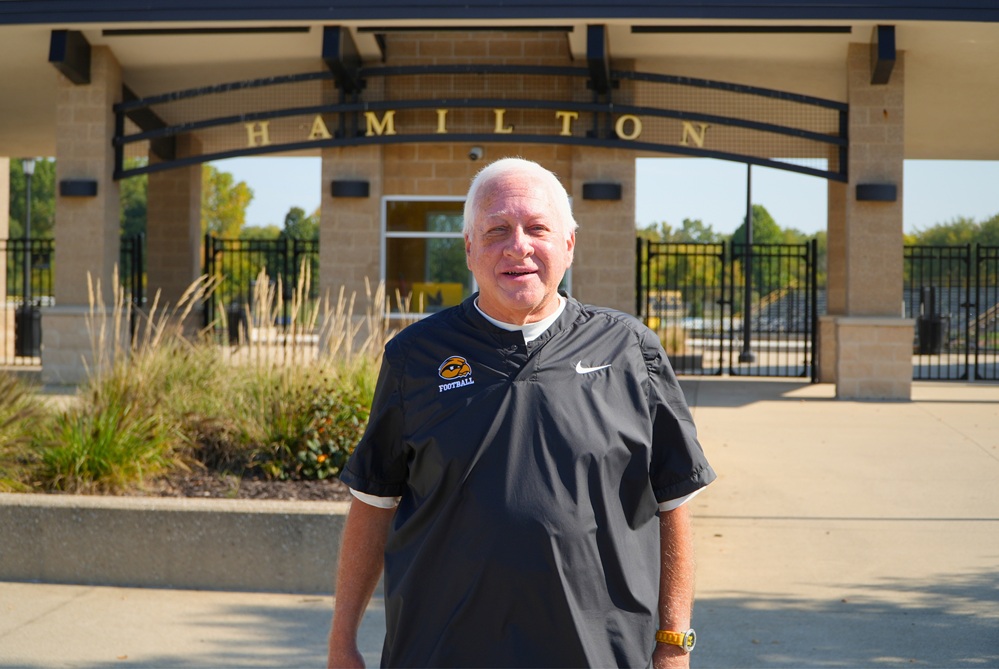
PHOTOS (Top) Hamilton’s Loren Joostberns poses for a photo in front of the high school stadium this fall. (Middle) Joostberns has served the district in several roles over the years, including as a member of the school board. (Below) Joostberns takes a moment for a photo while behind the microphone. (Photos courtesy of Hamilton Community Schools.)