

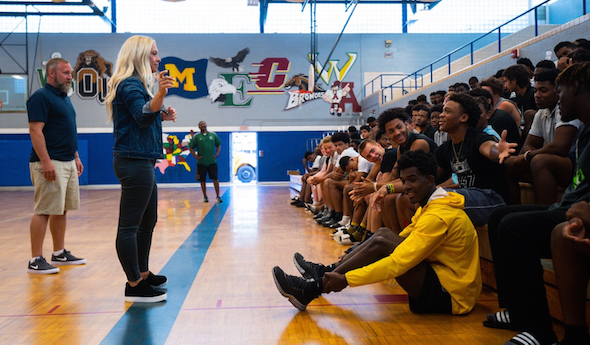
Speakers Bureau Helps Generate Conversation
December 30, 2019
By Rob Kaminski
MHSAA benchmarks editor
As student mental health climbs the list of health and safety concerns, the MHSAA and state associations across the country are taking measures to provide resources and guidance aimed to keep school sports an enjoyable and valuable experience.
In sports, coaches and athletes learn to expect the unexpected. It’s the nature of competition; constructing gameplans tailored to utilize team strengths and expose opponents’ weaknesses. Often times this entails doing things that opponents won’t expect. Participants then learn and prepare for the next time; it’s one of the ways athletics prepares participants for life, as educational leaders often preach.
Today’s ever-changing culture recently threw such a curveball at the young people who populate our hallways and playing surfaces, calling for statewide associations and organizations to shift focuses and prepare for a new opponent while attempting to keep school sports one of the best means to a healthy adolescent lifestyle.
“I was at the NCAA summer meeting in 2017, discussing health and safety issues and the topic of concussions came up, as it often does. I assumed that concussions was the No. 1 health and safety issue,” said MHSAA Executive Director Mark Uyl. “I was quickly corrected that it’s student mental health; that knocked me back.”
It would not be an uncommon reaction, given the amount of information, media coverage and programs designed to recognize and reduce concussion incidents in recent years.
All the while, anxiety, depression and stress had been creeping into the picture beneath the surface. Such disorders are much more difficult to detect, as there are few visible symptoms when compared to sprains, fatigue, head injuries and other physical ailments.
“I became interested and began to research the topic. The more I read, the more concerned I became,” Uyl said. “The MHSAA, with a great deal of help and cooperation from our school leaders, has done a tremendous job educating and providing resources for health-related issues such as heat management, concussion reporting and practice policies, and now we have a new challenge.”
Fortunately, as has often been the case, there are knowledgeable and qualified people throughout Michigan’s roster of educational leaders who are willing to assist.
As word spread regarding the student mental health initiative, the MHSAA was able to establish a Mental Health Speakers Bureau composed of several experienced individuals willing to assist (see below).
“Our speakers bureau really grew by word of mouth,” Uyl said. “A school would bring in a speaker, or a league would invite a speaker, and once we were connected with them, then those people would share names and it grew from there.”
The resources range from former professional athletes, to behavioral specialists, to current MHSAA coaches.
Dave Ingles, basketball coach at Kent City, is one such individual. His credibility comes from first-hand experience.
“I privately struggled with deep depression for six years,” Ingles said. “Be alert. Talk to your athletes and students and actually listen to what they are saying. I always used the phrase, ‘I’m fine;’ that is not an acceptable answer to me anymore when I hear it.”
The National Institute of Mental Health reveals that most mental health conditions begin around the time children are transitioning from middle school to high school. The more people trained to identify symptoms and behavior, the better the chance to reduce or reverse some of the following numbers:
• 50% of all lifetime cases of mental illness begin by age 14
• 37% of students with a mental health condition age 14 or older drop out of school
• 20% of students ages 13-18 live with a mental health condition
• 11% of youth have a mood disorder and 8% have an anxiety disorder
• Suicide is the third leading cause of death for ages 10-24
Non-visible ailments always have been most difficult to detect, and today’s proliferation of technology – from streaming to social media – can serve to further mask symptoms.
“The more kids spend time with their devices, staring at their screens, isolation can be quick to take hold,” Uyl said. “Everything is instant. It used to be if our friends didn’t invite us somewhere, we didn’t worry about it; we probably wouldn’t find out for a couple days and had already moved on. Today, in about 10 minutes, there’s a picture on Instagram or Snapchat and kids instantly know, ‘I’m not included.’ Isolation leads to depression and anxiety, and in the worst cases can even lead to suicide.”
That message might sound familiar. Segments of the 2019-20 MHSAA online rules meetings include Uyl emphasizing student mental health and a video clip produced by benice.org promoting a mental health action plan endorsed by four of the state’s most recognized collegiate coaches.
It’s all part of the plan to promote awareness and generate conversation surrounding this serious health and safety issue during 2019-20 and beyond.
“We’re not going to try to do this all by ourselves,” Uyl said. “There are plenty of experts in the field, and we’re going to utilize their knowledge. We’ll build relationships and align ourselves with these people to provide a foundation. We need to become a resource center for our membership.”
In addition to the rules meetings messages, the MHSAA also partnered with the Michigan Association of Secondary School Principals Student Mental Health Summit on Oct. 8 in Lansing. This event – sold out within weeks of posting – invited principals, counselors, student leadership advisers and student leaders to come together to discuss and seek solutions for student mental health concerns impacting schools. The MHSAA lined up Eric Hipple, one of its speaker bureau members, who delivered a keynote, “Depression and Suicidal Awareness.”
Student mental health was among topics during the MHSAA Update and AD In-Service tour around the state this fall as well. The meeting at Comstock Park on Sept. 30 included a presentation from the Mental Health Foundation of West Michigan to introduce the be nice® action plan and encourage schools to take advantage of that and other resources the group has to offer.
The rise of mental health as one of the more prominent medical concerns nationally has occurred, as Ingles sees it, “because more people are talking about it now.”
Leaders like Ingles and those in numerous organizations have begun to assist the MHSAA in identifying and treating cases in our schools.
MHSAA Mental Health Speakers Bureau
Below is a list of individuals and organizations partnering with the MHSAA to assist in promoting mental well-being for students around the state. The MHSAA encourages school personnel to reach out to any of these experienced leaders in the field for programming in your buildings and districts.
• Christy Buck, Executive Director – Mental Health Foundation of West Michigan - be nice.® [email protected]
• Brooke Buys, Mental & Behavioral Health Specialist – BLND Health [email protected]
• Eric Hipple, former Detroit Lions quarterback [email protected]
• Dave Ingles, Basketball Coach & Speaker – Kent City High School [email protected]
• Cat Lanting, Program Coordinator – Mental Health Foundation of West Michigan - be nice.® [email protected]
• Halle Wangler, former University of Michigan basketball player [email protected]
PHOTO: Brooke Buys, a mental and behavioral health specialist and founder of BLND Health, speaks with students. (Photo courtesy of BLND Health.)

Century of School Sports: Together, We are the MHSAA
By
Geoff Kimmerly
MHSAA.com senior editor
July 9, 2025
A primary mission of the MHSAA’s 100-year anniversary has been to connect today’s athletes, administrators, coaches, game officials and spectators with their roles in the ever-growing story of school sports in Michigan.
Indeed, together, we are the MHSAA.
Over the last 10 months and with today’s 44th and final installment, our “Century of School Sports” series also has sought to tell a deeper and more detailed story of how the MHSAA has arrived at this moment. As our work becomes new with the start of every school year, and with every family experiencing educational athletics for the first time, it’s a story that must always be updated, expanded and retold.
But at the heart of most organizations is a fundamental statement. So to close this celebration, we below break down what is literally the “About” of the MHSAA – as we prepare to build on these values in adding to our story again and again during the century to come.
The MHSAA is a private, not-for-profit corporation …
Although the MHSAA has built a thriving relationship with the Michigan Department of Education over the last many decades – and, in fact, the state superintendent or designee has a non-voting position on the Representative Council – the MHSAA also has maintained its autonomy since its start and even before, as a legislative takeover attempt of the former Michigan Interscholastic Athletic Association led to the MHSAA’s formation in December 1924.
The MHSAA was first incorporated in 1972 and is classified as a 501(c)(3) organization. In the most basic terms, as a non-profit corporation the MHSAA must reinvest all revenue it receives back into its mission of administering school sports. Put another way, whatever money the MHSAA makes must be spent to conduct its tournament events and the several other educational, leadership, etc., programs the MHSAA provides for students, coaches, officials and others who contribute to educational athletics.
… of voluntary membership …
Through their boards of education, member schools voluntarily join the MHSAA each and every year, vowing by formal school board resolution to abide by and enforce the MHSAA’s rules for educational athletics. Membership is optional; schools may conduct a complete program of interscholastic athletics and may participate against MHSAA member schools in regular-season competition without joining the MHSAA. But the great majority of high schools in Michigan approve that membership annually.
… by more than 1,500 public and private senior high schools and junior high/middle schools …
Over the last several years, the MHSAA has counted about 750 high schools and 800 junior high or middle schools, or elementary schools with 6th-grader participation, among its membership. For 2024-25, those totals were 754 high schools, 777 junior high/middle schools and 63 elementary schools with participating sixth graders.
… which exists to develop common rules for athletic eligibility and competition.
This drove the original formation of school sports associations across the nation going back to the late 1800s, including the Michigan State Teachers Association’s first inroad into athletic administration in 1895. The MHSAA Handbook, updated annually with rules and other changes voted upon by the Representative Council, is the rulebook for all MHSAA member schools – public and nonpublic – with rules for general topics like student eligibility but also specific to each sport to regulate scheduling and other intricacies.
No government funds or tax dollars support the MHSAA …
In maintaining that independence noted above, the MHSAA receives no funding from local, state or federal governments. The MHSAA’s income is derived primarily from ticket sales at postseason events, with smaller portions from sponsors and advertising, officials and coaches education registration fees – and again, with all money brought in by the MHSAA going back into those tournament events and programs to support students, athletic directors, coaches and officials.
… which was the first such association nationally to not accept membership dues or tournament entry fees from schools.
These have long been points of pride for the MHSAA; membership remains and has been completely free since the mid-1940s, after the end of World War II, and member schools may enter MHSAA Tournaments for free.
Member schools which enforce these rules are permitted to participate in MHSAA tournaments …
In adopting and upholding MHSAA rules as their own, school districts agree to promote a standard of competitive equity necessary to keep MHSAA Tournament events fair for all involved.
… which attract more than 1.4 million spectators each year.
Over the last 35 years, attendance at MHSAA Tournament events has reached at least 1.1 million spectators annually (not counting the COVID-affected 2019-20 and 2020-21 school years), with a high of 1.68 million during the 2005-06 school year. Attendance during the 2022-23 and 2023-24 school years began climbing again toward 1.5 million spectators, those last two years’ ticket totals ranking among the highest over the last 15.
School sports have a massive footprint in Michigan, which has a population just above 10 million residents. Sure, attendance figures likely count the same spectators several times – the same person might buy tickets for several rounds of several sports over the course of a school year – but a one-to-one comparison using athlete totals also is powerful.
Conservatively, Michigan has at least 160,000 high school athletes. Add in parents of those athletes, grandparents, other relatives with significant interest, and that’s a huge block – let’s say at least 5 percent of the state’s population have some current tie to the athletes playing at the local high school. That’s not even covering athletes at MHSAA junior highs and middle schools, coaches and athletic directors at all levels, and more than 8,000 game officials who make those contests possible. And our groups of athletes are rolling over at least every four years, meaning many tens of thousands more have had at least recent direct contact as participants in our programs.
The MHSAA always has provided opportunities to compete and win championships, but more importantly to learn life lessons gleaned from simply taking part in the process.
This work is important; its impact is significant. And just as our predecessors surely felt beginning this endeavor 100 years ago, we remain eager and enthused to play our part.
Previous "Century of School Sports" Spotlights
June 25: All-Time 'Parade of Champions' - Read
June 17: Top Performers Tell Us What High School Sports Mean to Them - Read
June 10: 'The Mitten' Becomes Sought-After Symbol of MHSAA Greatness - Read
June 3: MHSAA's Move to TV, Now Internet, 60 Years Old & Growing - Read
May 27: Upper Peninsula Helps Make Michigan's School Sports Story Unique - Read
May 20: From Nearly A to Z, Schools Repped by 221 Nicknames - Read
May 13: These Record-Setters were Nearly Impossible to Defeat - Read
May 6: 200+ Representatives Fill All-Time Council Roster - Read
April 29: MHSAA Programs Prioritize Health & Safety - Read
April 23: Patches Signify Registered Officials' Role in MHSAA Story - Read
April 16: Student Advisory Council Gives Voice to Athletes - Read
April 9: State's Storytellers Share Spring Memories - Read
April 2: Sharp Leadership Synonymous with MHSAA Success - Read
March 25: Athletic Directors Indispensable to Mission of School Sports - Read
March 18: 2025 Finals Begin Next Half-Century of Girls Hoops Championships - Read
March 11: Boys Basketball's Best 1st to Earn MHSAA Finals Titles - Read
March 5: Everything We Do Begins with Participation - Read
Feb. 25: Slogans & Logos Remain Unforgettable Parts of MHSAA History - Read
Feb. 19: MHSAA Tickets Continue to Provide Fan-Friendly Value - Read
Feb. 11: We Recognize Those Who Make Our Games Go - Read
Feb. 4: WISL Conference Continues to Inspire Aspiring Leaders - Read
Jan. 28: Michigan's National Impact Begins at NFHS' Start - Read
Jan. 21: Awards Celebrate Well-Rounded Educational Experience - Read
Jan. 14: Predecessors Laid Foundation for MHSAA's Formation - Read
Jan. 9: MHSAA Blazes Trail Into Cyberspace - Read
Dec. 31: State's Storytellers Share Winter Memories - Read
Dec. 17: MHSAA Over Time - Read
Dec. 10: On This Day, December 13, We Will Celebrate - Read
Dec. 3: MHSAA Work Guided by Representative Council - Read
Nov. 26: Finals Provide Future Pros Early Ford Field Glory - Read
Nov. 19: Connection at Heart of Coaches Advancement Program - Read
Nov. 12: Good Sports are Winners Then, Now & Always - Read
Nov. 5: MHSAA's Home Sweet Home - Read
Oct. 29: MHSAA Summits Draw Thousands to Promote Sportsmanship - Read
Oct. 23: Cross Country Finals Among MHSAA's Longest Running - Read
Oct. 15: State's Storytellers Share Fall Memories - Read
Oct. 8: Guided by 4 S's of Educational Athletics - Read
Oct. 1: Michigan Sends 10 to National Hall of Fame - Read
Sept. 25: MHSAA Record Books Filled with 1000s of Achievements - Read
Sept. 18: Why Does the MHSAA Have These Rules? - Read
Sept. 10: Special Medals, Patches to Commemorate Special Year - Read
Sept. 4: Fall to Finish with 50th Football Championships - Read
Aug. 28: Let the Celebration Begin - Read