

Specialization Not the Only Pathway
April 21, 2015
 By Eric Martin
MSU Institute for the Study of Youth Sports
Specialization is not a new topic facing athletes and parents.
In a 1989 study by Hill and Simons, athletic directors indicated that the three-sport athletes of the past were being replaced by athletes who only participated in a single sport. Multiple athletic directors indicated that the decrease of multi-sport participation was a concern for all involved in the sport environment as increased emphasis on sport specialization was not in the true vision of high school sports.
Even though the distress concerning sport specialization is not a new topic, the rise of club sports and year-round travel teams have increased the number of youth athletes who are forced to make a choice between playing multiple sports or focusing their time and training efforts solely on one sport. The decision to focus solely on one sport sometimes is done by athletes (or their parents) who believe that quitting other sports is the sole way to earn a coveted college scholarship.
However, even though counter intuitive, sport specialization may be hampering their pursuit to play at the next level.
Elite level achievement in sport is rare, with statistics showing that only 0.12 percent of high school athletes in basketball and football eventually reach the professional level. To combat these odds, many in popular media including Malcolm Gladwell have forwarded Anders Ericcson’s proposal that to become an expert in a field, an individual must accumulate 10,000 hours of practice.
To achieve this aim, many parents and athletes disregard other sports believing that extra exposure to a single sport may result in accumulating these hours quicker and increase an athlete's chances of elite skill achievement. Reducing the achievement of sport excellence to solely practice hours overlooks the importance that developmental, psychosocial, and motivational factors play in the achievement of high level success in youth. Further, several research studies have found that elite athletes typically fall short of this 10,000 hour milestone.
Simply accumulating a magic number of hours does not guarantee sport success, and in fact, trying to accumulate these hours too early can lead to many different negative outcomes for youth.
Sport specialization has been shown to have a variety of negative physiological and psychological outcomes for youth athletes. Typically, athletes who specialize in one sport play that sport year-round with little or no offseason. In these cases, athletes who continually perform repetitive motions such as throwing or jumping can experience overuse injuries that can range from tendinitis to torn ligaments.
In addition to the increased risk of injury, youth who specialize and play a single sport year-round are at risk for psychological issues as well. Youth who play a single sport are less likely to allow for proper recovery and face the increased chance of burnout or decreases in motivation that may result in leaving sport entirely. Additionally, as practice time demands and multiple league involvement increases, youth may feel added pressure to succeed due to the increased time and financial costs incurred by parents.
Finally, youth who specialize early in only one sport do not develop the fundamental motor skills that help them stay active as adults, instead only developing a very narrow skill set of a single sport.
If the dangers of sport specialization do not encourage multisport participation, a majority of studies have shown that sport specialization does not increase long-term sport achievement. In fact, most studies indicate that athletes who reach the highest level of sport achievement typically played a variety of sports until after they were well into high school.
For example, a study with British athletes found that youth who played three or more sports at the ages of 11, 13, and 15 had a significantly higher likelihood of playing on a national team at ages 16 and 18. These athletes had a more rounded set of skills, were more refreshed for their chosen sport, and were more psychologically and emotionally ready to perform due to their experiences in a number of sports.
A study recently conducted by the Institute for the Study of Youth Sports with collegiate athletes showed similar results as the British athlete study. In the ISYS study, 1,036 athletes from three Division I universities were asked to report their past youth sport participation. On average, youth participated in three or more sports in elementary and middle school. The number of sports youth participated in decreased with each year of high school, but even with the decrease of participation, a larger number of individuals played more than one sport during every year of high school including senior year than those who played a single sport.
Even though a majority of athletes did play at least two sports throughout high school, several athletes did indicate that they specialized in one sport indicating that there are multiple pathways to elite sport achievement.
Athletes were also asked for their perception of how important it was to specialize in one sport in order to earn a college scholarship. On a scale of 1-9, athletes felt that specializing in one sport prior to high school was neither important nor unimportant (4.97).
Sport specialization is not a new issue, but that does not minimize the damage that can occur if athletes are overtaxed early in their development. Each athlete is unique, and each situation requires care. If an athlete does decide to play in only one sport, the decision should be made in regards to the athlete’s interest and development, not just in the pursuit of a college scholarship. Additionally, if athletes specialize in one sport, it is critical to understand that youth are developing and proper recovery is critical both physically and psychologically.
Early specialization in sport is an issue that is not going to go away, but for coaches, parents, and athletes this decision should be made with a long-term perspective and with the athletes’ long-term well-being central to the choice.
Martin is a fourth-year doctoral candidate in the Institute for the Study of Youth Sports at Michigan State University. His research interests include athlete motivation and development of passion in youth, sport specialization, and coaches’ perspectives on working with the millennial athlete. He has led many sessions of the MHSAA Captains Leadership Clinic and consulted with junior high, high school, and collegiate athletes. If you have questions or comments, contact him at [email protected].
Century of School Sports: These Record-Setters Were Nearly Impossible to Defeat
By
Geoff Kimmerly
MHSAA.com senior editor
May 13, 2025
Most days, across Michigan high school sports and athletics at every level, a rare big-time upset is going to grab a bigger headline over yet another win by a usual favorite that comes out on top all the time.
But today, we’re going to celebrate teams that have made winning something of a daily routine over long stretches during the MHSAA’s 100-year run.
For the majority of head-to-head team sports, the MHSAA tracks winning streaks and lists the longest in their respective record books. And while all making those lists are impressive, the longest seem almost inconceivable.
Let’s start with the 192-match winning streak by Marysville from Dec. 10, 1996, through Jan. 15. 2000, the longest by number of victories. That incredible run made up most of the first half of an also incredible eight-straight Class B Finals championship seasons for the Vikings. Three others volleyball teams have won at least 92 straight matches, but none more than 98.
Traverse City Central girls tennis’ 107-dual match winning streak from 1989-2000 is the longest by length of time, and the only other to reach triple digits for total wins – with a seven-year, 71-match run by the Okemos boys tennis team from 1990-97 also reaching toward nearly a decade of similar success.
Several more have approached the 100-consecutive-win milestone. Hudsonville Unity Christian girls soccer won 86 straight games from 2005-08, and actually was 97-0-1 over those four seasons. The Allen Park Cabrini softball team won 80 straight games during the 2006-08 seasons, the Powers North Central boys basketball team won 84 straight games between 2014-17, and Orchard Lake St. Mary’s baseball team became our latest winning streak record-setter with 84 straight victories from May 1, 2021 through May 3, 2023.
Okemos is the one of only two schools with two record winning streaks, having also won 64 straight girls lacrosse games from March 21, 2009, through May 3, 2011. The other is North Central, which also won 41 straight 8-player football games between Sept. 18, 2020, and Sept. 15 2023, with many of the same athletes who played on the record-setting boys basketball team.
Also from the Upper Peninsula, Carney-Nadeau’s girls basketball teams of 1989-91 held on to their record of 78 consecutive wins despite a 76-victory pursuit by Pittsford from 2015-18. Bloomfield Hills Brother Rice won the first 13 Division 1 boys lacrosse championships, and the early years of that run included a 29-game winning streak during the 2008 and 2009 seasons.
The record holders in boys soccer and 11-player football require a little bit of explanation. While Genesee Christian owns the boys soccer winning streak record of 33 from 2015 and beginning of the 2016 season, Detroit Country Day easily outpaces the rest for longest unbeaten streak in that sport having gone 69-0-10 between 1991-94.
Hudson football also remains legendary for its record streaks of 72 straight wins (including playoffs) from 1968-1975 and 81 straight during the regular season from 1968-1977 – although that playoff era streak included only one playoff win, as the Tigers won their Semifinal in 1975 but fell to Ishpeming in the inaugural Class C title game. The longest football playoff streak built entirely during the playoff era belongs to Ithaca, which won 69 straight games beginning with its opener in 2010 and ending in the 2014 Division 6 championship game as the Yellowjackets pursued what would have been a fifth-straight title in that division.
The lack of winning streak lists in wrestling and ice hockey are a noticeable gaps in this collection. Those lists hopefully will be constructed in the future.
Previous "Century of School Sports" Spotlights
May 6: 200+ Representatives Fill All-Time Council Roster - Read
April 29: MHSAA Programs Prioritize Health & Safety - Read
April 23: Patches Signify Registered Officials' Role in MHSAA Story - Read
April 16: Student Advisory Council Gives Voice to Athletes - Read
April 9: State's Storytellers Share Spring Memories - Read
April 2: Sharp Leadership Synonymous with MHSAA Success - Read
March 25: Athletic Directors Indispensable to Mission of School Sports - Read
March 18: 2025 Finals Begin Next Half-Century of Girls Hoops Championships - Read
March 11: Boys Basketball's Best 1st to Earn MHSAA Finals Titles - Read
March 5: Everything We Do Begins with Participation - Read
Feb. 25: Slogans & Logos Remain Unforgettable Parts of MHSAA History - Read
Feb. 19: MHSAA Tickets Continue to Provide Fan-Friendly Value - Read
Feb. 11: We Recognize Those Who Make Our Games Go - Read
Feb. 4: WISL Conference Continues to Inspire Aspiring Leaders - Read
Jan. 28: Michigan's National Impact Begins at NFHS' Start - Read
Jan. 21: Awards Celebrate Well-Rounded Educational Experience - Read
Jan. 14: Predecessors Laid Foundation for MHSAA's Formation - Read
Jan. 9: MHSAA Blazes Trail Into Cyberspace - Read
Dec. 31: State's Storytellers Share Winter Memories - Read
Dec. 17: MHSAA Over Time - Read
Dec. 10: On This Day, December 13, We Will Celebrate - Read
Dec. 3: MHSAA Work Guided by Representative Council - Read
Nov. 26: Finals Provide Future Pros Early Ford Field Glory - Read
Nov. 19: Connection at Heart of Coaches Advancement Program - Read
Nov. 12: Good Sports are Winners Then, Now & Always - Read
Nov. 5: MHSAA's Home Sweet Home - Read
Oct. 29: MHSAA Summits Draw Thousands to Promote Sportsmanship - Read
Oct. 23: Cross Country Finals Among MHSAA's Longest Running - Read
Oct. 15: State's Storytellers Share Fall Memories - Read
Oct. 8: Guided by 4 S's of Educational Athletics - Read
Oct. 1: Michigan Sends 10 to National Hall of Fame - Read
Sept. 25: MHSAA Record Books Filled with 1000s of Achievements - Read
Sept. 18: Why Does the MHSAA Have These Rules? - Read
Sept. 10: Special Medals, Patches to Commemorate Special Year - Read
Sept. 4: Fall to Finish with 50th Football Championships - Read
Aug. 28: Let the Celebration Begin - Read
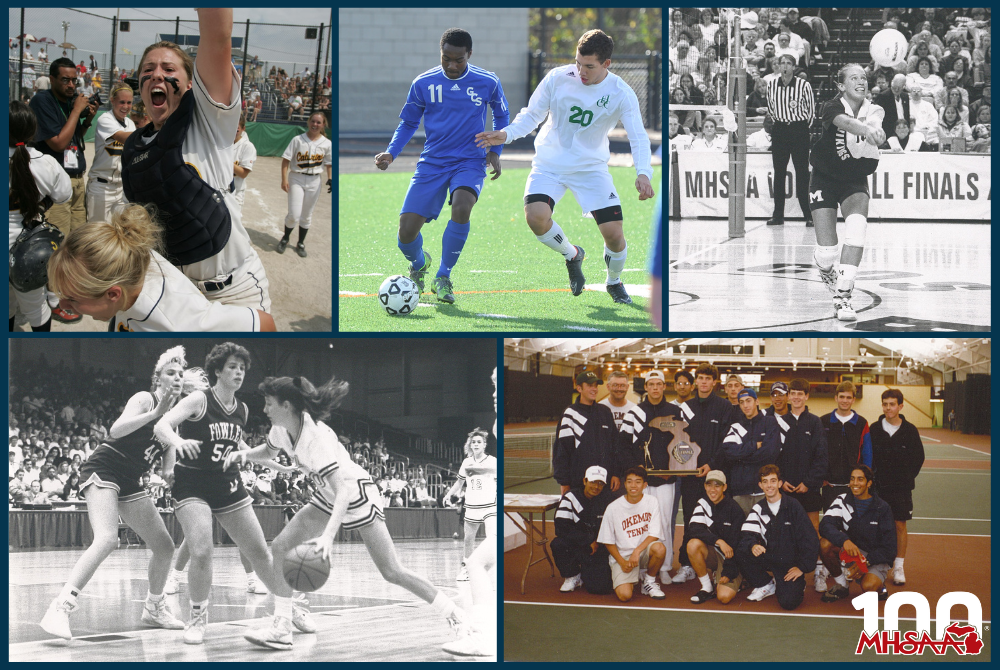
PHOTOS Clockwise from top left: Allen Park Cabrini catcher Amanda Chidester celebrates her team's 2007 softball championship. (2) Genesee Christian's Caleb DuPree (11) controls possession as Kalamazoo Hackett Catholic Prep's Kawika Singson pursues during their 2015 championship match. (3) Shaleene Glombowski sets for Marysville during the 1998 Class B Final. (4) The 1995 Okemos boys tennis team takes a photo after clinching another Finals championship. (5) Carney-Nadeau's Jill Wetthuhn drives against Fowler during the 1990 Class D Final.