

Baseball Remains Front of Tuttle's Mind, Close to Retired Coach's Heart
By
Doug Donnelly
Special for MHSAA.com
June 29, 2023
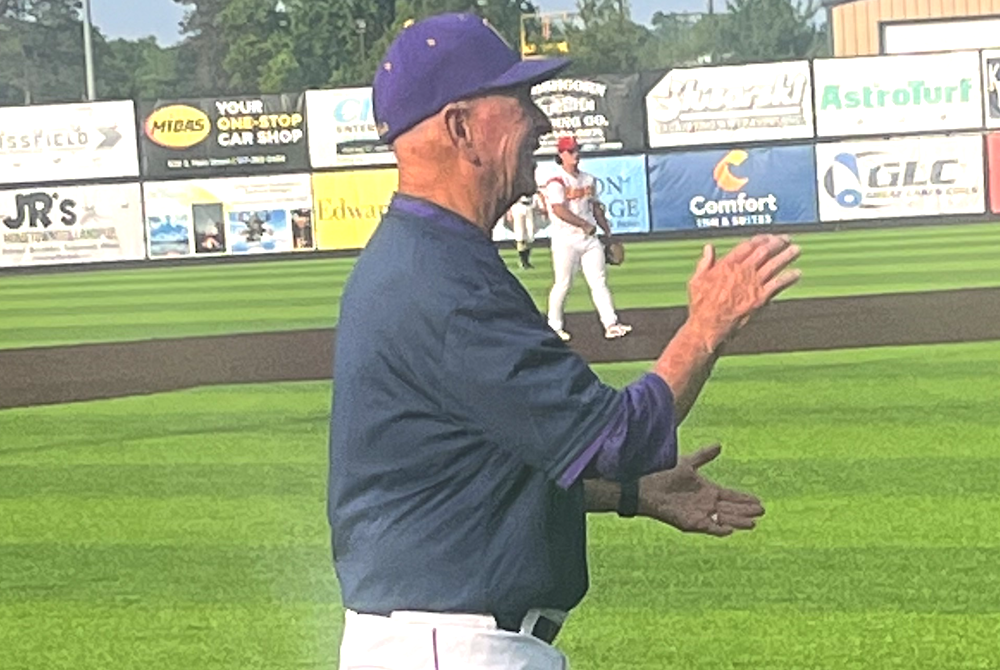
BLISSFIELD – Larry Tuttle jogged out of Tuttle Dugout onto the artificial turf at Adrian College and took his spot in the third base coach’s box, looked in at the batter as he approached the plate and clapped his hands.
It’s like he never left.
For more than 50 years, Tuttle occupied the third base coach’s box for the Blissfield Royals. He is the winningest high school baseball coach in Michigan history and one of the winningest prep baseball coaches in America. It’s been two years since Tuttle last coached the Royals, but when the Lenawee County All-Star Game came around this year, and Onsted coach Matthew Randall was named a head coach of one of the teams, one of his first calls was to Tuttle.
“To see him coach third base again for two innings of that all-star game was nothing short of amazing,” Randall said. “I love that man and everything he has taught me.”
Tuttle and Randall faced off about 40 times over the years.
“There’s a lot of respect between us,” Tuttle said. “I was happy to do it.”
Tuttle, 79, is a Morenci native who played baseball and graduated from Adrian College, coached for one year at Temperance Bedford and five decades at Blissfield. He spends a little more than half of the year in Florida these days in a house he owns in The Villages, a retirement community about an hour north of Orlando.
This past spring, Blissfield took a spring baseball trip to Florida and Tuttle was able to come out to the field and watch a few practices.
“That’s the best time,” he said. “I always enjoyed those first practices of each season. People will ask me, ‘But what about the cold? It’s always so cold in Michigan that first week.’ The first 10 days or two weeks or so inside, that’s where we formed our whole season, working on the fundaments and the strategy, getting the kids mentally ready for the season. That was a fun part of coaching.”
He returns home to Michigan each summer to spend time with his kids and grandchildren, including a freshman-aged granddaughter who is showing good things in softball. His roots are in southeast Michigan, and he has every intention of keeping it that way.
 Tuttle’s career at Blissfield was nothing short of remarkable.
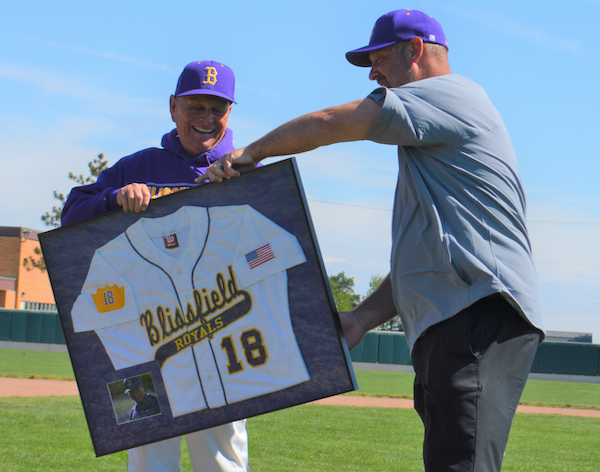
He coached Blissfield for 54 seasons. It would have been 55, but the 2020 season was canceled due to COVID. The Royals won 1,332 games during his career. They won 33 District titles, 23 Regional championships and seven Finals crowns. Blissfield also won 40 league titles, including in his final season of 2021. His No. 18 jersey was retired by the school district.
In 2015, Tuttle was an easy inaugural choice for the Michigan Baseball Hall of Fame.
This summer, Tuttle returned to Michigan in time to see Blissfield play a few regular-season games and was there when his beloved Royals played in the Division 3 District tournament. He wore his familiar Royals gear. When the Lenawee County All-Star game was played, Tuttle was in his full Blissfield uniform. It still fits perfectly.
“I still enjoy the game,” Tuttle said. “It’s my energy level that just isn’t what it used to be. That’s why I stepped down. I still love the strategy of the game.”
When he’s watching a game, he still goes through every play in his mind and what he would do if he was calling the shots.
“You’re always coaching even though you might a spectator,” he said. “It may not be the right way, but it’s my way. That’s baseball. I love thinking about what to do on this count or that count, to take a pitch or not.
“I see a lot of coaches these days who had played in college. Young coaches coach the college way, but you are dealing with high school kids who may not have a real firm understanding of the game itself. You have to teach high school baseball to college kids. You don’t teach college or pro ball to high school kids.”
Tuttle, who has battled some health issues the last couple of years, misses being in his role as coach.
“I miss the players and the relationships I had with umpires and the other coaches,” he said. “It’s hard to replace that.”
Tuttle is an icon in Lenawee County. When he goes to a game, people gather around him to talk. He still follows the area teams and has a relationship with several coaches and ex-players.
Tuttle enjoyed monumental success at Blissfield. The Royals’ last sub-.500 season was in 1971.
“I know that because I have the records,” Tuttle said. “The closest we came was we were 8-8 one year in the 1980s.”
Tuttle has been a stickler for stats his entire career. Some coaches have a hard time remembering how their team did two years ago. Tuttle knows. He kept intricate stats on every team he’s coached at Blissfield and to this day has them organized only a few steps away from his kitchen table at his home in Blissfield – which is just across the street from the high school and a long home run away from the baseball field that is named in his honor.
“I have a file cabinet full of files from each season and I have the scorebook from every year I coached at Blissfield, starting in 1968,” Tuttle said. “Stats were always important to me, not the wins, but the stats. Baseball stats tell you so much about the game.”
Since stepping aside, Tuttle has had time to reflect on his career.
“I would have never believed I would have coached that long,” Tuttle said. “Then, I sit back and think, ‘That was a lot of wins, wasn’t it?’ I don’t mean that in a bragging way. I think more about it when I go to a game.”
Randall recently announced his retirement from Onsted after 13 years as head coach. Onsted is in the same conference as Blissfield, the Lenawee County Athletic Association, so he had a close-up view of Tuttle in action.
He now has a memory of the last game he coached at the All-Star Game at Adrian College.
“I credit a lot of my coaching philosophy to this day to him,” Randall said. “Our relationship has really grown over the years. I wanted Coach Tuttle to be with me in my final game. That’s why I asked him.”
PHOTOS (Top) Retired Blissfield baseball coach Larry Tuttle coaches third base during the June 26 Lenawee County All-Star Game. (Middle) Tuttle’s jersey is retired during a 2021 ceremony. (Photos by Doug Donnelly.)
Top-Ranked St. Francis Earns Repeat Try, Unranked K-Christian Walks Off To Advance
By
Steve Vedder
Special for MHSAA.com
June 11, 2026
EAST LANSING - You can say much about a defending state champion, but opportunistic likely describes Traverse City St. Francis best.
The Gladiators remained in the hunt to become the first team to win back-to-back MHSAA Division 3 titles in 13 years after topping Rochester Hills Lutheran Northwest 13-3 in Thursday's five-inning Semifinal at Michigan State.
St. Francis didn't necessarily pound the ball offensively and two pitchers scattered six hits, just four fewer than the Gladiators (33-5) tallied. But St. Francis took advantage of eight Crusaders errors, either bunted the ball for hits or used a sacrifice to involve scoring seven runs, and stole 10 bases en route to the win.
That, said coach Tom Passinault, is typically how the team rolls.
"Absolutely," he said. "There were the errors and that compounds things. But Rochester is a good team. You can't yell at the kids because it's just baseball. But there are things that we can do."
The win sent St. Francis into Saturday's 11:30 a.m. Final against Kalamazoo Christian.
Gladiators freshman infielder John St. Peter said taking advantage of opponents' mistakes is a trademark for the team, which won Division 3 a year ago and will be playing in its fourth Final since 2017.
"That's always how we roll," said St. Peter, who contributed a two-run triple and RBI single. "We pick up on what they can't do and the things we can do. I'm just a freshman and this is my first year, and I know I have some big shoes to fill. There's a lot of responsibility for sure."
There was no more of an opportunistic inning for St. Francis than the third. Already ahead 3-0, the Gladiators bunched three singles, a fielder's choice, a walk, three stolen bases, three errors and a wild pitch to score four more runs.
 St. Francis senior captain Sam Wilfong said the ability to capitalize on mistakes added to the experience from playing in last year's Final likely makes the current team better than last season’s champion.
"I would say better because we're battle-tested," he said. "We know what we have to do and how to keep our emotions in check. We know what it takes to win much better this year. Guys have been there before."
St. Francis pitcher Lanse Vos, who gave up four hits in 3 1/3 innings, won't necessarily compare the two teams. But there's little doubt last year's run has affected this season.
"I think we've built off last year," he said. "Our four seniors we lost from last year said go run it back this year. That's what we're trying to do. We put the ball in play, and good things happen. We make those plays this year."
Kalamazoo Christian 6, Detroit Edison 5
Who says Kalamazoo Christian is too young to cause ripples in the MHSAA baseball tournament?
The Comets rallied with a pair of runs in the bottom of the seventh inning to outlast Detroit Edison and to sail into Saturday's 11:30 a.m. Final.
Despite having just two seniors on the roster, the unranked Comets – who start six juniors and a sophomore – overcame a 5-4 deficit during their final at bats to win the game on a based-loaded single by junior outfielder Max Johnson. Kalamazoo Christian (26-8) let a 4-2 lead slip away in the fifth inning and was tied as late as 4-4 in the sixth before trailing 5-4 going into the last half inning.
Comets coach Russ Meyer said the young team "hasn't flinched" in handling big moments, even with just two seniors.
"I knew and they knew we had incredible talent last year, that people expected a lot and things didn't happen for us," he said. "We played with a chip on our shoulder this year. It's like what about us?"
Johnson, who entered the game hitting .304 but with just nine RBIs in 79 at-bats, said his clutch hit was the first walk-off he's ever had, going back to Little League.
"I was down in the count and I knew I had to battle," he said. "Everyone on base trusted me, and that trust helped. It was like see ball, hit ball. We've done this all year; we just had to stick it out."
Comets junior outfielder Noah Zichterman had a pair of huge hits, including a third inning RBI double that gave the team a 3-2 lead, and a game-tying triple in the seventh two batters before Johnson's heroics.
Zichterman said it doesn't bother his teammates that the team isn't ranked or that few expected the club to be in an MHSAA Final.
"No one expected us to be this good," he said. "We've had some adversity that we overcame. I believe in us, we believe in ourselves and we just play the game."
Another key hit for the Comets was a two-run third-inning double by Jace Rarick. Crosby Croel had an RBI single in the fourth that put Kalamazoo Christian up 4-2.
Among Edison's highlights were a run-scoring single by Javarious Jackson that tied the game at 4-4 in the sixth inning and an RBI single by Jerrell Crosson II that gave Edison (23-9) a 5-4 lead in the top of the seventh.
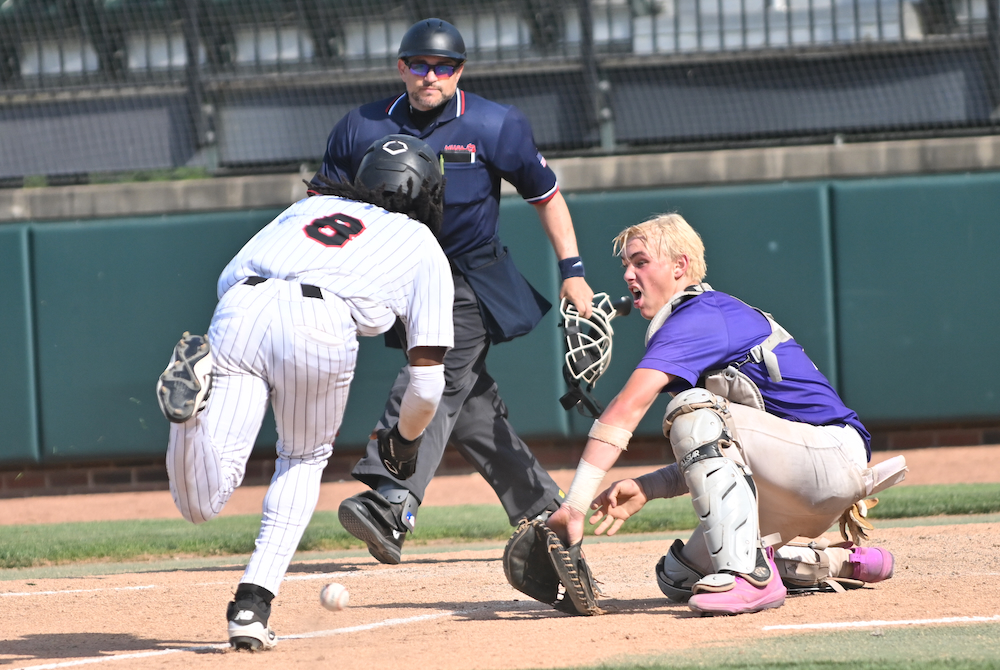
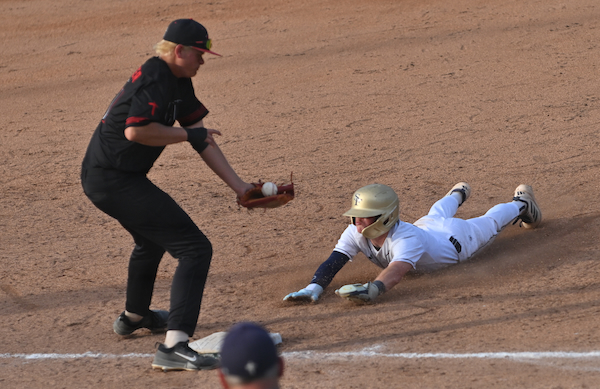
PHOTOS (Top) Kalamazoo Christian catcher Jace Rarick prepares to put a tag on Detroit Edison's DaiJon Brooks (8) during the Comets' Division 3 Semifinal win Thursday at McLane Stadium. (Middle) A Traverse City St. Francis runner attempts to get back to first base during his team's win over Rochester Hills Lutheran Northwest.