

Vermontville Ace Joins NFHS Hall (Video)
August 15, 2016
By Geoff Kimmerly
Second Half editor
Michigan celebrated its eighth inductee to the National High School Sports Hall of Fame with the honoring of Vermontville baseball star Ken Beardslee during the annual National Federation of State High School Associations summer meeting, this summer in Reno, Nevada.
 Beardslee, who died in 2007, has been proclaimed as “prep baseball’s first ace” in the NFHS National High School Sports Record Book and was featured in the former print version of the book for his incredible feats from 1947-49. In his three years on the mound for Vermontville, Beardslee won 24 of his 25 starts (the team was 31-1 during that time). His 24 victories included eight no-hitters, with two perfect games, and seven one-hitters.
He set seven national records, and two still stand after 66 years: his per-game season strikeout mark of 19.0 and his per-game career strikeout mark of 18.1. He was drafted by the New York Yankees immediately after graduating from high school and pitched in the minor leagues from 1949 to 1956, when an injury ended his playing career. Beardslee went on to scout for the Pittsburgh Pirates for 21 years, and he received a World Series ring after the team’s championship win in 1971. He also went on to write eight books including novels, poetry and an instructional on pitching.
He was one of 12 individuals, including five athletes, inducted as part of this year’s class. His wife Marilene represented Beardslee in accepting the honor, and offered this as to the role high school athletics played in her husband’s life and career:
“My time with Ken was long after his high school days. I'm sure Ken's career gave him joy, happiness. It allowed him to accomplish goals. It opened doors; it opened doors to friendships throughout his life ... Terry Collins with the Mets, Doug Melvin (who) just this year stepped down with the Milwaukee Brewers. Those are things that high school opened doors for him.”
Beardslee was nominated for the NFHS Hall of Fame by the Michigan High School Athletic Association after years of research by Charlotte resident Terry Lowery. Lowery didn't have an immediate connection to Beardslee and only moved to Eaton County as an adult. But during a funeral for one of Beardslee’s high school teammates, Lowery heard the stories of the high school ace – and went to work building his application.
Below is the video produced by the NFHS that played during Beardslee’s portion of the induction ceremony and includes a touching interview with Marilene, who received Ken’s plaque from MHSAA assistant director Kathy Vruggink Westdorp.
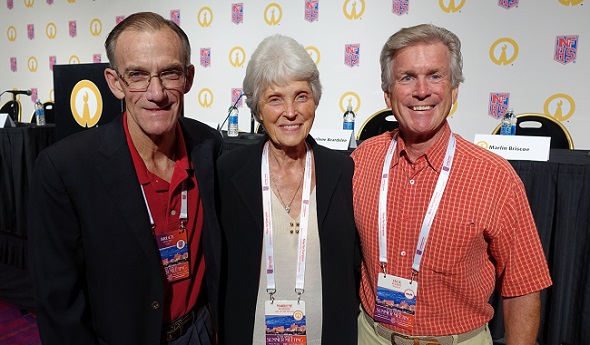
PHOTOS: (Top) Marilene Beardslee stands with the NFHS’s Bruce Howard (left) and MHSAA Executive Director Jack Roberts during the Hall of Fame festivities in Reno, Nev. (Middle) Ken Beardslee, during his high school days at Vermontville. (Top photo courtesy of Terry Lowery.)

Scholar-Athlete Applications Available
By
Geoff Kimmerly
MHSAA.com senior editor
October 19, 2016
By Geoff Kimmerly
Second Half editor
One of the Michigan High School Athletic Association’s most popular programs, the Scholar-Athlete Award, will again present 32 $1,000 scholarships to top student-athletes at member high schools during the 2016-17 school year.
 The MHSAA-Farm Bureau Insurance Scholar-Athlete Award highlights the value extracurricular activities play in the total education of high school students, often improving their academic achievements in the process. The Scholar-Athlete Award is in its 28th year. Since the award’s inception in 1988-89, Farm Bureau Insurance has presented more than $700,000 in scholarships through this program.
The first 30 scholarships will be presented on a graduated basis across the MHSAA’s traditional class structure. From Class A schools, six boys and six girls will receive scholarships; from Class B schools, four boys and four girls; from Class C schools, three boys and three girls; and from Class D schools, two boys and two girls will be honored. The final two scholarships will be awarded at-large to minority recipients, regardless of school size. The scholarships may be used at the institution of higher learning the recipients attend during the first year at those colleges.
Applications from individual schools will be limited to the number of available scholarships in their enrollment class. Class A schools may submit the names of six boys and six girls, Class B schools may submit four boys and four girls, Class C may submit three boys and three girls and Class D may submit two boys and two girls.
Students applying for Scholar-Athlete Awards must be graduating during the 2016-17 school year, be carrying an unrounded 3.5 (on a 4.0) grade-point average and have won a varsity letter prior to senior year in a sport in which the MHSAA sponsors a postseason tournament: baseball, girls and boys basketball, girls and boys bowling, girls competitive cheer, girls and boys cross country, football, girls and boys golf, girls gymnastics, ice hockey, girls and boys lacrosse, girls and boys skiing, girls and boys soccer, softball, girls and boys swimming and diving, girls and boys tennis, girls and boys track and field, girls volleyball and wrestling.
Applicants will be required to show involvement in other school and community activities and submit an essay on the importance of sportsmanship in educational athletics.
Applications are available only in digital format. The downloadable forms on the MHSAA Website need only be saved to a computer, filled out in nearly any word processing program – in Windows or Macintosh platforms – and then printed to be attached to the required essay and letters of recommendation. Students must submit their applications to their school athletic director, principal or guidance counselor by Nov. 21, 2016. Students should check with their school administration to determine who the internal coordinator for the program is, and if the school has an earlier internal application deadline. Schools have additional materials to submit with student applications, and each school must submit all of its applications at one time. Individually mailed applications to the MHSAA office will not be accepted.
The application materials are available online on the Scholar-Athlete Award page of the MHSAA Website.
A committee composed of school administrators from across the state will select finalists and winners in early February, with the winners to be announced later in the month. All applicants, finalists and scholarship recipients will be announced on the MHSAA Website. The 32 scholarship recipients will be recognized during the MHSAA Boys Basketball Finals at the Breslin Student Events Center in East Lansing on March 25, 2017.
Farm Bureau Insurance of Michigan was founded in 1949 by Michigan farmers who wanted an insurance company that worked as hard as they did. Those values still guide the company today and are a big reason why it is known as Michigan’s Insurance Company, dedicated to protecting the farms, families, and businesses of this great state. Farm Bureau Insurance agents across Michigan provide a full range of insurance services—life, home, auto, farm, business, retirement, Lake Estate®, and more—protecting nearly 500,000 Michigan policyholders.
The MHSAA is a private, not-for-profit corporation of voluntary membership by more than 1,400 public and private senior high schools and junior high/middle schools which exists to develop common rules for athletic eligibility and competition. No government funds or tax dollars support the MHSAA, which was the first such association nationally to not accept membership dues or tournament entry fees from schools. Member schools which enforce these rules are permitted to participate in MHSAA tournaments, which attract more than 1.4 million spectators each year.