

Vermontville Ace Joins NFHS Hall (Video)
August 15, 2016
By Geoff Kimmerly
Second Half editor
Michigan celebrated its eighth inductee to the National High School Sports Hall of Fame with the honoring of Vermontville baseball star Ken Beardslee during the annual National Federation of State High School Associations summer meeting, this summer in Reno, Nevada.
 Beardslee, who died in 2007, has been proclaimed as “prep baseball’s first ace” in the NFHS National High School Sports Record Book and was featured in the former print version of the book for his incredible feats from 1947-49. In his three years on the mound for Vermontville, Beardslee won 24 of his 25 starts (the team was 31-1 during that time). His 24 victories included eight no-hitters, with two perfect games, and seven one-hitters.
He set seven national records, and two still stand after 66 years: his per-game season strikeout mark of 19.0 and his per-game career strikeout mark of 18.1. He was drafted by the New York Yankees immediately after graduating from high school and pitched in the minor leagues from 1949 to 1956, when an injury ended his playing career. Beardslee went on to scout for the Pittsburgh Pirates for 21 years, and he received a World Series ring after the team’s championship win in 1971. He also went on to write eight books including novels, poetry and an instructional on pitching.
He was one of 12 individuals, including five athletes, inducted as part of this year’s class. His wife Marilene represented Beardslee in accepting the honor, and offered this as to the role high school athletics played in her husband’s life and career:
“My time with Ken was long after his high school days. I'm sure Ken's career gave him joy, happiness. It allowed him to accomplish goals. It opened doors; it opened doors to friendships throughout his life ... Terry Collins with the Mets, Doug Melvin (who) just this year stepped down with the Milwaukee Brewers. Those are things that high school opened doors for him.”
Beardslee was nominated for the NFHS Hall of Fame by the Michigan High School Athletic Association after years of research by Charlotte resident Terry Lowery. Lowery didn't have an immediate connection to Beardslee and only moved to Eaton County as an adult. But during a funeral for one of Beardslee’s high school teammates, Lowery heard the stories of the high school ace – and went to work building his application.
Below is the video produced by the NFHS that played during Beardslee’s portion of the induction ceremony and includes a touching interview with Marilene, who received Ken’s plaque from MHSAA assistant director Kathy Vruggink Westdorp.
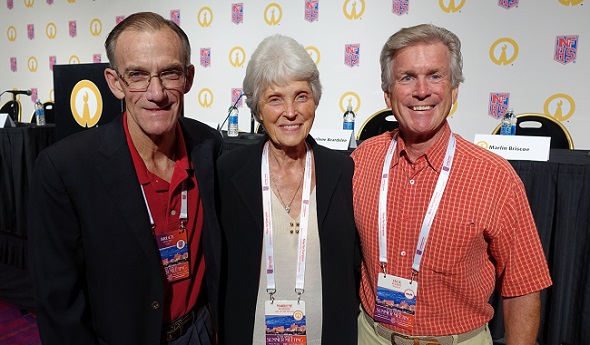
PHOTOS: (Top) Marilene Beardslee stands with the NFHS’s Bruce Howard (left) and MHSAA Executive Director Jack Roberts during the Hall of Fame festivities in Reno, Nev. (Middle) Ken Beardslee, during his high school days at Vermontville. (Top photo courtesy of Terry Lowery.)

Scholar-Athlete Finalists Announced
By
Geoff Kimmerly
MHSAA.com senior editor
January 23, 2014
The 120 finalists for the Michigan High School Athletic Association's Scholar-Athlete Awards for the 2013-14 school year have been announced.
The program, celebrating its 25th anniversary, has recognized student-athletes since the 1989-90 school year and again this winter will honor 32 individuals from MHSAA member schools who participate in at least one sport in which the Association sponsors a postseason tournament.
 Farm Bureau Insurance underwrites the Scholar-Athlete Awards and will present a $1,000 scholarship to each recipient. Since the beginning of the program, 608 scholarships have been awarded.
Scholarships will be presented proportionately by school classification, with 12 scholarships to be awarded to Class A student-athletes, six female and six male; eight scholarships will be awarded to Class B student-athletes, four female and four male; six scholarships will be awarded to Class C student-athletes, three female and three male; and four scholarships will be awarded to Class D student-athletes, two female and two male. In addition, the final two scholarships will be awarded at-large to minority recipients, regardless of school size.
Every MHSAA member high school could submit as many applications as there are scholarships available in its classification, and could have more than one finalist. Dearborn Heights Crestwood, Hastings and Marlette each have three finalists this year. Fourteen schools each had two finalists: Bay City Central, Bloomfield Hills Marian, Dearborn, Grand Haven, Grand Rapids West Catholic, Manistee Catholic Central, Marquette, Middleville Thornapple Kellogg, Midland Dow, Saginaw Swan Valley, Sturgis, Traverse City Central, Walled Lake Western and Yale.
Multiple-sport participation remains the norm among applicants. The average sport participation rate of the finalists is 2.70, while the average of the application pool was 2.16. There are 75 three-plus sport participants in the finalist field, and all but two of the 28 sports in which the MHSAA sponsors postseason tournaments are represented.
Of 407 schools which submitted applicants, 55 submitted the maximum allowed. This year, 1,701 applications were received. All applicants will be presented with certificates commemorating their achievement. Additional Scholar-Athlete information, including a complete list of scholarship nominees, can be found on the MHSAA Website.
The applications were judged by a 63-member committee of school coaches, counselors, faculty members, administrators and board members from MHSAA member schools. Selection of the 32 scholarship recipients will take place in early February. Class C and D scholarship recipients will be announced Feb. 4; Class B scholarship recipients will be announced Feb. 11, and Class A scholarship recipients will be announced Feb. 18. All announcements will be made on the MHSAA Website.
To honor the 32 Scholar-Athlete Award recipients, a ceremony will take place during halftime of the Class C Boys Basketball Final, March 22, at the Breslin Student Events Center in East Lansing.
To be eligible for the award, students must have a cumulative grade point average of 3.50 (on a 4.0 scale), and previously have won a varsity letter in at least one sport in which the MHSAA sponsors a postseason tournament. Students also were asked to respond to a series of short essay questions, submit two letters of recommendation and a 500-word essay on the importance of sportsmanship in educational athletics.
Farm Bureau Insurance, one of Michigan's major insurers, has a statewide force of more than 400 agents serving more than 380,000 Michigan policyholders. Besides providing life, home, auto, farm, business and retirement insurance, the company also sponsors life-saving, real-time Doppler weather tracking systems in several Michigan communities.
The MHSAA is a private, not-for-profit corporation of voluntary membership by more than 1,500 public and private senior high schools and junior high/middle schools which exists to develop common rules for athletic eligibility and competition. No government funds or tax dollars support the MHSAA, which was the first such association nationally to not accept membership dues or tournament entry fees from schools. Member schools which enforce these rules are permitted to participate in MHSAA tournaments, which attract more than 1.4 million spectators each year.
2013-14 Scholar-Athlete Award Finalists
BOYS CLASS A
Stone Manczak, Bay City Central
Zachary Segall, Berkley
Andrew Barton, Birmingham Seaholm
Rami Kadouh, Dearborn
Samuel A Mousigian, Dearborn
Jared Hagan, Dearborn Heights Crestwood
Jalal Taleb, Dearborn Heights Crestwood
Brad King, Garden City
Ryan S Fischer, Grandville
Kenneth Elkin, Grosse Pointe North
Chris Kruger, Holt
David Doyle, Linden
Craig Ekstrum, Marquette
David Walter III, Middleville Thornapple Kellogg
Nate Fisher, Midland
Vikram Shanker, Midland Dow
Tanner Vincent, Novi
Trevor Denoyer, Petoskey
Kellen Scott Michael, South Lyon
Kyle Dotterrer, Traverse City Central
Cody James McKay, Utica Ford
Devin Kimberlin, Walled Lake Northern
Mitchell Dennis, Walled Lake Western
David J Walczyk, Walled Lake Western
GIRLS CLASS A
Anna Haritos, Auburn Hills Avondale
Saige Tomczak, Bay City Central
Jessica Hacker, Bay City Western
Tatyanna Dadabbo, Bloomfield Hills Marian
Clare Nienstedt, Bloomfield Hills Marian
Tala Taleb, Dearborn Heights Crestwood
Caroline Ann Hagan, East Lansing
Elizabeth Cowger, Fenton
Paige Blakeslee, Gibraltar Carlson
Mallory Beswick, Grand Haven
Claire Elise Borchers, Grand Haven
Joslyn Mae TenBrink, Jenison
Jessica Graves, Lowell
Gabrielle Gencheff, Marquette
Fiona B Shea, Middleville Thornapple Kellogg
Kallisse R Dent, Midland Dow
Rachel Barrett, Milford
Grace Kao, Okemos
Kirsten Avery Chambers, Riverview
Meghan Datema, Rockford
Elianna Shwayder, Saline
Molly Peregrine, Traverse City Central
Sarah O'Connor, Waterford Kettering
Jenna Ciennik, Waterford Mott
BOYS CLASS B
Tye Wittenbach, Belding
Carl Steinhauser, Berrien Springs
Ryan Spaulding, Freeland
Joseph Corey, Grand Rapids West Catholic
Nicholas Linck, Grand Rapids West Catholic
John Gatti, Grosse Ile
Matt Johnson, Hastings
Richard Cassell, Jackson Lumen Christi
Ben Woodruff, Jackson Northwest
Ismail Aijazuddin, Madison Heights Lamphere
Zachary A Ohs, Monroe St Mary Catholic Central
Michael T von Kronenberger, Ogemaw Heights
Anthony William Canonie, South Haven
Trenton Karle, Three Rivers
Daniel Kosiba, Vicksburg
Noah Nicholl, Yale
GIRLS CLASS B
Greer Elizabeth Clausen, Bloomfield Hills Cranbrook-Kingswood
Abigail Brown, Caro
Lindsey Brewis, Dearborn Divine Child
Bailey Baker, Eaton Rapids
Callie Jensen, Gladstone
Grace Bosma, Hastings
Kylee Nemetz, Hastings
Amanda M Metz, Otsego
Alexandra J Grys, Portland
Kiersten Mead, Saginaw Swan Valley
Courtney T Reinhold, Saginaw Swan Valley
Roxane L Strobel, Spring Lake
Peyton Boughton, Sturgis
Alea Penner, Sturgis
Angela Maurer, Williamston
Alana Koepf, Yale
BOYS CLASS C
Ty Michael Rollin, Beal City
Matthew S Johnson, Fennville
Carter Ballinger, Jonesville
Luke Joseph Smigielski, Mancelona
Dakota Hall, Marlette
Bradley Schaub, Marlette
Kyle Baxter, Mayville
Stephen T Erwin, Royal Oak Shrine Catholic
Jason Beckman, Shelby
James Barber, St Charles
Devin Morrow, Three Oaks River Valley
Nicholas DeSimpelare, Unionville-Sebewaing
GIRLS CLASS C
Korinna Corbin, Addison
Kirsten Olling, Breckenridge
Elizabeth Baker, Bronson
Melissa Dowell, Clinton
Amanda Reagle, Homer
Mandy Haferkorn, Iron Mountain
Megan Chapman, Ishpeming Westwood
Keara Wilson, Marlette
Grace Leighton, Mendon
Allie Kendall, Saginaw Nouvel
Kari Feddema, Schoolcraft
Erin McDonnell, Traverse City St Francis
BOYS CLASS D
Grant Hohlbein, Adrian Lenawee Christian
Bret Hiveley, Au Gres-Sims
Tyler Anthony Johnson, Bear Lake
Jeremy Bigalke, Manistee Catholic Central
Ben Feliczak, Manistee Catholic Central
Steven McKenzie, Marcellus
Alec Firack, Pickford
Harding Fears III, Southfield Christian
GIRLS CLASS D
MacKenzie Ciganick, Bellaire
Julie Ahnen, Bessemer
Sara Inbody, Deckerville
Vanessa Freberg, Eben Junction Superior Central
Kari Borowiak, Gaylord St Mary
Lyvia Deaver, Jackson Christian
Erin Gast, Lake Linden-Hubbell
Jennifer Malcolm, Plymouth Christian