

Breslin Bound: Boys Report Week 5
January 13, 2015
By Geoff Kimmerly
Second Half editor
With the beginning of January comes the end of holiday basketball showcases and a switch in focus by MHSAA teams toward local opponents, conference races and the haul of the second half of the regular season.
The first week of 2015 saw the ranks of the undefeated decreased by 35 boys teams statewide to 64 remaining, with some listed below among those that caught my eye during the first days of the new year.
Class A
Alpena (6-0) – The Wildcats not only sit alone atop the Big North Conference standings as they look to repeat as champions, but avenged their two losses from last season – by 10 over Traverse City West before break and by 20 over Traverse City Central last week.
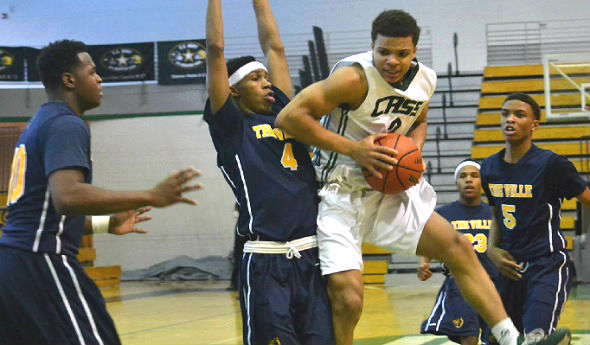
Detroit East English (4-2) – The Bulldogs are early leaders in a Detroit Public School League East Division 1 that includes powers Pershing, Cass Tech, Martin Luther King and Southeastern; East English’s current three-game winning streak started with a big win over solid Southfield and includes a five-pointer over better-than-its-record Cass Tech from last week.
Grand Ledge (5-0) – Last season’s somewhat-surprise Capital Area Activities Conference Blue runner-up isn’t sneaking up on anyone this winter; a strong backcourt has paced a fast start that’s included wins over Lansing Sexton on the first Friday of the season and much-improved Jackson by 15 last week.
Middleville Thornapple Kellogg (5-0) – The Trojans have bounced back from last season’s sub-.500 finish thanks in part to four wins by four or fewer points, including a 49-46 victory last week over Caledonia.
Class B
Detroit Henry Ford (7-0) – Ford is off to a strong start again this season after starting and ending strong a year ago; the Trojans look good to avoid the five-game losing streak they encountered at this time last year, although Cass Tech and Pershing are up next.
Dowagiac (4-1) – A one-point loss to Wolverine Conference West leader Paw Paw before break surely smarted a bit, but the Chieftains came back to start 2015 with a 58-55 win over rival Niles; they pick up league play Friday against Berrien Springs.
Flint Northwestern (5-0) – After struggling mightily the last two seasons, Northwestern has begun like the Northwestern of old, with a nine-point win over Midland and 37-pointer over Saginaw Heritage last week keeping the Wildcats among the undefeated.
Williamston (6-1) – Only a loss to Class A Dexter in the championship game of Coldwater’s holiday tournament has kept the Hornets from perfection – and also from beating all of their opponents by double figures as they did last week versus East Lansing and Fowlerville.
Class C
Burton Bendle (6-0) – The Tigers are halfway to last season’s 12 wins and tied for first in the Genesee Area Conference Blue thanks in large part to a 72-67 overtime win last week over New Lothrop, last season’s league runner-up.
Detroit Loyola (5-2) – The newly-crowned Division 7 football champion has been pretty good at basketball too over the years – but has looked better than that early with its only losses by six or fewer points to much bigger Henry Ford and Detroit Renaissance.
Gwinn (4-2) – The Modeltowners have won four straight after two big losses to start and beat Houghton and Norway on back-to-back nights last week – they took the lead against Norway with 31 seconds to play on the way to winning 43-41.
Laingsburg (5-0) – The Wolfpack have made a smooth transition from coach Greg Mitchell (now at Hope College) to Dan Blemaster (formerly coach of Brown City). Laingsburg sits atop the Central Michigan Athletic Conference by a half-game over Fulton-Middleton (see below).
Class D
Fulton-Middleton (5-1) – The Pirates are right behind Laingsburg in the CMAC after having last week’s game against Bath postponed, but did open the week with a 55-53 victory over reigning Class C runner-up Pewamo-Westphalia – one of only three teams to beat Fulton during 2013-14.
Peck (5-1) – The 8-player football power is strong at basketball too, with its only loss to Class B Richmond, 45-41, on Jan. 3. The Pirates lost only once in 2013-14, to eventual Class D champion Southfield Christian in their Quarterfinal.
Morenci (3-1) – The Bulldogs are following their football success of the fall with a nice start to the winter including a one-point win last week over Whitmore Lake after a two-point win to kick off the new year against Gorham-Fayette (Ohio) on Jan. 3.
Onekama (4-0) – The Portagers sit atop the West Michigan D League standings in part because of a two-point win last week over reigning league champion Baldwin; Onekama followed up with another two-point win against Manistee.
PHOTO: Detroit East English defenders block the lane during their 75-70 win over Detroit Cass Tech last week. (Photo courtesy of the Detroit Public School League.)
Finally, Clarkston Celebrates in Class A
By
Paul Costanzo
Special for MHSAA.com
March 25, 2017
EAST LANSING – After 35 years, nearly 700 wins and three high school gyms, Dan Fife has brought an MHSAA title to his alma mater.
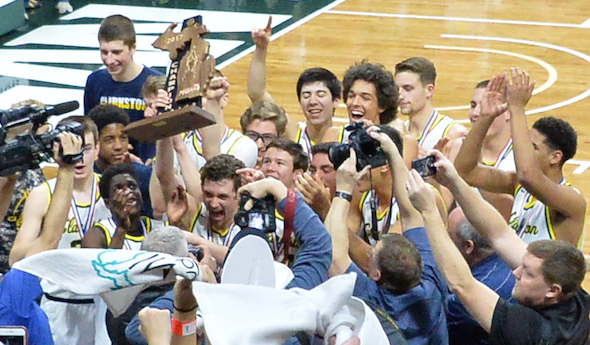
Fife’s Clarkston boys basketball team defeated Grand Rapids Christian 75-69 on Saturday in the Class A Final at the Breslin Center for the first boys basketball title in program history.
“It’s really unexplainable right now,” Fife said. “I really don’t know how to put it. All I know is I’ve been through three high school gyms at Clarkston during my tenure. I’ve said this before, but I really truly meant it: Clarkston’s a special place, I think one because we have one public school in our district. We have great support from our administration, our teachers and our families. I don’t think you can be successful in athletics, especially in today’s world of athletics, if you don’t have that support.”
Fife, who has a 677-169 record at Clarkston, is a 1967 graduate of the school. He took over the program 1982, and in his 35 seasons, only one has ended without a winning record. Even that season included a District title.
 “This whole season has been a group journey,” Clarkston all-state junior guard Foster Loyer said. “For my teammates and myself to come out here and win this state championship tonight, it not only means everything to us as players, as a team, as a family; but just knowing we were able to get that done for Coach Fife, it’s what we’ve been dreaming about since we started playing basketball here in Clarkston. It’s just been a phenomenal experience, and we’re loving life right now.”
Loyer, a Michigan State recruit, led all scorers with 29 points on his future home court, shooting 50 percent from the field (8 of 16) and from 3-point range (4 of 8). His future MSU teammate, senior Xavier Tillman, led Grand Rapids Christian with 25 points on 12 of 15 (80 percent) shooting, and grabbed seven rebounds.
“(Loyer) can shoot the ball, he can handle the ball, he can pass the ball, so it’s kind of like pick your poison when it comes to Foster,” Tillman said. “When we tried to step up, he would drive by, give a pump fake, get the foul, two free throws. It was hard to stop him, and he’s going to be a great player for us later on when it comes to Michigan State.”
Clarkston sophomore Taylor Currie added 16 points and 10 rebounds, while junior C.J. Robinson had 14 points, and senior Dylan Alderson had 12. Grand Rapids Christian juniors Duane Washington, Jr., and Setrick Millner, Jr., added 16 and 11 points, respectively.
“I give Clarkston a lot of credit – they’re well coached, their kids played great, they played hard, and they responded and made shots,” Grand Rapids Christian coach Mark Warners said. “The ball didn’t always go our way, but that’s the way the game goes. They were awesome tonight. We were good, but we weren’t awesome.”
Fife lauded his team’s overall effort in the game, as Robinson’s secondary scoring – specifically 12 second-half points – and ballhandling were able to take pressure off Loyer, and Currie was able to hold his own at times and stay out of foul trouble against Tillman despite giving up more than 50 pounds.
“We knew that (Tillman) is a great force in the paint,” Currie said. “My main focus going into the game was just try to stay in front, knowing I had help in the back. If I could force a pass over the top, it could be a steal. Then when he got the ball, trying to stay straight up and avoid getting into foul trouble. And keeping him off the glass, that was something we really keyed in on because he’s a great rebounder, especially on offense. He uses his body really well, so I was trying to box out as soon as I could.”
 Clarkston (27-1) gained the game’s first bit of separation with 3-pointers on four straight possessions to close out the first quarter. Loyer hit three in a row, while Alderson added one at the buzzer to give the Wolves a 20-12 lead.
They led by as many as 11 points in the second quarter, as Loyer opened it with another 3. Grand Rapids Christian (27-1) pulled to within three on a 3-pointer from Tre Vallar in the final minute of the half, but an acrobatic buzzer beater from Robinson gave Clarkston a 34-29 lead heading into the break.
Grand Rapids Christian had a better half from the field, shooting 57.1 percent compared to Clarkston’s 40 percent, but the Wolves held an 8-0 edge in points off turnovers and an 11-2 edge in second-chance points, as they pulled down nine offensive rebounds during the opening 16 minutes.
The hot shooting continued for the Eagles into the third quarter, but they weren’t able to close the gap, as Clarkston was just as hot, hitting 75 percent of its shots in the third quarter and 60 percent in the fourth. The Wolves also shot 14 of 17 from the free throw line (82.4 percent) in the fourth quarter.
“We scored 69 points, so offensively we were fine,” Warners said. “The problem is we gave up 75. The credit goes to, like I said, to Clarkston. We just didn’t have an answer consistently. We’d get a good defensive possession and then we’d come down and not capitalize on it, miss a shot. Then they’d come down and make a shot.”
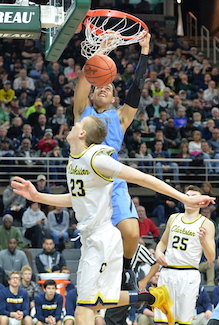
PHOTOS: (Top) Clarkston holds up its Class A championship trophy in celebration after Saturday’s Final. (Middle) Clarkston coach Dan Fife. (Below) Grand Rapids Christian’s Duane Washington, Jr., throws down a dunk.