

Detroit 'Longtime' Boys Coaches Down to Few
By
Tom Markowski
Special for Second Half
December 14, 2016
Gary Fralick considers himself one of the fortunate ones.
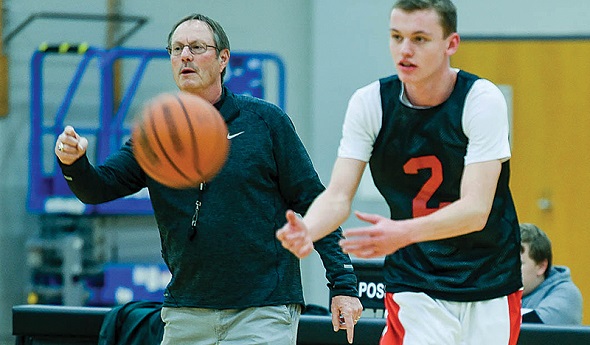
 Fralick, 66, is in his 32nd season as a head boys basketball coach. He retired from his teaching position in 2013. He started coaching at Redford Thurston in 1979, went to Royal Oak Kimball in 1984 and is in 23rd season as the head coach at Troy.
Fralick might be lucky, but he is unquestionably rare. Fralick is believed to be one of three coaches in the Macomb/Oakland/Wayne area who has coached for more than 30 seasons.
There’s Dan Fife at Clarkston and Kevin Voss of Clinton Township Chippewa Valley, both of whom in their 35th seasons, all at the same school.
Another, Greg Esler at Warren DeLaSalle, is in his 30th season. He was the head coach at St. Clair Shores Lake Shore for seven seasons before going to DeLaSalle in 1994.
“We’re part of a dying breed,” Voss said.
It certainly appears so. Coaching longevity has taken on a different meaning recently. Twenty seems like a lot in these times, and in reality it is a long time. Twenty years or so ago, 20 years was normal. There’s a new normal, and 20 or 25 years isn’t it.
Many factors have contributed to this change. A person’s personal and family life often don’t coincide with the demands of coaching basketball. The responsibilities that come with coaching have increased. Some coaches say that to be an effective coach, it can be a 10- or 11-month job.
Two factors are at the forefront, and they are both financial. Coaches used to be educators as well as coaches. Yes, coaching can be viewed as teaching on the court, but at one time teaching in a classroom and coaching used to go hand in hand.
 Then there’s the subsidy coaches receive. It varies from school district to school district. Some make $4,000 a season, others can make $7,000. And it also costs money to run a program; unless the coach receives financial help from a booster club or parents, the money he or she receives begins to dwindle.
But the most important factor is time.
“A tremendous amount of time is devoted to watching DVD or tapes,” Fralick said. “I know I’m dating myself with saying that. The point is, you’re watching a lot. There’s more scouting. And you don’t get paid much. Why don’t they stay as long as they used to? They get burned out. They want to spend more time with their families.
“You don’t see as many of the young coaches stay. Coaches don’t have the ambition to coach a long time. It’s not a profitable job. I don’t know what other coaches make. We used to compare what we made. Not anymore.
“Thirty years or more? I don’t see it happening. There’s the dual job thing. Things have changed. To me, it’s been a great job.”
To compensate for being away from home, Fralick brought his family with him. Sort of. He coached his son Gary, Jr., and Tim. Gary, a 1996 Troy graduate, played for his father his junior and senior seasons and Tim, a 1999 graduate, played four seasons on varsity. Fralick said he was even more fortunate to coach both on the same team (during the 1995-96 season).
Then there’s his wife, Sharon, who remains the scorekeeper.
“I’ve always had a passion for coaching and teaching,” Fralick said. “I love the game of basketball. I love the kids. There’s never a dull moment. It’s been a great ride.”
Vito Jordan has been around basketball all of his life. His father, Venias Jordan, was the boys head varsity coach at Detroit Mackenzie and Detroit Mumford before stepping down as a head coach only to return to the bench assisting his son the last six seasons.
Vito Jordan, 31, became a head coach at Detroit Osborn when he was 24. He started his coaching career the year before as an assistant to Henry Washington at Macomb College. Jordan went to Detroit Community after one season at Osborn and guided Community to its only MHSAA Finals appearance (Class B, 2013). He’s now in his fourth season as the head coach at Detroit Renaissance.
“I followed my father all of my life,” Jordan said. “I knew what I wanted to do when I was in college (Alma College). This is what I want to do the rest of my life.”
It’s different in Detroit. Schools close. Job titles change. Jordan, for instance, teaches at the Academy of Warren, a middle school in Detroit. It’s a charter school, not within the Detroit Public School system, therefore he receives his pay from two separate school systems (Renaissance is in the DPS).
There is a distinction. In some school systems coaches will receive a percentage – let’s say for argument sake, 10 percent – of their teaching salary to coach. Let’s say a person makes $60,000 a year to teach. He or she would then receive $6,000 to coach. If you coach two sports, that’s $12,000.
 Jordan is not privy to such a contract. Each job is separate. Jordan loves to coach, and he understands he must be a teacher to earn a decent living, and he’s content to continue on the path he is following. But he also knows that to make a good salary just coaching one must move on to the collegiate level like others have done.
“When there were coaches like my dad, Perry Watson (Detroit Southwestern), Johnny Goston (Detroit Pershing) and others, they all worked in the (Detroit Public) school system. Everyone was teaching. That was your career. None of them had aspirations of being a college coach. Not even Watson. Now everyone isn’t in the teaching profession. Maybe they do have a degree and maybe they don’t. The point is, most aren’t teachers. I can count on one hand those (in Detroit) who have their teaching certificate and coach.”
Jordan noted such successful PSL coaches like Derrick McDowell, Steve Hall and Robert Murphy who left high school to pursue a coaching career in college. Murphy guided Detroit Crockett to the Class B title in 2001 and is now the head coach at Eastern Michigan. McDowell has had two stints as a collegiate assistant coach, most recently at EMU. He’s since returned to coach at Detroit Western. Hall coached Detroit Rogers to three consecutive Class D titles (2003-05) before going to Duquesne University and Youngstown State as an assistant coach. Hall returned to Detroit last season and is in his second season as head coach at Detroit Cass Tech.
Jordan said they left high school to challenge themselves professionally, among other considerations. Voss said there are variables that influence how long a person lasts, in one school district or in coaching in general, that didn’t exist 20 years ago.
“Athletics have become pervasive in high school,” he said. “The whole booster situation you find in college is here. You can be winning but not winning enough. It’s a trickle down affect.
“Coaches complain about parents. Parents complain about playing time. High school sports is not as pure as it once was. Winning is way more important now. Now a coach comes in with a three-year window. You can have one or two down years, and the third you’d better win.
“Then there’s the pressure on your family. I’ve been lucky. My wife and I have had the players over for team dinners. We create a family atmosphere. It’s a change of society. I don’t envy the young coaches coming in.”
Community involvement has always been a priority for Voss. To keep a hand on the pulse, Voss heads the elementary basketball program within the Chippewa Valley school district. Games are held on Saturdays, and approximately 750 students take part.
“You have to have the right fit,” he said. “I’m in the right spot. You coach for different reasons when you get older. I’m enjoying the game. There’s a different level of satisfaction.”
 Tom Markowski is a columnist and directs website coverage for the State Champs! Sports Network. He previously covered primarily high school sports for the The Detroit News from 1984-2014, focusing on the Detroit area and contributing to statewide coverage of football and basketball. Contact him at [email protected] with story ideas for Oakland, Macomb and Wayne counties.
PHOTOS: (Top) Troy boys basketball coach Gary Fralick, left, is in his 32nd season coaching. (Middle) Detroit Renaissance boys coach Vito Jordan is following in the coaching footsteps of his father, Venias. (Below) Chippewa Valley boys coach Kevin Voss, left, is in his 35th season at his school. (Top and below photos courtesy of C&G Newspapers; middle photo courtesy of Detroit Public School League.)
Hackett Mentor's Care Sparked Lifetime in Hoops for BCAM President White
By
Pam Shebest
Special for MHSAA.com
July 24, 2026
KALAMAZOO — When Kevin White counsels an unruly student, he usually understands what’s going on.
 At one time, he was that student.
For the dean of students at Kalamazoo Hackett Catholic Prep, White’s life has come full circle.
He thrived while attending St. Monica Elementary School as a child, but after his father Damon passed away in 1989, the family moved to Portage and he changed schools.
“Eighth and ninth grades there was a change in behavior and grade point average,” White said. “Right about Christmas break, I had three gentlemen in my living room.
“Mike Smith, Shawn Potts and Nib Reisterer were having a conversation with my mom. They were worried about the direction I was headed and I think somehow those three came up with a plan to get me back (to Hackett).
He soon realized he needed the structure, discipline and smaller class sizes available there. But the worst part of transferring to Hackett was that he had to sit out the upcoming basketball season.
“I was not allowed to play right away because they decided my grades weren’t good enough to play, only to practice,” he recalled. “To sit on the bench as a high school kid with a bad GPA, and (bad attitude), it was like when I was little. If I wanted to do things, I had to do them the right way.”
At Hackett, he was reunited with Reisterer, his mentor who put him through some tough workouts.
“They were some of the hardest workouts I ever had because I had to go back to changing some bad habits, which changed pretty quickly,” White said.
He also had to face the players he idolized as a child when they asked why he wasn’t playing.
“That’s when I knew I had to kick it into gear because I didn’t want to let those guys down,” White said. “They said, ‘You wanted to wear that jersey since you were in fifth grade.’ My mom says peer pressure is the best pressure.”
Learning from the best
White first encountered Reisterer, who changed his life, during elementary school.
After losing his father, White would have to remain at school until his mother, Sheila, who was a police officer, picked him up.
“This gym teacher was, ‘Hey, do you want to hang out in the gym?’ Then he said he had basketball practice at 5 and did I want to come with him to practice? And he’s been stuck with me ever since,” White recalled. “It turned into ‘can I come to practice’ to ‘can I go to a couple games?’ Then I got to ride the bus. Then the Reisterer vacations at the lake became ‘Kevin’s coming too.’ There was a time when the Reisterers became my extended family, and within that came a basketball family.”
Reisterer, who was physical education teacher at St. Monica, said he knew White’s situation and wanted to help.
“My son Ryan was only a couple years younger than Kevin,” he said. “Ryan just adored him, and Kevin became my second son.”
 Reisterer, who was also Hackett’s head boys basketball coach, noted, “Kevin became my ball boy. He came to every practice and did all the drills with the kids. He led the team in warmups before the game and became quite a celebrity himself.”
The highlight of his younger years was riding the bus with the Irish players, White said.
“Doing my third-grade homework with them showing me how to do the math problems and arguing about giving me the answers or not giving me the answers,” White laughed.
“The reward was, if you behaved in school you got to go to the games. So it was real easy to behave because I wanted to hang out with the high school guys and be on the bench.”
That sparked his love of basketball.
White graduated from Hackett in 1998 and then played at Glen Oaks Community College. With thoughts of prolonging his career in basketball after college – he went on to graduate from Western Michigan University – White remembered words he heard in passing.
“The guy said, ‘You might be able to play for a long time, but you’ll coach a lot longer than you’ll play if you start coaching right away,’” White said. “As a young guy, you hear it but you don’t think about it.
“Then you get into coaching and start working camps and going to the Final Fours and start networking. I like playing, but I love teaching the game. It’s been fun doing it that way.”
Reisterer said White wasn’t going to “set the world on fire” as a basketball player, but he worked his way through the coaching ranks, from instructing young kids and contributing at summer camps to filling roles at the high school and college levels, learning at each stop.
“He has quite a network of coaches and a lot of experience,” Reisterer added.
Prioritizing family life
As an assistant coach at Kalamazoo College, White met athletic trainer Kathleen O’Farrell and was immediately smitten. He credits her with making him more detailed and organized.
They eventually married and have two children – Vincent, 7, and Riley, 3.
“Vincent is at the age where he wants to come to practice with dad,” White said. “People ask if he’s going to play basketball.
“Right now he loves to swim, loves to play soccer. I love that because I can just sit there and be Dad.”
Vincent not only goes to practice with his dad, but has his own whistle, his own spot in the locker room and his own practice plan.
“He’s in charge of the clock,” White added. “I make him sweep the floor because I had to sweep the floor when I was young. If he decides to coach, I wouldn’t be upset.”
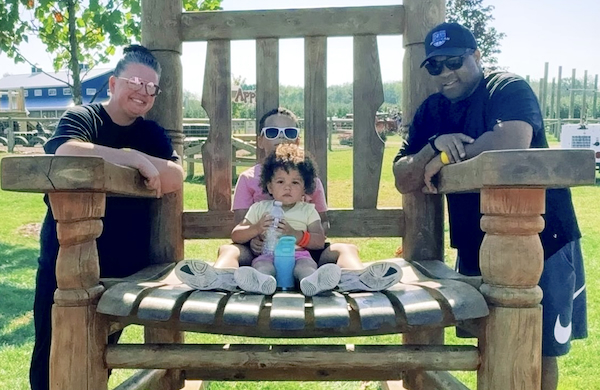 White called his daughter a “mini-me.”
“She will say hello to anyone,” he said. “She’s got confidence, she will speak up. If she doesn’t like something, she will tell you.”
White honed his coaching skills as an assistant to several college and high school coaches, including at Hackett last season, and discovered that working at the same school where he coaches is special.
“I will tell any young coach, if you can get a high school job in today’s age and work in the school, that’s a win-win,” White noted. “The relationship with players is an advantage of working in the school because you’re with them during the day and after school, a lot of times more than they’re with their parents.”
White is running the summer basketball program at Hackett, but that’s not all the gregarious coach is doing.
As the current president of the Basketball Coaches Association of Michigan (BCAM), “We run an event called Reaching Higher,” he said. “High school teams are selected from all over the state and they come for two days to play at Grand Valley University.
“It’s open to college coaches all over the country to watch the top high school players from the state.”
He was also involved in Midwest Live where 20-40 Michigan teams compete against teams from Ohio, West Virginia and Pennsylvania at Cedar Point.
But next month, White will be back at Hackett, working to keep students on task.
“I see a lot of my classmates and myself in students today,” White said. “Yes, times have changed, but kids still want to be taken care of and want to be treated well and have support. Yes, some discipline comes with my job, but it’s also built on relationship and trust.
“I want (alumni) to come back and tell current kids that yes, Mr. White was hard on me about x, y and z, but when I needed something, he was there for me and if I didn’t follow through, he made sure I did.”
2026 Made In Michigan
July 24: Mackey Leaving Court with 500+ College Hoops Wins, Many More Lessons Shared - Report
July 16: Country Day Two-Time Champ Moore Building Perennial Winner at Harvard - Report
July 9: Multi-Sport Career at TC West Helps Gillis Thrive as Pro in Game She Once Left Behind - Report
July 2: Inspired by Home, Eager to Give Back, Spencer Hosts Hoop City Alumni Games - Report
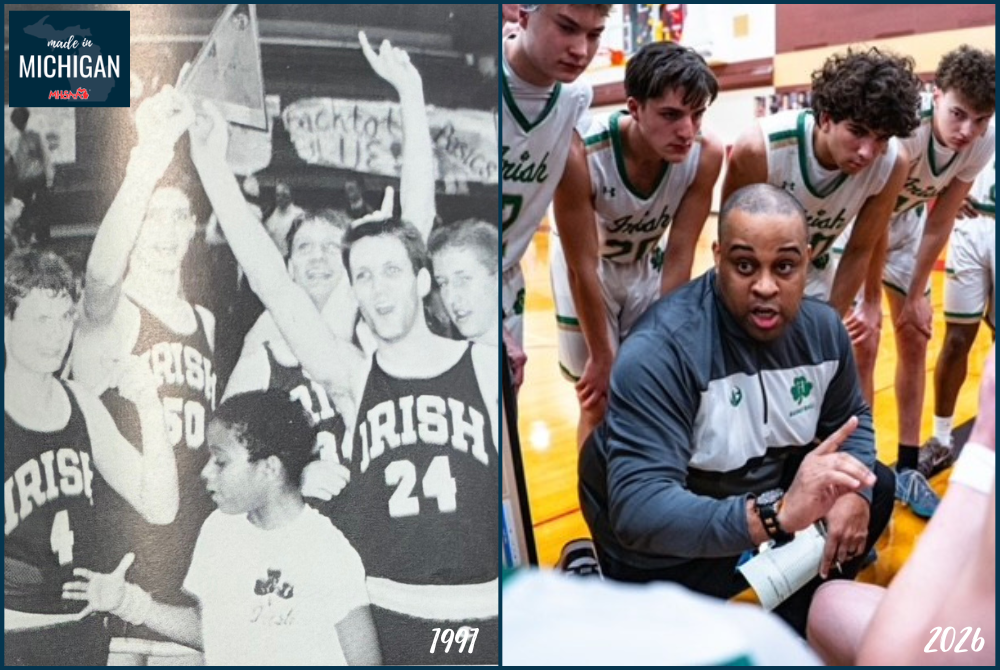
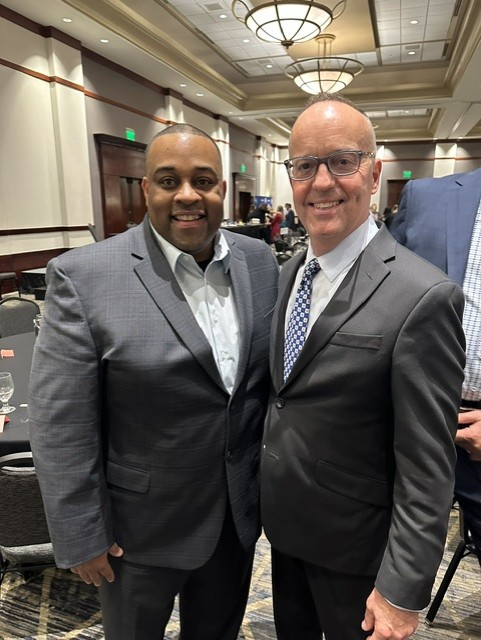
PHOTOS (Top) At left, fifth-grader Kevin White celebrates with the Hackett boys basketball team in 1991. At right, White huddles with his players this past season while serving as an assistant with the Irish varsity. (Middle) White stands for a photo with BCAM Executive Director Dan Young. (Below) White poses with wife Kathleen and children Vincent and Riley. (Photos provided by Kevin White.)