

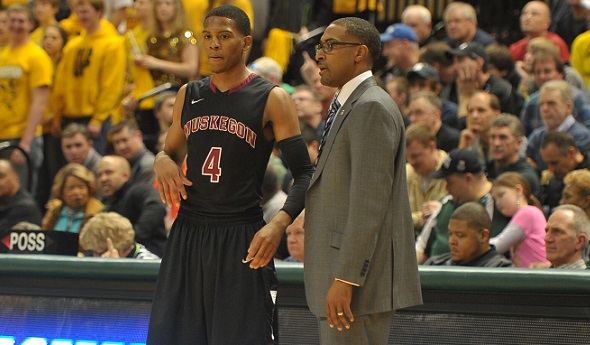
Guy Guides Muskegon Hoops Rise
December 8, 2015
By Tom Kendra
Special for Second Half
For many years, basketball was a letdown at Muskegon High School.
 The Big Reds have been known for football ever since their first victory in 1895, racking up 806 more wins since then (most in the state), along with eight MHSAA championships – including recent titles in 2004, 2006 and 2008.
But as the snow slowly blanketed Hackley Stadium’s hallowed turf on an annual basis, Muskegon was never consistently able to transfer the energy, focus and success from the gridiron to the hardwood of Redmond-Potter Gymnasium.
That all changed in 2012, when nearby Muskegon Heights went through a period of upheaval, before eventually reconstituting itself as Muskegon Heights Public School Academy. During that time of uncertainty about the school’s athletic future, boys basketball coach Keith Guy made the move down Sanford Street to Muskegon High, and suddenly football was no longer the only show in town.
“I’ve always thought that there are enough great athletes and enough potential at city schools that they could be great in both football and basketball,” said Guy, who starts his fourth season as Muskegon’s basketball coach Friday night against visiting Rockford.
“I know we won’t ever be what the football program is here at Muskegon, but I feel like we now have a little identity of our own.”
That’s an understatement.
In the past two years, the Muskegon boys basketball program has won two Ottawa-Kent Conference Black titles, two Class A Districts, two Regionals, one MHSAA Finals title in an undefeated 2014 season, 51 of 53 games overall and produced back-to-back Mr. Basketball winners with DeShaun Thrower in 2014 and Deyonta Davis last year.
Thrower, as his name suggests, was a star quarterback for Muskegon coach Shane Fairfield in the fall and the star point guard for Guy in the winter. Thrower is now a sophomore guard for Stony Brook, a Division I school in New York which narrowly missed qualifying for the NCAA Tournament last year.
Guy’s handling of Thrower’s situation, essentially staying out of the way while football season was still going on, set the tone for Big Reds football and basketball programs that continue to encourage each other and push each other higher. While basketball has elevated itself among the state’s elite programs, Muskegon football has kept pace, advancing to MHSAA championship games three straight years in 2012, 2013 and 2014.
Guy, 40, a former standout point guard at Muskegon Heights, Muskegon Community College and Ferris State University, explained that situation after basketball practice on Nov. 30, after quickly changing from his sweat suit into formal attire to help run that night’s end-of-year football banquet as the athletic director.
“When one succeeds, all of us succeed,” said Guy, whose son, Christian Martinez, was the star quarterback of Muskegon Catholic Central’s Division 8 football championship team this fall. “Shane has gone and filmed games for me on the east side of the state before, and he knows that he’s got my support during football season.”
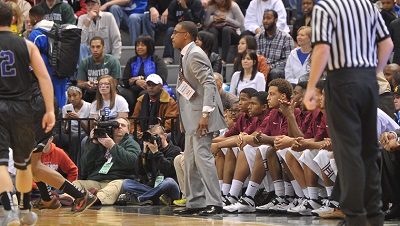 While this year’s Muskegon basketball team may lack the star power of the past two years, it hopes to make up for it with depth. At a recent practice, it was difficult to decipher the starting five from the reserves.
“Last year, we ran a lot more set plays with DD (Davis) in there,” said Michael Littlejohn, a 5-11 senior guard who is the lone returning starter off last year’s team, which was stopped a game short of returning to the Breslin Center by Lansing Everett in the Class A Quarterfinals. “This year, it’s going to be more running, more showtime.”
Littlejohn will start at point guard and will be joined in the backcourt by smooth-shooting senior Linwood Lee and defensive stopper Jacarius Scott. The leaders up front are versatile juniors Jermayne Golidy (6-3) and Anthony Bethea (6-5), along with senior Desi Stephens (6-4).
The Big Reds also will get a boost of muscle and toughness from a couple of college football prospects in senior Terrion Hill-McKay and junior Jacorey Sullivan.
Guy also has three sophomores – Chris Murry, Willie Shanks Jr. and Antwan Reed – on the varsity roster, along with freshman DeAndre Carter. Reed (6-7, 286 pounds), considered one of the nation’s top sophomore offensive tackles, is improving his conditioning and footwork for football and could develop into a basketball force as well.
Muskegon’s playing rotation and style of play will take shape during back-to-back blockbuster tournaments over holiday break, when Muskegon will be the focus of prep basketball interest statewide – and give Guy an indication of whether this year’s group has the makings of another 20-plus win team.
“I won’t ever shy away from playing the best,” said Guy, who is assisted on the varsity level by his brother and former Muskegon Heights teammate, Maurice Sain, along with Louis Murray and Josh Wall. “I would rather find out the truth about my players in December and January than in March.”
The truth will start to be told Dec. 29 and Dec. 30, when Muskegon takes on Detroit Consortium and East Kentwood on back-to-back nights at the Meijer Hall of Fame Classic at Reeths-Puffer High School, a tournament which also features Lansing Sexton and Grand Rapids Ottawa Hills.
The challenge then gets ratcheted up later that same week, when Illinois power Chicago Whitney Young comes to Redmond-Potter on Jan. 2 for the featured event in the three-game Muskegon Basketball Showcase.
“Our goal at Muskegon now is to win a state championship in football and basketball every year – it doesn’t always happen, obviously, but that’s always our goal,” explained Hill-McKay, who is a rare Class A three-sport athlete, playing baseball as well. “We’re not going to lower our expectations just because we don’t have a 7-footer.”
 Tom Kendra worked 23 years at The Muskegon Chronicle, including five as assistant sports editor and the final six as sports editor through 2011. E-mail him at [email protected] with story ideas for Muskegon, Oceana, Mason, Lake, Oceola, Mecosta and Newaygo counties.
PHOTOS: (Top) Muskegon boys basketball coach Keith Guy, right, confers with Jordan Waire during the Class A Semifinal in 2014. (Middle) Guy works to get the attention of his players during the championship game win that season.
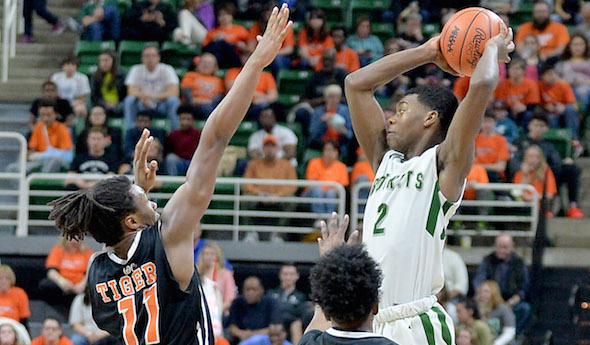
New Haven Grows into Class B Contender
March 24, 2017
By Geoff Kimmerly
Second Half editor
EAST LANSING – Eric Williams, Jr., has learned a lot about becoming a champion these last few seasons.
And as Williams has grown, so too has New Haven’s success on the basketball court.
The Rockets will find themselves playing in their first MHSAA championship game Saturday night, thanks to a 78-49 win over Benton Harbor on Friday in what was the program’s first Semifinal as well.
Williams had 22 points, seven rebounds, four assists and three steals, continuing a closing run that could see him leave an unprecedented legacy at the school. He had 11 points, six rebounds and two steals in the first quarter Friday, setting the tone from the start.
“I just came out looking to be aggressive more, because last game I was just out there. I think I had to come in and prove something,” Williams said.
“I’ve learned I’ve just gotta stay calm and not get stage fright on the big stage. Learning to play defense and what team basketball really is, I think I’ve learned that over the (last) few years.”
New Haven (25-1) will face Ludington in the final game of this season, Saturday’s 6:30 p.m. Class B Final.
Williams, a 6-foot-5 guard, entered this week averaging 20.9 points, 6.5 rebounds, 4.1 assists and 3.8 steals per game. New Haven coach Tedaro France II said after Friday’s win that upping his defense has made Williams a complete player – and that newfound all-around game has made him “one of the hottest players in the state right now.”
The first Semifinal came three days after the Rockets' third straight Quarterfinal. They are now 72-5 during this three-season run, and Williams’ rise is just an example of how experience has benefitted the team as a whole.
“That’s something as a coach you can’t teach,” France said. “Kids have to play in big games, and sometimes like with these guys, we have to fail first before we have success. And we’ve failed a lot.
 “Me, I say to our kids, let’s win today. And in practice each day, we fail. I say, let’s learn from our mistakes. I don’t mind if they make 10 mistakes, but let’s not make the same ones. And I think our kids are learning to play through adversity. They know they can make mistakes, then just go back and get back on defense."
Following Williams’ hot start, New Haven took a 22-10 lead into the second quarter and a 43-19 advantage into halftime. The lead got up to 38 during the fourth quarter before Benton Harbor (22-4) finished on a 9-0 run.
The Tigers entered the postseason ranked No. 5 by The Associated Press – New Haven was No. 3 – and had plenty of success as well this season. But they struggled this time to get into a groove against an opponent that beat them at their own game.
New Haven excelled defensively, holding Benton Harbor to 33 percent shooting and taking advantage of 17 turnovers. The Rockets turned on the transition game, to the point Tigers freshman center Carlos Johnson said, “When we’re running up the floor … they were already up there.”
Benton Harbor also is used to outrebounding its opponents, and Johnson had 10. But as coach Corey Sterling said, it was like New Haven had “two or three Carloses” – the Rockets won the rebounding edge 44-31.
“Pretty much we do pressure defense and get out in transition, but they didn’t turn the ball over and they made shots, and that’s pretty much it,” Sterling said. “It seemed like they had an answer for everything we threw at them tonight.”
In addition to Johnson being one of the most highly-regarded freshmen in the state – and finishing with nine points and five blocks to go with those 10 boards – the game also featured one of the state's top sophomores in New Haven forward Romeo Weems, who tallied 14 points, 13 rebounds and five assists. Sophomore guard Roland Jeffery II added 10 points for the Rockets.
Junior guard Elijah Baxter scored 14 points to top Benton Harbor, which played in its second Semifinal in four seasons – and perhaps began a string of championship weekend trips to come.
“We’ve only got two seniors really in our rotation, and this is a good experience for guys like Elijah, Carson, Shawn (Hopkins) and Dennie (Brown),” Sterling said. “Now we know how to get here … now let’s work hard in the summer to take the necessary steps to try to win it all.”
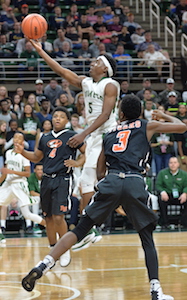
PHOTOS: (Top) New Haven’s Eric Williams, Jr., (2) looks to pass over Benton Harbor’s Carlos Johnson. (Middle) The Rockets’ A.J. Crawford III splits a pair of Tigers defenders during Friday’s Class B Semifinal.