

Hoops on Film: 1972 Class B Boys Final
August 24, 2015
By John Johnson
MHSAA communications director
One of the best has indeed been saved for last in the final edition of the MHSAA.TV’s Hoops On Film Series.
The series concludes this week with the 1972 Class B Boys Basketball Final between River Rouge and Muskegon Heights, a game won by Rouge in perhaps the most amazing final minute comeback in the history of the tournament.
From the late 1940’s to the mid 1970’s the Michigan High School Athletic Association shot portions of the action at its boys and girls basketball finals on 16mm film. The films were loaned out, primarily to the participating schools, to help them relive the moments of playing in a championship game.
While many of the old films have wandered astray over time, about 60 games still exist in the MHSAA archives. Anyone in possession of such a film is encouraged to contact John Johnson at the MHSAA Office ([email protected]) to discuss having the film converted to a digital format.
Some of the films only have portions of the second half and the post-game awards; some have most of the action. None of the films have sound. They range in length from 10 minutes to about an hour. A new film will be posted online each Monday through the week of August 17. DVD’s may be purchased directly from the MHSAA.tv Website – just click the Get DVD button below the player.
Here’s a look at this week’s game, with recap courtesy of MHSAA historian Ron Pesch:
River Rouge 65, Muskegon Heights 64 – 1972 Class B Boys Final - After 16 appearances and 11 titles by River Rouge and coach Lofton Greene, the Class B crown had, in the words of Detroit writer Joe Falls, “become almost their divine right each March.” Muskegon Heights had lost to Rouge in the Final one year earlier, but it appeared that the Tigers had finally turned the tables on the perennial powerhouse. With the lead 64-57 with only 58 seconds remaining on the clock at Jenison Field House, this game appeared to be over. But, in perhaps the most amazing comeback in tournament history, the turnaround started with 45 seconds remaining. Ralph Perry's easy lay-up cut the Heights margin to five points. Fouled on the play, Perry missed the free throw, but teammate Byron Wilson pounded home the rebound and the Panthers trailed by three. An errant inbound pass kept the dream alive. Leighton Moulton sank a 22-foot jumper with 23 seconds remaining, and the Panthers trailed by a point, 64-63. The Tigers were called for traveling on the change of possession, and Rouge had its chance. Moulton, the leading scorer in the contest, was again called upon. He drove toward the basket and was fouled before the shot. “The clock read: 0:02. If Moulton missed the first, it would have been all over,” wrote Falls, capturing the scene in characteristic clarity. “All of it rested on his lean, lithe shoulders ... and the delicate touch in his finger. He stepped to the line while the crowd quieted. The pressure was immense. Moulton looked up, let it go – and swish. Now utter bedlam. Moulton broke toward the center of the court, thrusting his fist into the air. He jumped and danced and was mobbed by his teammates. ... He'd tied it. Rouge could do no worse than go into overtime. But now he had another chance,” continued Falls, “the chance to win it. He made the most of it by dropping in his second free throw. ... That's when the tears started coming out of Lofton Greene's eyes, if you can imagine that.”
Previous releases:
1959 Class A Boys Final: Lansing Sexton 80, Hamtramck 79 (OT) - Watch
1977 Class C Girls Final: DeWitt 51, Carrollton 36 - Watch
1970 Class D Boys Final: Flint Holy Redeemer 62, Kingsley 60 - Watch
1961 Class D Boys Final: Marquette Pierce 68, Freesoil 61 - Watch
1958 Class A Boys Final: Detroit Austin 71, Benton Harbor 68 - Watch
1976 Class D Girls Final: Lake City 58, Perkins 48 - Watch
1971 Class A Boys Final: Flint Northern 79, Detroit Kettering 78 - Watch
1954 Class A Boys Final: Muskegon Heights 43, Flint Northern 41 (OT) - Watch
1973 Class C Boys Final: Detroit East Catholic 50, Saginaw St. Stephen 49 - Watch
River Rouge Star Wilburn Remembered
By
John Johnson
MHSAA Communications Director emeritus
October 19, 2016
One of the captains from the legendary boys basketball teams of the early 1960s at River Rouge passed away earlier this month.
 Ken Wilburn, 72, a forward on the 1961 and 1962 teams that were part of a since-unequaled streak in Michigan high school basketball – five consecutive MHSAA championships – accomplished what was thought to be the first triple-double in Finals history in the 1962 Class B championship game against East Grand Rapids.
Wilburn scored 26 points – 13 in the third period – to go with 15 rebounds and 11 steals in a 69-39 win, a game Coach Lofton Greene said “was his best ever.”
Wilburn would go on to lead Central State University (Ohio) to a 30-0 record and the NAIA national championship in 1965, when he was named the title game’s Most Valuable Player. He earned All-America honors and finished his career as the school’s scoring leader.
During a 13-year journeyman professional career, Wilburn played in the NBA, the ABA and in the Eastern Pennsylvania Basketball League/Eastern Basketball Association. He played on three championship teams in the EPBL/EBA and was a league MVP on two occasions.
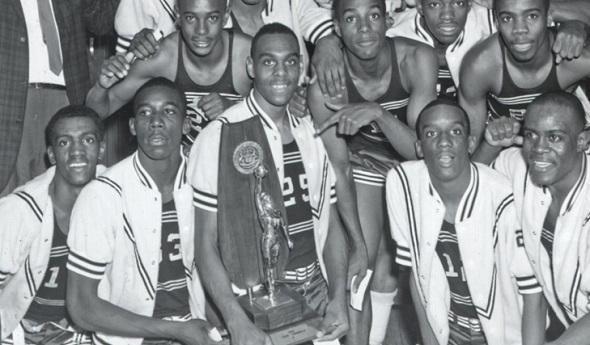
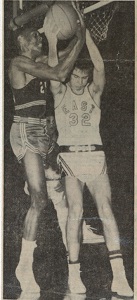
PHOTOS: (Top) Ken Wilburn (25) poses with his teammates after the 1962 Class B championship game victory. (Middle) Wilburn works to gather a loose ball from an East Grand Rapids player.