

Lessons From Banner Run Still Ring True
February 20, 2019
By Tim Miller
Mio teacher, former coach and graduate
If you were to travel to northern Michigan to canoe or fish the famous AuSable River, you might find yourself in a small town named Mio.
With one stoplight and a host of small businesses that line Main Street, Mio is well known for its access to the AuSable River and its high school sports team. And like so many small towns across America, the school is the main focal point of the community. Mio is the home of the Mio Thunderbolts, which is the mascot of the only school in town.
On Saturday, December 29, head boys basketball coach Ty McGregor and fans from around the state gathered in the Mio gymnasium to welcome back two former boys basketball teams. The two teams being honored that night were the 1989 state championship team who went undefeated and the 1978 boys basketball team who made it to the Semifinals.
As we stood there watching the former players of those teams, and coach of the 1978 team Paul Fox, make their way across the gym floor, we were reminded of the deceased players Cliff Frazho, Rob Gusler, Dave Narloch and John Byelich – the coach of the 1989 state championship team – that were no longer with us. All of them leaving us way too soon and a reminder of how fragile life can be.
The ’89 team would be a story in itself. That team was the most dominating team in Mio’s history.
After recognizing these two teams and visiting with many of them in the hallway, I stepped into the gym and began looking at the banners hanging from our walls. I found the state championship banner that the ’89 team won and the ’78 banner, and I began remembering those teams and how they brought so much excitement, happiness and pride to our small community.
Like so many schools throughout the state, the banners are a reminder of a team’s success and the year that it was accomplished. It’s a topic of conversation as former players share their memories with others about the year they earned their spot in history.
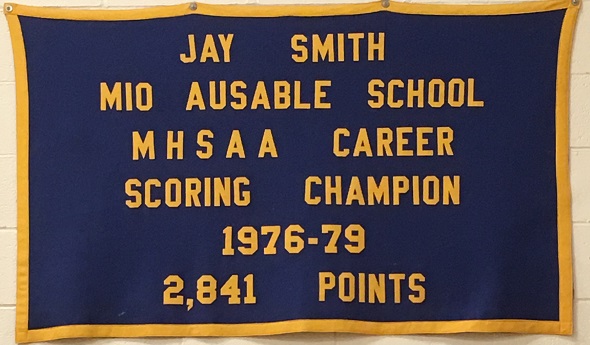
However, hanging on the south wall of the gym, all by itself, is a banner that only hangs from the walls of the Mio AuSable gym. No other school in Michigan has one like it. It has a weathered look, and the color has slightly faded over time. It’s been the conversation piece at deer camp, restaurants, and any other social gathering concerning Mio sports history. Basketball players throughout the state have dreamed of taking it away, but none have succeeded. It’s been hanging there for close to 40 years.
It reads:
Jay Smith
Mio AuSable School
MHSAA Career Scoring Champion
1976 – 1979
2,841 points
That banner represents something far greater than one person’s accomplishments. The story of how it got there and why it hasn’t left is a lesson that every sports team should learn – such a rare story in teamwork, coaching, parental support, the will to win, and the coach who masterfully engineered the plan.
The night Jay Smith broke the state scoring record, the Mio gym was packed with spectators from all parts of Michigan. The game was stopped and people rose to their feet to acknowledge the birthplace of the new record holder. After clapping and cheering for what seemed like an eternity, the ceremony was over and the game went on.
Although I wasn’t on the team, like so many people from Mio, I followed that group of basketball players from gym to gym throughout northern Michigan.
I had a front row seat in the student section where every kid who wasn’t on the team spent their time cheering for the Thunderbolts.
We were led by our conductor, “Wild Bill,” who had a knack for writing the lyrics to many of the cheers the student body used to disrupt our opponents or protest a referee’s call.
The student section was also home to the best pep band around. During home games they played a variety of tunes that kept the gym rocking. They were an integral part of the excitement that took place in that gym, game after game.
I also ate lunch and hung out at school with some of those guys. I got to hear the details of the game, the strategy, the battles between players, and the game plan for the next rival’s team.
I remember the school spirit, the pep assemblies, and the countless hours our faithful cheerleaders put into making and decorating our halls and gym with posters.
It was like a fourth of July parade that happened every Tuesday and Friday night. The bleachers were filled with people anxiously awaiting tip off.
Showing up late meant you were stuck trying to get a glimpse of the game from the hallway.
So here’s what I saw. Jay Smith was a tall, skinny kid who could shoot the ball with such accuracy that it must have been miserable for opposing coaches and players. Once it was in his hands, they had two options: watch him score or foul him and hope that he missed the free throws.
If you fouled him, you gambled wrong. He stood there and calmly shot the ball through the hoop with the sound of the net swishing as opposing players and coaches watched helplessly.
If you chose to let him shoot, you lost that bet too.
He shot often and rarely did he miss. It was no secret to our opponents or Jay’s teammates who would be doing the bulk of the shooting in Mio.
The game plan was simple: get the ball to Jay and watch him score. The Thunderbolts were coached by Paul Fox, a teacher at the school. He was demanding and intense as a coach, and his players played hard and respected him both in school and on the court. It wasn’t until I had the opportunity to coach a couple of high school teams that I realized and recognized what an incredible job he did.
I also realized what an outstanding group of players he was blessed to coach.
He was a step ahead of everybody.
Like Bill Belichick the famous coach of the New England Patriots, Paul Fox understood how to build a team around one person. He convinced everyone on the team that the way to the promised land was through the scoring of Jay. However, the type of players who buy into such a plan have to be special. And they were. Jay was blessed his first two years on varsity. He was surrounded by a very talented group of ball players who allowed him to be successful.
His last two teams weren’t as talented, but just as special.
Most of those guys were classmates of mine, so here’s what I can tell you.
Not one time during that stretch did I ever hear one of them complain about playing time. There was no pouting on the bench or kicking it because you were taken out.
No one complained the next day about their stats. They were happy to win, and if that meant Jay shooting most of the time, that was okay with them. After the game, no one ran to the scorer’s table to check their stats. Or went off in the corner of the locker room to act like a preschooler in timeout. Their parents didn’t march over to the coach and demand answers on why their son wasn’t playing or shooting more. Players didn’t quit the team because their individual needs weren’t being met. There were expectations from the coach, the parents, and everyone else involved. After each home game, the whole community gathered at the local bar/ bowling alley. Players, parents, and fans were happy their team had won and celebrated together in the victory. It was a simple blueprint that every sports team should follow.
Forget about your own personal gratification and do what’s best for the team.
It’s a lost concept these days. And the question many of us in Mio talk about from time to time is will the record ever be broken?
There’s more than one factor to consider when discussing the topic.
Jay set that record long before the 3-point shot was implemented.
Can a coach like Paul Fox assemble a group of players who would put their ego aside and desire winning more than their own personal satisfaction?
Can you find a humble kid like Jay who would crush the dreams of opposing teams with his shooting ability?
Can you find a group of parents out there willing to watch a kid like him put on a show, game after game, and not be offended?
Can you find a student body like the one we had to fill the student section with loud, rowdy fans?
The scoring banner represents the scoring accomplishments of Jay. And to his credit, I never once heard him brag about his success on the court.
He simply said, “We won.”
But that banner represents more than points. It’s an amazing story of what happens when a group of people come together with a common cause – the will to win.
What we saw during that time was special!
The state scoring record was set by Jay and a large list of supporting teammates who helped him.
He was fortunate to have a coach who understood how to manage and convince a group of players to buy into his system.
A group of parents who understood what was going on and supported it.
A student body section that rattled the best players from the other teams game after game.
A dedicated group of cheerleaders who spent countless hours making posters to decorate our school with pride.
A pep band that brought their best sound, game after game.
A teaching staff who understood how a bunch of kids wanted to get ready for the next big game, and gave us their blessing.
It was the culture of our school and community. Get ready for the game.
The anticipation, those long lines waiting outside in the cold, those packed gyms, that noise.
It was all part of it.
Perhaps somewhere in Michigan a group of coaches, players, parents, teachers, and fans could copy the formula from the ’70s that brought our team, school, and town so much success.
If a coach can find a group of players that only care about one thing, and that’s winning, it can be done. Doing that will require a group of people who think they understand the concept to execute it. As a society we see it at every level of sports: the “I” syndrome, the selfishness, the lack of respect for coaches and teammates. It’s the fiber that destroys any chance for success.
My guess is the banner will hang in our gym until someone in the school decides to replace the old one. Perhaps Jay’s children or grandchildren will want the old one to add to their family memorabilia. And after the new one is hung up and another forty years have passed, someone else will write a story about the banner that continues to hang in Mio’s gym.
NOTE: Jay Smith went on to play at Bowling Green and Saginaw Valley State University, and coach at Kent State, University of Michigan, Grand Valley State, Central Michigan, Detroit Mercy, and currently as head coach at Kalamazoo College. He was diagnosed with prostate cancer last summer and faces another round of radiation treatments after undergoing surgery in September. Click for a recent report by WOOD TV.
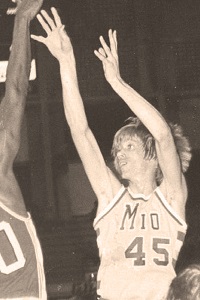
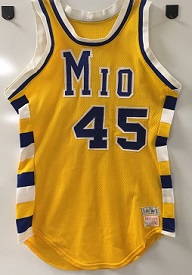
PHOTOS: (Top) The banner celebrating Jay Smith’s state high school career scoring record continues to greet fans at Mio High School’s gym. (Middle) Smith was a standout for the Thunderbolts through his graduation in 1979. (Below) Smith scored 2,841 points over four seasons, averaging 29 points per game.
As Soules Guided, East Catholic Reigned
January 31, 2019
By Ron Pesch
Special for Second Half
“I’m surprised to be this far. Some nights we play very good and some nights we play very bad. I just didn’t think we’d be consistent enough to get this far.”
The words were spoken by varsity basketball coach Dave Soules of Detroit East Catholic back in 1973, but, no doubt, could have come from any number of coaches who have found themselves, unexpectedly, somewhere deep into the MHSAA postseason.
It was Soules’ first season in charge of Detroit East Catholic’s varsity, but far from his first year in the building the school occupied.
The Chargers had advanced to the Class B Quarterfinals the previous year, falling to perennial powerhouse River Rouge, 65-64. That East Catholic team was coached by Eugene Dennis Alexander. An all-city player at Detroit Northeastern, Denny Alexander played college ball at Aquinas in Grand Rapids and became only the fourth player in Michigan collegiate history to surpass 2,000 points in a career, joining John Bradley of Lawrence Tech, Dave DeBusschere of the University of Detroit and the University of Michigan’s Cazzie Russell on the list. In May of 1969, at age 23, he was named head coach at East Catholic.
Denny’s brother, Darryl Alexander, was East Catholic’s best ballplayer in 1972. The team streaked to 11 straight victories during the regular season, then squared off in a series of late February games against larger Detroit Public School League teams. The scheduling was designed to ready the squad for the postseason. Losses to Detroit Southeastern (68-47), Detroit Kettering (80-71) and Detroit Northern (59-58) were a means to that end. While the Chargers did not make the Detroit Catholic League tournament, they were ready to do some damage in the Class B MHSAA tournament.
Only a field goal by River Rouge’s Byron Wilson with 26 seconds remaining prevented the Chargers from doing more. East Catholic trailed in the Quarterfinal by as many as 14 points, and made valiant runs to pull within a point on two occasions, but couldn’t upset coach Lofton Greene’s Panthers. Alexander finished with 19 to again lead the Chargers but was lost to fouls with 1:37 remaining in the third period. Trailing 61-53, East Catholic cut it to 61-60 with 1:35 left to play on a Phil Young field goal. Larry Merchant’s pair of free throws again brought the margin to a single point, 65-64 – but with only five seconds left, the Chargers were out of miracles.
River Rouge, on the other hand, was not. The Panthers would advance through the Semifinals and then survive another thriller, escaping with another one-point victory in the title game against Muskegon Heights. That win marked their 12th Class B title in 19 years.
The Chargers finished the season with a 16-7 record. Alexander earned Associated Press Class B all-state honors that season as a senior, averaging 20 points, 13 rebounds and six assists per game. Come the fall, the brothers headed north to Central Michigan University, where Darryl became a prized recruit. In mid-September, CMU president William Boyd announced Denny had been hired as an assistant coach.
In 1977, Denny was interviewed for the head coaching vacancy at Wayne State, and then was named head coach at Xavier University in New Orleans in 1978.
In 1966, with shrinking enrollments driven by flight of parishioners to the suburbs and rapidly changing neighborhood demographics, the Roman Catholic Archdiocese of Detroit directed that four Catholic high schools on Detroit’s east side – St. Catherine, St. Rose, Annunciation, and St. Charles – consolidate into the old St. Catherine building at 4130 Maxwell Street.
The amalgamation was christened Detroit East Catholic, and it opened its doors in the fall of 1967.
But the mergers were simply not enough. Needs for new equipment, combined with increased costs for teacher salaries and legislative changes to funding meant a need to increase tuition to cover expenses. That, in turn, led to even more departures.
“The East Side Catholic schools ran up a total deficit of over $1 million last year,” said Bishop Thomas J. Gumbleton, vicar general of the archdiocese, announcing additional closings and mergers of high schools and elementary schools planned with the conclusion of the 1968-69 school year.
Detroit St. Anthony and Detroit Elizabeth were merged into East Catholic to help address the deficit and exodus. With the changes in the fall of 1969, East Catholic High School was relocated from St. Catherine’s to the St. Anthony building a mile away at the corner of Field and Frederick streets.
Soules had graduated from Dearborn Sacred Heart in 1957 and then the University of Detroit. He was hired as an English teacher at St. Anthony and became the school’s JV basketball coach in 1962. In 1964, he took charge of the varsity team.
“When we merged (into East Catholic) they divvied up the jobs and Dennis got the basketball job,” said Soules in 2005 to Mick McCabe, Detroit Free Press sportswriter. “If I’d have got the job, I’d have lost my mind. I mean literally. The merger was painful. Everybody hated everybody else …”
In May 1972, the Free Press had interviewed Soules about the challenges and the future of the school located at 5206 Field. As an assistant principal, he spoke for those who remained.
“From here, there isn’t any place to go. You close up, and you go out of business. If we keep working at it and keep believing in it, it’s gonna keep going. It has so far. If we close, there’s no inner city Catholic school on the lower east side,” he said.
Raffles, paper drives, lollipop and baked good sales, car washes, fish dinners and dances all contributed to keeping the doors open.
Making a new school community from all of the former had not come easily.
“It was hell. I lost 25 pounds last year. We lost a lot of good staff people. But we came back this year, and, all of a sudden, people could smile at each other in the halls. That’s important. As people got to know each other, they did become friends,” Soules added
With Alexander’s late departure, Soules became the school’s newest varsity basketball coach. At the time, no one knew that he would also be the school’s last.
With the graduation of Darryl Alexander, the expectations of the team, loaded with juniors and sophomores, were limited. Smaller enrollment meant the team had fallen a classification come tournament time. With a 5-3 mark, the Chargers were No. 5 in Hal Schram’s weekly Free Press Class C Top Ten in early January, but had fallen well out of the United Press International’s Top 20 Class C rankings by mid-February with a 12-4 record. The team was quickly eliminated in the annual Detroit Catholic League tournament and, unranked in the final state polls, carried a 12-6 record into the MHSAA postseason. Following District wins over Hamtramck St. Florian – ranked eighth by AP – and Hamtramck St. Ladislaus, Soule’s crew quickly changed the landscape in the opening round of the Class C Regionals.
“Just two days into regional play, the tourney is starting to live up to its Pseudonym – ‘March Madness’”, wrote Harry Atkins for The Associated Press.
“The Chargers were given hardly a chance against a talent-rich Dearborn St. Alphonsus team in Class C action,” continued Atkins, “but East Catholic didn’t let Dearborn’s No. 2 ranking scare them as they matched the Arrows basket for basket.” Trailing by six with 1:46 left to play, Larry Merchant’s field goal with 46 seconds left tied the score. “Then Mike Walton hit a free throw with one second on the clock to give East Catholic its upset.”
Mike Woods led the team with 21 points. St. Alphonsus exited the tournament with a 22-2 mark.
On a very snowy evening across Michigan, East Catholic took advantage of its height and survived a 27-point performance by New Haven’s Don Sims to win their Regional and advance to the Quarterfinals of the MHSAA tournament. Merchant scored 10 of the Chargers’ 11 points in the final four minutes to seal the 68-63 win.
Merchant showed off his ball-handling skills dishing out 12 assists in the 71-48 Quarterfinal win over Erie-Mason. Sophomores Greg Guye, a 6-foot-6 center, and Walton, a 6-2 sophomore guard, each pumped in seven field goals, both finishing with 14 points, to lead the Chargers in scoring.
Merchant scored 26, while Walton added 23 – 18 points over his season average – as East Catholic rolled to a 66-55 Semifinal victory over Battle Creek St. Philip to earn a trip to the championship game.
“We had accurate scouting reports on East Catholic,” said St. Philip coach Tom Miller following the game. “They were quick. I knew we were in trouble when we had a fast break – and they had two guys at the other end waiting for us,” Miller told UPI’s Richard Shook, laughing. “At least we got beat by a team that was better than we were.”
The state’s scribes had a week to contemplate the upcoming Final matchups as Michigan’s tournament format of the time injected seven days between the Semifinal and Final rounds. Soules had never won a tournament game as a coach at St. Anthony, and noted his club’s strengths and challenges to the media during the time.
“This is a young team which makes mistakes,” he told Atkins of the AP, “but we don’t quit and we’ve won some games on hustle in the last few minutes. It is difficult to key on one player and beat us, because we have excellent balance.”
In a conversation with Schram he noted that his team had a tendency to work out big leads, then start to get sloppy.
“We’ve never put anyone away yet,” he added. Schram noted that Soules took only half of the 700 tickets allotted East Catholic at the state association. “I won’t sell all that I have. These kids simply don’t have the bread to go running all over the state.”
“I don’t believe many of our students or fans have a great amount of confidence in us,” declared the coach, but emphasized that was not the view of the team. “They want this state title and will fight all the way to win it Saturday.”
By most, if not all accounts, not many others had faith in the Chargers’ chances in the championship matchup.
“St. Stephen lost in the ‘C’ finals in 1972 to Shelby and have their key players returning,” wrote Fred Stabley Jr. in the Lansing State Journal. “Led by 6-5 Elijah Coates and 6-2 Jimmy Beavers, St. Stephen has the size and speed to win it all this year.”
“Every game is a home game for Saginaw St. Stephens,” noted Atkins in his pregame AP write-up. “The Titans have a frenzied following of nearly 1,500 fans at every tournament game and you can bet your last lottery ticket they’ll all be in Ann Arbor for Saturday’s showdown.
“On paper there’s no way you can pick a favorite … but neither St. Stephens nor East Catholic has been winning on paper … Saginaw, however, has done a slightly better job of it and who can measure how much their loyal throng of well-wishers has contributed to that record.”
“East Catholic won’t make the trip to Ann Arbor for nothing,” wrote Schram, as his alter ego, “The Swami,” on the Saturday of the game. “There’s a trophy for the runnerup.”
Saginaw coach Sam Franz, celebrating his 25th year as a coach, may have been the only skeptic.
“Any team that comes this far has to have something more than luck going for them,” said Franz to Schram.
The story of the Final can still be seen in silence today.
“From the late 1940’s to the mid 1970’s the Michigan High School Athletic Association shot portions of the action at its basketball finals on 16mm film,” notes John Johnson, communications director for the MHSAA. “Some of the films only have portions of the second half and the postgame awards; some have most of the action. None of the films have sound.”
One of the surviving films is the 1973 Class C classic. The Chargers blew a 10-point lead late in the third quarter. With 2:29 remaining, the game was tied, 46-46. A free throw gave St. Stephen the lead 47-46 with 2:16 to play.
The final two minutes of film spools out the story, in thrilling – and heartbreaking – detail.
In the days before the possession arrow, jumps for possession could mean the difference between victory and defeat. East Catholic won a possession on a jump ball, but a miss by the Chargers and a defensive rebound by St. Stephen sent the Titans into stall mode. However, a turnover grabbed and converted by Merchant gave the Chargers a 48-47 lead with just over a minute to play.
A pair of free throws by Elijah Coates pushed St. Stephen out front 49-48 with 45 seconds left. Yet with four seconds remaining on the clock, Merchant's 18-foot jumper from left of the key gave the Chargers a 50-49 victory.
The front page of the Free Press shouted the headline, “A Chance to Be Somebody,” with a story representative of the time. Focused on the players and their struggles, the title could have easily applied to the re-start of a coaching career, and a life, which ultimately would become legendary at least on Detroit’s east side.
To students, he became famous for a rope of keys around his neck, his pad of detention slips and the substitution of “Hot Dog” or “Baby” for names when trying to keep the halls clear during the school week. Saturday mornings for many included time in “The Jug” serving detention.
“He’s more to East Catholic than just the basketball coach,” Lou Miramonti told Jo-Ann Barnas of the Free Press in 1996. Miramonti, the athletic director at Royal Oak Shrine, knew of whom he spoke. “It’s the most visible thing he does, but it may well be the least important thing that he does at that school and for those kids.”
Soules was assistant principal, disciplinarian, tuition collector, the giver of rides, and one who called students just to make sure homework was getting done. And, of course, the coach that guided the talent that came through the halls of a building that today no longer stands.
Playing witness in 2005 to another sweeping closure of schools by the Detroit archdiocese – one that included the shuttering of East Catholic – Soules discussed a career he never could have predicted.
“I was the right guy who just happened to be in the right place at the right time,” he explained to McCabe as he tried to come to grips with the announced closing. Soules’ coaching career at East Catholic featured 544 wins against 250 defeats over 33 seasons. The Chargers’ athletic cases included eight MHSAA Finals championship trophies won by his teams. To this day, only Greene at River Rouge won more.
An honest, humble and caring individual with a “self-deprecating sense of humor,” he discussed those earliest of days:
“The saddest part is, I was so dumb at the time, we didn’t win it again (over the next two years) … I didn’t know how to deal with the 2-2-1 three-quarter court press (in 1974) … in the semis (in 1975) … we just weren’t ready to play.”
“With some of the kids I had, you didn’t have to be a genius,” he stated. “I’m a lot better coach now than I was then.”
In 2009, Soules passed away after a three-year battle with cancer. His extended family numbered thousands.
The many condolences that followed, and that continue today, are a heartfelt testament to the difference one man can make in a life, both on the court and in the hallways, of an ancient building built with the lofty purpose of education.
Ron Pesch has taken an active role in researching the history of MHSAA events since 1985 and began writing for MHSAA Finals programs in 1986, adding additional features and "flashbacks" in 1992. He inherited the title of MHSAA historian from the late Dick Kishpaugh following the 1993-94 school year, and resides in Muskegon. Contact him at [email protected] with ideas for historical articles.

PHOTOS: (Top) The Detroit East Catholic 1973 Class C championship team. (2) Denny Alexander was hired as East Catholic boys basketball coach in 1969. (3) The former Detroit St. Anthony High School. (4) Dave Soules coaches his East Catholic players during the 1973 season. (5) Film survives from the Chargers’ 1973 championship game win over Saginaw St. Stephen. (6) Soules instructs his team during a 1996 game. (7) The Detroit East Catholic gymnasium, after the school’s closure. (Photos gathered by Ron Pesch.)