

Lessons From Banner Run Still Ring True
February 20, 2019
By Tim Miller
Mio teacher, former coach and graduate
If you were to travel to northern Michigan to canoe or fish the famous AuSable River, you might find yourself in a small town named Mio.
With one stoplight and a host of small businesses that line Main Street, Mio is well known for its access to the AuSable River and its high school sports team. And like so many small towns across America, the school is the main focal point of the community. Mio is the home of the Mio Thunderbolts, which is the mascot of the only school in town.
On Saturday, December 29, head boys basketball coach Ty McGregor and fans from around the state gathered in the Mio gymnasium to welcome back two former boys basketball teams. The two teams being honored that night were the 1989 state championship team who went undefeated and the 1978 boys basketball team who made it to the Semifinals.
As we stood there watching the former players of those teams, and coach of the 1978 team Paul Fox, make their way across the gym floor, we were reminded of the deceased players Cliff Frazho, Rob Gusler, Dave Narloch and John Byelich – the coach of the 1989 state championship team – that were no longer with us. All of them leaving us way too soon and a reminder of how fragile life can be.
The ’89 team would be a story in itself. That team was the most dominating team in Mio’s history.
After recognizing these two teams and visiting with many of them in the hallway, I stepped into the gym and began looking at the banners hanging from our walls. I found the state championship banner that the ’89 team won and the ’78 banner, and I began remembering those teams and how they brought so much excitement, happiness and pride to our small community.
Like so many schools throughout the state, the banners are a reminder of a team’s success and the year that it was accomplished. It’s a topic of conversation as former players share their memories with others about the year they earned their spot in history.
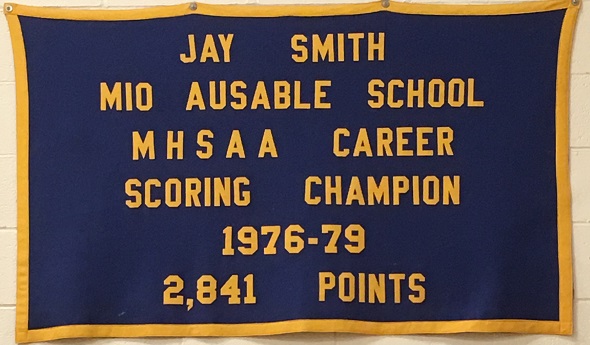
However, hanging on the south wall of the gym, all by itself, is a banner that only hangs from the walls of the Mio AuSable gym. No other school in Michigan has one like it. It has a weathered look, and the color has slightly faded over time. It’s been the conversation piece at deer camp, restaurants, and any other social gathering concerning Mio sports history. Basketball players throughout the state have dreamed of taking it away, but none have succeeded. It’s been hanging there for close to 40 years.
It reads:
Jay Smith
Mio AuSable School
MHSAA Career Scoring Champion
1976 – 1979
2,841 points
That banner represents something far greater than one person’s accomplishments. The story of how it got there and why it hasn’t left is a lesson that every sports team should learn – such a rare story in teamwork, coaching, parental support, the will to win, and the coach who masterfully engineered the plan.
The night Jay Smith broke the state scoring record, the Mio gym was packed with spectators from all parts of Michigan. The game was stopped and people rose to their feet to acknowledge the birthplace of the new record holder. After clapping and cheering for what seemed like an eternity, the ceremony was over and the game went on.
Although I wasn’t on the team, like so many people from Mio, I followed that group of basketball players from gym to gym throughout northern Michigan.
I had a front row seat in the student section where every kid who wasn’t on the team spent their time cheering for the Thunderbolts.
We were led by our conductor, “Wild Bill,” who had a knack for writing the lyrics to many of the cheers the student body used to disrupt our opponents or protest a referee’s call.
The student section was also home to the best pep band around. During home games they played a variety of tunes that kept the gym rocking. They were an integral part of the excitement that took place in that gym, game after game.
 I also ate lunch and hung out at school with some of those guys. I got to hear the details of the game, the strategy, the battles between players, and the game plan for the next rival’s team.
I remember the school spirit, the pep assemblies, and the countless hours our faithful cheerleaders put into making and decorating our halls and gym with posters.
It was like a fourth of July parade that happened every Tuesday and Friday night. The bleachers were filled with people anxiously awaiting tip off.
Showing up late meant you were stuck trying to get a glimpse of the game from the hallway.
So here’s what I saw. Jay Smith was a tall, skinny kid who could shoot the ball with such accuracy that it must have been miserable for opposing coaches and players. Once it was in his hands, they had two options: watch him score or foul him and hope that he missed the free throws.
If you fouled him, you gambled wrong. He stood there and calmly shot the ball through the hoop with the sound of the net swishing as opposing players and coaches watched helplessly.
If you chose to let him shoot, you lost that bet too.
He shot often and rarely did he miss. It was no secret to our opponents or Jay’s teammates who would be doing the bulk of the shooting in Mio.
The game plan was simple: get the ball to Jay and watch him score. The Thunderbolts were coached by Paul Fox, a teacher at the school. He was demanding and intense as a coach, and his players played hard and respected him both in school and on the court. It wasn’t until I had the opportunity to coach a couple of high school teams that I realized and recognized what an incredible job he did.
I also realized what an outstanding group of players he was blessed to coach.
He was a step ahead of everybody.
Like Bill Belichick the famous coach of the New England Patriots, Paul Fox understood how to build a team around one person. He convinced everyone on the team that the way to the promised land was through the scoring of Jay. However, the type of players who buy into such a plan have to be special. And they were. Jay was blessed his first two years on varsity. He was surrounded by a very talented group of ball players who allowed him to be successful.
His last two teams weren’t as talented, but just as special.
Most of those guys were classmates of mine, so here’s what I can tell you.
Not one time during that stretch did I ever hear one of them complain about playing time. There was no pouting on the bench or kicking it because you were taken out.
No one complained the next day about their stats. They were happy to win, and if that meant Jay shooting most of the time, that was okay with them. After the game, no one ran to the scorer’s table to check their stats. Or went off in the corner of the locker room to act like a preschooler in timeout. Their parents didn’t march over to the coach and demand answers on why their son wasn’t playing or shooting more. Players didn’t quit the team because their individual needs weren’t being met. There were expectations from the coach, the parents, and everyone else involved. After each home game, the whole community gathered at the local bar/ bowling alley. Players, parents, and fans were happy their team had won and celebrated together in the victory. It was a simple blueprint that every sports team should follow.
Forget about your own personal gratification and do what’s best for the team.
It’s a lost concept these days. And the question many of us in Mio talk about from time to time is will the record ever be broken?
There’s more than one factor to consider when discussing the topic.
Jay set that record long before the 3-point shot was implemented.
Can a coach like Paul Fox assemble a group of players who would put their ego aside and desire winning more than their own personal satisfaction?
Can you find a humble kid like Jay who would crush the dreams of opposing teams with his shooting ability?
Can you find a group of parents out there willing to watch a kid like him put on a show, game after game, and not be offended?
 Can you find a student body like the one we had to fill the student section with loud, rowdy fans?
The scoring banner represents the scoring accomplishments of Jay. And to his credit, I never once heard him brag about his success on the court.
He simply said, “We won.”
But that banner represents more than points. It’s an amazing story of what happens when a group of people come together with a common cause – the will to win.
What we saw during that time was special!
The state scoring record was set by Jay and a large list of supporting teammates who helped him.
He was fortunate to have a coach who understood how to manage and convince a group of players to buy into his system.
A group of parents who understood what was going on and supported it.
A student body section that rattled the best players from the other teams game after game.
A dedicated group of cheerleaders who spent countless hours making posters to decorate our school with pride.
A pep band that brought their best sound, game after game.
A teaching staff who understood how a bunch of kids wanted to get ready for the next big game, and gave us their blessing.
It was the culture of our school and community. Get ready for the game.
The anticipation, those long lines waiting outside in the cold, those packed gyms, that noise.
It was all part of it.
Perhaps somewhere in Michigan a group of coaches, players, parents, teachers, and fans could copy the formula from the ’70s that brought our team, school, and town so much success.
If a coach can find a group of players that only care about one thing, and that’s winning, it can be done. Doing that will require a group of people who think they understand the concept to execute it. As a society we see it at every level of sports: the “I” syndrome, the selfishness, the lack of respect for coaches and teammates. It’s the fiber that destroys any chance for success.
My guess is the banner will hang in our gym until someone in the school decides to replace the old one. Perhaps Jay’s children or grandchildren will want the old one to add to their family memorabilia. And after the new one is hung up and another forty years have passed, someone else will write a story about the banner that continues to hang in Mio’s gym.
NOTE: Jay Smith went on to play at Bowling Green and Saginaw Valley State University, and coach at Kent State, University of Michigan, Grand Valley State, Central Michigan, Detroit Mercy, and currently as head coach at Kalamazoo College. He was diagnosed with prostate cancer last summer and faces another round of radiation treatments after undergoing surgery in September. Click for a recent report by WOOD TV.
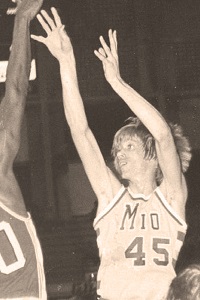
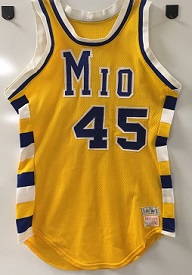
PHOTOS: (Top) The banner celebrating Jay Smith’s state high school career scoring record continues to greet fans at Mio High School’s gym. (Middle) Smith was a standout for the Thunderbolts through his graduation in 1979. (Below) Smith scored 2,841 points over four seasons, averaging 29 points per game.
Breslin Bound: Quarterfinal Preview
March 19, 2018
By Geoff Kimmerly
Second Half editor
Breslin Center is only one more win away for 32 boys basketball teams taking the floor in Quarterfinals on Tuesday across Michigan.
 So far we know we’ll have at least two new champions, in Class C and Class D, when this week ends. And only eight of the 16 teams that made the trip to East Lansing last season have a chance to book Semifinal repeat returns.
Our final “Breslin Bound” report – powered by MI Student Aid – takes a glance at all 16 Quarterfinals, which are all at 7 p.m. unless noted. All Quarterfinals will be broadcast and viewable with subscription on MHSAA.tv. Come back Wednesday night for a more in-depth look at our 16 finalists as they head into this weekend.
Class A
Warren DeLaSalle (18-7) vs. Detroit U-D Jesuit (22-3) at University of Detroit Mercy – 5 p.m.
These Detroit Catholic League Central rivals have played three times, with Jesuit winning all three meetings – although the second Feb. 10 by just two points. The Cubs won their fourth straight Regional title and were Class A champions in 2016, while this will be DeLaSalle’s first Quarterfinal since 2010. Junior guard Daniel Friday leads three Jesuit players averaging double-digit scoring at 13.9 ppg, while senior forward Luke Pfromm scores a team-high 15.6 ppg for the Pilots.
Flint Carman-Ainsworth (23-2) vs. Clarkston (23-1) at Grand Blanc
Reigning champion Clarkston is hoping to add to last season’s first-ever title and celebrated its second Mr. Basketball Award winner Monday in senior guard Foster Loyer (25.6 ppg, 6.0 apg). Center Taylor Currie (13.1 ppg) and guard CJ Robinson (13.8 ppg) are also senior standouts. Only four opponents have come within single digits of the Wolves, and Carman-Ainsworth was the first falling 72-67 on Dec. 7. The Cavaliers are seeking their first Semifinal berth since back-to-back trips in 2003 and 2004. Their only other defeat this winter came to Holland West Ottawa, alive on the other side of this bracket. Senior guards Omari Duncan (16 ppg) and Ja’Kavien Lewis (14.9 ppg, 3.0 apg) are among playmakers.
East Lansing (22-3) vs. Holland West Ottawa (23-2) at Lansing’s Don Johnson Fieldhouse
West Ottawa is 23-2 for the second straight season but with a first Regional title in program history this time. In addition to defeating Carman-Ainsworth, the Panthers have beaten powers Muskegon and Grand Rapids Catholic Central over the last three weeks. Senior forward Tyler Bosma leads with 17.2 ppg. East Lansing’s Brandon Johns (26.3 ppg, 10.4 rpg) finished second in the Mr. Basketball voting and can lead the Trojans to their first Semifinal since 2008. The Regional Final win over rival Okemos avenged East Lansing’s two most recent defeats.
Belleville (20-5) vs. Novi (16-8) at University of Detroit Mercy – 7 p.m.
A pair of teams with high preseason hopes followed by slow starts have made good by reaching the final week of this winter. The Tigers have won 15 of their last 16 – with the lone loss in overtime – and are led by standout seniors Gabe Brown and Davion Williams. Novi has won 10 of its last 11 and surged with the return of senior guard Trendon Hankerson (14.2 ppg) from injury to go with senior Taveon Maddox, Jr. (17.5 ppg), and junior Jiovanni Miles (15.3 ppg).
Class B
Benton Harbor (24-1) vs. Williamston (22-2) at Ionia
Benton Harbor is seeking its second straight and third Semifinal berth in five seasons. Since falling to eventual champion New Haven in a Semifinal to end last winter, the Tigers have lost only to Class A Hazel Park. Sophomore Carlos Johnson (18.3 ppg, 13.1 rpg) remains among the top players statewide in his class and is joined by senior Shawn Hopkins (15.7/11.4). Williamston is undefeated in calendar year 2018, having fallen to Class A quarterfinalist DeLaSalle and Howell in November. The Hornets will play in their third straight Quarterfinal and made the Semifinals in 2016.
Dearborn Divine Child (18-6) vs. River Rouge (22-1) at Chelsea
River Rouge also is celebrating its third straight Quarterfinal appearance and after falling in last year’s Semifinal by a point in overtime to eventual Class B runner-up Ludington. Senior guard Jayvien Torrance-Jackson is the only returning starter from that team, but the Panthers have fallen this winter only to Class D quarterfinalist Southfield Christian. Divine Child is coming off its first Regional title since 2011 and seeking to make the Semifinals for the first time since 1977. Senior forward Quinn Blair leads at 20.2 ppg.
New Haven (25-0) vs. Bridgeport (24-1) at Corunna
Reigning champion New Haven has won 51 straight games going back to Dec. 2016, with junior star Romeo Weems (23.5 ppg, 11.8 rpg, 5.7 apg, 5.1 spg) leading four players averaging double-digit scoring. Seniors Tavares Oliver (16.8) and Ashton Sherrell (15.7) follow on that list. Bridgeport’s lone slip-up came by three points in its opener at Lansing Everett. The Bearcats have rattled off 24 straight wins thanks in part to the scoring of senior Charles Garrett (20.1 ppg) and junior Sirquarius Bell (17 ppg).
Grand Rapids Catholic Central (22-2) vs. Boyne City (19-6) at Big Rapids
GRCC’s 6-foot-11 senior Marcus Bingham, Jr., (16.8 ppg, 10 rpg) is another Mr. Basketball finalist who has brought his team to the final week, with plenty of help in the post from 6-8 senior Jake Polakovich (14.2 ppg, 10.5 rpg). The Cougars’ only loss of calendar year 2018 was to Class A quarterfinalist West Ottawa. Boyne City has been a Class C power over the last four seasons but moved into B for 2017-18. They eliminated reigning runner-up Ludington last week after winning a fourth straight District title. Senior forward Mason Gardner leads a balanced scoring attack at 11.4 ppg.
Class C
Detroit Edison (14-10) vs. Unionville-Sebewaing (25-0) at West Bloomfield
Edison reached the Quarterfinals and Semifinals for the first time last season and will play this time after also winning the Detroit Public School League tournament last month. Senior guards Gary Solomon (16.2 ppg) and Pierre Mitchell, Jr. (15.3 ppg), set the scoring pace. Unionville-Sebewaing eliminated three-time reigning Class C champion Flint Beecher in the Regional Final to reach championship week for the first time since 2005. That and the Regional Semifinal win over Saginaw Nouvel were the first single-digit victories for the Patriots since their third game this season against Detroit Douglass.
Grand Rapids Covenant Christian (21-4) vs. Sanford Meridian (21-3) at Stanton Central Montcalm
After a more than a 20-year absence, Covenant Christian returned to the season’s final week a year ago and ended up as Class C runner-up. Its losses during this repeat run were all to bigger schools, including by just four to GRCC. Senior forward Carson Meulenberg has returned as the team’s leading scorer at 15.4 ppg. Sanford Meridian celebrated its first Regional title since 2001 and is playing for its first Semifinal berth. The Mustangs are making this run without injured top scorer Lucas Lueder (14 ppg), as senior point guard Garrett Stockford (9.2 ppg) leads a balanced bunch.
Kalamazoo Christian (23-2) vs. Monroe St. Mary Catholic Central (24-0) at Kalamazoo Loy Norrix
Kalamazoo Christian won its second straight Regional title, this time by handing Cassopolis its only loss of the season 61-48 on Wednesday. Senior forward Jordan Katje (16.8 ppg, 11.6 rpg) has been a force. Monroe St. Mary also made the Quarterfinals last season – and this will be its fifth trip this decade. Senior C.J. Haut (18.4 ppg, 11.3 rpg) has a similar post presence as Katje, and they could provide a memorable matchup. Katje is 6-5 and Haut 6-8.
Maple City Glen Lake (22-2) vs. Iron Mountain (23-1) at Petoskey – 6 p.m.
Like its girls team last week, Glen Lake’s boys are Regional champs and playing for more. The Lakers’ lone losses were to reigning Class D runner-up Buckley, which also remains alive. Junior guard Xander Okerlund checks in at a team-leading 16.1 ppg. Iron Mountain is enjoying its longest tournament run since 1994, with its only loss to league foe Ishpeming. Sophomore Marcus Johnson (23.5) and freshman Foster Wonders (19.1) offer one of the most potent 1-2 scoring punches left in the tournament – and with a few more seasons to build on this success.
Class D
Cedarville (21-3) vs. Dollar Bay (25-0) at Escanaba
Dollar Bay has been one of the statewide stories of this season, and the Blue Bolts have advanced to the final week for the first time since 1979. They won their Regional games last week over Rapid River and Carney-Nadeau by a combined four points and should get another challenge from Cedarville. The Trojans have won 11 in a row and beat 20-win league foe Brimley to claim a fourth Regional title this decade. Senior guard Dakota Fairchild (14.1 ppg) leads a balanced attack.
Southfield Christian (20-4) vs. Flint International Academy (23-2) at Goodrich
Southfield Christian earned its fifth Regional title this decade and is sure to be motivated this week after missing last season’s championship game by a point in a double overtime loss to eventual champ Powers North Central. Senior Bryce Washington (21.6 ppg) and junior Harlond Beverly (16 ppg, 5.4) are among players to watch. Flint International will play its first Quarterfinal riding an 18-game winning streak. The Phoenix has given up more than 60 points this season only four times, and no more than 65 in a game.
Marcellus Howardsville Christian (20-5) vs. Hillsdale Academy (23-2) at Portage Northern
Howardsville Christian is another team playing a Quarterfinal for the first time. The Eagles have won 10 straight led by dynamic junior guard Dylan Jergens at 31.5 points and also 6.3 assists per game. Hillsdale Academy, coming off its first Regional title as well, also features a dynamic player – 6-7 senior center Peter Kalthoff, who averages 21.9 points and 8.2 rebounds per game for the Colts. They avenged their second loss of the season with a Regional Final win over Adrian Lenawee Christian.
Buckley (19-5) vs. Hillman (24-0) at Gaylord
This has been a long-awaited matchup in the northern Lower Peninsula, as reigning Class D runner-up Buckley has faced many of the best in Class C and D on its side of I-75. Seniors Denver Cade (16.5 ppg), Austin Harris (17) and Joey Weber (14.4) are all 1,000-point career scorers. Hillman has only two single-digit wins this season, although the latest was a four-pointer over league foe Mio in the Regional Final. This will be the Tigers’ second straight and third Quarterfinal in four seasons. Senior guard Jared Juergens (14.8 ppg) leads four players scoring at least 10 per game.
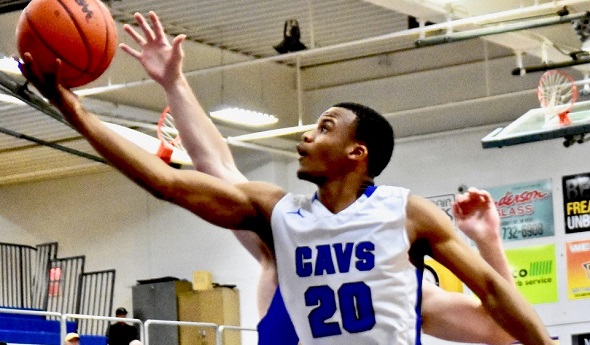
PHOTO: Flint Carman-Ainsworth's Ja'kavien Lewis looks to finish a drive against Midland this season. (Photo by Terry Lyons.)